
Article's Content
Article's Content
Welcome to the new Foundation newsletter.
If you’ve been reading us for a while, you’ll notice things look different this week.
For years, this newsletter was a roundup of industry links, jobs, podcasts, and a feature story. We’re shifting the format.
From now on, each issue will focus on What Matters This Week: one story, why it matters, and what to do about it.
We’ll still share good reads and the occasional thing worth watching, but the goal is simple: one useful insight for B2B marketing leaders.
This is an evolving format, so if you have feedback, hit reply or reach out on LinkedIn.
Now, to the first of many.
GPT-5.3 Instant Is Citing Fewer Sources. If You’re Not One of Them, You’re Invisible.
What’s happening
OpenAI released GPT-5.3 Instant this week. One line in the announcement matters far more than the rest:
“GPT-5.3 Instant is less likely to overindex on web results, which previously could lead to long lists of links or loosely connected information.”
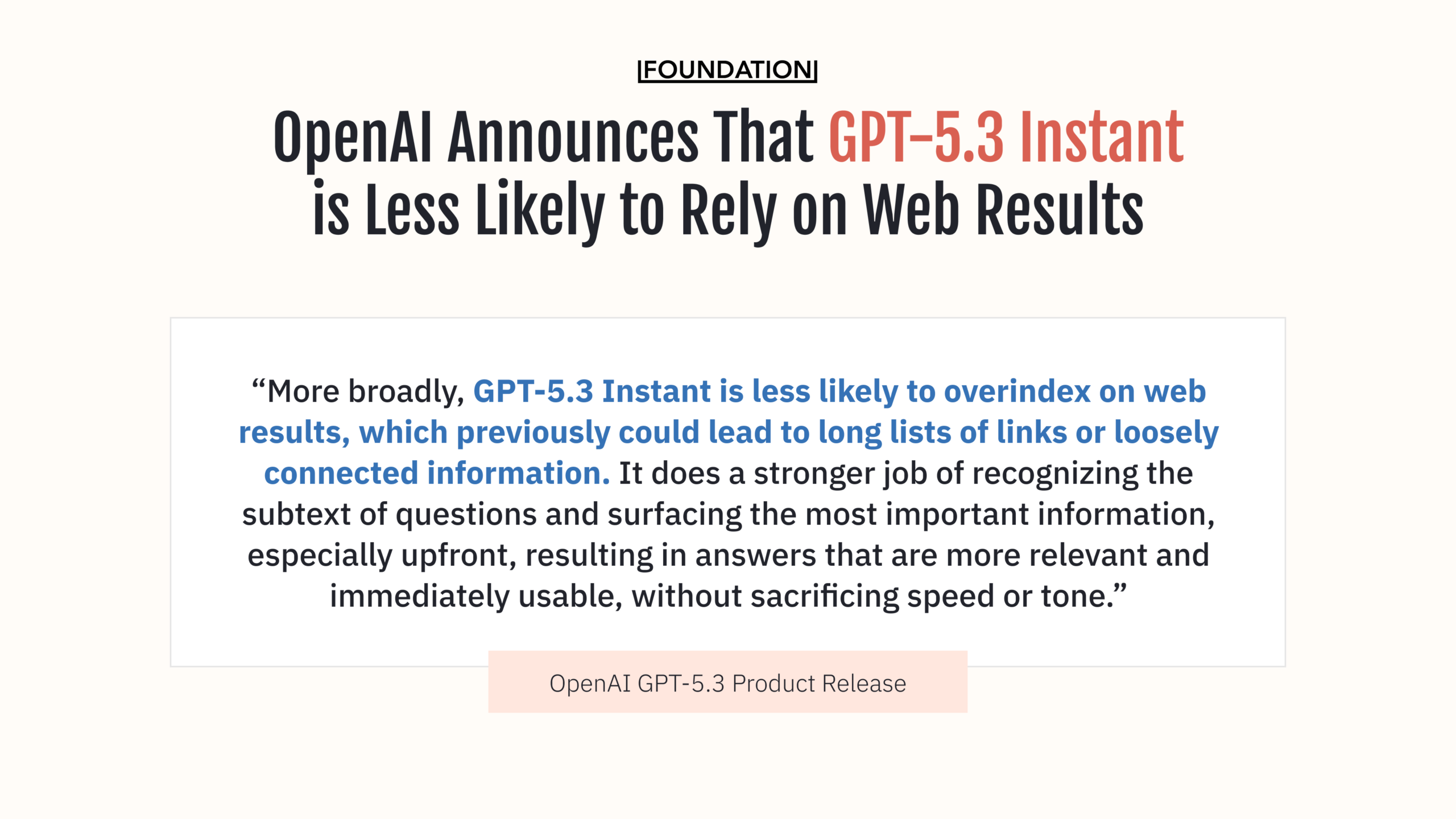
In practice, ChatGPT will show far fewer links.
Glenn Gabe tested this immediately after the release. He found that GPT-5.3 returned just two links where 5.2 included over a dozen. His conclusion:
If you were expecting referral traffic from ChatGPT, you need to adjust expectations right away.
OpenAI’s model is moving away from acting like a search engine and towards an answer engine that synthesizes information into tighter, more opinionated answers.
Why it matters
For the last few years, the GEO conversation has obsessed about citations. Show up in ChatGPT, get your content links into Perplexity, and appear in the AI Overviews, because more citations means more visibility and, eventually, more traffic.
GPT-5.3 just compressed the playing screen. We are now in a winner-take-most (if not all) territory.
Three consequences show up immediately.
1) Citation scarcity raises the value of every mention.
When GPT-5.2 cited eight sources for a query, being in position five was decent. When GPT-5.3 cites two, there is no position five.
You’re either in the answer, or you’re invisible.
According to 6sense’s 2025 B2B Buyer Experience Report, 95% of buyers purchase from a vendor on their initial shortlist. If ChatGPT is where that shortlist starts forming, being one of two cited brands carries extraordinary weight.
2) “Traffic from ChatGPT” was always the wrong metric. Now it’s officially dead.
If you’ve been measuring GEO success through referral traffic, this update is going to look like a disaster on paper. Fewer links means fewer clicks.
But GEO was never about traffic. It’s a brand legitimacy layer. Closer to PR or thought leadership than performance marketing.
As our VP of Strategy, James Scherer, put it:
“Referral traffic from ChatGPT is, on average across the web, 0.26%. Who cares about referral traffic of less than a half a percent? Are you showing up when someone types in ‘best payroll software for small business’ as the first mention? That’s the win.”
3. The model is getting pickier about what it trusts.
OpenAI says GPT-5.3 does “a stronger job of recognizing the subtext of questions and surfacing the most important information.”
Read from a GEO lens, that means the model is exercising more editorial judgment about which sources deserve to appear.
The bar for citation just went up.
Our bet is that surface-level content that happened to rank on Google won’t survive this compression. The sources that will are the ones with genuine authority: original data, named experts, unique analysis, and presence across trusted third-party platforms.
What to do about it
You need to change how you think about AI visibility now. Here are three ways to start:
- Audit your citation frequency now, before the model fully rolls over. Run your top 15–20 priority prompts through ChatGPT and compare your citation count against what you were seeing a month ago. If it dropped, you need to understand why. If it held, you’re likely in the surviving citation set, and that’s a position worth protecting.
- Stop optimizing for traffic. Start optimizing for “last source standing.” The question is no longer “how do we get cited alongside nine other brands?” It’s “how do we become one of the two or three sources the model refuses to drop?” That means original research, proprietary data, named-expert commentary, and deep presence on the third-party platforms LLMs trust most: Reddit, G2, industry publications, and YouTube.
- Shift your GEO metrics from volume to concentration. Citation frequency still matters, but in a scarcer citation environment, citation share matters more. How often does the model cite you vs. your top competitor when both of you are relevant? That number tells you whether you’re winning or losing.
And don’t mistake fewer links for fewer opportunities. As James put it:
“The LLMs are, fundamentally, still learning models. Nothing’s changed there. They’re still pulling their answers from reputable sources. The winners of GEO in 2026 will be the brands that think more about brand visibility in AI search than they do about referral traffic from it.”
Those who treated GEO as a checkbox are about to disappear from the answer. The brands that built real authority are the ones the model keeps citing.
Go Deeper on AI Visibility
→ GEO Metrics: How to Measure Visibility, Trust, and Brand Presence in AI Search — Our full framework for tracking the metrics that actually matter in a zero-click world. Includes the three-pillar model (visibility, citations, sentiment) and how to operationalize measurement.
→ Over 55% of Enterprise Buyers Ask AI First. Is Your Brand On the Shortlist? — Why the sensemaking phase of the B2B buyer journey has moved into AI, and what the 6sense data on Day One shortlists means for how you invest in visibility.
→ The Dark SEO Funnel: Why Traffic No Longer Proves SEO Success — Gaetano DiNardi makes the case on Search Engine Land that we’ve entered an era of “invisible attribution” where AI drives vendor discovery before Google ever sees the click. His framing of branded search as a leading indicator for dark funnel success pairs perfectly with what we’re seeing in the GPT-5.3 shift.
One Thing Worth Watching
Back in October, our CEO Ross Simmonds took the stage at Profound’s Zero Click conference and laid out a framework for content distribution in an AI-first world. His core argument: the brands still treating content as a blog-first exercise are going to get left behind.
YouTube, Reddit, and LinkedIn are the platforms LLMs actually cite. The research-creation-distribution-optimization loop he walks through is a practical blueprint for building the kind of multi-platform authority that survives citation compression like what we’re seeing with GPT-5.3. Worth the watch, especially if you’re rethinking where your content investment goes next.
That’s it for the first issue of the new format.
This is a new format for us too. If something landed well this week, tell us. If something felt off, tell us that too. Reply to this email or DM me on LinkedIn (I respond more often there).
This week’s vibe: It’s Called: Freefall — Rainbow Kitten Surprise
Have a great weekend,
Ethan Crump ethan@foundationinc.co