Article's Content
Article's Content
“The best time to start investing in content to influence the AI was ten years ago. The second-best time is today.”
— Ross Simmonds, The Ross Simmonds Show
The B2B buyer journey doesn’t start where it used to. Increasingly, they turn to AI tools like ChatGPT for a list of vendor recommendations. And what shows up in those answers alongside company websites? Reddit threads, YouTube videos, LinkedIn posts, review site pages, and countless other third-party sources.
In other words, both buyer influence and AI visibility are determined by the strength of your content across multiple platforms and surfaces.
It’s not about pumping out content. It’s about placing it right. And to do that, you need a well-thought-out content distribution strategy.
The brands appearing in those Ai recommendations aren’t necessarily the ones with the biggest content teams or the deepest budgets. They’re the ones that have committed and built a presence across the platforms buyers and AI systems rely on.
That’s the shift B2B content teams need to make heading into 2026.
B2B Content Distribution Strategy and AI Visibility
Traditionally, content distribution referred to promoting content across owned, earned, and paid channels to reach a target audience. That definition is no longer broad enough for how buyers discover information or how AI systems generate recommendations.
Two major developments are simultaneously driving changes in B2B content distribution strategy:
- B2B buyers now research across a wider range of platforms before they ever talk to a salesperson: review sites, AI chatbots, Reddit threads, LinkedIn posts, YouTube videos, peer communities.
- AI systems synthesize answers from the same platforms buyers use, plus the long tail of off-domain content the model was trained on or can retrieve at query time.
Both shifts point to the same conclusion: brand visibility now depends on presence across an ecosystem of channels, not publication on a single owned property.
A modern distribution strategy reflects this new reality and treats distribution as a continuous, multi-channel discipline.
How Modern Content Distribution Actually Works
A modern distribution strategy turns every piece of content into the starting point of an ongoing process. Each stage builds on the work of the one before, and each stage feeds back into the others over time.
Here’s how that process works in practice:
- Research before you create. Start by understanding your audience’s pain points, language, behaviors, and preferred platforms. Sales calls, Reddit discussions, customer interviews, and podcasts reveal not only what buyers care about, but where conversations and influence already exist.
- Create with distribution in mind. Content should be designed from the beginning to live across multiple formats and platforms. A webinar, research report, or pillar page should never remain a single asset. The strongest teams plan for repurposing before production even begins.
- Publish across owned channels first. Your website is only one layer of distribution. Email, social profiles, newsletters, and owned communities should all reinforce core narratives consistently. Many brands stop at publication on owned channels alone—and limit their visibility as a result.
- Distribute across community-driven platforms. Extend content into the spaces where buyers actively evaluate products and exchange opinions. Reddit, LinkedIn discussions, industry forums, Slack groups, and niche communities increasingly shape both buyer perception and AI-generated recommendations.
- Repurpose into new formats. High-performing distribution strategies adapt ideas into multiple media formats. Long-form articles become videos, podcasts, social content, and short-form commentary. Video and podcast transcripts can reinforce written assets, while embedded multimedia increases both engagement and discoverability.
- Build off-site authority. Visibility increasingly depends on third-party reinforcement. Guest posts, podcast appearances, digital PR, review platforms, newsletter mentions, and industry publications all strengthen the association between your brand and the topics you want to own. These signals influence both buyer trust and AI-generated responses.
- Measure visibility, not just engagement. Traditional metrics like pageviews and email opens only tell part of the story. Modern distribution strategies should also track AI citations, brand mentions in LLM responses, referral traffic from AI platforms, and presence in buyer evaluation conversations.
- Optimize and reactivate. Distribution is iterative. Analyze which formats, platforms, and narratives generate the strongest results, then expand them. Older content can often be updated, reformatted, and redistributed to generate renewed visibility long after its original publication date.
Each stage reinforces the others, creating a compounding visibility effect over time. That’s why brands with consistent distribution systems tend to outperform those that focus primarily on publishing new content.
Want a tactical content distribution playbook?For a channel-level breakdown of specific distribution tactics — from email and social media to video, podcasts, and influencer partnerships — see Ross’s full Guide to Content Distribution. |
Why B2B Content Distribution Strategy Matters More Than Ever
AI has dramatically lowered the barrier to content creation. A single marketer can now generate blog posts, whitepapers, videos, and social assets at a scale that once required entire teams.
As content supply explodes, visibility becomes the scarce resource.
The competitive advantage is no longer simply producing content. It is ensuring your brand appears in the places that influence both buyer decisions and AI-generated recommendations.
Ross has summarized this shift with a simple framework: DREAM — Distribution Rules Everything Around Me.
That idea matters for two reasons: AI visibility and buyer behavior.
1) Content distribution drives AI visibility
Roughly 90% of the citations appearing in B2B AI responses come from third-party sources, not brand-owned websites. The information shaping AI-generated recommendations mostly originates outside the brands those recommendations are about.
That finding comes from the Hidden Selection Phase report, a study Foundation ran with AirOps analyzing 5.1 million AI responses and 57.2 million citations across 50 B2B brands, seven SaaS verticals, and five major AI platforms.
Large language models do not generate recommendations in isolation. When a buyer asks ChatGPT or Claude for the best marketing automation platform for a mid-market SaaS company, the answer is assembled from trusted sources, third-party mentions, review platforms, and community discussions distributed across the broader ecosystem. The brands appearing most consistently in those responses are the ones with the strongest visibility across the platforms AI systems already cite.
Three platforms dominated the external citation data:
- Reddit: 20.8% of top-50 external citation domains across all 50 brands and seven verticals. Reddit was the #1 external source in six of seven verticals.
- YouTube: 13.0%
- LinkedIn: 11.0%. Sales & Revenue was the only vertical where LinkedIn edged out Reddit.
But here’s the more important finding from the report. No single platform is enough.
GEO is an aggregate visibility game
Presence across owned media, Reddit, YouTube, LinkedIn, review platforms, earned media, and third-party discussions collectively shapes how AI systems interpret and represent a brand. The advantage comes from consistent presence across the ecosystem, not dominance on any one channel.

A blog post published only on your website lives in a single environment. The same insight repurposed across Reddit, YouTube, LinkedIn, G2, and other third-party channels expands the number of places buyers and AI systems can encounter your brand by an order of magnitude.
2) Content distribution influences the B2B buyer journey
AI is accelerating the importance of distribution, but the underlying shift began earlier: B2B buying journeys started to unfold across fragmented ecosystems rather than a single search channel or vendor interaction.
According to the G2’s 2025 Buyer Behavior Report, which surveyed 1,000 decision-makers, buyers regularly rely on multiple parallel sources during evaluation, including:
- Software review sites (38–61%)
- AI search (35–57%)
- Google (47–55%)
- Vendor sites (33–50%)
- Peers/colleagues (28–32%)
And those categories increasingly overlap. Peer recommendations now happen across LinkedIn, Reddit, Slack communities, podcasts, forums, and other distributed ecosystems where buyers actively validate purchasing decisions.
The implication is straightforward: brands that are absent from these environments are often excluded from consideration before a sales conversation even begins.
The distinction between AI visibility and buyer influence is disappearing
A Reddit thread can shape an AI-generated recommendation while simultaneously influencing a buyer validating vendors late in the evaluation process. A YouTube video may appear in AI Overviews while also answering category-level questions directly for prospective customers. Review platforms influence LLM citations and reinforce credibility during procurement and shortlist evaluation.

The same distribution ecosystems now shape both AI-generated visibility and human decision-making. Brands that treat these as separate challenges often fragment their efforts. Brands that recognize them as interconnected visibility systems build stronger reinforcement across every platform where discovery and evaluation occur.
How to Refine Your Content Distribution Strategy for AI Visibility and B2B Buyer Influence
Distribution now shapes both AI-generated visibility and buyer discovery. Increasingly, those functions are inseparable.
The challenge is no longer understanding why distribution matters. It is operationalizing it effectively.
A modern distribution strategy must answer three practical questions:
- Which platforms most influence our buyers and AI visibility?
- How do we scale presence across those environments without multiplying production overhead?
- Which signals actually correlate with citations, discovery, and pipeline impact?
In practice, that falls into three operational priorities:
- Building the right distribution ecosystem for your audience
- Integrating repurposing into the content production workflow
- Measuring the signals most closely tied to visibility and commercial outcomes
Our Hidden Selection Phase research reinforces a critical point: visibility does not come from dominating a single channel. It comes from sustained presence across the broader ecosystems where buyers research vendors and AI systems retrieve information.
1) Build your audience-specific content distribution stack
There is no one-size-fits-all distribution strategy.
A B2B SaaS brand selling to security buyers will not distribute content the same way as a company targeting RevOps leaders or developers. Some core platforms overlap — Reddit, LinkedIn, YouTube, search, review sites — but the actual mix should reflect where your audience researches vendors and validates decisions.
As Ross has argued on The Ross Simmonds Show, your website is only one part of the visibility equation.
Owned, earned, and paid media still help organize distribution thinking, but those categories no longer explain how influence actually spreads across modern buying journeys or AI systems. Buyers and LLMs increasingly rely on broader ecosystems of communities, creator platforms, forums, newsletters, podcasts, and third-party publications.
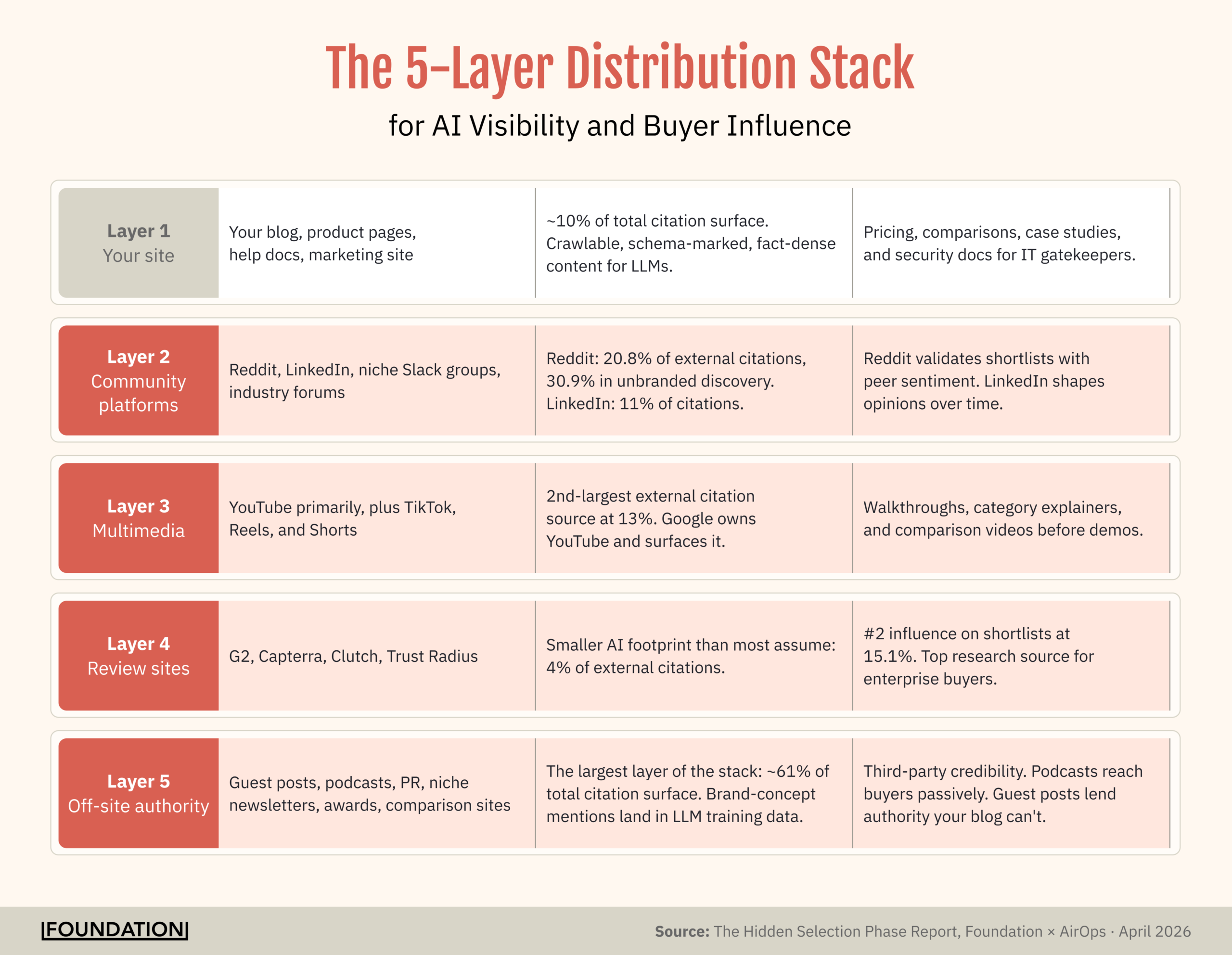
The stack below organizes those layers based on the role they play in shaping both AI visibility and buyer influence.
Distribution Layer 1: Your site.
Your website is still the foundation of your visibility strategy, even if it now represents only a small portion of the overall citation landscape.
The Hidden Selection Phase research found that brand-owned domains account for roughly 10% of citations across B2B AI prompts.
To capture those citations, your site needs to be accessible to LLM crawlers, technically structured for retrieval, and organized around information that AI systems can easily interpret and reference. Crawl accessibility, schema markup, strong information architecture, and clear factual content all matter.
For buyers, your website becomes most important during evaluation and procurement. This is where prospects validate pricing, compare vendors, review customer proof, and assess implementation or security requirements. According to G2, IT stakeholders now influence nearly half of software purchasing decisions, making accessible technical documentation increasingly important.
Distribution Layer 2: Community platforms.
Community platforms account for a significant share of unbranded AI citations.
In the Hidden Selection Phase research, Reddit represented 20.8% of all external citations and climbed to 30.9% for unbranded discovery prompts. LinkedIn accounted for another 11%, while niche forums, Slack communities, and industry-specific groups contributed additional category-level visibility.
These same environments also shape buyer perception.
Reddit functions as a validation layer, where prospects compare vendors and evaluate peer sentiment during shortlist creation. LinkedIn operates differently: it influences perception gradually through repeated exposure to industry perspectives, operator insights, and professional credibility over time.
The strategic principle for community distribution is straightforward: participation has to create value before it promotes anything. Audiences on these platforms are highly sensitive to transactional behavior and low-value brand insertion.
Ross’s “four E’s” framework applies well here. Content that educates, engages, entertains, or empowers tends to earn visibility and participation. Content designed purely for promotion rarely does.
Distribution Layer 3: Multimedia platforms.
Multimedia platforms now play a major role in both AI visibility and buyer discovery.
In the Hidden Selection Phase research, YouTube accounted for 13% of external citations, making it the second-largest citation source after Reddit.
That influence is not accidental. Google increasingly prioritizes video across search results and AI experiences because users actively engage with it and because it keeps discovery inside Google’s broader ecosystem.
For buyers, video helps bridge the gap between awareness and evaluation. Prospects increasingly watch demos, walkthroughs, comparison videos, and category explainers before ever talking to sales. Video answers the practical questions text alone struggles to communicate clearly: what the product actually looks like, how it works, and whether it feels credible in use.
Distribution Layer 4: Review sites.
Review platforms require a slight mindset shift for many B2B marketers.
In the Hidden Selection Phase research, sites like G2, Capterra, Clutch, and TrustRadius accounted for roughly 4% of external AI citations — smaller than many teams would probably expect given how much attention review platforms receive within SaaS marketing.
But their influence on buyers remains substantial. According to G2’s 2025 Buyer Behavior Report, review platforms are one of the strongest influences on vendor shortlists, and among enterprise buyers they now outperform Google as a research source in parts of the evaluation process.
The operational work behind strong review visibility is relatively straightforward: encourage authentic customer reviews, maintain complete profiles, update screenshots and pricing consistently, participate in relevant categories and awards, and actively manage your presence over time.
It is not particularly glamorous work, but it contributes directly to buyer confidence and third-party credibility.
Distribution Layer 5: Off-site authority.
This is the broadest and least controllable layer of the distribution stack.
Our Hidden Selection Phase research found that a significant percentage of AI citations go to unmanaged third-party sources: guest articles, podcast appearances, newsletters, digital PR coverage, industry publications, comparison sites, community discussions, and the broader web ecosystem AI systems draw from when generating category-level answers.
This is where brand associations are often formed at scale.
A podcast appearance by your CEO may shape perception long before a prospect visits your website. A guest contribution on a respected industry publication can create credibility that carries differently from self-published content. Third-party ecosystems influence not only what buyers encounter, but also how AI systems contextualize brands within categories and conversations.
This layer is also where vertical-specific strategy matters most. Different audiences rely on different authority ecosystems.
A fintech company may need visibility across platforms like NerdWallet and Investopedia. Developer-focused companies may require stronger presence across Stack Overflow and GitHub. RevOps brands may benefit more from operator communities, sponsorship ecosystems, and industry newsletters.
The five-layer framework remains consistent. The specific channel mix depends on where your ICP builds trust, validates expertise, and discovers vendors.
2) Make repurposing a core part of your content supply chain
Too many content teams treat publishing as the finish line. The brands earning the highest citation share treat publishing as the starting point of a broader distribution process.
The content supply chain — a system where every core asset becomes source material for multiple downstream formats, channels, and discovery environments – is a highly useful operational model.
It’s also the practical answer to the “we don’t have the budget to be everywhere” concern. Most brands do not need to create dramatically more content. They need to extract more value from the content they already produce.
The Content Repurposing Playbook
Think of every long-form asset as a source file. The real work is converting it into the formats your audience and the AI systems already index.
Every piece of content can live in three primary formats: text, video, and audio.
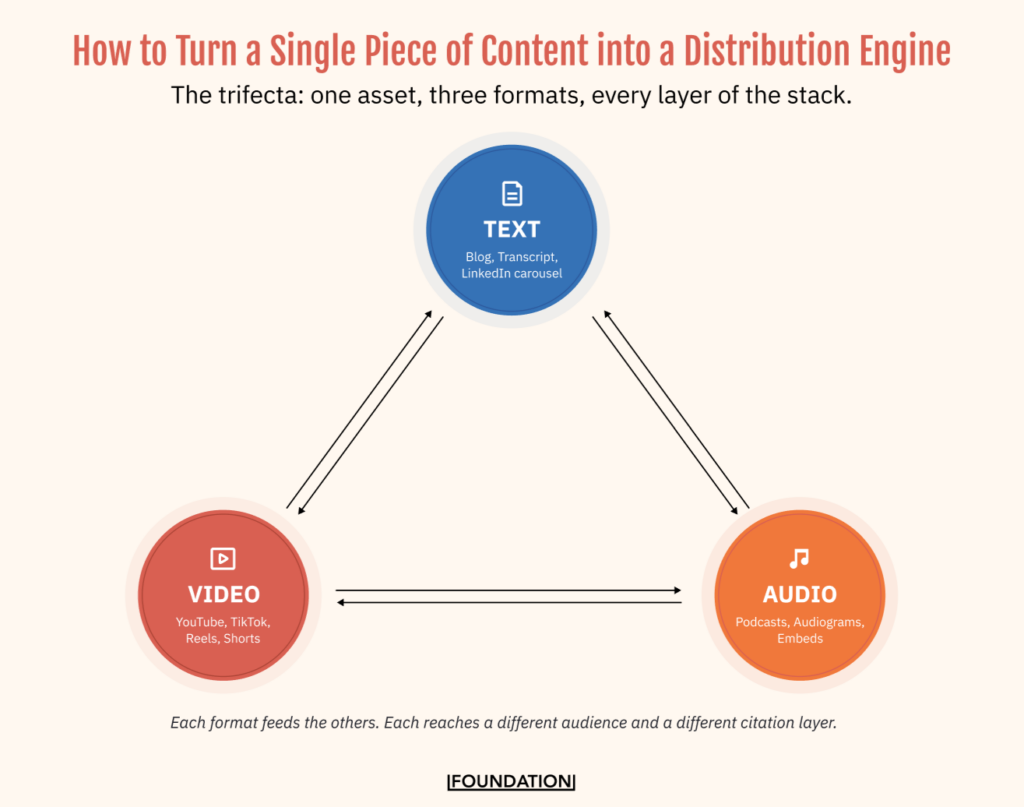
The trifecta is the playbook for moving between them.
- Text becomes video. A high-performing article can be adapted into a script, expanded into commentary, or turned into a visual walkthrough using recorded presentation, b-roll, animation, or screen capture. That content can then be distributed across platforms like YouTube, which the Hidden Selection Phase research identified as one of the largest external citation sources across AI systems.
- Video becomes audio. The same recording can be repurposed into podcast distribution across platforms such as Spotify and Apple Podcasts, extending reach into environments where audiences consume information passively throughout the day.
- Audio becomes text. Transcripts can become articles, newsletters, social commentary, discussion prompts, or updated long-form resources. Embedding multimedia formats back into the original asset also creates richer content environments that increase usability, deepen engagement, and expand the number of surfaces where both buyers and AI systems encounter the brand.
Once content exists in text, video, and audio formats, it can be adapted into channel-specific assets aligned to different layers of the distribution stack:
- LinkedIn commentary and carousel posts built from key insights
- Audiograms and quote clips distributed through social and podcast channels
- Short-form video segments adapted for discovery platforms and feeds
- Reddit discussions focused on specific findings, questions, or industry debates
- Email sequences introducing the asset to subscribers over time
- Guest post pitches tailored to publications your audience already trusts
- Sales enablement materials derived from the same underlying research and positioning
One core asset, distributed strategically, can extend across every major layer of the visibility ecosystem.
That distribution depth matters. The Hidden Selection Phase research suggests that brands earning stronger citation visibility are not necessarily creating dramatically more content than competitors. More often, they are extending the reach, lifespan, and discoverability of the assets they already produce.
Increasingly, platforms such as Distribution.ai are emerging to help operationalize these workflows at scale rather than requiring teams to rebuild distribution systems manually for every campaign.
For a full walkthrough of how leading brands systematically repurpose a single podcast episode into an integrated campaign, see our Lab post on Podcast Repurposing: How to Expand the Reach and Impact of Each Episode.
3) Measure and optimize your content distribution strategy
The third piece of the operational work is closing the loop: identifying which distribution efforts are actually influencing AI visibility, buyer consideration, and pipeline outcomes, then feeding those insights back into the next cycle of production and distribution.
Metrics like pageviews, social engagement, and email opens don’t tell you whether you’re showing up in ChatGPT’s answer to a category query, whether you’re on the shortlist when a buyer’s committee meets next week, or which layer of the distribution stack is generating the most pipeline influence.
A modern distribution measurement framework needs to track both dimensions simultaneously:
| KPIs for AI visibility: | KPIs for B2B buyer influence: |
|
|
|
|
|
|
|
|
|
|
Build AI Visibility and Buyer Influence Through Distribution
Your content distribution strategy now determines whether AI systems surface your brand and whether buyers encounter it during evaluation.
The companies gaining visibility in 2026 are extending their ideas across multiple formats, channels, and third-party environments where both AI systems and real buyers form opinions. They build distribution stacks aligned to audience behavior, treat repurposing as operational infrastructure, and measure visibility through signals that extend beyond owned-channel traffic alone.
The result is broader discoverability, stronger brand association, and more consistent presence across the ecosystems shaping modern B2B buying decisions.
Ready to do the same? Get in touch with the leading content distribution and generative engine optimization agency.

Did you enjoy this post?
Read this next