
Article's Content
Article's Content
37% of enterprise B2B content is thought leadership. It returns just 27.5% of their backlinks.
That 9.5% gap between input and return is the single largest content misallocation we found across 12,154 pages and 24 B2B brands.
And in my experience, most marketing teams have never once pulled the data to confirm it’s happening to them.
We built this report because I’ve been saying for years that most B2B content programs are investing in the wrong formats.
Now we have the receipts.
37% of B2B Content Pages. 27.5% of the Backlinks. The Math Doesn’t Work.

Thought leadership accounts for 37% of all content asset allocation in our dataset. It’s the single most-published format in B2B by a wide margin. And it returns just 27.5% of all referring domains.
The numbers get worse when you take a closer look.
Thought leadership carries a 44.8% fail rate, meaning nearly half of this content earns fewer than 50 referring domains. Just 2.1% of pieces break through to 1,000 or more.
For a format that consumes the largest share of content budget and editorial time in most B2B enterprises, those are brutal numbers.
With a 0.74x efficiency ranking, thought leadership ranks beneath nearly every other format. Here’s what each tier means in practice:
- Tier 1 — Punches far above weight: Earns dramatically more referring domains than its page share would predict.
- Tier 2 — Earns its share: Sits at or above the 1.0x break-even point.
- Tier 3 — Below average: Falls under 1.0x.
- Tier 4 — Structural underperformer: Generates high page counts while returning a shrinking share of the total link pool.
The chart above isn’t an indictment of any single brand. It’s a structural pattern across every vertical in the study. The format that consumes the most pages returns the least per page.
So, why do marketing executives continue to green light thought leadership?
Why Smart Teams Keep Making the Same Bet
The case for thought leadership is a rational one. Publish authoritative perspectives, earn press coverage, build brand equity, generate demand. If the content is strong enough, the flywheel turns.
But this is a fundamental misread of the backlink mechanism.
Thought leadership is the most produced content type in B2B — 37% of all pages in our dataset. Yet nearly half of it earns fewer than 50 referring domains.
What we have here is a format-market fit problem.
Opinion and perspective content competes in a highly saturated market. Writers, journalists, and analysts don’t need another “novel” C-Suite POV to cite — they need information that’s valuable to their target audience. That means industry data, clear definitions of complicated concepts, and practical guidance they can reference.
The formats that meet those needs earn links. The formats that don’t, don’t.
Then there’s a deeper issue: most teams never verify whether the amplification is actually happening.
The content goes live. It looks professional. A few LinkedIn comments and internal shares create the appearance of performance without the substance of it.
Nobody checks the referring domain count six months later. When they do, they usually see the same sad number we’re sharing with you.
Before this becomes a blanket dismissal, the data deserves its nuance: thought leadership does work. Just not for most of the brands reading this.
Thought Leadership’s Backlink Impact is Market- and Brand-Dependent
Our analysis suggests that thought leadership is more effective at securing backlinks for certain markets and brand profiles.
Market-Dependent
Management consulting firms earn a median 305 referring domains per thought leadership piece in our dataset. B2B SaaS brands earn 126.
The same format, applied by brands investing at similar levels, produces 2.4x different results depending on brand type.
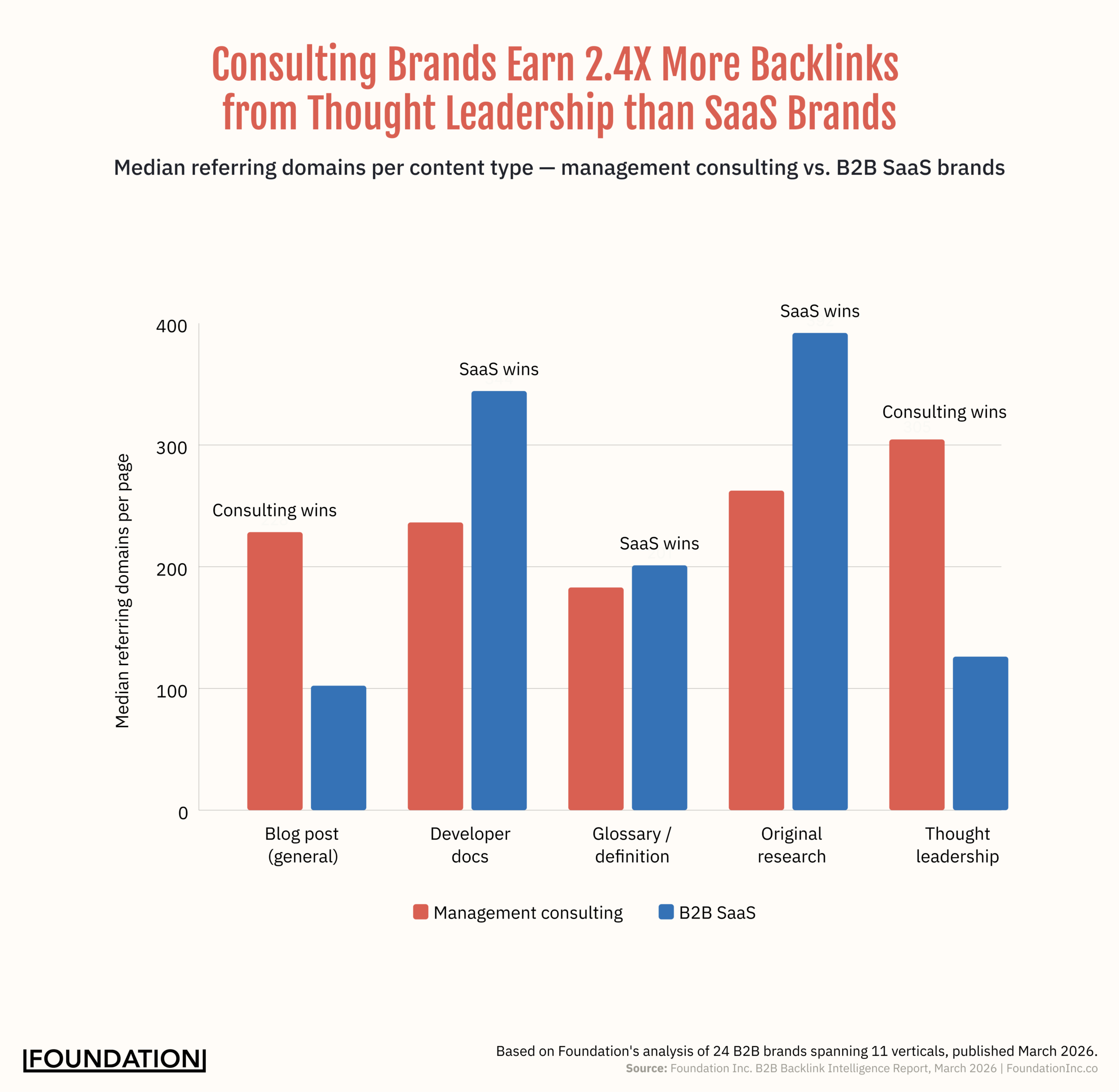
The honest read:
Thought leadership works when you’re already famous for your takes.
If Deloitte or McKinsey published a POV on supply chain resilience tomorrow, it would earn citations from journalists who already have them in their email list. If a mid-market SaaS company published the same piece, it would earn a thumbs-up from the sales team and 11 referring domains.
Brand-Dependent
SaaS brands can also earn significant backlinks…once they break through to a certain level of influence.
Salesforce’s State of the Connected Customer pages earn between 3,500 and 4,700. It’s an exceptional outcome, but they aren’t necessarily the product of exceptional writing. They’re the product of institutional authority that has been compounding for decades, backed by global PR distribution, research budgets that dwarf most SaaS companies’ entire content programs, and citation credibility that journalists and academics have built into their workflows over years.
When Deloitte publishes a State of the Workforce Report, it gets cited as a primary source in academic papers, government reports, and analyst decks. That’s institutional citation behavior. The citations are inherited because of the brand that published it, not because of the piece itself.
Most B2B Brands are not Deloitte.
What the Data Says You Should Invest in Instead
The same dataset that diagnoses the thought leadership problem points clearly at the alternatives.
Three formats consistently earn more than their share of the link pool — and all three are structurally underinvested in most B2B content programs.

Statistics and data roundups (4.25x efficiency score, 5% fail rate)
Stats and data roundups represent just 1% of all pages in the dataset and attract 4.1% of all referring domains. 42.1% of statistics pages in our study hit 1,000 or more referring domains. The fail rate is 5.3%, the lowest of any format with meaningful volume.
One well-maintained statistics page on a topic with persistent search demand will earn more links than a year of general blog posts. The data is clear.
Glossary and definition pages (1.47x efficiency score, 24% fail rate)
Glossary and definition pages carry a 23.8% fail rate. Low risk, consistent returns. Writers need to define terms when they produce content. They link to the clearest, most credible definition they can find.
As long as a brand’s definition page is authoritative and well-maintained, it earns citations indefinitely. The format doesn’t go stale the way news does or become outdated the way predictions do. It accumulates links over time.
How-To content (1.36x efficiency score, 28% fail rate)
The backlink impact of How-To content depends highly on the job to be done. It performs best when it solves tasks the audience already has, independent of the product.
The top-performing How-To pages in our dataset have almost nothing to do with their brands’ core offerings:
- Zapier’s breakout How-To pieces cover Google Drive, HTML, and browser inspection tools.
- Shopify’s top performers cover Fiverr, wholesale suppliers, and URL shortening.
The shift these formats represent isn’t about abandoning content marketing. It’s about changing the question from what do we want to say to what does the web want to link to. Those are different questions with different answers.
Self-Audit Questions Before the Next Content Calendar Meeting
If you’re not sure whether this applies to your program, three questions will tell you:
- What is the median referring domain count on your last 10 thought leadership pieces? Pull this from your SEO tool of choice. Don’t look at the outlier that happened to get picked up — look at the median.
- What percentage of those pieces earned fewer than 50 referring domains? If the answer is close to 44.8%, you’re tracking with the average in this study. If it’s higher, the format is performing even worse for you than it does across the full dataset.
- How does that compare to your best-performing glossary or how-to page? If one definitional page is outperforming ten thought leadership pieces combined, that’s not a coincidence — it’s a signal about where the next dollar of content budget belongs.
Most teams have never run this type of audit because they assume thought leadership delivers value that doesn’t show up in backlink data. That may be true in a narrow sense.
But if the content isn’t earning citations, it isn’t being amplified. And if it isn’t being amplified, it isn’t influencing anyone’s thinking at scale. That’s the mechanism thought leadership is supposed to trigger — and without the links, it doesn’t fire.
Want the Full Picture? Get Our B2B Backlink Intelligence Report
This piece covers what I consider the most important finding in our research. But it’s one of ten.
The full B2B Backlink Intelligence Report covers findings we didn’t get into here, including:
- The content format with a 74.5% floor rate for hitting 200+ referring domains that barely appears in most B2B programs (it’s not one of the three formats above)
- Why including a current year in your title produces a consistent 1.4x backlink uplift across formats
- The surprising title tactic that lifts blog posts 1.75x but actually hurts statistics pages
- Brand-level benchmarks across all 11 verticals so you can compare your performance against your actual peer group
If you run content at a B2B company and you’ve never audited your format mix against backlink performance, this report will change how you plan your next quarter.