Article's Content
Article's Content
Ask a B2B marketer about their video strategy, and you’ll get a tour of product demos and stitched-together testimonials buried on the website.
Ask about YouTube, and you’ll get blank stares.
That’s how you wake up one quarter behind.
YouTube is where buyers learn how to fix the problem before they ever see your homepage. It’s where AI engines go hunting for answers they’re willing to cite. And it’s where decisions get made long before sales gets looped in.
Here’s the opportunity: The brands winning on YouTube aren’t the ones with studio budgets or the most subscribers.
They’re the ones ranking for the questions buyers ask months before a demo is even on the table.
They’re shaping how buyers think about their category — and their product becomes the natural choice.
Most B2B brands are still stuck on whether YouTube fits. But the market’s already moved on.
This is for teams ready to move with it.
Why YouTube Dominates AI Search & Purchase Decisions
Two forces make YouTube unavoidable for B2B brands: its outsized influence on purchase decisions and its growing dominance in AI-powered search.
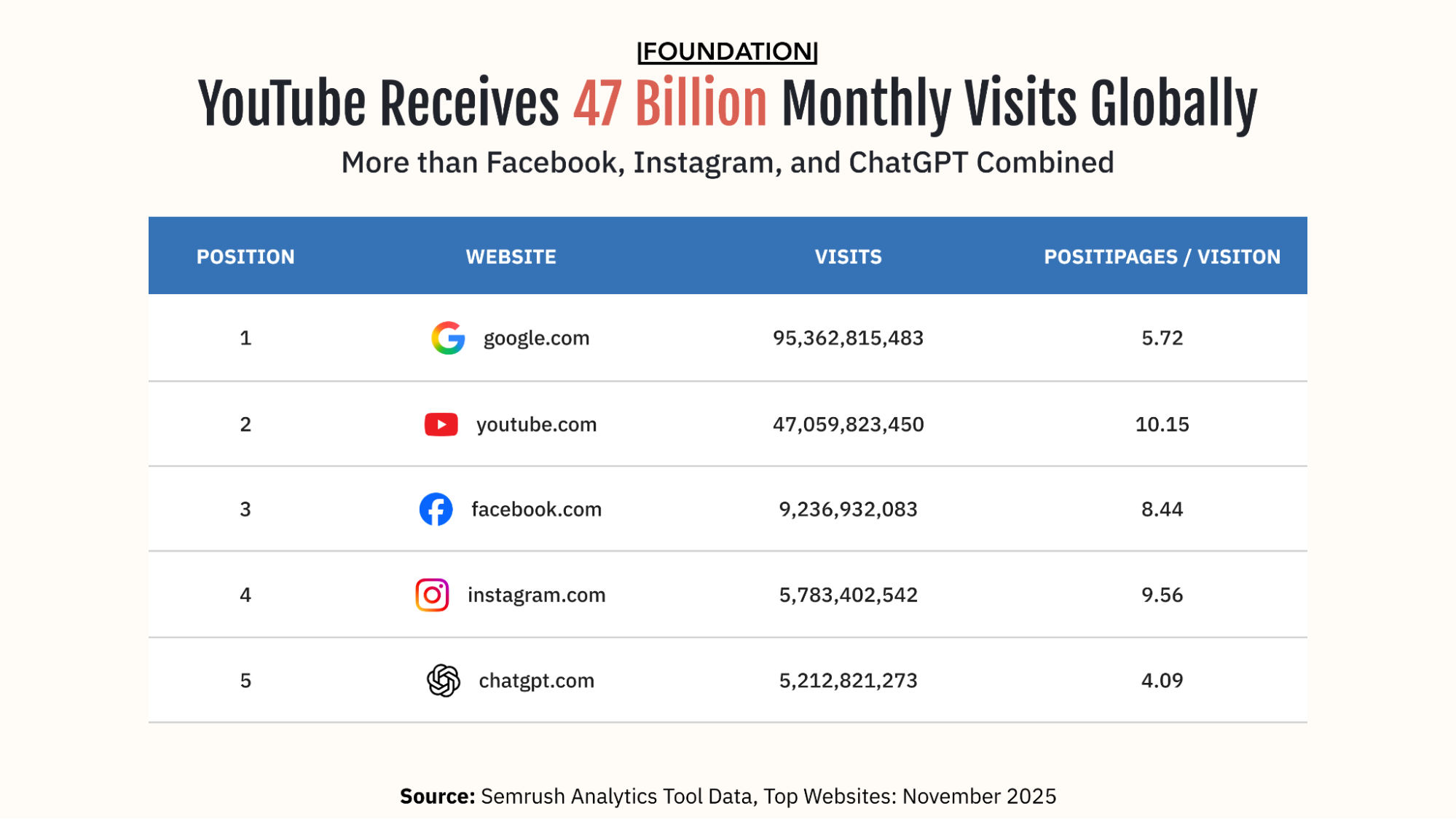
YouTube sits at #2 among the most visited websites globally with 47 billion monthly visits and the lowest bounce rate of any safe-for-work site in the top-20. It had more monthly visits at the end of 2025 than Facebook, Instagram, ChatGPT, Reddit, Wikipedia, and X combined.
As part of the Google ecosystem, it benefits from algorithmic integration that amplifies its authority across all Google properties.
Video Shapes Purchase Decisions
Boston Consulting Group (BCG) research commissioned by YouTube reveals the risk of underinvesting in digital video. According to survey data of nearly 4,000 people who encountered brand videos:
- 50% discovered new products/brands through digital video
- 43% got interested in buying
- 45% found video helpful in choosing which product/brand to purchase
- 34% were prompted to buy a specific item
According to BCG, surveyed shoppers reported that on YouTube they’re 1.5X more likely to pay attention to content, that the content is 1.7X more relevant, and that the content is more than twice as trustworthy than social platforms.
BCG describes YouTube’s advantage as three currencies:
- Attention (1.5X higher than social)
- Relevance (1.7X higher)
- Trust (2X+ higher)
If that wasn’t enough to convince you that YouTube for B2B is a non-negotiable, listen to this.
AI Search Runs on YouTube Content
YouTube is one of the biggest sources of AI citations:
- 7.7M citations in Google AI Overviews (Search Engine Land, 2025)
- 349K ChatGPT citations (AirOps State of AI Report 2026)
- 1.1M Perplexity citations (#2 most-cited source)
- 259K Gemini citations (#2 most-cited source)
- 57K Copilot citations
Here’s what matters for business: 75% of YouTube’s citations come from non-branded educational queries — the exact searches your prospects make when evaluating solutions.
When someone asks ChatGPT “how to improve customer retention” or Gemini “best CRM for small business,” YouTube videos dominate the answers.
“YouTube videos are going to play an increasingly large role in search and discovery. Gemini is my pick for the LLM that changes the world and is adopted by most users in the future. Gemini will utilize Video on YouTube along with all other formats to win.”
Ross Simmonds, CEO at Foundation Marketing and Distribution.ai
As AI visibility tracking expands as a central component of GEO, companies like Profound are noticing that YouTube has a model-dependent impact.
Not all AI models treat YouTube results the same.
According to Profound data, YouTube is cited much more frequently by Gemini than ChatGPT. The average view count of a ChatGPT-cited video is also twice as high as a Gemini citation (~9,000 vs. 4,400). It’s an early finding that Davis McCain suggests is proof that there’s more value in the longtail of YouTube content with view counts of less than 1,000.
In other words, ChatGPT prioritizes social proof (views), while Gemini prioritizes content relevance.
Understanding YouTube’s dominance is step one. Step two is choosing the right strategic approach for your organization.
How to Start A YouTube Channel: Building the Foundation
A successful YouTube channel is built over time. These three stages set the foundation before you hit record:
- Choose the right channel archetype for your business model
- Set up the technical infrastructure that helps generative engines parse and cite your content
- Develop a production framework that balances quality with sustainable output
Get these foundations right, and you’ll build a channel that compounds in value over time — where each video reinforces your authority, improves discoverability, and makes the next video easier to produce. Get them wrong, and you’ll burn the budget creating content that nobody watches and AI engines never cite.
1) Choose Your Channel Archetype
Before any optimization work, decide what kind of YouTube channel your business should run.
Foundation strategist Enzo Carletti breaks down the channel archetypes, along with what it takes to succeed in each.
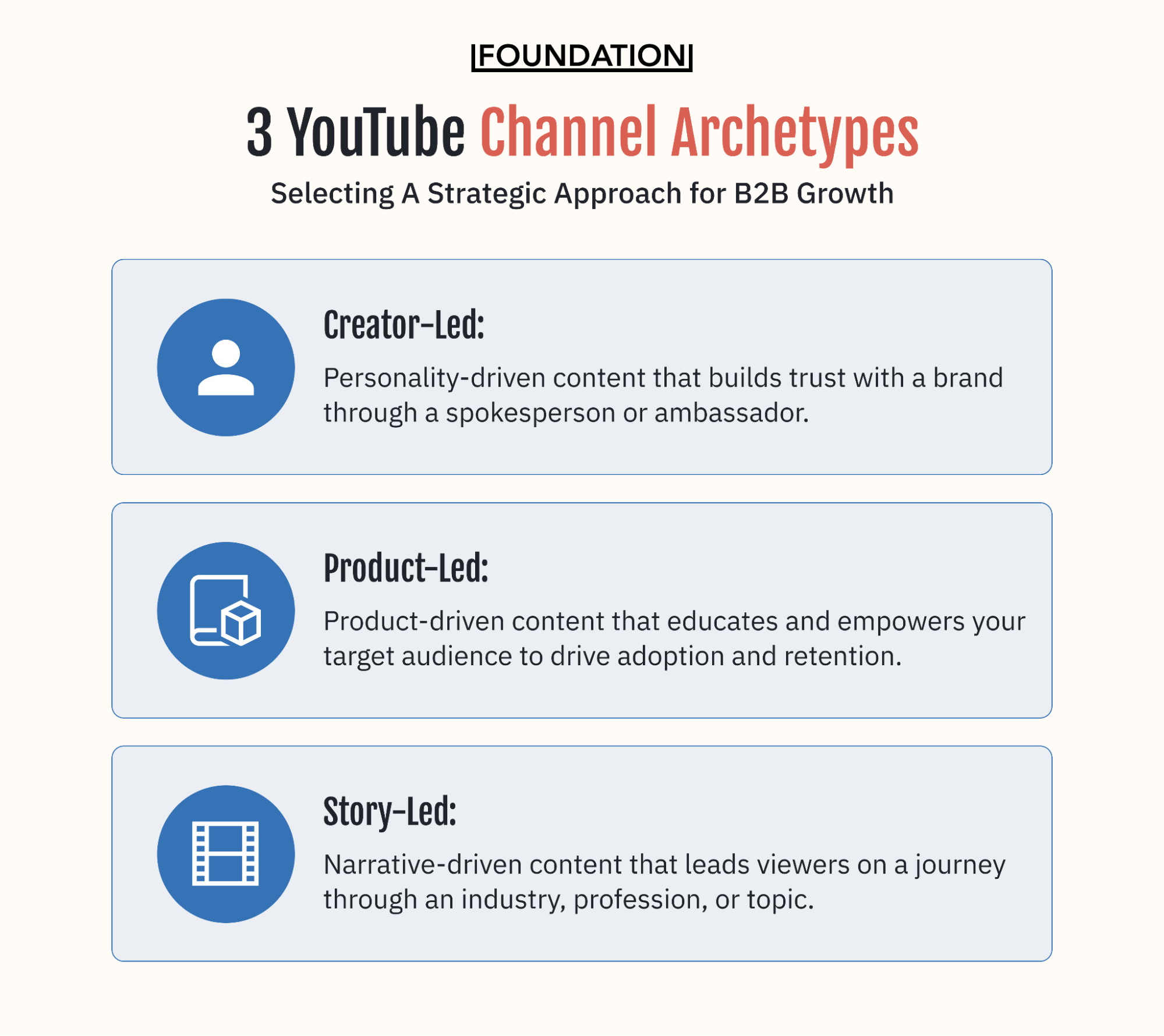
Archetype 1: Creator-Led Channels
Creator-led YouTube channels produce personality-driven content centered on building long-term trust with an individual spokesperson.
There are plenty of examples of this in B2C and influencer marketing, Mr. Beast being an obvious one, but the approach is effective in B2B as well. For instance, Rand Fishkin’s SparkToro channel delivers marketing insights from a recognizable founder. As does the Ross Simmonds channel.
One of the best examples of a creator-led YouTube channel is vidIQ. The YouTube optimization tool went all-in on this priority channel in 2017, hiring the influential creator Rob Wilson as their YouTuber-in-residence to boost traffic. Wilson had spent years building up a tech review channel with over 100,000 subscribers and 43 million views — the perfect expert to grow a channel dedicated to helping aspiring YouTubers.
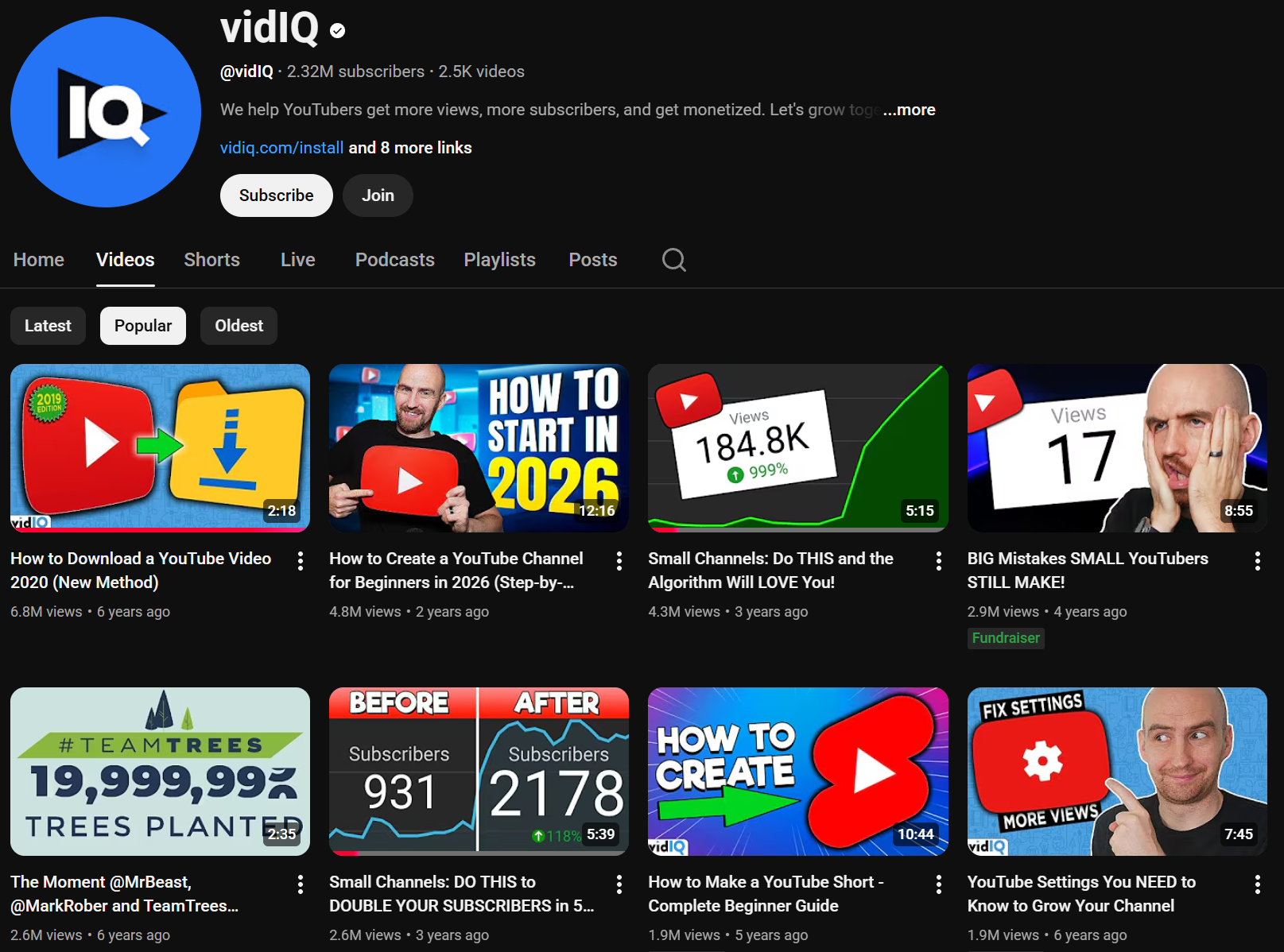
The creator-led approach is great for brands that are prioritizing thought leadership or where expertise is the product, like consultancies or agencies. Video is one of the stickiest mediums of communication, so the likelihood of audiences engaging with the creator increases.
Unfortunately, according to Enzo, it’s also the hardest type to cold start. Starting from scratch requires long-term commitment (3+ years) and a charismatic spokesperson willing to be the face of the brand. (Or you can take the vidIQ approach and go find one.)
Archetype 2: Product-Led Channels
Product-led channels produce content that makes the product interesting or useful to the target audience, typically through education or empowerment.
SaaS products or tech tools with visual outputs are ideal because viewers can see exactly how they work through video. Screen capture products make it easy to record how-to and quick start guides for new users or create enablement content that turns novices into power users.
Product-led companies like Loom or Webflow use YouTube to support adoption and show new users how to get the most out of their free tier or trial. This is even more effective in technical industries, where products are more complicated and the stakes are higher.
Hashicorp’s strategy, for example, features straightforward product explainers led by internal experts using nothing more than a whiteboard. Simple, budget-friendly, and — most importantly — effective.
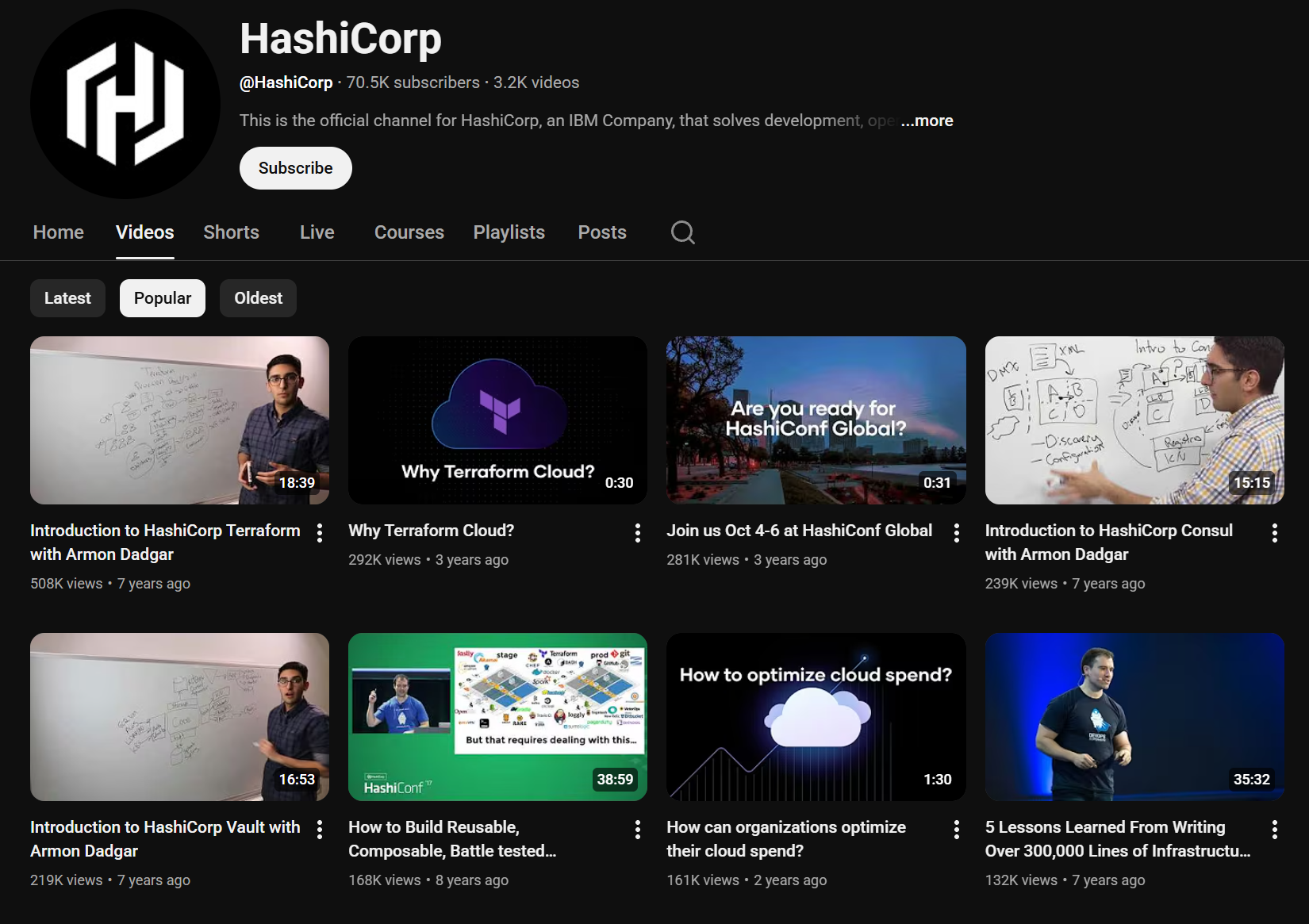
The product-led approach is ideal for teams with a clear use case and a product that benefits from demonstration. It’s easier to start than a creator-led channel, but growth is tied closely to product interest, making consistency and topic depth critical over time.
Archetype 3: Story-Led Channels
Story-led channels produce narrative-driven content where viewers follow an unfolding journey or transformation.
In the context of B2B, this could mean telling the story of your company’s growth, success story interviews with happy customers, or even telling the story of your ideal customer profile (occupation, goals, fears, etc.).
Revenue intelligence platform 6Sense brings their thought leadership and storytelling prowess to YouTube.
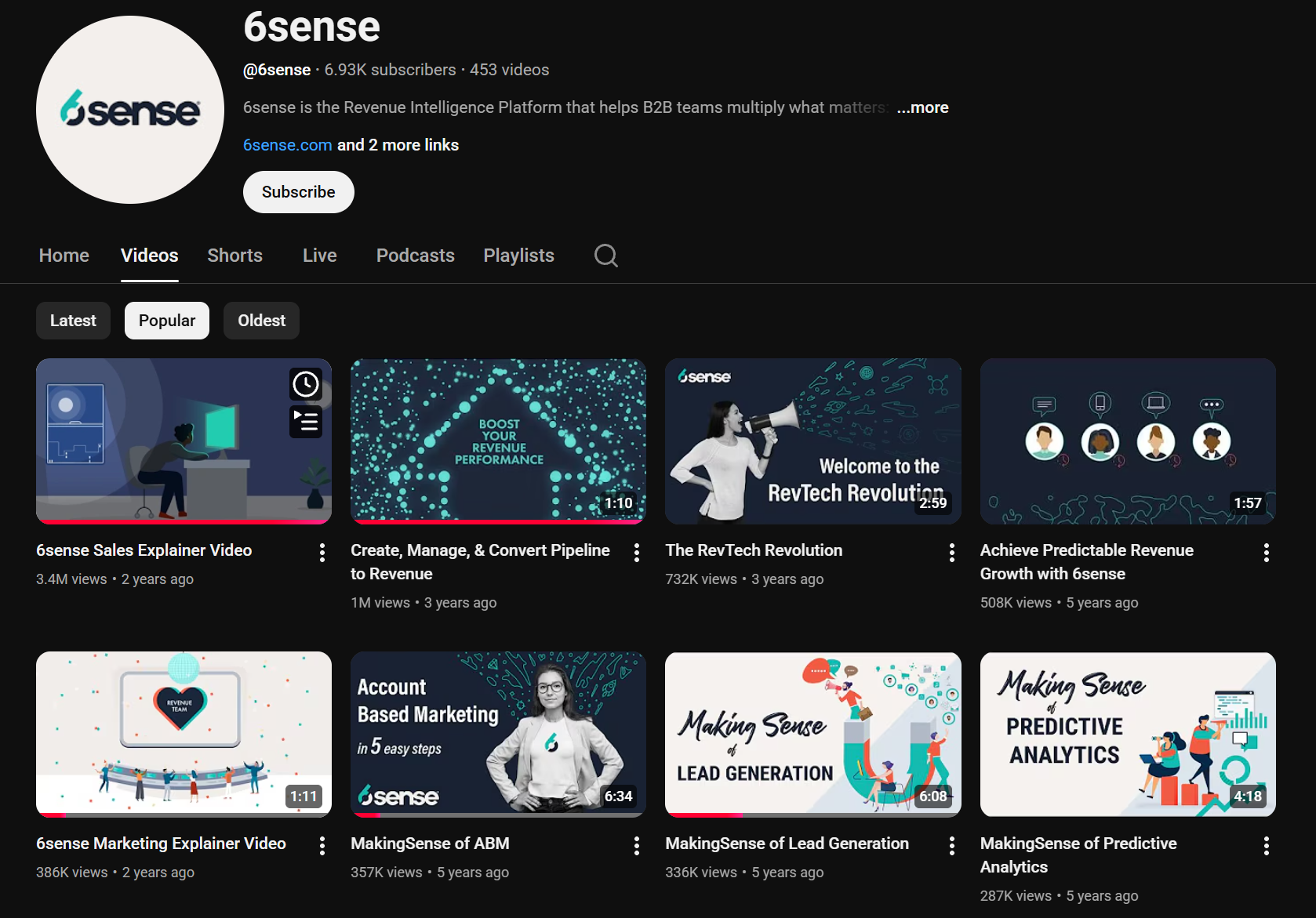
Their channel has 6.93k subscribers and 453 videos, including their Talking Sense series where they talk ABM and sales topics like Lead Generation and Predictive Analytics.
Story-led channels are ideal for brands that work in industries that are in constant flux (like marketing and sales) or any company that has a strong relationship with their customers and can create compelling content from interviews.
Which archetype should you choose?
Here are a few key questions you can ask to help you identify the right archetype:
- Creator-led: Do you have a charismatic spokesperson willing to commit 3+ years?
- Product-led: Can you make your product visually interesting in 8-minute videos?
- Story-led: Do you have transformation stories worth documenting over time?
Keep in mind, of course, that there’s no hard line.
YouTube channels, like websites, social accounts, and brands themselves, evolve alongside audiences. A creator-led channel may need to lean on product demos at times, while a product-led channel can keep its audience engaged with narrative-heavy story-led content.
The key is to anchor your channel to the archetype that makes the most sense for your current situation.
With your archetype chosen, the technical setup becomes straightforward.
2) Set Up Your YouTube Channel
The initial setup of your YouTube account is fairly straightforward. Google outlines the main steps to setting up your YouTube channel for personal use and business, the main difference being that business channels require a Brand Account.
Once the administrative setup is out of the way, you can start branding your business channel by adding the following elements:
- Channel Art: 2560x1440px banner optimized for mobile and desktop viewing.
- Profile Picture: 800x800px minimum — use either your logo or spokesperson headshot, depending on your chosen archetype.
- About Section: Write a short section explaining your product or service, what viewers will gain from your channel, and links to high-priority or relevant pages.
To make your channel search- and GEO-friendly:
- Enable auto-generated captions, then edit for accuracy — LLMs parse transcripts when determining citation-worthiness.
- Add structured data: Use organization schema on your website linking to your YouTube channel.
- Create channel trailer: 60–90 second explainer answering “Why subscribe?” featuring your value proposition.
With the foundation in place, the right tools help you execute consistently without adding operational drag. These tools support research, production, optimization, and measurement as you move into strategy and content creation:
- Keyword research and optimization: TubeBuddy or vidIQ.
- Thumbnail creation: Canva, Figma, or Photoshop templates for consistent branding.
- Caption editing: YouTube Studio’s built-in editor for transcript refinement.
- Analytics tracking: YouTube Studio + Google Analytics 4 integration for comprehensive data.
With infrastructure in place, success depends entirely on content strategy and production execution.
3) Content Strategy & Production Framework
With 20 million daily uploads, winning means understanding what YouTube’s algorithm rewards versus Google’s.
Unlike traditional SEO, where keywords and backlinks drive visibility, YouTube prioritizes watch time, retention, thumbnail CTR, and subscription signals.
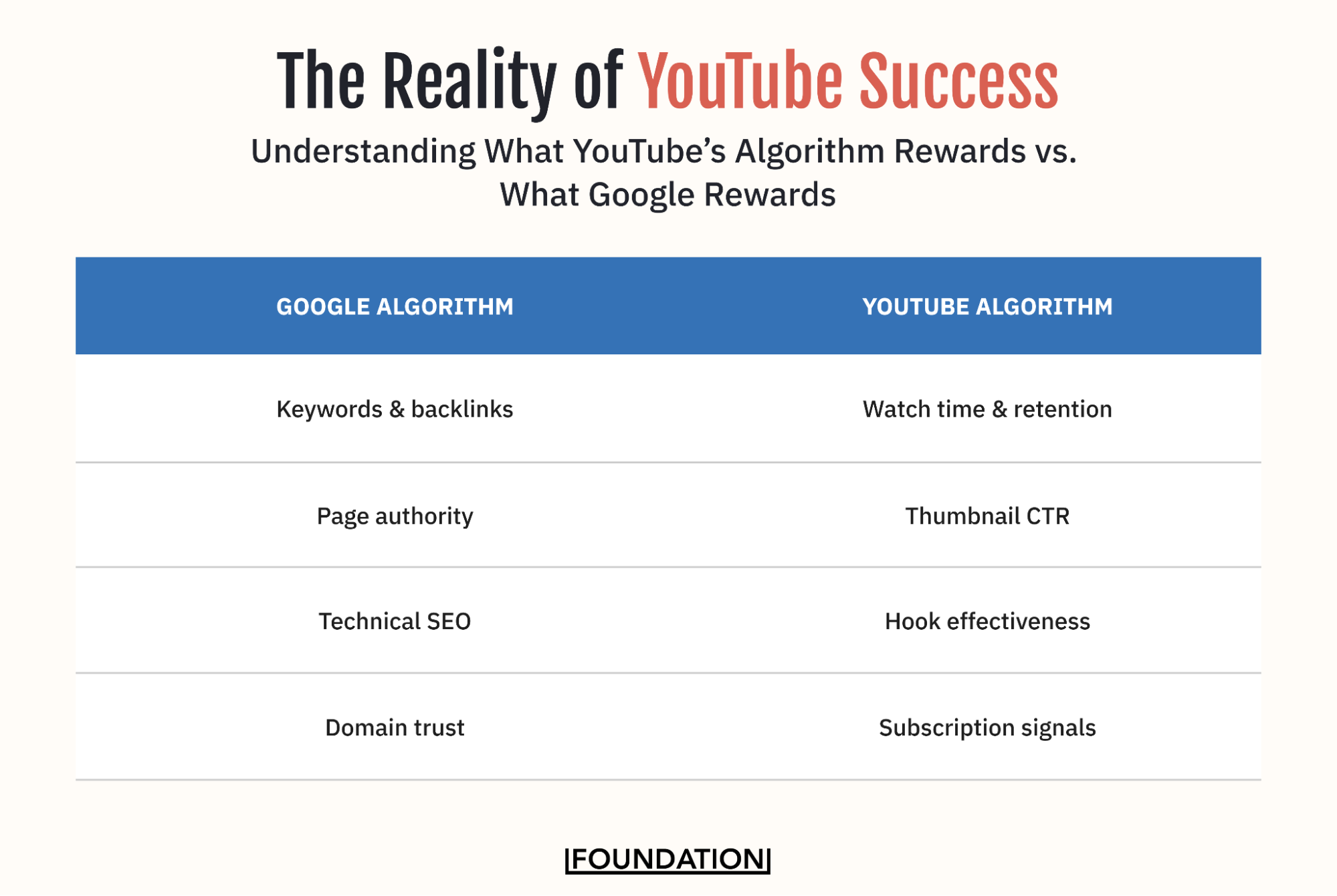
As you can see, optimizing for Google’s video algorithm is a different beast than website SEO. If you want to learn more, check out our guide on YouTube Search Engine Optimization.
After building out your YouTube content strategy, it’s time for the lights, camera, action of video production.
Pre-Production: The Foundation of Video Content
Rushing into video content creation without a framework and plan is a recipe for wasted budget and mediocre results.
Complete these pre-production tasks before filming:
| Strategic Planning | Content Development |
|
|
Production: Bringing Your Story to Life
Production is where your pre-production planning comes to life. This is the actual filming phase, where the goal is to capture high-quality visuals and audio. The success of your shoot depends on three factors: technical setup, environmental control, and adherence to your storyboard.
- Technical setup: Configure cameras, lighting, and audio equipment according to specifications. Direct talent to ensure they understand the messaging and tone. Record footage while maintaining focus on both visual quality and audio clarity — poor audio ruins even the most stunning visuals.
- Environmental control: Monitor background noise, natural lighting changes, and potential interruptions. The right environment is non-negotiable for quality output.
- Storyboard adherence: Follow your storyboard closely to maintain consistency across takes and scenes. This discipline saves significant time and resources in post-production.
Video content creation typically carries higher production costs than other types of content. Spending time during pre-production to plan everything prevents expensive reshoots and wasted resources.
Post-Production: Refining Your Content
Post-production transforms raw footage into a polished final product. This is the stage where you:
- Edit clips together to create a coherent narrative flow, remove unnecessary footage, and ensure smooth transitions between scenes.
- Incorporate visuals, integrate music or sound effects, and perform color correction to enhance visual appeal.
- Add text overlays and visual cues that convey information more effectively (particularly important for complex or dry B2B topics).
These elements directly impact viewer engagement and retention. For AI visibility, create accurate captions and transcripts. Enable auto-generated captions in YouTube Studio, then edit for accuracy. LLMs read these transcripts when determining citation-worthiness, making this step essential for GEO performance.
Start Building Your YouTube Strategy Now
YouTube’s role in brand discovery and purchase influence is accelerating because of its impact on AI visibility. The underlying value has always been there.
Brands that invest in YouTube now will own category visibility for years. Late adopters will inherit someone else’s narrative.
Foundation specializes in helping B2B companies develop content strategies that capture both traditional search visibility and AI citations. Our team understands how to create video content that ranks, converts, and scales across platforms.
Ready to turn YouTube into your competitive advantage? Get in touch with Foundation to discuss your content marketing strategy and generative engine optimization.