Article's Content
Article's Content
Welcome back to What Matters This Week.
This week, we’re sharing something we’ve been building for months.
The Hidden Selection Phase is a joint research report with our friends at AirOps. It’s the most comprehensive study we’ve done on how B2B brands appear inside AI-generated responses. It’s now live and we’re breaking down the key findings below.
What We Did (And Why)
The starting point was a simple but uncomfortable reality: B2B buyers are increasingly starting their vendor research inside AI, and most brands aren’t showing up in the answers that shape buying behavior.
According to G2’s 2025 Buyer Report, 94% of buying groups now use LLMs at some point in their purchasing journey. In enterprise organizations, AI has overtaken traditional search as the starting point for software evaluation. And by the time buyers do reach out to a vendor, 94% have already ranked their vendor shortlist.
That shortlist is being formed inside LLM conversations. Before a single sales call. Before a demo is booked. Even before your website gets a visit.
And the first-choice vendor on the list wins the sale around 80% of the time.
So, we partnered with AirOps, whose AI visibility platform provided the data infrastructure, to measure exactly what that looks like at scale. Over 60 days (December 2025 through February 2026), we tracked:
- 50 brands across 7 B2B verticals
- 5 major AI platforms: ChatGPT, Gemini, Perplexity, Google AI Mode, and Google AI Overviews
- 5.1 million AI responses and 57.2 million individual citations
- 100 prompts per brand: split into 65% unbranded discovery queries, 35% branded validation queries
Every citation in every response was classified as either brand-owned or third-party, then further categorized by source type. That dataset is what the entire report is built on.
Access the full Foundation Marketing x AirOps report now to learn how AI visibility changes across prompt type and vertical.
What We Found
Here’s a taster of what we learned from the data:
1) 90% of AI citations don’t come from your domain
Across all 50 brands and seven verticals, only 10.15% of citations in LLM responses linked out to brand-owned domains. The remaining 90% linked to sources those brands don’t control: Reddit threads, YouTube videos, review sites, competitor pages, community forums, and more.
In more than two out of three AI responses, the brand’s own content was completely absent from the cited sources, even when the brand itself was discussed.
But the number that should concern every B2B marketing leader is what happens during discovery.

When a buyer searches for your brand by name, your content appears in 77.6% of responses. When a buyer searches at a category level, exploring the market without naming a specific vendor, only 2.2% of citations come from brand-owned domains.
And that’s exactly when buyers build their shortlist and pick their first-choice vendor.
2) Reddit is the dominant voice in your AI narrative
90% of the citations don’t point towards the 50 brands we studied, but one source dominates above the rest (and you may have heard us talk about it before).
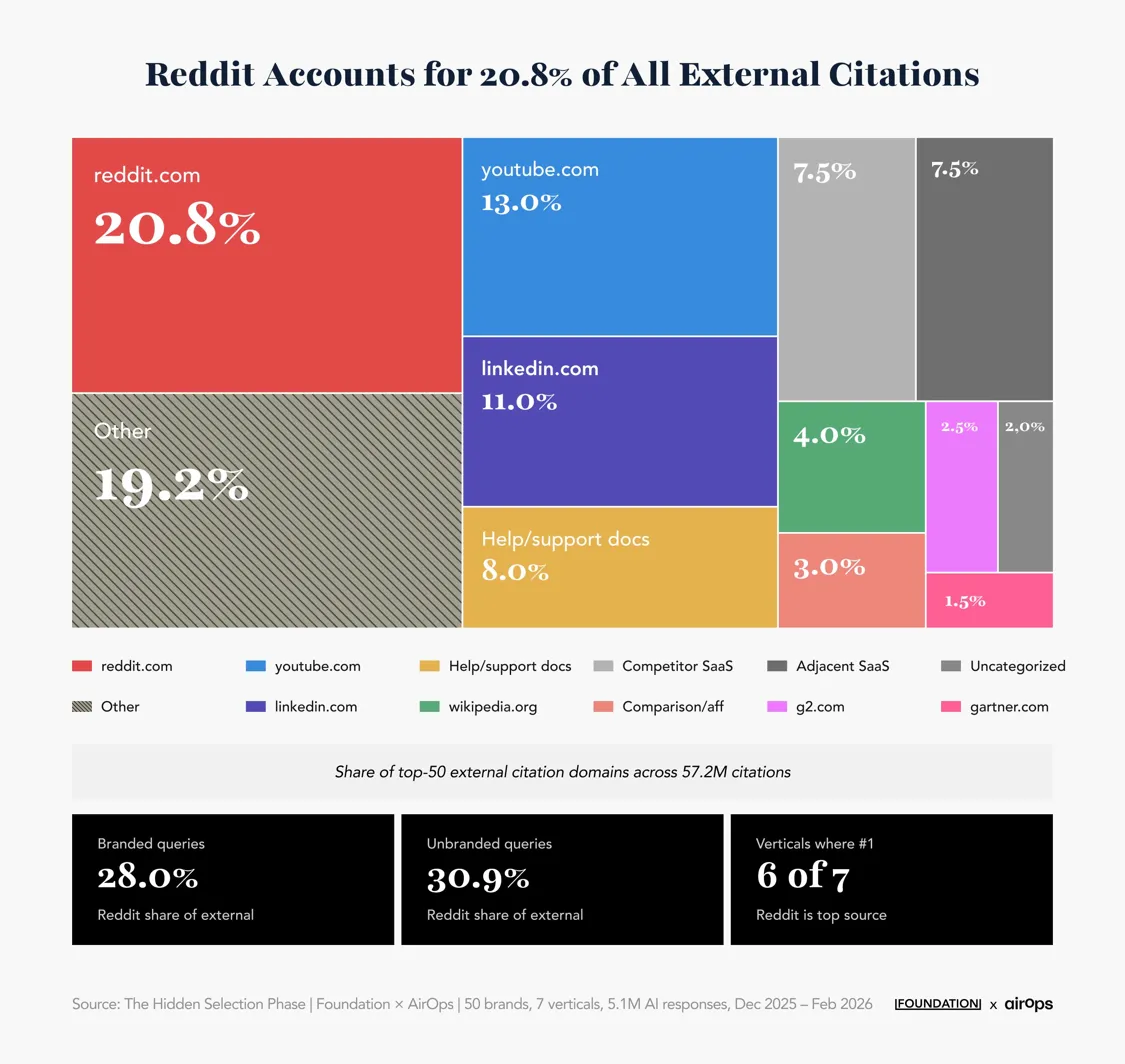
Reddit accounts for 20.8% of all external citations across the dataset. It’s the single largest source in six of the seven verticals we studied. In unbranded discovery queries, that share climbs to 30.9%. Nearly one in three sources AI draws from when answering “what’s the best [category] tool?” is a Reddit thread. Potentially years old, and from a user whose experience may no longer reflect your product.
YouTube sits at 13%, LinkedIn at 11%, help and support docs at 8%. G2, the platform many B2B brands invest in heavily to influence buyer behavior, accounts for just 4%.
3) Every vertical has a different citation fingerprint
The third-party links problem exists across every vertical. But the specific sources shaping the narrative vary by industry.
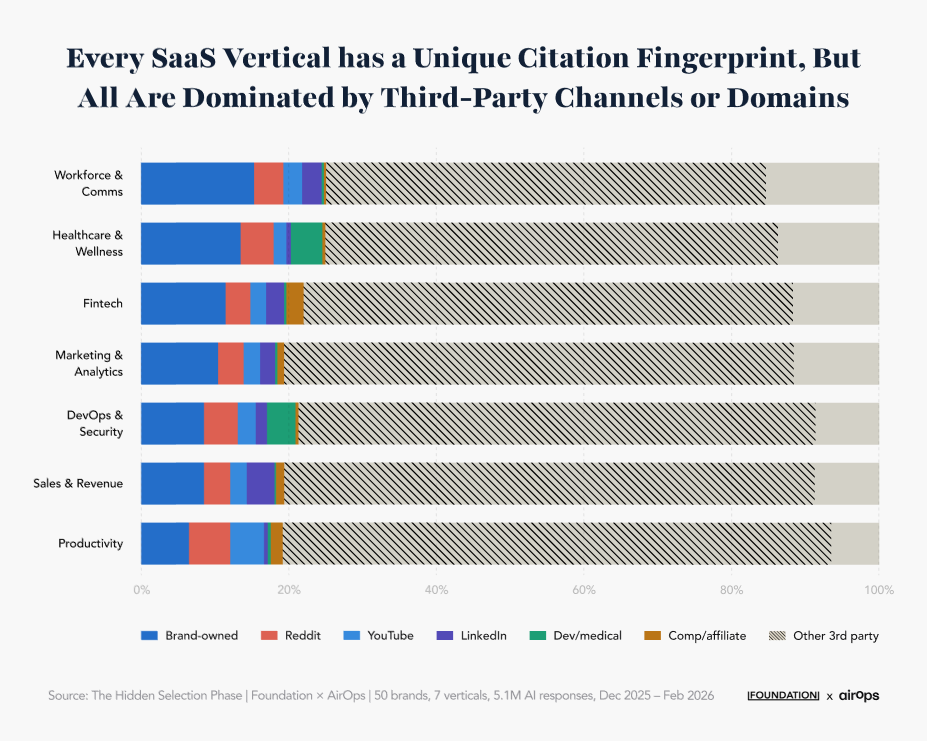
Fintech is heavily influenced by comparison and affiliate sites like NerdWallet and Bankrate, which appear in no other vertical.
DevOps citations are dominated by developer community platforms like GitHub, Medium, and dev.to.
Healthcare brands compete not just with direct competitors but with PubMed, Healthline, and Mayo Clinic for authority in AI responses.
Productivity tools are cited more through YouTube than any other single source in the study.
This tells us that there’s no universal “GEO playbook.” The path to closing the AI visibility gap looks different depending on where you sit.
What To Do About It
The results point to one conclusion: owning and optimizing your own domain will never be enough.
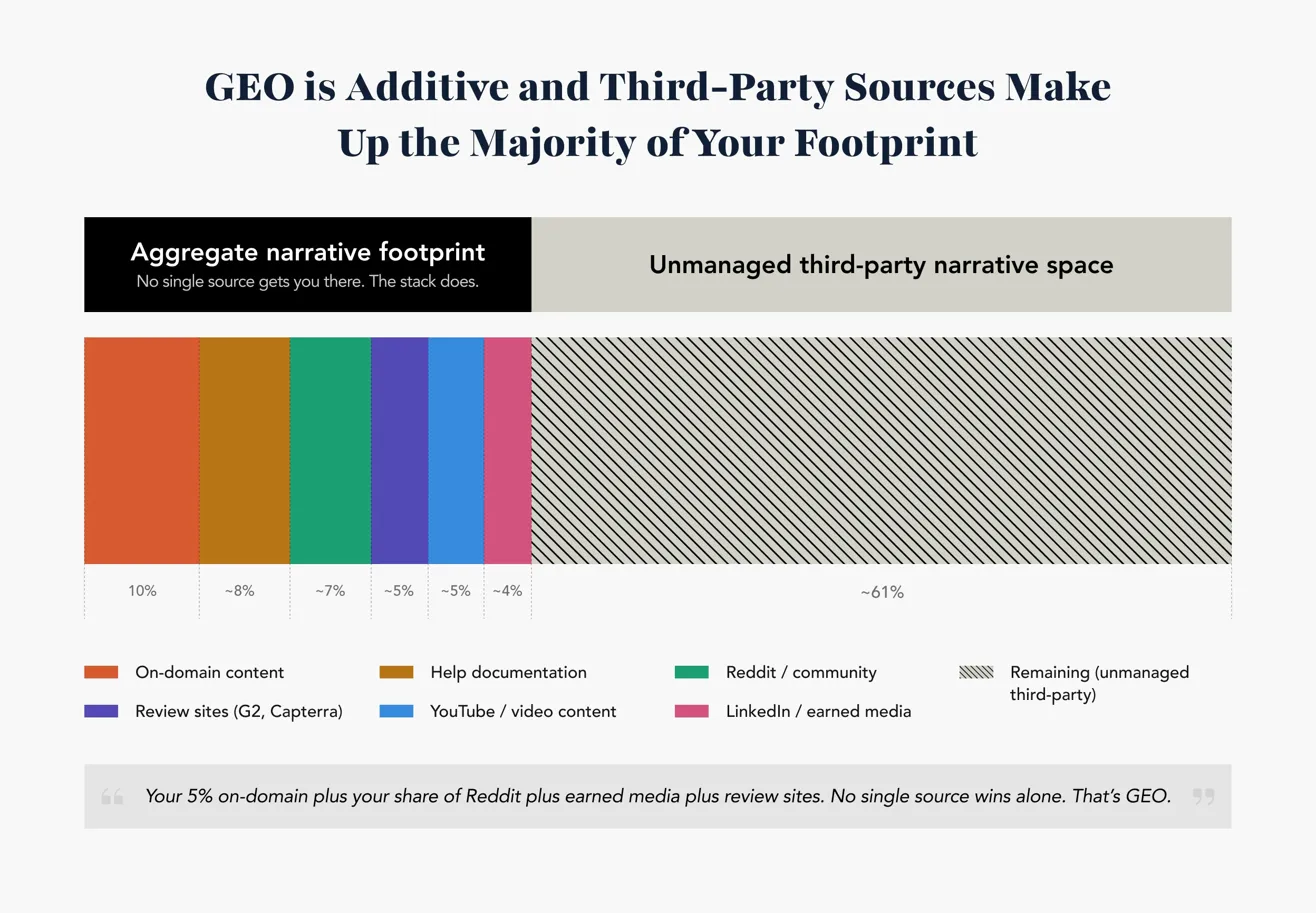
On-domain content accounts for roughly 10% of all citations in the dataset. Help documentation adds another ~8%. Reddit and community presence, review sites, YouTube, and LinkedIn/earned media each contribute between 4–7%. Together, the manageable sources add up to roughly 39% of the citation footprint. The remaining ~61% is unmanaged third-party space: content that brands have no direct influence over.
Closing the attribution gap requires building presence across every source type AI models actually draw from.
A piece of content that lives only on your blog covers one citation surface. That same insight distributed as a LinkedIn post, a YouTube breakdown, a Reddit reply, a support doc, and a trade pitch covers six. Same idea. Six times the footprint.
The brands that perform best across our three-gap framework — attribution, consistency, and narrative — haven’t found a single channel or tactic. They’ve built citation surface area across the full stack. GEO is an aggregate game and stacking visibility is how you win it.
Read the Full Hidden Selection Phase Report Now
The Hidden Selection Phase includes brand-level and platform-level breakdowns, the full citation fingerprint analysis across all seven verticals, and a framework for evaluating where your brand stands and what to prioritize.
Read The Hidden Selection Phase Report
A Foundation × AirOps Research Report. 50 brands | 7 verticals | 5.1M AI responses | 57.2M citations.
G2 Asked 1,076 Software Buyers How They Actually Research Now. Here’s What They Said.
G2 just published new research that every B2B marketer needs to read. They surveyed 1,076 software buyers and found that 51% now start their research with an AI chatbot more often than Google. More alarming: 69% ended up choosing a different vendor than they originally planned — and 33% bought from a brand they’d never heard of before the AI surfaced it.
Your buyers are forming shortlists before your sales team knows they exist. The full report breaks down exactly what that means for your GTM strategy.
Learn how B2B Buyers Make Decisions in the Answer Economy Era.
Ready to increase your presence across AI answers?
The report gives you the framework. If you want to apply it to your brand — auditing your current AI visibility, identifying gaps across attribution, consistency, and narrative, and building the distribution strategy to close them — that’s the work we do at Foundation.
Get in touch with Foundation Marketing, the generative engine optimization agency.
That’s it for this week.
Have a great weekend,
Ethan Crump ethan@foundationinc.co