Article's Content
Article's Content
Welcome back to What Matters This Week.
Last week, we covered Reddit’s bot crackdown and what it means for brands trying to earn organic and AI visibility. This week, we’re turning the lens inward — on your own content strategy, and where most B2B brands are bleeding link equity.
The 1% of Content Earning 4x Its Fair Share of Backlinks
Here’s the TL;DR
- We analyzed 12,154 content pages across 24 B2B brands and 2.4 million referring domains to find out which content formats actually earn backlinks at scale.
- One format represents just 1% of all content in the dataset and earns 4.25x its fair share of referring domains, the highest efficiency score of any format we measured.
- The format most brands pour their budget into has a 44% failure rate and a -9.5 percentage-point gap between pages published and links earned. It’s the single largest misallocation in the study.
- The full breakdown, all 15 formats, 10 findings, and a vertical-by-vertical misallocation map, is in the report.
What Happened
We published our B2B Backlink Intelligence Report this week — a study of 12,154 content pages across 24 brands, 11 verticals, and 2.4 million referring domains. The brands in the dataset range from HubSpot and Salesforce to Atlassian, Shopify, McKinsey, and Cloudflare.
The goal was straightforward: understand which content formats earn backlinks at scale, identify where brands over-invest, and surface the structural patterns that separate content that compounds from content that disappears.
The top-line finding is hard to ignore. Statistics and data roundup pages make up just 1% of all content in this dataset. They attract 4.1% of all referring domains, a 4.25x efficiency score, the highest of any format we measured.
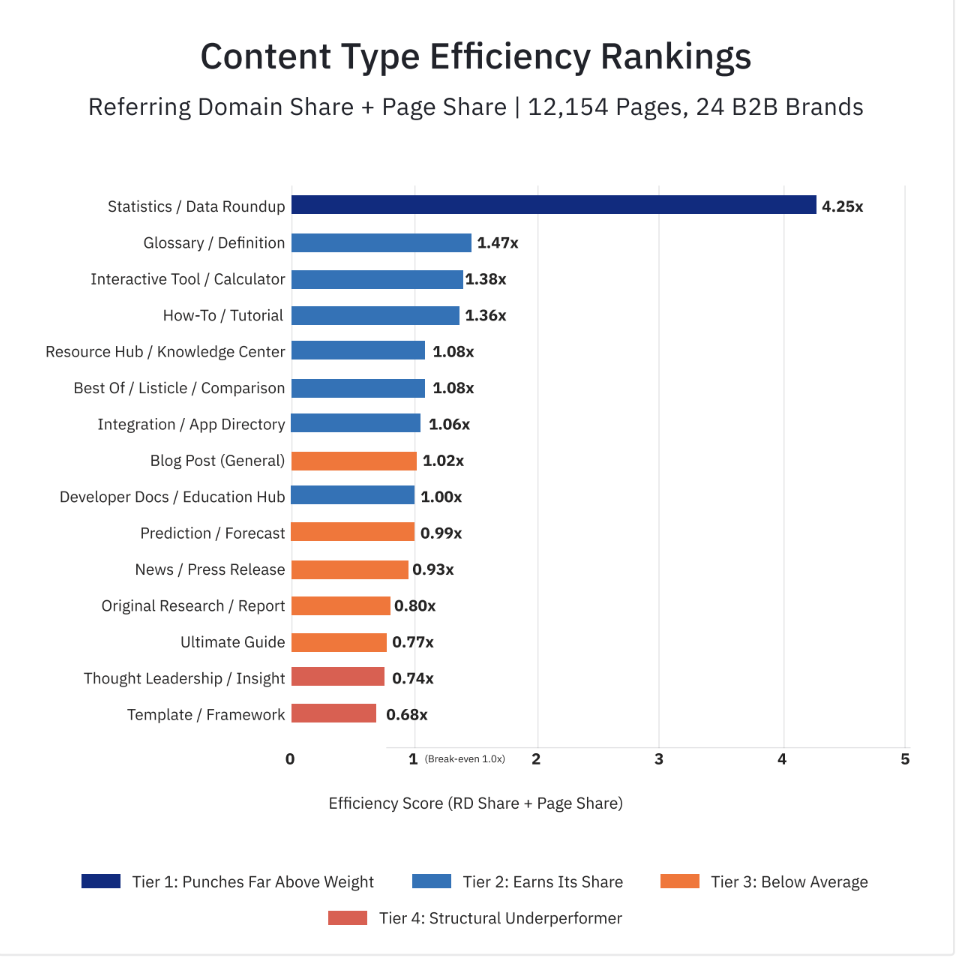
The chart above shows every format ranked by efficiency score. Statistics pages sit alone at the top. But the breakout numbers are what make it actionable: 42% of statistics pages earned 1,000 or more referring domains, with a fail rate of just 5.3%, the lowest of any format tracked at meaningful volume.
Deloitte’s State of AI in the Enterprise report earned 2,448 referring domains. SEMrush’s content marketing statistics page earned 2,095. Shopify’s TikTok statistics page earned 1,912.
None of these are long investigative features. They’re curated, regularly updated collections of data that the rest of the internet reaches for when it needs a citation source.
Why It Matters
Most B2B content programs are built around what brands want to say, not what the web wants to link to. The gap between those two questions is where most content budgets get lost.
Statistics pages work because they solve a persistent problem for other content creators: finding credible data to cite. When a writer needs a benchmark, a trend figure, or an industry stat, they link to the clearest, most current source they can find. A well-maintained, regularly updated statistics page earns that citation indefinitely and collects another one every time someone writes about that topic.
The flip side matters just as much. The format most brands rely on (named in the full report) carries a 44% fail rate. It accounts for 37% of all content published in the dataset, yet returns just 27.5% of referring domains. Nearly half of all pieces produced in this format earn fewer than 50 backlinks each.
This finding held across verticals, brand sizes, and authority levels. The brands spending the most on the wrong format aren’t suffering from bad luck. They’re following a content strategy the data consistently doesn’t support.
With AI search compressing citations and Google continuing to reward genuine authority over volume, the cost of misallocating content budget is higher than it’s ever been.
Formats that earn links build durable, cross-platform authority that survives algorithm changes. Formats that don’t are a sunk cost, and in 2026, an increasingly expensive one.
What to Do About It
- Pull your last 10 content pieces and check their referring domain counts in your tool of choice. Use the median, not your best performer. If the number is lower than you’d expect, the format mix is likely the first place to look.
- Audit what share of your content budget is going toward statistics, glossary, and how-to formats. The report provides benchmarks for comparison. If the answer is under 30% (the threshold the data surfaces), your mix almost certainly doesn’t reflect where backlinks actually come from.
- Before publishing your next piece of thought leadership or evergreen content, ask whether it’s the format the web has a reason to cite or one your team defaults to out of habit. The data has a consistent answer to that question.
The full B2B Backlink Intelligence Report covers all 15 content formats, brand-level benchmarks across four authority tiers, vertical-by-vertical format rankings, and the misallocation map that shows exactly where the budget leaks are.
→ Read the full B2B Backlink Intelligence Report
🎙️ Upcoming Events: SEO Week and Ross x Reddit
🗽 SEO Week — April 27–30, NYC
Ross is also speaking at SEO Week in New York this month — four days of advanced sessions, live experiments, and practical frameworks from the people actually shaping AI search strategy. No recycled decks. Last year’s edition set the standard. This one goes bigger.

Here’s the part worth sharing with your team: use code SEO-SIMMONDS for $100 off a four-day pass ($30 off single-day tickets). And for every ticket purchased with that code, iPullRank will donate $100 to Black Girls Code.
👉 Get your tickets at seoweek.org
🎙️ The State of AI Search — April 24th, 10am PST / 1pm EST
Ross is partnering with Reddit for Business to break down how LLMs decide which brands to surface — and what marketers can do about it right now. New research, new data, and new tactics on the role of UGC and community content in AI visibility. If this week’s newsletter hit a nerve, this session goes deeper.
👉 Register for the free webinar
Go Deeper On: Backlinks
→ Do Backlinks Still Matter in AI Search? Insights from 1,000 Domains — Semrush and Kevin Indig studied how backlink signals influence visibility across ChatGPT, Gemini, Google AI Overviews, and Perplexity. The short answer: quality still matters, but only after you cross certain authority thresholds. Incremental link wins won’t move the needle until a site reaches stronger overall authority, and nofollow links carry nearly the same weight as follow links once you’re there. [Semrush]
→ The Brand-to-Links Ratio Revolution — As search engines and AI platforms increasingly weigh brand mentions alongside backlinks, Russell Welch makes the case for a new metric: the brand-to-links ratio. The piece breaks down why entity trust is compounding in importance, how to measure brand presence across web, social, and AI surfaces, and what a healthy ratio actually looks like for different types of businesses. [Search Engine Land]
→ SEO Link Building: Best Practices for Quality Backlinks — A practical breakdown of the two link-building approaches Foundation uses to earn hundreds of backlinks for clients: link partnerships and link campaigns. Covers what makes a link qualified, how to structure outreach, the difference between 1:1 and three-way exchanges, and why relevance and quality matter more than volume. If the report made you want to act on your content mix, this is the tactical starting point. [Foundation Labs]
That’s it for this week.
Until next time,
Ethan Crump ethan@foundationinc.co