
Article's Content
Article's Content
There’s a version of your buyer’s journey that your sales team never sees. No form fill. No website visit. No demo request. Just a prompt typed into ChatGPT that returns a shortlist, and your brand either made it or it didn’t.
That’s the world G2’s latest research report maps. The Answer Economy: How AI Search is Rewiring B2B Software Buying is the most comprehensive look yet at how AI chatbots have restructured the way B2B buyers research, evaluate, and select software. The findings aren’t speculative.
They’re already happening, and the gap between vendors who understand this shift and those who don’t is widening fast.
Read G2’s Insight Report on The Answer Economy.
From Reference to Inference
The clearest way to understand what’s changed is this: buyers have moved from reference to inference.
For twenty years, search engines indexed the web and buyers did the synthesis. You’d type a query, get ten blue links, and spend your week reading through them, building your own spreadsheet, forming your own opinion. The search engine pointed. You decided.
Now, buyers ask an AI chatbot to do both jobs at once. The chatbot reads the web, weighs the sources, and hands back a shortlist, a synthesized answer with three or four vendor names and a paragraph of reasoning for each. The buyer hasn’t done the research. The model has.
And the buyer arrives at the demo already leaning toward a decision.
This is why 69% of the buyers G2 surveyed said an AI chatbot led them to select a different software vendor than they initially planned. The synthesis layer is doing the shortlisting now, and the synthesis layer is someone else’s software.
How G2 Built This Report
G2 polled 1,076 B2B decision-makers and purchase influencers across North America, EMEA, and APAC in March 2026. Respondents ranged from individual contributors to C-suite executives, and represented companies across SMB (1–250 employees) through large enterprise (5,000+).
They also ran 39 qualitative interviews with B2B software marketers through their AI Custom Research (AICR) solution to capture how teams are actually adapting.
The result is a dataset that reflects how buyers are actually behaving right now, and why answer engine optimization needs to be a priority. And the numbers are hard to ignore.
Three Stats That Should Change Your GTM Strategy
1. The buyer journey has split. 51% of B2B software buyers now start their research with an AI chatbot more often than Google.
It’s no longer “fringe behavior” from early adopters. It’s pulled even with Google search. Up from roughly 60% of buyers using AI chatbots at all seven months ago, now 71% of buyers rely on them somewhere in the process.
The first impression your brand makes is increasingly happening inside a chat window, not on your homepage.
If an AI chatbot doesn’t know who you are, doesn’t understand your positioning, or can’t find credible third-party signals about you, then you don’t exist in that buyer’s consideration set. The demo request you never got was lost in a prompt you’ll never see.
2. AI chatbots changed the final vendor selection for 69% of buyers.
Nearly 7 in 10 buyers chose a different vendor than they expected as a direct result of AI chatbot guidance. More striking, 33% purchased from a vendor they’d never heard of before the AI surfaced them.
That same mechanism that lifts an unknown challenger into a deal can just as easily push a known category leader off a shortlist. No brand is safe from this dynamic by reputation alone. And the brand equity you built over a decade can be flattened by a chatbot that didn’t think to mention you.
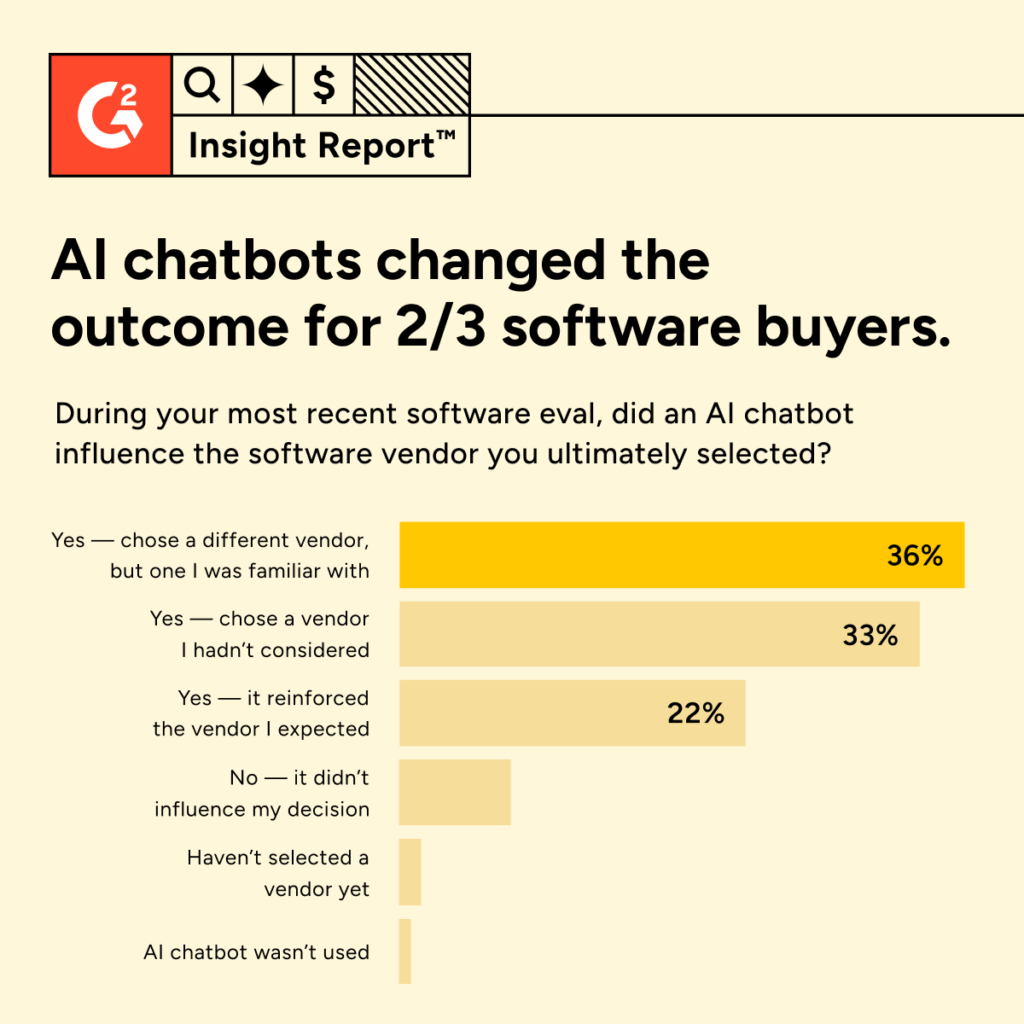
During their most recent software evaluation, 69% of buyers said an AI chatbot influenced which vendor they ultimately selected — including 33% who chose a vendor they’d never previously considered.
3. Review site citations are the #1 trust signal buyers want from AI answers.
Buyers trust AI chatbots, but they know it doesn’t get things right all the time. In fact, G2’s report shows that 64% of buyers encounter hallucinations from AI chatbots “often” or “very often” when researching software. So, what do buyers do when the chatbot returns something that doesn’t smell right? They verify.
G2 asked software buyers what would increase their confidence in an AI-generated recommendation, and the top answer was a citation from a review site. Among daily AI power users, 50% ranked review site citations as their single most important trust signal.
Reviews are now much more than marketing collateral. They are the infrastructure that AI chatbots use to build answers, and the safety net buyers reach for when they want to verify what they’ve been told.
And they’re the only source besides AI chatbots that actually gains influence as buyers move deeper into the funnel.

Review sites are the only information source besides AI chatbots that grows in influence from discovery through to retention, making them a full-funnel asset, not just a top-of-funnel play.
These data points are striking on their own, but that’s just the tip of the iceberg of what you’ll find in G2’s report on the Answer Economy.
The Uncomfortable Truth Most Vendors Are Missing
Winning the AI answer is not a content problem. It’s a trust problem.
The best time to start optimizing for AI visibility was ten years ago. The next best time is now.
The brands winning trust from ChatGPT, Perplexity, and Claude today are mostly winning because of content decisions they made years ago: SEO investments, community presence, review profiles, guest posts, Reddit threads, YouTube tutorials.
All of it was built long before anyone used the phrase “answer engine optimization.”
Most of the work that goes into LLM visibility isn’t new. It’s years of content distribution that most companies have always been too busy to do consistently, but the best companies have embraced since day one. That built the rolodex of authoritative sources that today’s chatbots rely on.
The G2 data confirms this from the buyer side. Review sites are the single most trusted citation.
But zoom out.
When an LLM answers a software question, it’s not pulling from your homepage. It’s pulling from wherever your brand has earned a footprint. G2 reviews. Reddit threads. YouTube videos. Guest posts. Third-party mentions. Independent comparison articles. The LLM weighs all of it and returns the synthesis.
The vendors scrambling right now are the ones who treated trust signals as optional busywork for the last five+ years. The vendors getting cited at scale are the ones who treated it as the job.
How to Build the Stack that Gets You Cited
G2’s report closes with three strong recommendations:
- Collect reviews constantly
- Own your owned properties
- Build an AEO strategy
Every one of those is spot-on. But we’d push further on each.
Collecting reviews isn’t a campaign but an always-on system. In-product prompts, post-onboarding triggers, after every renewal, after every support resolution. The vendors who dominate G2 rankings aren’t lucky. They’ve built customer voice into their GTM, product and customer success workflows.
Owning your profiles means a presence on every surface an LLM might crawl: G2, Capterra, Clutch, Trustpilot, LinkedIn etc. Inconsistency across these surfaces is a trust problem for both AI and humans. When your positioning reads differently across five platforms, or the LLM can’t find a critical mass of trust signals about your brand, it’s much more likely to omit you from its answer.
Building an AEO strategy means treating the full distribution stack as the unit of work. Reviews get you in the room, and the rest of the stack wins trust, and that’s what closes the deal.
Add presence in the subreddits your buyers actually read.
Add long-form YouTube that explains the problems your product solves, not demos that nobody watches.
Add third-party mentions on the “best of” lists already ranking for your category queries. Add the SEO foundation that still feeds every LLM on the planet.
This is the work. It compounds. And it’s the single biggest delta between the vendors who’ll win the next five years and the ones who’ll spend those five years wondering why their pipeline dried up.
The buyer is already in the chat window. The question is whether your brand is in the answer.
What You’ll Learn in the Full G2 Report
There’s a version of your category forming inside AI chatbots right now. This report shows you what it looks like.
Inside, you’ll find out:
- How buyers are using Deep Research and Thinking mode tools to run structured vendor evaluations.
- Which AI chatbots dominate at different stages of the funnel, and why ChatGPT’s 73% share at discovery drops sharply as buyers move toward a final decision.
- What 39 B2B software marketers told G2 about their own readiness, including the attribution problem that’s keeping even the most forward-thinking teams stuck in reactive mode.
Ready to find out where you stand? Read the full G2 Answer Economy report.
Want help turning G2’s insights into an Answer Engine Optimization strategy? Foundation builds content ecosystems designed to win AI answers.