
Article's Content
Article's Content
The digital marketing playbook that worked for the past decade is breaking down.
For years, growth followed a predictable formula: rank on Google, drive traffic to your website, convert visitors into leads. That model assumed discovery began — and largely ended — with a search engine results page, with websites acting as the center of the buyer’s journey.
That assumption no longer holds.
Today, discovery is shaped by AI and community platforms, long before a prospect ever lands on a brand-owned property. Buyers ask ChatGPT what to purchase, scan Reddit threads to validate options, watch YouTube comparisons, and form opinions based on what others say, often without clicking a single link.
As Similarweb’s VP of Digital Marketing Solutions recently put it, “Generative AI is transforming the internet from a network of links into a network of logic.” The implications for marketers are massive.
The first touchpoint isn’t your website anymore. It’s an AI response and a handful of Reddit threads. Your brand either shows up there, or it doesn’t show up at all.
At Foundation, we’re already seeing this shift play out with clients across industries. The brands that adapt fastest aren’t just adjusting tactics. They’re rethinking how visibility, trust, and influence are built before the first click.
Below, we’ll walk through the shifts rewriting modern discovery and decision-making, and how to adapt so your brand stays visible before a buyer ever visits your site.
Shift 1: Discovery Has Escaped Google
Discovery has become multi-platform and multi-format, and the path to a decision is no longer predictable.
A buyer might rendezvous with a category through a TikTok video, explore options through YouTube comparisons, follow creator threads on LinkedIn, or scan community posts to get a sense of what’s “real.” Search is still part of the mix, but it’s no longer the default starting point — it’s one stop in a wider loop.
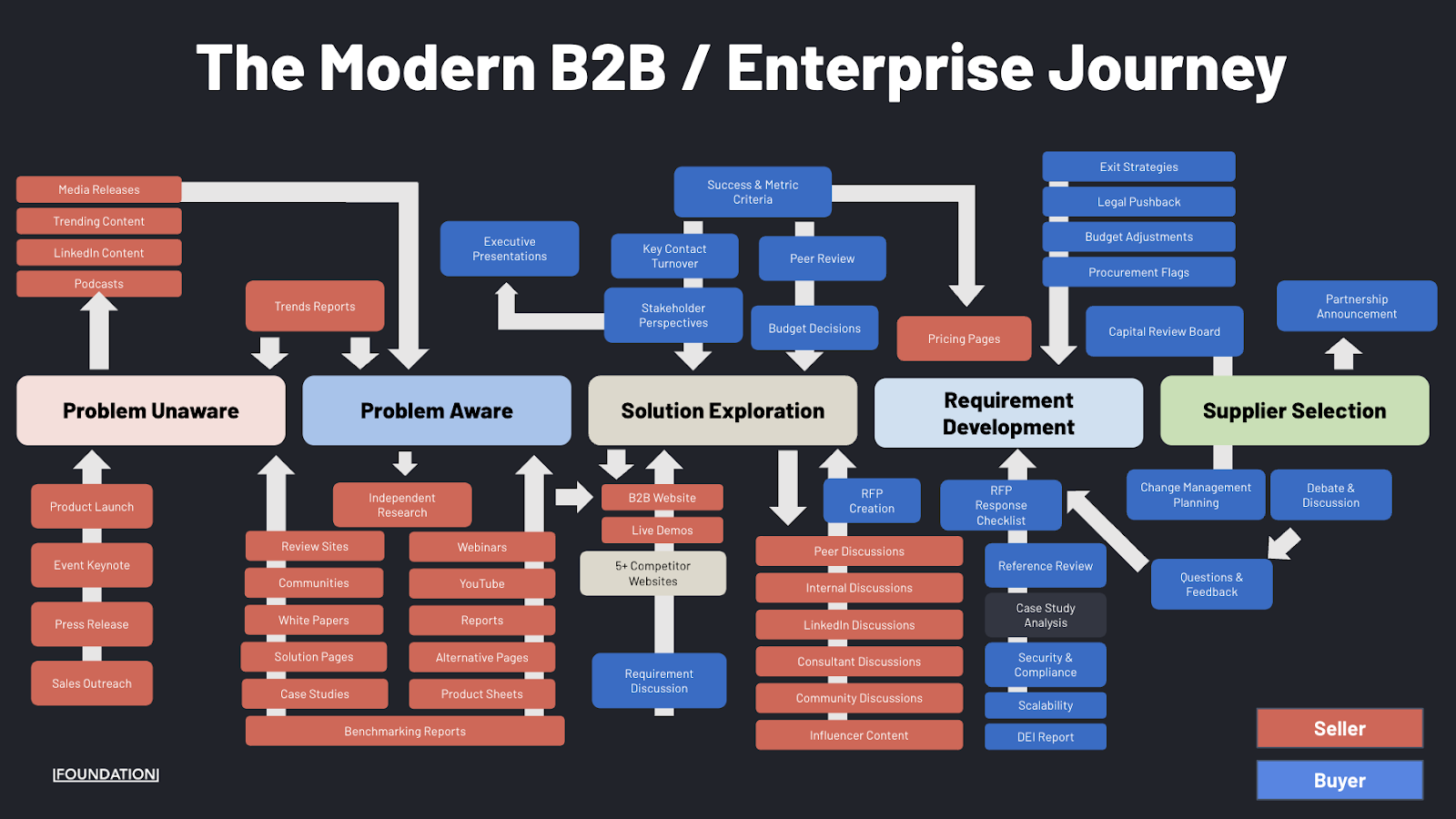
This matters because modern discovery isn’t just diversified. It’s unstable.
According to AirOps research, only 30% of brands remain visible from one AI answer to the next, and just 20% stay present across five consecutive runs. In other words: visibility now fluctuates as discovery engines regenerate answers and signals shift.
As Ross Simmonds notes: “SEO no longer means just Google. People search Reddit to know what to buy, TikTok for where to eat, Instagram for what to wear.”
Fragmentation is the new baseline. And that creates the next problem: when discovery happens everywhere, buyers need a faster way to make sense of it all.
Shift 2: AI Became the Research Interface
AI tools are increasingly where buyers go to turn messy discovery into a clear set of options.
Instead of clicking through ten links, people now ask a model for a recommendation, a shortlist, a comparison, or a “best tool for…” overview. LLMs are simply synthesizing information for review. They’re influencing — structuring a buyer’s perception.
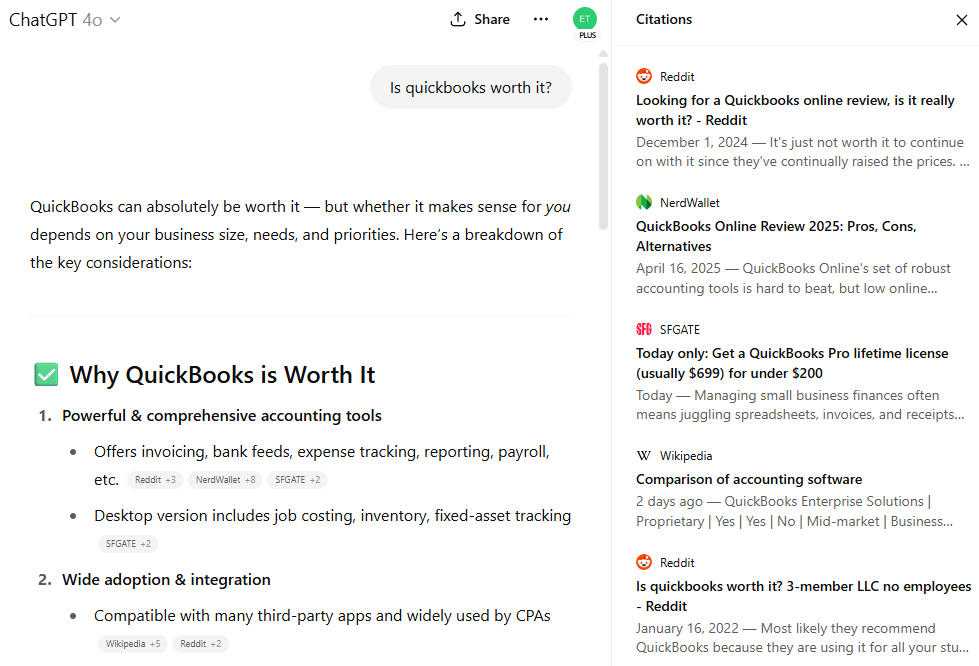
This shift is happening fast. Stanford’s HAI AI Index Report shows 78% of organizations now use AI, up from 55% in 2023, the largest single-year jump on record. Generative AI usage has more than doubled year-over-year.
But the more important shift is behavioral: AI is now the place where buyers form first opinions at scale.
As Ross shares on The Ross Simmonds Show: “Buyers are arriving at sales conversations already informed via AI comparisons and analysis. Trust has already been formed — or lost — before your team speaks to the buyer.”
This creates a hard new reality for marketing: you can’t treat your website as the primary place persuasion begins. The first pass of evaluation often happens elsewhere, shaped by the sources and patterns the model uses to answer.
Which leads to the next question: if AI is assembling the shortlist, what determines whether your brand makes the cut?
Shift 3: Optimization Shifted from Rankings to Citability (SEO → GEO)
This is where SEO evolves into something larger.
Traditional SEO still matters, but rankings alone don’t guarantee LLM visibility. Research from AirOps suggests roughly 60% of AI Overview citations come from URLs that don’t rank in the top 20 organic results. Authoritas has also found that only a small fraction of top-ranking pages reliably appear inside AI-generated answers.
That shift is driving the rise of Generative Engine Optimization (GEO): optimizing for visibility across AI-powered discovery interfaces, not just Google rankings.
As Ross explains: “GEO includes SEO, but it’s broader. It encompasses TikTok search, Instagram Reels, Reddit, and any platform with discovery. GEO is about visibility in AI-powered interfaces, not just search rankings.”
GEO requires a different mental model: the goal isn’t simply earning the click. It’s earning the mention and being cited as a credible source.
What GEO Requires (Three Signals That Matter)
Across the research, the same three signals consistently predict whether your brand gets pulled into AI-generated answers: freshness, structure, and citations.
1) Freshness signals credibility. AI systems treat freshness as credibility. Pages not updated quarterly are more than 3× as likely to lose AI citations. Over 70% of AI-cited pages have been updated within the past 12 months. And for commercial queries, that bar climbs to 83%.
2) Structure enables extraction.
AI models cite what they can interpret quickly. Sequential heading structures correlate with 2.8× higher citation likelihood. Many cited pages use multiple schema types, with FAQ schema showing up frequently in AI responses.
3) Third party validation drives citations
AI systems rely heavily on external sources to validate claims and recommendations. AirOps research shows that 85% of brand mentions in AI answers originate from third-party domains, with most coming from listicles, comparisons, and review roundups.
And that leads us to the next shift, where we’ll answer one of the most important questions around LLM citations: what sources do these models treat as “trusted” in the first place?
Shift 4: Communities Became the Trust Infrastructure
AI doesn’t just pull from “the internet.” It pulls from the places where trust is legible.
Community platforms (think: Reddit, YouTube, LinkedIn, Wikipedia) are the sources models use to validate credibility. AirOps reports that about 48% of AI search citations come from community and user-generated sources. Perplexity references community platforms in more than 90% of its answers.
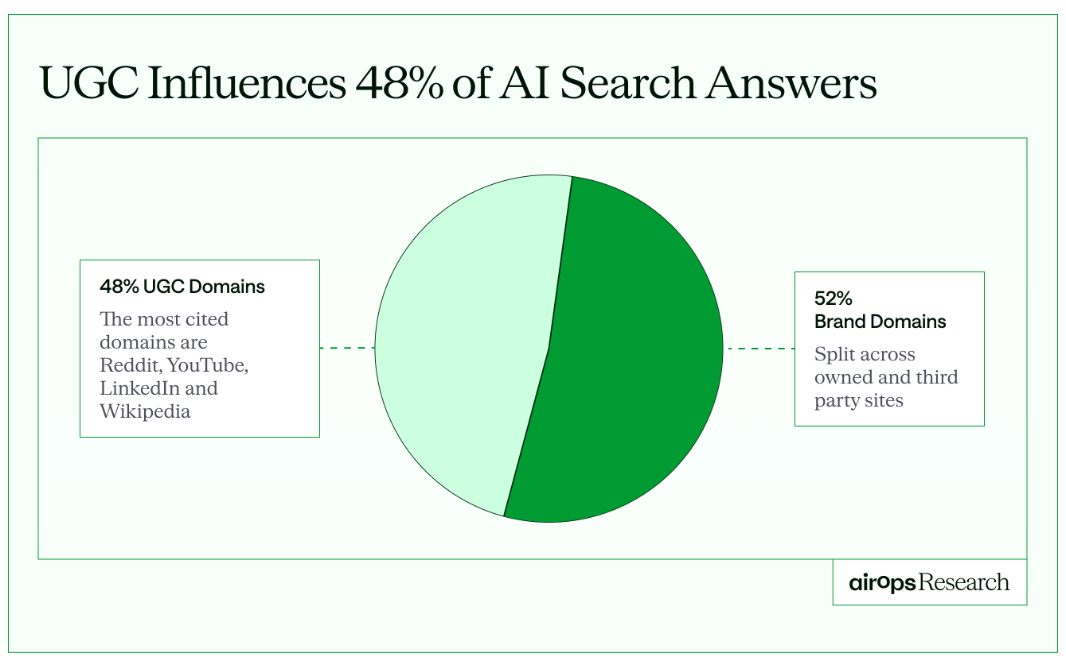
Reddit is the standout example because it captures something brands can’t manufacture: lived experience. And because of these real experiences and insights, Reddit threads are being cited in AI-generated answers.
Similarweb’s research shows that for certain products (like running gear), Reddit can account for the majority of citations in AI answers (54% for “running gear”), outpacing traditional publishers and review sites. The pattern holds across categories.
The implication is clear: brands that ignore Reddit and community platforms are ceding control of their reputation to anonymous threads. And those threads are training the AI models that will recommend products to the next wave of buyers.
At Foundation, we use a simple engagement model:
- Lurk to find the conversations that shape decisions
- Listen to understand language, objections, and sentiment
- Leap when you can contribute authentically and substantively
Community presence isn’t a “nice to have” anymore. It’s the trust layer that now sits between buyers and brands.
But presence alone doesn’t scale. To earn repeated visibility, and repeated citations, you need something more systematic.
Shift 5: Content Must Be Treated as a Product, Not a Campaign
Most organizations still treat content like a campaign: publish, promote, move on.
That approach made sense when traffic was the primary goal. It fails when visibility depends on freshness, structure, and repeated references over time.
The organizations pulling ahead treat content more like a product: maintained, refreshed, improved, and distributed continuously. Ross calls this building a content supply chain — a system where research, creation, distribution, and optimization work as interconnected stages.
A useful example is Hootsuite’s “best time to post on social media” resource. Built on data, refreshed regularly, and distributed across channels, it generated massive lifetime traffic (21 million lifetime visits). Not because it launched once, but because it was maintained over time. That’s what content-as-product looks like.
Content that isn’t maintained loses more than rankings. It loses citability.
The minimum bar is now simple: if your content isn’t being updated, structured, and reinforced, it becomes invisible to the systems shaping the next wave of buying decisions.
But even maintained content isn’t enough in a world flooded with AI-generated sameness. Differentiation comes from something machines can’t mass-produce.
Shift 6: The Human Layer is the Defining Differentiator
AI has made information easy to generate. That makes insight harder and more valuable.
The internet is being flooded with safe, generic summaries. The content that cuts through has a point of view, backed by craft, lived experience, and emotional intelligence..
Foundation Marketing Manager Pat Blakely captures the shift plainly:
“AI has made information easy to find, but insight still belongs to we carbon-based beings. Don’t just report the data. Find the patterns. Say what they mean. Name them. Then package it into a sexy narrative. Buyers aren’t looking for more information to file away. They want a perspective with a backbone they can actually invest in.”
Dozie Anyaegbunam, Foundation’s Creative Director, adds a powerful lens: “B2B content marketers need to think more like documentary filmmakers, not content marketers. This means understanding what your audience’s category entry points are and building narrative layers that position your brand as the source of truth in those conversations.”
AI can assist production, but it can’t replicate empathy, intuition, or trust built through real human understanding. The marketers who invest in storytelling, relationships, and genuine expertise will stand out.
That human layer is what makes content worth citing, and worth believing.
This brings us to the final shift: measurement. When visibility and trust are built inside AI answers and community conversations, how do you know it’s working? How do you measure success?
Shift 7: Measure the Mention (Not the Click)
Traditional ROI models struggle here because the influence you’re creating often happens in places you can’t track.
When a buyer’s opinions are shaped through AI summaries and community validation, the familiar “track the click → attribute the conversion” model breaks down. GEO behaves less like performance marketing and more like reputation and distribution: you feel it in pipeline quality and conversion rates, even if you can’t tie it to a single touchpoint.
That doesn’t mean measurement is impossible. It means the scoreboard needs to change.
The GEO metrics that matter include:
- Visibility share: your percentage of appearances for priority queries across AI platforms
- Mention rate: how often your brand shows up in high-intent discussions
- Position quality: whether you’re a top recommendation or an afterthought
- Sentiment: how AI describes your brand when it does mention you
- Dual-signal presence: being both mentioned and cited — a pattern AirOps associates with significantly higher resurfacing likelihood
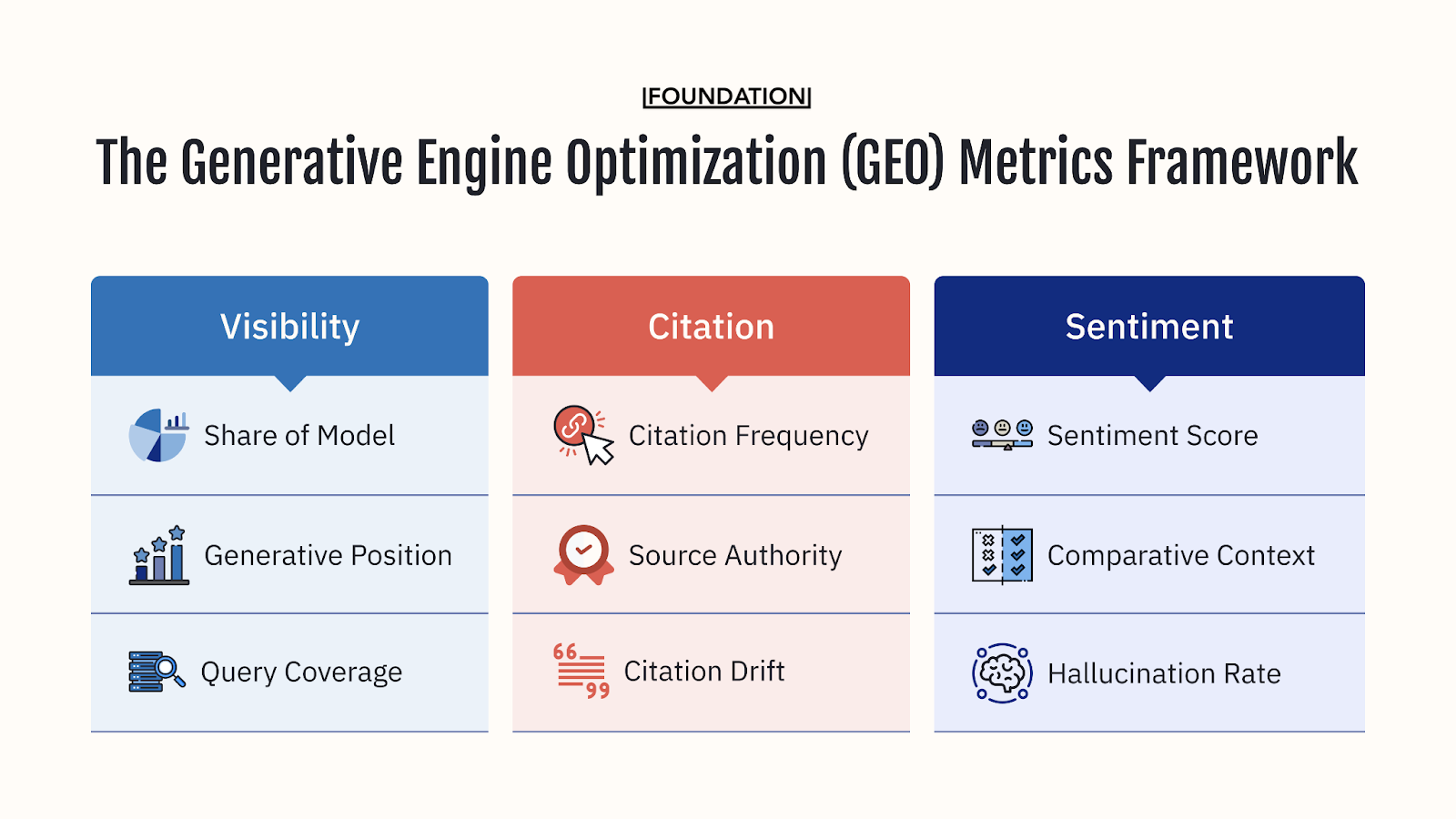
The mindset shift is straightforward: the ROI of GEO is like the ROI of reputation. You can’t calculate it perfectly but you’ll absolutely notice when competitors dominate the conversation without you.
The metrics give you the map. But the real question is whether you’re ready to move.
If You’re Not in the AI Answer, You’re Not on the Shortlist
The shifts outlined here aren’t theoretical. They’re already reshaping how buyers discover, evaluate, and decide.
Discovery has fractured across platforms. AI has become the research interface. Communities have become the trust infrastructure. Optimization has shifted from rankings to citability. Content needs to be maintained like an asset. Differentiation comes from human judgment. Measurement now tracks presence more than clicks.
As Similarweb observed, “Generative AI isn’t just another platform. It’s the pathway through which people discover and decide online.” Brands don’t get to opt out of that pathway. They’re either present within it or absent from it.
The rules are being rewritten. The question is whether your brand shows up in the AI answers buyers rely on, or watches trust and attention consolidate around competitors instead.
Ready to future-proof your digital marketing strategy? Talk to Foundation, the leading AI marketing agency, about building visibility in the GEO era.