Article's Content
Article's Content
Google quietly shipped something this week that should change how every SEO, content marketer, and founder thinks about search.
They expanded Preferred Sources globally. It was announced in Google’s publication The Keyword.
Here’s what that basically means: users can now tell Google which publications they want to see more often in Top Stories. They click a star icon, search for the outlets they trust, and Google surfaces those sources more frequently for relevant news queries.
The user picks. The algorithm adjusts. The publication rises.
That sounds like a small product update.
But in REALITY:
It’s enormous.
People will now have even more personalized search experiences. It will not only be personalized by the things that the LLM knows about them. It will also be personalized based on the websites that they believe are “preferred” sources.
I’m not going to get into the cultural and social challenges that can arise from this. But I do want to talk about the business impact.
This is the latest signal that the “10 blue links + keywords + backlinks” model of SEO is over. And honestly?
That model has been dying for years.
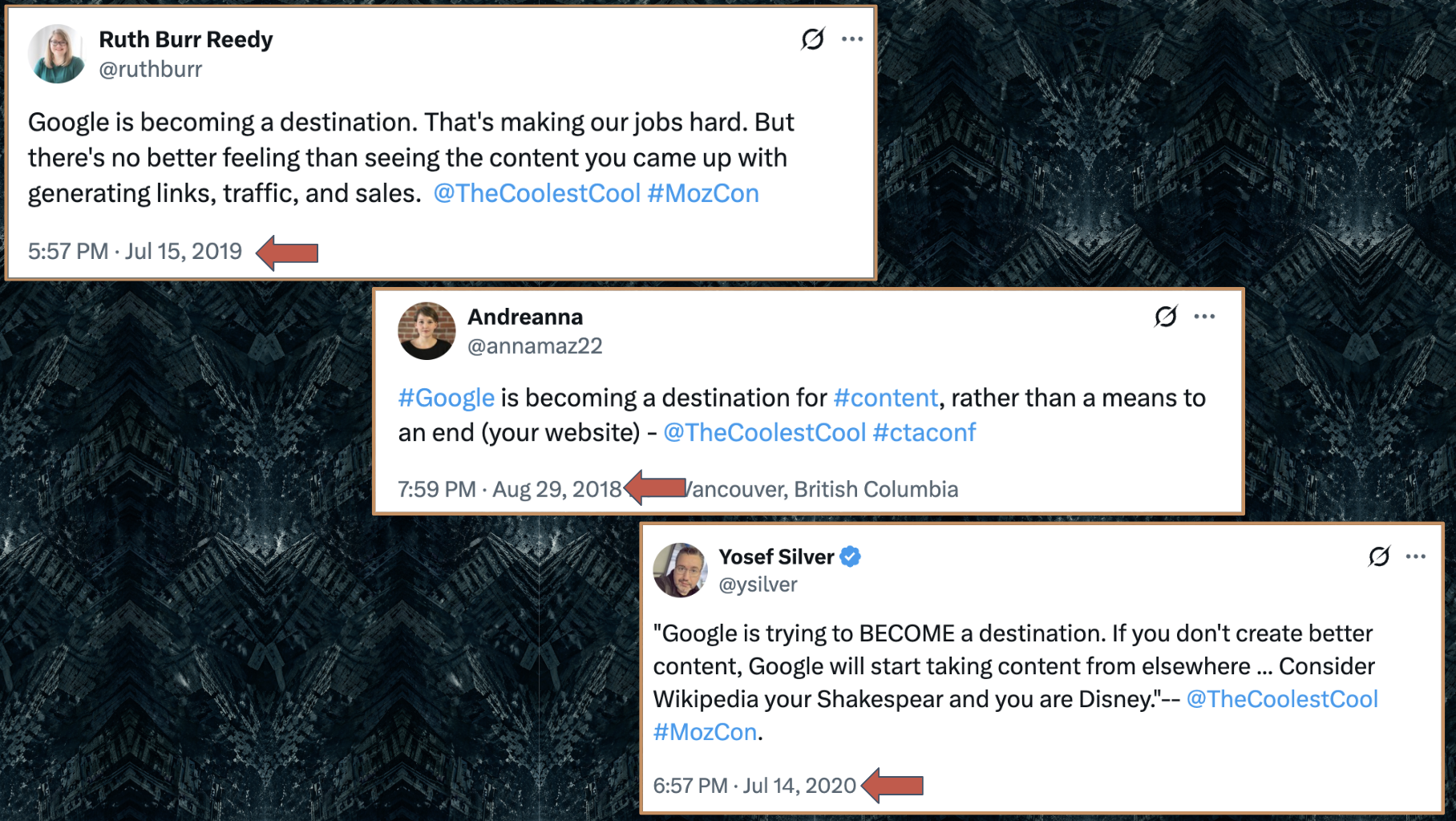
Google’s been writing the obituary in real time. Most marketers haven’t been listening but many years ago I was telling marketers:
Google is becoming a destination. See here:
Alright. Now back to Preferred Sources.
What Preferred Sources Actually Does
Quick recap on the feature so we’re on the same page:
When Google detects a news-oriented query, “Top Stories” appears as a primary search result. Until now, those stories were selected algorithmically based on relevance, prominence, and authority of the publisher.
Now there’s a new layer: the user’s stated preference.
If I tell Google I trust Stratechery, The Information, and Foundation Inc., those sources show up more often in my Top Stories and in a new “From your sources” carousel. Publishers can even add a button to their site that deeplinks readers straight to the preference selector — basically saying “here’s how to see more of my work in your search results.”
Personalization has moved from the query level to the source level.
That’s the shift. And it changes everything downstream.
The Bigger Pattern Most Marketers Are Missing
Forget this single feature for a second. Look at the pattern.
Over the last 36 months, Google has been quietly fragmenting the search results page into a dozen different surfaces, each with its own ranking logic:
- AI Overviews — synthesized answers that cite sources based on factors most SEOs still don’t fully understand.
- AI Mode — a full conversational search experience where ranking is replaced by retrieval and citation.
- Top Stories — now influenced by user-selected Preferred Sources.
- Discover — a feed driven by behavioral signals, not queries.
- Video carousels — pulling YouTube content directly into core results.
- Reddit threads — embedded into SERPs since the partnership deal.
- People Also Ask — extracting answers from individual paragraphs across the web.
- Shopping results — driven by feeds, reviews, and merchant trust scores.
- Maps and the Local Pack — a completely separate ranking system.
- Knowledge Panels — pulling from structured data and entity recognition.
That’s ten different surfaces inside one search result page. Each one has its own ranking logic. Each one rewards different signals.
None of them care about the classic ten ranked blue links so many marketers have been optimizing toward.
The ranked list metaphor is dead. Search behaves more like a buffet now. The algorithm decides which dishes you see based on who you are, what you’ve signaled, what you trust, and what you’ve engaged with before.
Preferred Sources just hands users the spoon and says “load up your own plate.”
The Mental Model Shift
Old SEO thinking went something like this:
“I want to rank for [keyword]. Let me write a post optimized for [keyword]. Let me build links to that post. Let me hit position 1. Let me get the click.”
That model worked when SERPs were a ranked list of ten options. They aren’t anymore.
The new model is closer to this:
“I want my brand to be mentioned, pickable, citable, and included across every surface where my buyer asks a question related to it… Whether it’s in Claude, Google AI Mode, ChatGPT, Perplexity, Reddit, YouTube,etc…”
Search isn’t linear anymore. It’s a constellation. And content elements get pulled into the right surface, for the right user, at the right moment, based on dozens of factors that have nothing to do with how well you stuffed a keyword into an H2.
I’ve been saying this since 2018, when we leaned into Reddit before the rest of the agency world noticed:
Distribution beats creation.
Always has.
The Preferred Sources update is one more proof point in a multi-year unwinding of the keyword-first internet. Search has been fragmenting for years. Personalization layered on top of fragmentation just speeds the process up.
Here’s the good news:
This is the most exciting moment in marketing in a decade.
The brands that show up across every surface.
The ones building genuine pull instead of relying on push.
Are about to win in a way that compounds for years.
Why?
Because they’re creating and distributing content that will train the LLMs in the future.
The 10 blue links are dead. Let’s get back to the basics.