Article's Content
Article's Content
According to G2’s 2025 Buyer Report, 94% of buying groups now use LLMs at some point in their purchasing journey. In organizations with more than 1,000 employees, 30% of buyers start with AI before turning to search engines.
Think about that: AI is shaping roughly one in three software evaluation journeys within large B2B companies. Whether a brand appears in category-level queries like “What’s the best project management tool?” is increasingly influenced by large language models.
As a result, the first impression a buyer forms of your brand is shaped by AI-generated responses, not your website, your ads, or your sales team.
According to data from our joint report with leading AI workflow platform AirOps, B2B brands tend to have strong visibility in AI answers when buyers search for them directly.
However, this visibility drops significantly for the types of queries buyers use at the start of their decision process.
The Hidden Selection Phase: An AirOps X Foundation Marketing Report
We partnered with AirOps to analyze how B2B brands appear in AI-generated responses. Over a 60-day period, we evaluated 50 brands across seven verticals, covering 5.1 million responses and 57.2 million individual citations across five major AI platforms.
The results reveal a critical blind spot in early-stage buyer discovery:
Across all 50 brands, only 10.15% of citations in AI responses pointed to brand-owned domains.
The remaining 90% came from third-party sources, including review sites, Reddit threads, LinkedIn posts, YouTube videos, and competitor pages. In most cases, the brand’s own content was absent from the sources cited — even when the brand itself was mentioned.
In other words, brands are frequently represented in AI responses, but they are not the primary source of that representation. As the data shows, this 10% figure masks a much sharper drop in visibility during the moments that influence whether a brand makes a buyer’s shortlist.
When Buyers Search Without a Name, Only 2% of Citations Are Brand-Owned
We refer to this as the Attribution Gap: the disconnect between how much brands invest in their own content and how often that content appears in AI-generated responses.
The overall 10.15% citation rate reflects performance across all query types. When the data is segmented by query intent, brand visibility declines significantly, particularly in unbranded queries that define early-stage discovery.
When a buyer searches for a brand by name, 77.6% of responses include at least one citation from that brand’s own domain. However, in 22.4% of cases, even branded queries produce responses sourced entirely from third parties.
In practice, this means a buyer researching a product by name may encounter information drawn from external sources—such as reviews, forums, or competitor comparisons—rather than the brand’s own content.
The gap becomes more pronounced in unbranded queries.
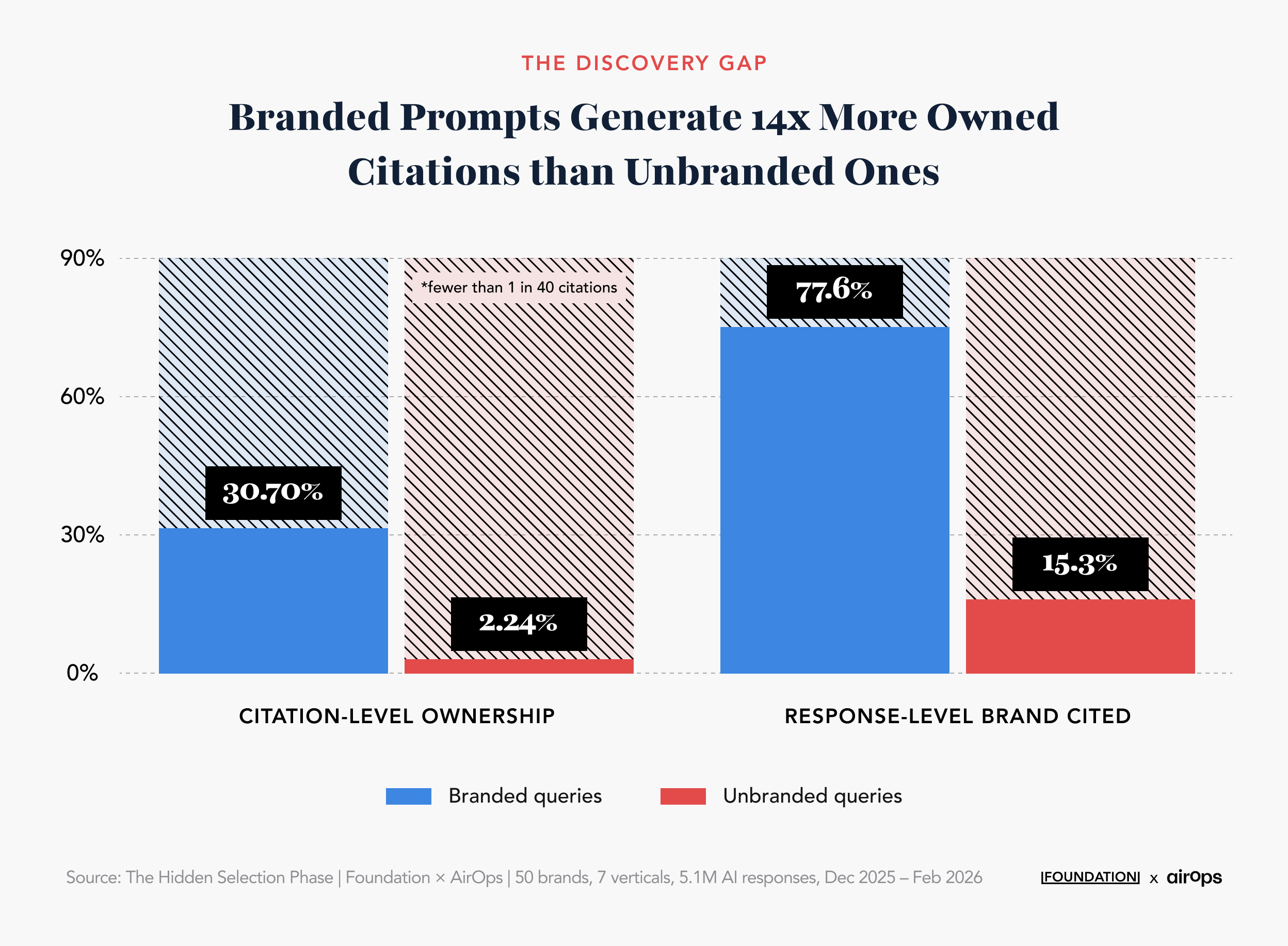
When AirOps analyzed AI responses to unbranded queries such as What’s the best marketing automation tool for mid-market? or Which DevOps platforms support Kubernetes natively?, only 2.2% of cited links came from brand-owned domains.
In 85% of those responses, no brand-owned source was cited at all.
These queries represent early-stage discovery, when buyers are forming their initial consideration set. At that point, the vast majority of citations shaping the response come from sources the brand does not control. The discovery phase is a major gap for B2B SaaS from a generative engine optimization perspective.
The AI Visibility Drop Varies By Vertical
The attribution gap appears across every vertical analyzed, but its magnitude varies significantly.
The following figures reflect aggregate performance across all query types, both branded and unbranded, within each vertical:
| Vertical | Brand-Owned Citations |
| Workforce & Communications | 15.18% |
| Healthcare & Wellness | 13.56% |
| Fintech | 11.43% |
| Marketing & Analytics | 10.40% |
| DevOps & Security | 8.46% |
| Sales & Revenue | 8.43% |
| Productivity | 6.30% |
Workforce & Communications leads with 15.18% of citations coming from brand-owned domains, meaning the majority still originates from third-party sources. Productivity ranksProductivity ranks lowest at 6.30%, highlighting a substantial variation across verticals.
The difference between the highest- and lowest-performing verticals is 2.4x.
This significant drop in citations suggests that brands are often absent during the early-stage decision process, when buyers evaluate and compare options. We refer to this as the Selection Phase in the report.
During the selection have no visibility into how they appear, what’s being said, or where the AI is sourcing its information. The infrastructure that gave them influence over the traditional buyer’s journey doesn’t map cleanly onto this new one.
That gap is what led us to build the Hidden Selection Phase study with AirOps: to measure the difference between how brands position themselves and how AI presents them to buyers.
The Hidden Selection Phase Report Drops This Week. Stay Tuned.
The full Hidden Selection Phase report introduces a framework for evaluating AI visibility across three dimensions, maps the attribution gap across all seven verticals, and highlights what distinguishes the brands that are cited from those ones that are not. It also includes detailed brand-level and platform-level data.
If most of your AI narrative is being shaped by external sources, the first step is understanding where that representation comes from.
Read the full Hidden Selection Phase Report now.
Looking to improve your visibility in the LLMs? Get in touch with Foundation Marketing: the leading GEO agency for B2B brands.