Article's Content
Article's Content
Your buyers are running their evaluation through ChatGPT, Perplexity, Claude, and Gemini before they reach your site.
More than half of B2B software buyers now start their research in an AI chat more often than they start in Google, and 71% lean on AI somewhere in the process. That’s an increase from around 60% just seven months earlier, according to G2’s 2026 survey of more than 1,000 buyers. The AI models build their answers from sources outside of your owned channels, and the brands that get cited across those sources are the ones that make the shortlist. Your website still matters. But it stopped being enough a while ago.
That’s the short version. Foundation Marketing CEO Ross Simmons laid out the long version in a recent conversation on the Nick Stanley Show. In this article, we’ll translate their analysis into a playbook any B2B team can act on. All that is backed by the buyer data we’ve been tracking at Foundation.
Your Buyers Now Build Their Shortlist Inside an AI Answer
Buyers don’t start at Google anymore. They open an LLM, ask a question, and get an answer assembled from Reddit threads, YouTube videos, review platforms, and a few owned sites.
G2 found that 93% of buyers say AI has fundamentally changed how they research software. Around 80% of buyers still use Google at some point in the journey. So it’s not dead, but it has become the second move for most people.
The mechanics behind this are what’s called the “query fan-out”. Here’s how it works:
- A buyer types one prompt, say “best data observability platform,” and the model rewrites it into roughly 20 variations: top, highest-rated, alternatives to, best for small teams, and so on down the list.
- It pulls sources for each variation, counts how often different brands appear, weights those mentions by credibility, and returns a single, confident answer.
- Most models draw from 10 to 16 sources per response.
- The brand that shows up most often, in the most trusted places, wins the recommendation.
These “trusted places” are mostly not your domain. Across millions of AI responses analyzed by Athena, Reddit accounts for nearly 23% of the top-cited domains, and YouTube accounts for over 13%, far ahead of any single company site.
This breaks attribution.
A buyer can read a Reddit thread that names you, get a recommendation from Claude that cites you, open a fresh browser, and arrive at your site with no referral trail. It’s the single loudest frustration in G2’s interviews with marketers: they can see AI influencing the pipeline but can’t measure it cleanly. Self-reported “how did you hear about us” has gone from a soft metric to a primary data source.
B2B Buyers Evaluate Deliberately
In Ross’s chat with Nick, he used examples from B2C, like coffee shops, undergarment brands, beauty creators, and solo founders making sandwiches on camera. The frameworks are just as relevant for B2B. But the order of operations isn’t. If you copy the consumer sequence in B2B SaaS, for instance, you risk spending on the wrong channels.
Three things change when the purchase is a five- or six-figure deal, and G2’s Answer Economy report proves it.
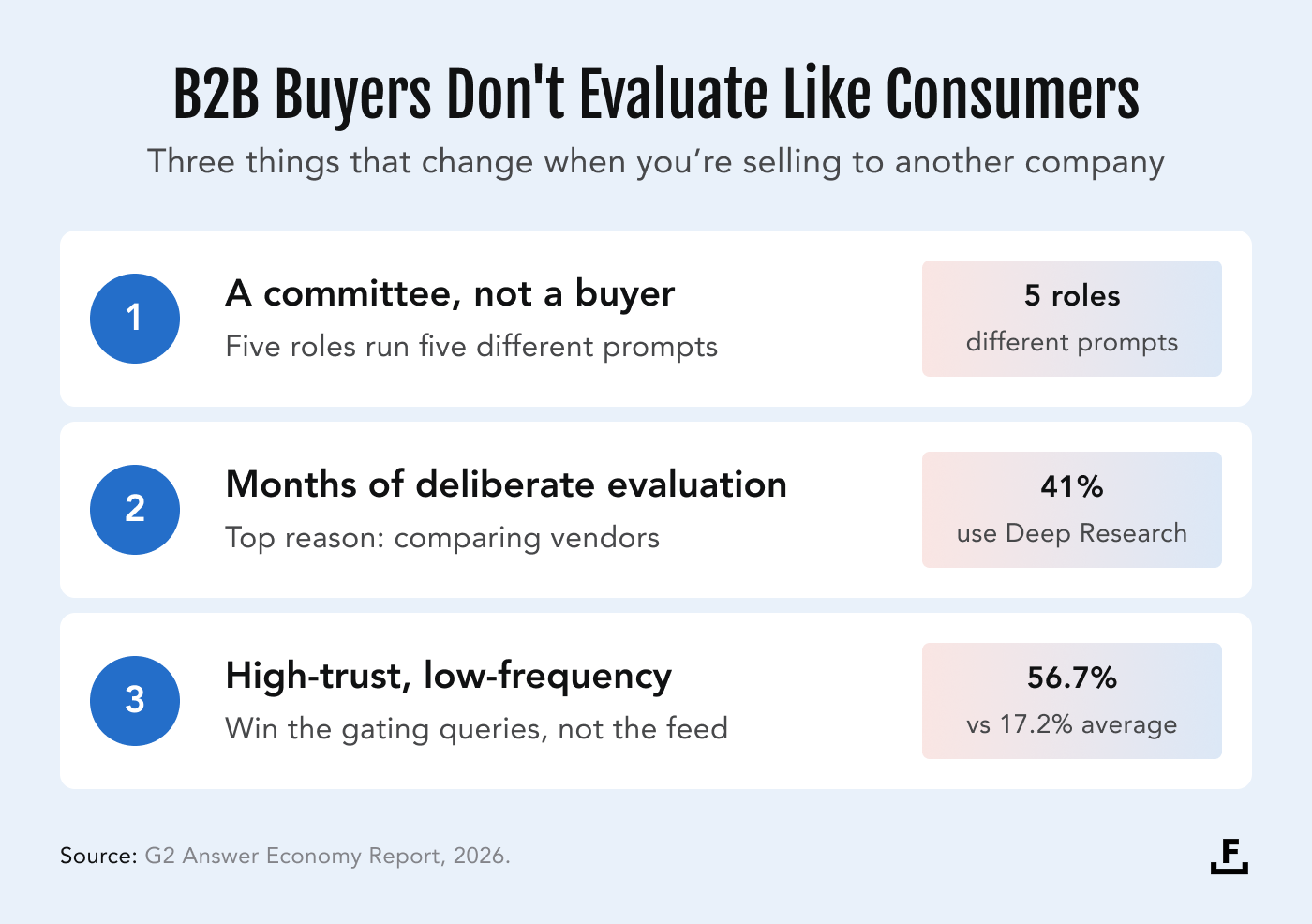
1) You’re selling to a committee, not a person.
Every role researches your category through a different question. The economic buyer asks about ROI and total cost of ownership, the end user about features and workflows, and procurement about security and compliance. Each prompt triggers its own query fan-out and surfaces its own sources, so winning one role’s answer does nothing for the others.
Tool choice fragments too. G2 found AI chat preferences vary by role and company size, with engineering using the widest mix, but the prompts are what you map and win.
2) The evaluation runs for months, in active mode.
A consumer picks a mattress in an afternoon, a B2B buyer committee can take an entire quarter to decide on a vendor. The top reason buyers turn to AI in software research is to compare vendor strengths and weaknesses, ahead of basic discovery. More than 40% use Deep Research tools regularly, and 44% default to slower reasoning models when the decision matters, according to G2’s report. This is scrutiny, not browsing, and it runs from the early “what are my options” prompt through to the late comparison.
3) The purchase is high-trust and low-frequency.
A B2B decision is one a buyer can’t easily walk back. Buyers weigh external validation heavily before shortlisting you, because they need to be sure. And because software or vendor services aren’t frequent purchases, people tend to be unfamiliar with the process, so they’re more reliant on whatever the AI provides them with in that moment.
Together, that puts enormous weight on a small set of high-stakes queries: be the trusted answer to those, or sit outside the consideration set.
The reward for getting it right is lopsided. The top brand in a category appears in 56.7% of relevant AI answers, against a 17.2% average across all brands. And it compounds, because 95% of buyers purchase from their Day One shortlist, and AI now sits upstream of that shortlist, shaping it before any trackable signal exists.
B2B buyers evaluate deliberately, so the strategy has to match deliberate behaviour. This is the gap where most teams misapply general distribution advice. G2’s marketer interviews describe a tactical, fragmented adaptation, with most teams still measuring page rankings and click-through rates, while buyer behaviour has moved past their instrumentation. That mismatch is where the budget burns.
How to Become a Source AI trusts
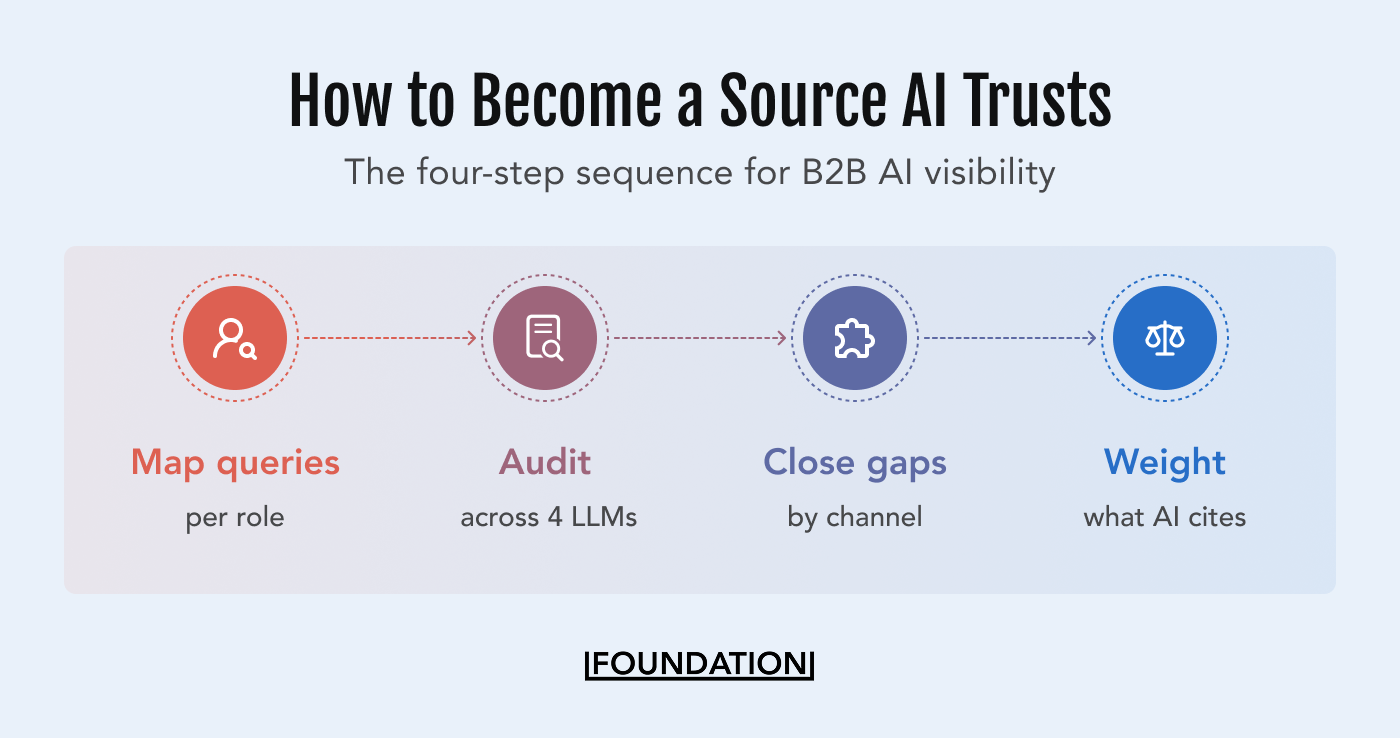
To move from a fragmented approach to a deliberate GEO strategy, you need to reorient your focus toward the specific touchpoints where buyers form their opinions. To bridge that gap, we’ve broken the execution down into four clear stages:
- Map the committee’s queries: Identify the specific questions your buyers ask throughout the evaluation process, from discovery to decision.
- Audit your citation footprint: Assess where you appear, where you’re absent, and where competitors are winning the conversation.
- Close the gaps in priority order: Build the content and third-party authority needed to fill those visibility voids.
- Measure via quality, not volume: Shift focus from clicks to visibility, citation authority, and sales velocity.
1) Map your buyers’ queries
List the roles in your typical deal. For most B2B software companies, that’s the economic buyer, the end user, the champion, the technical evaluator, and procurement. For each role, write down the prompts they likely run during evaluation. G2 found that two-thirds of buyers lead with category or competitor queries in their very first prompt, indicating commercial intent from the first move.
Make the prompts specific. For a data infrastructure platform selling to mid-market engineering teams, the end user might ask, “How to monitor data pipeline freshness?” or “Monte Carlo alternatives for small teams.” The economic buyer might ask “data observability ROI” or “build versus buy data quality monitoring.” Procurement might ask, “Is [vendor] SOC 2 compliant?” Different searches, different sources, different content needed to win them.
We call these your “Golden Prompts”, usually 15 to 20 per category. This step is the foundation for everything that follows. Skip it, and the rest is guesswork.
2) Audit your current citation footprint
Run each Golden Prompt in ChatGPT, Perplexity, Claude, and Gemini, in incognito mode to avoid personalization bias. For each one, note where you appear, where you’re absent, and where a competitor owns the answer. Record the position, the sentiment, and which sources got cited.
G2’s marketers have turned this into a standing competitive-intelligence habit, typing buyer prompts into the tools themselves to see who shows up and using the gaps to set content priorities. The pattern usually surfaces fast: strong on one or two prompts, invisible on the rest, while a competitor owns the high-intent comparisons.
3) Close the gaps that matter for your vertical
Start with the number that reframes everything. In our study with AirOps of 50 B2B brands, only about 10% of AI citations pointed to brand-owned domains. The other 90% came from off-site sources: Reddit, YouTube, review sites, and industry publications.
Your own content is still the foundation the models index and trust, but you can’t close a 90%-off-site gap on your domain alone. Here’s how we sequence off-site work to improve AI visibility in B2B.
The owned and off-site channels driving AI visibility
- Owned content and technical GEO. Long-form, well-structured pages that a model can parse and quote, plus the schema and crawlability that make them machine-readable. Blog and educational hubs are the single largest AI entry point into sites, and comparison and alternative pages punch above their weight, with roughly a third of all LLM citations coming from comparative listicles. This is table stakes, even though owned domains account for only about a tenth of citations.
- Third-party authority and review sites. This is the B2B trust layer. G2 found review sites are the #2 source shaping buyer shortlists, behind only AI chats themselves, and a review-site citation is the single thing most likely to raise a buyer’s confidence in an AI answer. Among daily power users, half rank it as their top trust signal. Review platforms feed the models, so a thin presence gives the LLM less to work with.
- Reddit. This was the most-cited off-site source in our B2B data, accounting for 21% of citations, and it dominates unbranded discovery queries. This is where Ross’s community mechanics from the Nick Standlea episode apply almost without modification.
- YouTube. It accounts for around 13% of B2B citations, and is the most-cited channel in evaluation-heavy, demo-driven verticals like productivity. Buyers reach for it as they evaluate and filter vendors.
- LinkedIn. Also, around 13% of the pie, and a real professional-authority signal in B2B discovery rather than an amplifier for content you’ve already published.
The conclusion holds in every case: you earn a bigger slice of AI visibility by competing off-site. What changes are which off-site sources move the needle for your category and vertical.
On Reddit specifically, Ross’s setup advice from the interview is the clearest version I’ve heard, so I’ll point you to it rather than re-explain.
The short version: claim a subreddit for your brand, create a clearly identified brand account, read each subreddit’s rules before posting, and add to the conversation instead of dropping links. Ross was banned more than a dozen times early on for spamming links, and hasn’t been banned in the six years since he started treating each community on its own terms. The B2B layer underneath is that your accounts should be staffed by people who can credibly answer buyers’ technical questions, because a substantive answer is what gets a thread cited.
4) Reorder the four Es for B2B
Ross frames content around four jobs: educate, engage, entertain, and empower. For consumers, the mix tilts toward entertainment. For B2B, it should skew towards educating:
- Educate (about 60% of effort). In-depth content that answers real evaluation questions. For B2B software specifically, comparative and decision-support content makes up the bulk of what AI cites, well ahead of promotional material. This is the workhorse.
- Empower (about 25%). Customer case studies and proof of outcomes with named results. This maps directly onto the review-as-trust-layer finding: in B2B, evidence carries more weight than entertainment ever will.
- Engage (about 10%). Community presence and executive perspective in the rooms where buyers research.
- Entertain (about 5%). The smallest slice and the easiest to get wrong. Most B2B brands should leave it alone until the rest is solid.
Take Tally and Clio, for example, both of which show the off-site-heavy, comparison-and-community approach working.
Tally, a bootstrapped form builder, went up against Typeform and Google Forms, both with far larger awareness. The strategy leaned on high-intent comparison pages, real engagement in the relevant Reddit communities, and an attribution question in onboarding to connect AI discovery to signups. ChatGPT became Tally’s leading referral source at 9.6% of web referrals, a quarter of new signups came from AI discovery, and the company hit its $3M ARR milestone five months ahead of schedule. User-generated content outperformed mass-produced marketing because communities produced authentic answers that the models trusted.
Clio, in legal tech, took the other route: a decade of authoritative, well-structured content that AI gravitated to without a GEO-specific pivot. The result was a first mention in AI Overviews, ChatGPT as a leading referral source at nearly 40% of referral traffic, a citation share of 7.3% (more than the next four competitors combined), and Share of Model running from roughly 33% on ChatGPT to 48% on Gemini, with sentiment 75% positive. Depth and structure win when you’ve banked them.
Depth and structure win when you’ve banked them.
Notice what those Clio results are actually made of: citation share, Share of Model, sentiment. That’s the scoreboard for AI visibility, and they’re what you need to track when the old funnel metrics stop reporting.
So the question for everyone who can’t point to a decade of content is, how do you measure any of this when the click trail is gone?
How to Measure AI Visibility When Attribution is Broken
Perfect attribution is gone, and pretending otherwise wastes everyone’s time. You can still measure, but you need to flip the mindset switch, and instead think about three questions: does AI see you, trust you, and like you.
Visibility, does AI see you?
- What it is: how often and how prominently you turn up when buyers ask about your category.
- How to measure: Share of Model (the share of category prompts where you appear at all), generative position (whether you’re named first or fifth), and query coverage (whether you appear across the full fanned-out set of prompt variations, not just the exact wording a buyer used).
- What to expect: active programs typically move from 0 to 5% Share of Model up to 25 to 40% over a year. Expect week-to-week swings; only about 30% of brands hold their spot between consecutive answers, so read presence across many runs, not single snapshots.
Citation: Does AI trust you?
- What it is: which sources the model pulls from when it describes you, and whether you’re one of them.
- How to measure: citation frequency (how often you’re cited), source authority (the weight of the citing site, where a G2 page counts for more than an unknown blog), and citation drift (how often a competitor takes your spot between runs).
- What to expect: roughly 90% of citations come from off-site sources, so track third-party citations, not just your domain. A steady presence across runs matters more than winning any single answer.
Sentiment, does AI like you?
- What it is: the tone and accuracy of what the model says about you.
- How to measure: sentiment score (positive, neutral, or negative), hallucination rate (wrong pricing, dead products listed as current, confusion with a competitor), and competitive framing (how you’re positioned when you and a rival show up in the same answer).
- What to expect: aim for majority-positive. Treat hallucinations as a fixable input problem, since the model is repeating what the open web says about you, so the remedy is better source material rather than a correction request.
In practice: track LLM referral traffic by tool in your analytics, use a citation-tracking platform to monitor Share of Model on your Golden Prompts, and add “how did you hear about us” to every form, sales-call opener, and onboarding conversation.
Use Profound, AirOps, and other GEO tools for the citation side, and any of them will show where you rank when a prompt returns a list. Watch for the break Ross described: a buyer naming an LLM as their source while analytics shows no matching referral. That gap is the signature of someone who researched in one window and converted in another.
A note on what “working” looks like, so the timeline is honest. Share of Model typically starts at 0 to 5%, reaches 8 to 15% by three months, 15 to 25% by six, and 25 to 40% by twelve, with category leaders sitting at 40 to 60%. Expect volatility along the way. Only about 30% of brands remain visible across consecutive answers, so measure presence across multiple runs rather than single snapshots.
If You’re Not in the Answer, You’re Not in the Deal
The citation network is now the discovery layer, and query fan-out is how buyers are routed to the brands that earn recommendations. The G2 data puts numbers on it: AI chatbots are the top source shaping B2B shortlists, and most buyers will change their pick based on what those say.
The translation is what matters for B2B. Read Ross’s framework, apply it consumer-style, and you’ll generate activity without pipeline. Map the committee’s queries, audit where you’re cited today, fix the gaps in priority order, and measure what you honestly can.
If you want help running that audit, that’s the work we do. Get in touch with the leading AI visibility agency today.