
Article's Content
Article's Content
In 2006, Google bought YouTube for $1.65 billion. Sixteen of the smartest people in the history of the internet sat in a room, debated numbers, and wrote that check. It was the third-largest acquisition in Google’s history at the time.
Today, YouTube generates north of $30 billion a year in ad revenue. It’s the second most visited website on the planet. And it is, by every reasonable measure, the single best acquisition in the history of technology.
So here’s the question nobody in B2B marketing seems to be asking:
If you owned the world’s biggest search engine AND the world’s biggest video platform, who would you want to win?
We went looking for the answer in the data. What we found should change how every B2B marketing team allocates budget this year.
The YouTube & B2B Marketing Study
We analyzed 8,566 keywords across 130+ SaaS categories and multiple SaaS domains.
We wanted to understand one thing:
Where is YouTube actually showing up in Google’s top 10 results, and what does that mean for the companies competing for those same keywords?
We broke every keyword down by search intent, query modifier, keyword length, paid search competition density, and cross-competitor overlap. Then we stacked YouTube’s performance against the brand domains of actual SaaS companies.
Here’s what the data told us.
YouTube Thrives on Commercial Intent Keywords
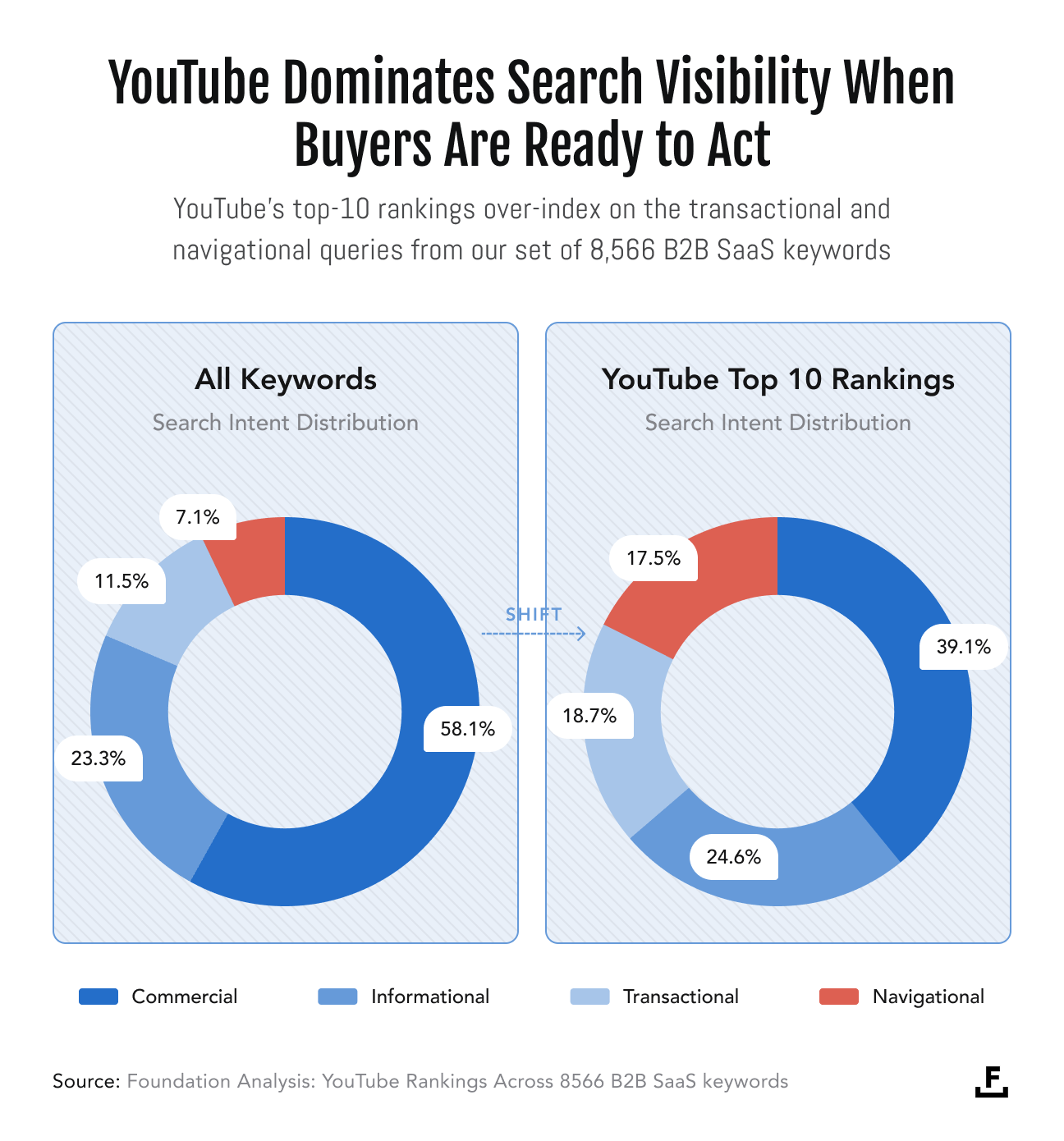
Start with the basics. When you look at all 8,566 keywords in the dataset, the search intent breakdown looks about how you’d expect: 58.1% commercial, 23.3% informational, 11.5% transactional, 7.1% navigational.
Now look at the keywords where YouTube actually cracks Google’s top 10.
Commercial intent drops from 58.1% to 39.1% — still the largest single bucket. But transactional intent more than doubles, jumping from 11.5% to 24.6%. Navigational nearly triples from 7.1% to 18.7%.
Read those numbers again. YouTube’s top 10 rankings over-index on transactional and navigational queries relative to the overall keyword universe.
These are queries where the searcher already knows what they want or is ready to act. They’re comparing. They’re evaluating. They’re buying.
The common assumption in B2B is that YouTube is an informational or awareness channel. The data says otherwise. YouTube is showing up where the money is.
If you were looking for a reason to start a YouTube channel, this is it.
What Are The Most Valuable Keywords On YouTube?
We tagged every keyword in the dataset by its query modifier. The word that signals what the searcher actually wants. Demo. Review. Best. Alternatives. How-to. Setup. Pricing. All of it.
Then we measured how often YouTube appears in Google’s top 10 for each modifier and determined the average CPC for phrases with that word.
Some of these numbers are wild.

The “Demo” query leads to YouTube showing up in the SERP more than any other query. When someone is looking for a product demo, YouTube appears in the top 10 results 80.2% of the time. The average CPC for those keywords is $49. Let me put this on a bumper sticker:
Eight out of ten times someone searches for a SaaS product demo, there’s a YouTube video on page one. Why?
Because Google knows that a demo tends to be delivered via video, and Google owns YouTube.
It’s a mistake for any SaaS company to host their demo videos exclusively on any platform other than YouTube today. Any marketing team that advises that you NOT put your demo videos on YouTube is a marketing team that is partaking in malpractice.
Ok. Now let’s get back to our regular scheduled programming.
Here’s a few other stats to remember:
- YouTube shows up for 26% of all “How To” related queries in SaaS.
- YouTube shows up for 26% of all “Trial” related search queries in SaaS.
- YouTube shows up for 36% of all “Beginner” related search queries in SaaS.
What does this tell us?
It suggests that brands creating educational content should consider creating video versions of their content and placing it on YouTube.
Now let’s look at the bottom-of-funnel commercial modifiers. These are the ones with the red arrows in my chart above because it’s these keywords that most SaaS companies are pouring tons of money into via paid advertising.
- YouTube shows up for 22% of all “Best” related queries in SaaS at an average CPC of $20.
- YouTube shows up for 20% of “Review” related queries in SaaS at an average CPC of $19.
- YouTube shows up for 20% of “vs” related queries in SaaS at an average CPC of $27.
- YouTube shows up for 13% of “alternative” related queries in SaaS at an average CPC of $33.
Huge.
One in five “best” queries has a YouTube video in the top 10.
One in five “review” queries. One in five “versus” queries.
These are the queries where buyers are actively choosing between vendors, and YouTube is sitting there pulling organic clicks while SaaS companies bid $20 to $33 per click for the same real estate. This is a massive opportunity for SaaS companies to create video content on their website or hire influencers to create content on their behalf.
Your Ad Budget Is Competing Against Free YouTube Videos
It tells you that YouTube has already won the SERP for the exact moment your buyer opens a new tab and types “show me how this thing works.” Demos. Tutorials. Setup walkthroughs. The queries where someone is deciding whether to buy, how to start, or which tool to pick. YouTube owns that territory.
And the CPC data makes the mispricing obvious. Look at the pattern.
Demo ($49), login/sign in ($45), trial ($37)… These are also the ones where advertisers are paying the most per click. These are expensive keywords. Competitive keywords. The ones your demand gen team fights over in Google Ads every quarter.
And YouTube content is ranking organically for those same queries.
A video published once, ranking for months, pulling clicks that would cost you $37 to $70 each if you bought them through paid searchNow flip it around.
Think about what your company actually produces (or could produce).
When someone searches “[your product] demo” — is there a YouTube video from your brand on page one? Or is it a creator with 3,000 subscribers who recorded a screen share in their living room and now owns that real estate because you never showed up?
This is the content people want.
It’s also the content that your brand can create.
When someone searches “[your product] vs. [competitor]” — is your version of that comparison anywhere on YouTube? Or is the only video a two-year-old review from someone who used your free trial for 45 minutes?
When someone searches “best [your category] for small teams,” do you exist in that conversation at all?
For most B2B companies, the answer to all three is no. They have zero videos targeting the query modifiers where YouTube dominates. Zero. They’re paying $20 to $70 per click in Google Ads for the same keywords, watching that budget evaporate every month, and never once asking why they don’t have a single organic video competing for those same SERPs.
That’s the gap.
Here’s an example of a real snapshot of a SERP for CRM related queries:

What do you notice?
The first AI Overviews citation is a YouTube video from a page called “Tool Finder”. The title of that YouTube video is: “The Best CRM Tools for Your Need” and it has 3.5k views. That’s not a lot of traffic when you consider there are videos out there from Mr.Beast that get 3.5k views in the matter of 20 minutes.
The format is pretty straight forward. Talking head. Looking in the camera:

Today, it only ranks for 31 organic keywords (based on our tracking tools). But in this instance, it’s the #1 influence on a SERP for high value query. This takes me to another point.
What influences the LLMs today, might not influence the LLMs tomorrow.
But that doesn’t mean you should throw out the idea of producing videos.
Let’s do some rough math. Say you’re a mid-market SaaS company bidding on 40 keywords that include “demo,” “review,” “best,” “vs,” and “alternative” modifiers. Your blended CPC across those keywords is $30. You’re driving 2,000 clicks a month from paid search on those terms.
That’s $60,000 a month.
$720,000 a year.
All going to Google.
But there are organic YouTube videos that are sitting on page one for roughly 20-25% of those same keywords. If you created 10 videos targeting the highest-value gaps and captured even a fraction of those clicks organically, you’d be offsetting tens of thousands of dollars in monthly ad spend with assets that compound over time instead of disappearing the second you pause the campaign.
YouTube vs. Brand Domains: YouTube Wins
Okay, so YouTube shows up a lot.
But is it actually beating the brands that are competing for those keywords?
We compared YouTube’s SERP presence against the actual SaaS company domains in each category. Not just “does YouTube appear” but “does YouTube outrank multiple companies for the same keyword?”
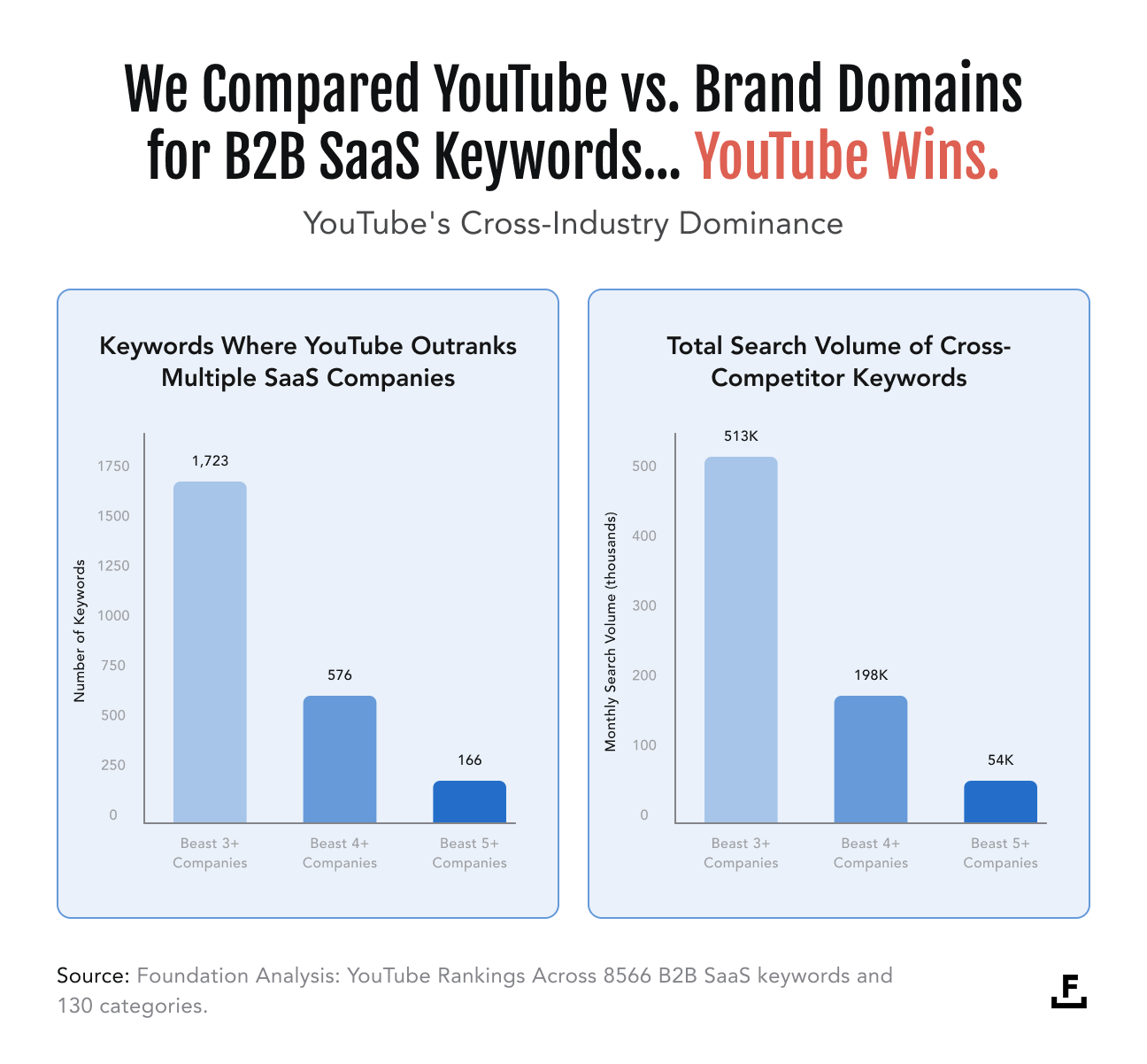
On 1,723 keywords, YouTube outranks three or more SaaS companies in the same SERP. Those keywords represent 513,000 monthly searches.
On 576 keywords, YouTube outranks four or more companies. 198,000 monthly searches.
On 166 keywords, YouTube outranks five or more SaaS companies simultaneously. 54,000 monthly searches.
That last number is the one that should sting.
There are 166 keywords in this dataset where YouTube is beating five or more companies — companies that have SEO teams, content programs, link building campaigns, and domain authorities built over years. YouTube is outranking all of them on the same page.
These aren’t obscure long-tail terms nobody cares about. 54,000 monthly searches across those 166 keywords means real traffic, real buyers, real pipeline that’s going somewhere other than those five SaaS brands’ websites.
Why YouTube Is The Most Underrated Investment In SaaS
Here’s where the investment thesis comes together.
We segmented the keywords where YouTube ranks in the top 10 by paid search competition density — a measure of how many advertisers are bidding on each keyword.
More advertisers means more competition for paid clicks.
And here’s what we found:
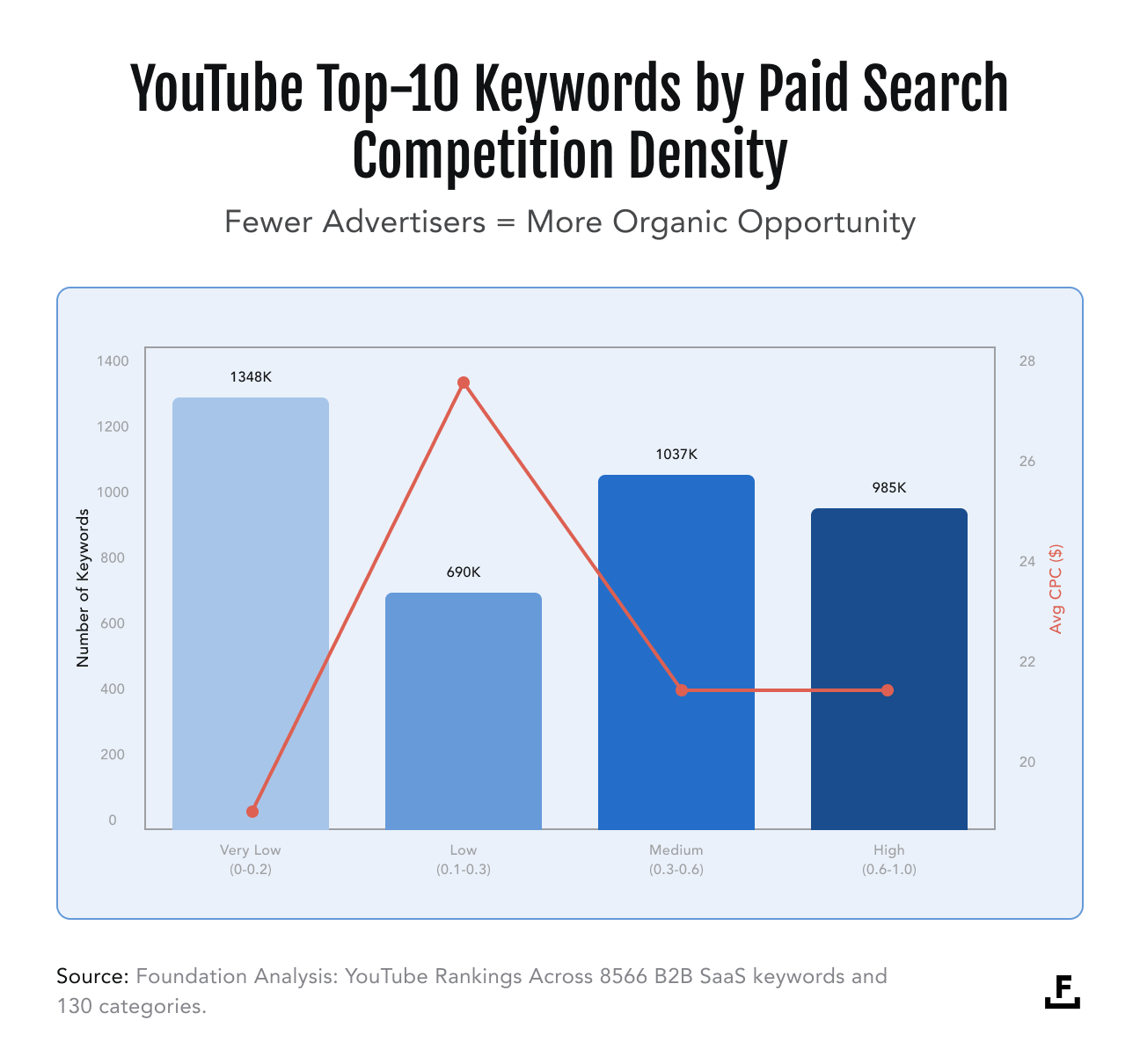
The biggest pool of search volume where YouTube ranks in the top 10 — 1,348,000 monthly searches — sits in the “very low” paid competition density zone (0–0.1). Almost nobody is advertising there. But YouTube is winning organically.
The “low” competition density zone (0.1–0.3) has 690,000 monthly searches where YouTube ranks — and the highest average CPC at roughly $28. Advertisers are paying premium prices here, but there’s still room because competition is thin. YouTube is right there, organically, grabbing clicks that would cost those advertisers real money.
Meanwhile the “medium” and “high” competition density zones still carry serious search volume (1,037K and 985K respectively) with CPCs around $21-22.
YouTube has an organic presence in all of them.
When something is generating disproportionate organic visibility relative to the attention and investment it’s receiving, investors call that mispriced. YouTube in B2B SaaS right now is a mispriced asset. The search volume is there. The commercial intent is there. The competition density says almost nobody has figured this out yet.
My Prediction On The Future Of Search & YouTube Visibility
One more chart. This one is about the future.
We measured YouTube’s top-10 penetration rate by keyword length…

Single-word queries: YouTube appears 43.8% of the time.
Two-word queries: 21.3%. Still strong.
Three and four-word queries: 11.8% and 11.6%. This is the mid-tail trough where traditional blog content competes hardest. But then something happens.
Five-word queries: 13.4%. Six-plus word queries: 16.1%.
YouTube’s penetration rate starts climbing again as queries get longer.
That uptick on the right side of the chart is the signal that I believe is worth taking note of, especially when you consider the launch of Ask YouTube:
Introducing Ask YouTube, our new conversational search experience in @YouTube. 📽️
With Ask YouTube, you can ask more complex search queries, like needing help planning a road trip through the California coast or wanting tips on how to teach your kid to ride a bike. You can even… pic.twitter.com/hYughQMge3
— Google (@Google) May 27, 2026
We’ve been studying how LLMs handle queries, and one of the most important dynamics is something called query fanout. When a user asks an LLM a question — “What’s the best tool for tracking employee productivity in a hybrid team of 50 people?” — the model doesn’t run one search. It runs 150+ modified queries based on what it knows about the user. Their company size. Their role. Their tech stack. Their past preferences.
Those fanout queries are long. They’re specific. Five, six, seven words or more…
And the data shows that as queries get longer and more specific, YouTube starts winning again.
A blog post targeting “best employee productivity software” is a one-page entry competing against 10,000 identical pages. A YouTube video titled “I Tested 8 Productivity Tracking Tools With My Remote Team — Here’s What Actually Worked” matches the natural language of a fanout query far better than a keyword-optimized H1 tag.
As LLMs generate longer, more specific queries on behalf of users, the channels that perform well on long-tail searches will capture a larger share of the discovery surface. YouTube is already showing that pattern in the data. The long-tail uptick is small right now. It won’t stay small.
Google Feeds the Child
None of this data exists in a vacuum. There’s a structural reason YouTube is showing up everywhere, and it has nothing to do with whether your buyers “like video.”
Google owns YouTube.
Google controls what appears in search results.
Google built AI Overviews.
Google built AI Mode.
Google announced Personal Intelligence in January 2026, which customizes search results based on what it knows about you.
And now… Google… Err… YouTube is launching Ask YouTube.
Every one of those products draws on YouTube data. Watch history. Engagement signals. Completion rates. Subscriber behavior. All of it feeds back into Google’s understanding of which content answers a question and which content keeps a person engaged.
No third-party video platform gets this treatment.
Vimeo doesn’t. Wistia doesn’t. Vidyard doesn’t.
The feedback loop between YouTube and Google Search is closed, and it’s getting tighter.
YouTube’s citation rate in AI Overviews has been climbing for months. It’s climbing in AI Mode too. When you factor in Google’s incentive structure… They built the thing, they own the data, they need it to win… There’s no universe (I can envision) where this trend reverses.
The parent is feeding the child.
The child is getting stronger.
And the data in this study makes a strong case for it.
The Objections (And Why They’re Wrong)
I’ve pitched this to enough CMOs and VPs of Marketing to know the pushback by heart.
“Our buyers don’t watch YouTube.”
Your buyers are humans. Humans use YouTube. It’s the second most-used search engine on the planet. When your buyer is evaluating software and they want to see what the interface actually looks like, they don’t read a 2,000-word blog post. They watch a 7-minute demo video. They watch a comparison. They watch someone walk through the onboarding process.
“Demo” queries have an 80.2% YouTube penetration rate. Eighty percent. Your buyers are watching demos on YouTube whether you know about it or not.
“Video production is too expensive.”
It was. In 2019. Today, a talking-head video shot on a good camera, scripted by a great writer shot with decent lighting, a $150 mic, and screen recordings edited by professionals costs you effectively nothing in comparison to what you get back. The production quality bar in B2B is a person who knows what they’re talking about, explaining it clearly, with a halfway decent thumbnail that is going to entice the click.
“We can’t measure its impact on pipeline.”
You can’t perfectly measure it. You also can’t perfectly measure the impact of your CEO speaking at a conference, and nobody argues that’s worthless. You can measure SERP displacement. You can measure branded search lift after publishing. You can lean into RoGEO (Return on Generative Engine Optimization). You can add “YouTube” to your “how did you hear about us” dropdown and see what happens. The same CFO who signs off on billboard spend can live with YouTube’s measurability.
“YouTube is a brand awareness play.”
This is the big one.
YouTube’s top 10 rankings over-index on commercial and transactional intent. It shows up on 22.5% of “best” queries, 20.4% of “review” queries, 20% of “versus” queries. It outranks three or more SaaS companies simultaneously on 1,723 keywords representing half a million monthly searches.
These are purchase-intent queries. The SERP data says so. Calling YouTube a “brand awareness play” is like calling Google Ads a “discovery channel.” The data doesn’t support it.
How Should B2B Brands Use YouTube For AEO/GEO
- Audit your most expensive keywords vs. YouTube
Pull your Google Ads keyword report. Sort by CPC. Manually search the top 50 and record whether YouTube shows up. Our data says it will for roughly 20-25% of your high-intent modifiers. Count how many of those keywords you have zero video content for. That gap is the opportunity.
- Start with demos, reviews, and comparisons
The data makes the priority order clear. “Demo” at 80.2% penetration. “Trial” at 25.7%. “Best” at 22.5%. “Review” at 20.4%. If you can only make five videos this quarter, make them for the query types where YouTube already dominates.
- Stop making commodity content videos
“Top 10 CRM Tools in 2026” is commodity content. Every brand and their cousin has one. Make something specific. “We Migrated 200 Sales Reps from Salesforce to HubSpot in 30 Days — Here’s What Broke” answers a fanout query that no listicle ever will. The long-tail data supports this: YouTube’s penetration climbs again at 5+ word queries. Specific beats generic.
- Optimize for both YouTube search and Google search
Your titles, descriptions, chapters, tags, and transcripts should target the same keyword clusters your SEO team is already working on. YouTube and Google SERPs are the same battlefield. The data makes that obvious.
- Repurpose everything into Shorts
Every long-form video should produce 3-5 Shorts. We’re seeing short-form video show up in B2B SERPs more and more. Free incremental surface area.
- Look at the low-competition zones
The mispricing chart shows 1,348,000 monthly searches in the very low competition density zone where YouTube ranks. These are keywords that almost nobody is advertising for. If you can create video content that ranks organically there, you’re getting visibility that would cost a fortune in paid — if anyone were even competing for it.
Stop Sleeping on Google’s Favorite Video Channel
The data says YouTube in B2B is a buy.
The signal is in the SERP. The thesis is in the ownership structure. And the urgency is in the fact that the “very low” competition density zone won’t stay empty forever.
Most B2B brands will figure this out in 18 months. The ones reading this can figure it out today.
Methodology: We analyzed 8,566 keywords across 130+ SaaS categories and 14 SaaS domains. Keywords were segmented by search intent (commercial, informational, transactional, navigational), query modifier, keyword length, and paid search competition density. YouTube presence was measured as appearance in Google’s top 10 organic results. Cross-competitor analysis measured instances where YouTube outranked 3+, 4+, or 5+ SaaS company domains for the same keyword.
Want the full dataset, or want us to run this analysis for your specific SaaS category? Reach out to the Foundation team.
We cover research like this every week. Subscribe to the newsletter and get it before everyone else.