Article's Content
Article's Content
A revenue operations buyer needs to replace their sales stack before five new reps start next month. According to data from G2, they’re just as likely to start their journey with an LLM than Google.
So the buyer opens ChatGPT and describes their situation in plain language, with a deadline attached and real constraints on what will actually work. The model reasons through the need, pulls in context the buyer mentioned earlier in the conversation, searches dozens (even hundreds) of trusted web sources, and hands back a ranked shortlist of several vendors, each with a reason it fits.
The vendors that show up in the answer have earned AI visibility in the highly influential hidden selection phase that happens before any of the moments a marketing team is used to measuring.
Most brands are losing that phase without knowing it. Across 50 B2B brands in our Hidden Selection Phase report, only 10.15% of AI citations point to brand-owned domains, and on unbranded discovery questions, the category-level searches that actually build shortlists, that figure falls to 2.2%. The answer your buyer reads is assembled almost entirely from sources you do not own, and your website is only one of them.
This guide provides an overview of everything you need to know about AI visibility — from what it is to the key channels that shape it to the metrics you need to measure and the timeline for improving it for your brand.
What is AI visibility?
AI visibility is how prominently your brand appears when an AI system answers a question your buyer is asking. It’s measured by how often, and how favorably, you are cited across the AI systems your buyers use, including ChatGPT, Perplexity, Google AI Mode, and Claude.
Being visible in an AI answer means that your brand is either:
- Mentioned as one of the product or service options in the shortlist the AI creates in its answer.
- Cited as one of the trusted sources that the model pulls from to build the answer.
The answer a buyer reads is assembled from sources the AI system has learned to trust. AI visibility optimization (also called generative engine optimization) is the work of becoming one of those trusted sources, so your brand shows up when a buyer asks a question you should be answering.
Here is what that looks like in practice. Take the revenue operations buyer from a moment ago. They open ChatGPT and type their situation, not a keyword:
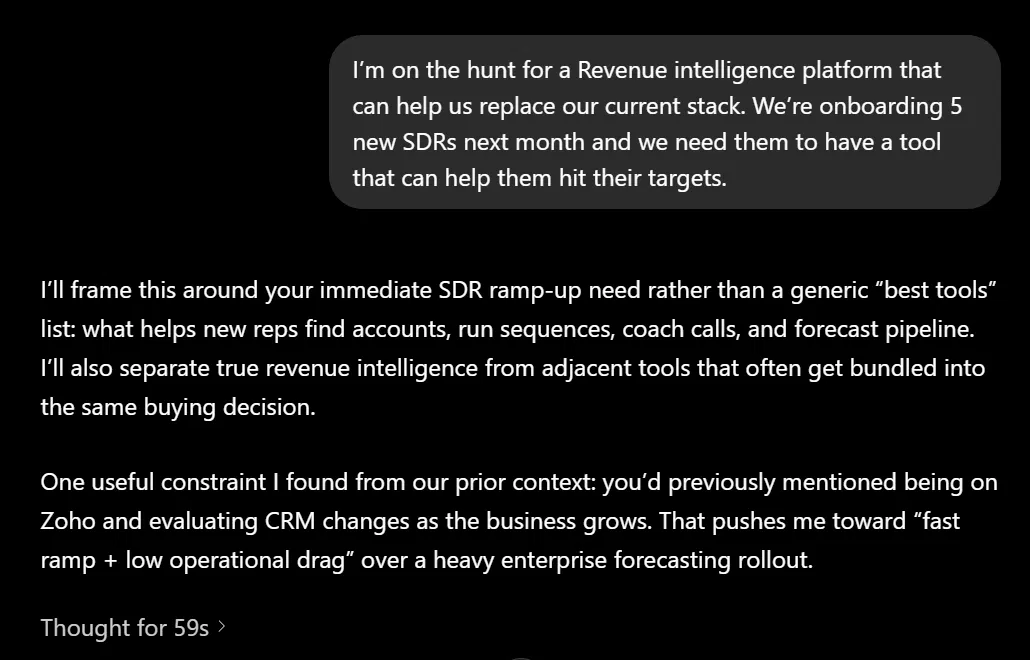
That is not a search query in the old sense. The buyer is describing a need in plain language, with a deadline and real constraints attached. In the 59 seconds it spent thinking, ChatGPT did the work a research analyst would:
- Reframed the request, setting aside a generic “best tools” list and rebuilding the question around the buyer’s real constraint: get five new SDRs productive fast, with low operational drag.
- Pulled in prior context from previous conversations through memory and used it to further screen the answers.
- Looked up current details on candidate vendors, including HubSpot, Outreach, Salesloft, Gong, Apollo, and ZoomInfo, from over 100 different websites.
- Ruled out the wrong fits, setting aside pure forecasting platforms and conversation-only tools for a team that mainly needs reps ramping quickly.
- Synthesized everything into a ranked shortlist of named vendors, each with a reason it fits.
The result came back as a 700 word answer that includes the 6 tools mentioned above:
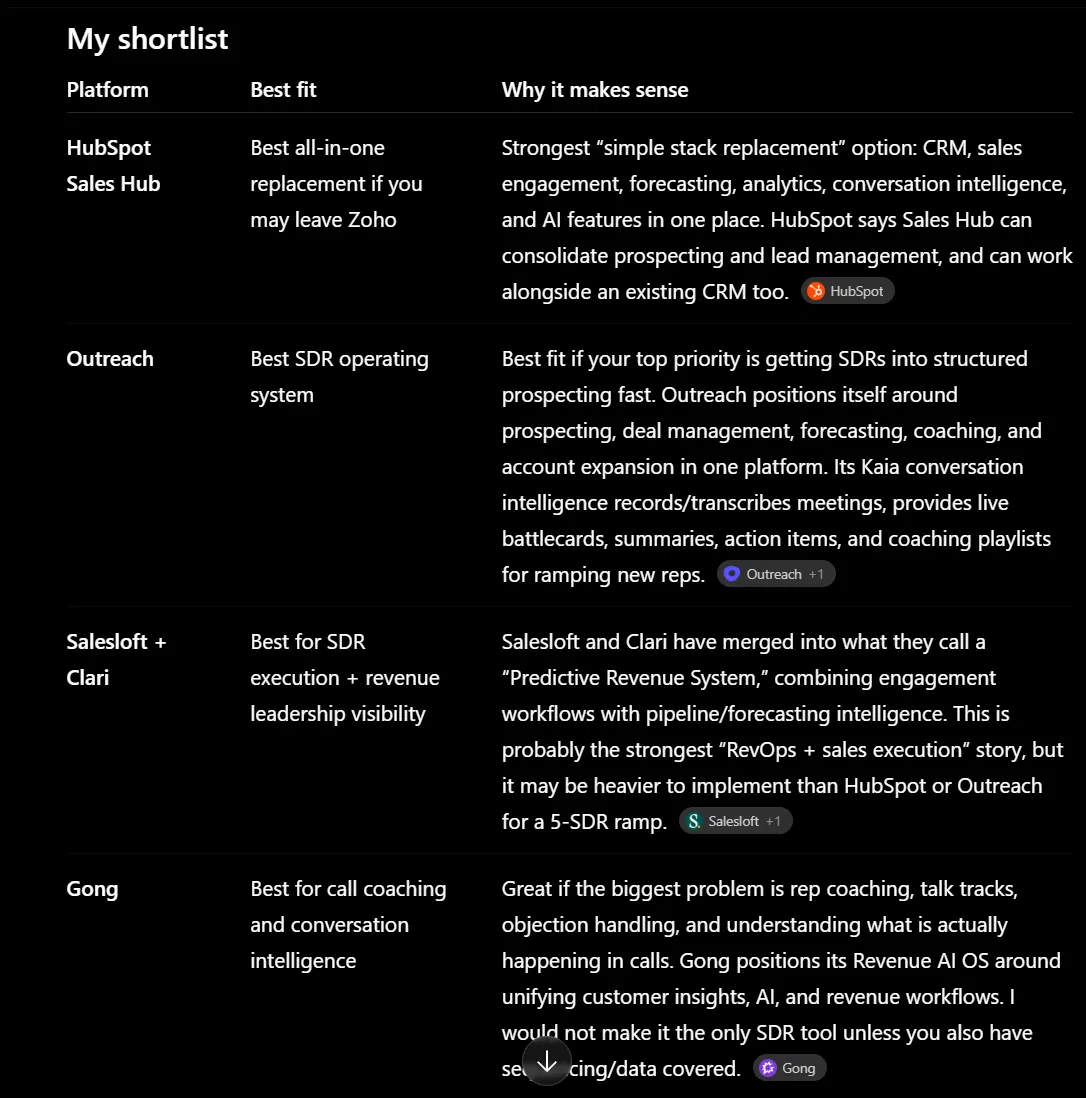
While each of the recommendations has a citation chip from their domain in the answer, their AI visibility is the result of a much larger search that the LLM performs called a query fan-out.
You win AI visibility when your brand makes it into the list of recommendations that the AI comes up with. If you are not in the answer, you are not in the consideration set, and the buyer may never learn you exist.
To make this concrete, we ran the example buyer question above through ChatGPT and traced every source the model pulled to build its answer. It used 104 of them. Where those 104 sources came from tells you where the influence actually lives.

Of those 104 sources, about a third were pages the vendors published themselves. The rest were written by someone else, and no single brand owned more than three or four entries.
Why AI visibility is different than traditional SEO
Traditional SEO optimizes a page to rank in a list of links. AI visibility optimizes your presence across every source a model cites when it writes a single answer. The buyer often never scrolls a list of links now. They read the answer and act on it.
That gap is where brands get caught. You can sit at the top of page one and still be missing from the answer your buyer actually reads, because the model built that answer from Reddit threads, YouTube transcripts, review sites, and competitor content instead of your page. A competitor with weaker domain authority can out-cite you for the same query. If they show up in the threads and transcripts the model trusts and you do not, the model cites them, and your ranking never enters into it.
The work, then, is not ranking a page. It is becoming one of the sources the model assembles its answer from. That happens across six channels.
The Six Channels of AI Visibility Optimization
AI visibility is built across six channels, with paid media as an accelerant on top. The key channels include a mix of on-site and off-site sources, including: your on-site content, your technical setup, Reddit threads, YouTube videos, LinkedIn posts, and earned media.
On-site content and technical GEO typically come first because they are the two channels you control outright, the foundation AI systems index and trust. Everything that outweighs them in citation volume sits off your domain, which is where a significant share of AI visibility is decided.

Across B2B, three off-site channels carry the most weight in AI answers: Reddit at roughly 21% of citations, YouTube at 13%, and LinkedIn at 13%. They are influential in every vertical, which is why they anchor the strategy regardless of category.
What changes is the map around them. Each vertical has its own citation fingerprint, so the off-site sources worth targeting shift with the industry you sell into.
Technical GEO
Technical GEO is the machine-readable layer: schema markup, structured data, and crawlability. It comes first because it gates everything else, and it is also the one channel that appears nowhere in the 104 sources. That absence is the point. None of those pages could have been cited if the model could not parse them.
A brand with excellent content and broken crawlability is invisible to the systems deciding what to cite, so this needs to be fixed before anything else is worth doing. Fixing it is rarely glamorous and almost always the prerequisite that unlocks the other five channels.
On-site content
Your own pages establish topical authority and teach AI systems to recognize your brand as an entity tied to your category. This is also where existing content gets reworked for citation, not only where net-new content gets published, so pages you already own start earning answers they were not earning before.
In our earlier example, vendor-owned pages were about a third of the sources, but split across nine brands, which left any single company holding a sliver. That’s the lesson in miniature. On-site content is necessary and fully in your control, which is exactly why it cannot be the whole strategy.
The next channels are the surfaces you do not own, and in the trace they did the heaviest lifting.
Reddit is one of the most-cited sources in AI answers, which gives threads in your category real weight in what a model says about you. In the trace only two Reddit threads appeared, but both anchored a contested, fast-moving fact the model needed to get right.
That is Reddit’s profile in one image: a light footprint with disproportionate trust weight, heavier in some categories than others. Showing up authentically in the subreddits where your buyers already are, and building that presence over time, earns citations a brand relying only on its own site will never reach.
Earned media and aggregators
AI systems pull heavily from trusted third-party sources like G2, Capterra, industry publications, and directories. In our earlier example, this was the single largest input. Comparison pages, “best platform” roundups, review and analyst platforms, and PR wires together made up more than half of the 104 sources, and the independent “best revenue intelligence platform” roundups alone outnumbered every vendor’s owned content combined.
A brand cited through these sources carries weight it cannot manufacture on its own site. If competitors are in those roundups and on those review platforms and you are not, this is the gap that decides the framing of the answer.
YouTube
AI systems treat video transcripts as authoritative source material, especially for how-to and tool-comparison queries, which is where a lot of category demand forms. The trace bears this out: video transcripts were cited for exactly those mid-evaluation questions. Getting your videos indexed, structured, and cited puts you in the answers buyers reach when they research a purchase.
LinkedIn articles are increasingly cited for B2B topics, where professional commentary signals authority. In the trace, posts from individual practitioners were cited as expert commentary, and they out-numbered the analyst platforms. Content built to be cited, rather than to chase feed engagement, surfaces in answers and reinforces your brand as a credible voice in the category.
Paid media, the accelerant
Paid media sits on the outside because it doesn’t impact AI visibility in the same way that the other six channels do. Paid captures the demand organic visibility creates and runs on the same pipeline narrative as the rest of the program, across Reddit, Google, Meta, and LinkedIn. It accelerates AI visibility. It does not substitute for presence in the channels a model cites.

The order you work these channels is set by where you are absent while competitors are cited, which is the first thing an audit answers. The trace makes the stakes plain: more than two-thirds of one buyer’s answer came from sources no vendor controlled, and the brands in that answer earned their place by being present across those surfaces at once.
Think of paid as the multiplier, not the foundation. It scales reach across Reddit, Google, Meta, and LinkedIn, but it cannot manufacture the citations that make a brand worth amplifying in the first place.
Three Key AI Visibility Metrics
AI visibility is the outcome. Three metrics measure it, tracked across every AI system your buyers use. Data from our recent Hidden Selection Phase report with AirOps shows where a cohort of 50 B2B SaaS brands stand across citation share, share of voice, and sentiment.
-
Citation share
Citation share is how often your owned domain is the source an AI system pulls from when it answers a question in your category. It’s the metric that matters most, because the sources behind an answer decide whose framing the buyer receives.
The benchmark is sobering: across 50 B2B brands, only 10.15% of AI citations point to brand-owned domains, and on unbranded discovery questions that figure falls to 2.2%. The brands that win push their response-level citation rate toward 40% or higher, the level Foundation’s research ties to consistent presence.
-
Share of voice
Share of voice is how often, and how prominently, your brand appears in answers compared with competitors. A brand can have a strong citation share on its own name and almost none in the category.
In Foundation’s study, brands appeared in about 99% of answers when asked about by name, but in only 44.6% of category-level questions and 42% of feature-specific ones, the exact questions buyers use to build a shortlist. Only 11 of 50 brands appeared consistently across query types. Share of voice tells you whether you are in the room when the shortlist forms.
-
Sentiment
Sentiment is how favorably an AI system describes you when it mentions you. It matters, but it is a guardrail rather than the growth lever. AI answers about B2B brands are overwhelmingly neutral or positive, with negative sentiment running below 1% in nearly every platform and vertical Foundation measured. The larger risk is not a bad description. It is no description at all, or one assembled entirely from sources you do not control.
Rolled up, these three become an AI visibility score you can track over time and against competitors using your GEO tool of choice. Foundation baselines them in Profound across ChatGPT, Perplexity, Gemini, Google AI Mode, and AI Overviews, then re-measures monthly.
What AI Visibility Results Look Like Over Time
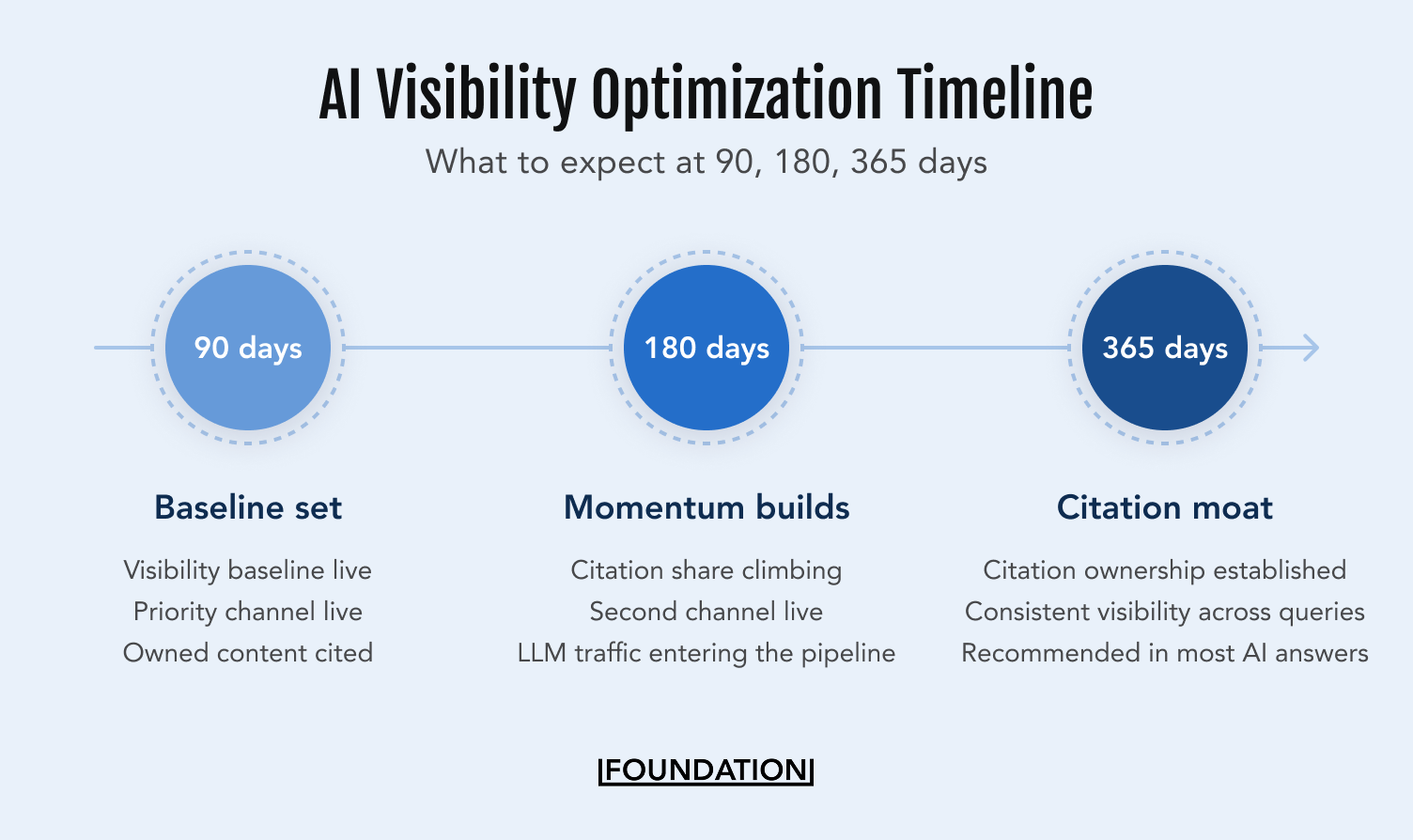
A program produces a citation baseline and first lifts inside 90 days, a second channel and visible pipeline influence by 180, and an attributable citation moat by 365.
The pace is set by how AI sourcing behaves.
Foundation’s research found the sources models cite are remarkably stable month over month, with citation retention between 96% and 100% across verticals. A model does not remember what it said last month; each answer is generated fresh. What stays steady is the content it draws from every time: the Reddit threads, documentation, videos, and review pages already in the mix. That stability is why early investment compounds. Content created in month one keeps earning citations while new content builds on top, and a position, once built, holds.
- First 90 days: baseline and proof. Profound establishes citation share, share of voice, and sentiment against competitors. The priority channel goes live. Owned content starts appearing in answers where it was absent before.
- By 180 days: momentum. A second channel contributes, citation share climbs against the 90-day baseline, and LLM referral traffic begins showing in pipeline, traffic that converts at higher rates because the buyer already did their evaluation inside the AI conversation.
- By 365 days: the moat. The program targets what the research associates with category winners: a response-level citation rate at or above 40%, consistent appearance across query types, and owned content present in the majority of answers.
Bitly is what this looks like in practice. It went from a dormant branded subreddit to the most-cited domain in AI answers for its category. Within a year of building visibility across Reddit, Bitly held the #1 citation rank for link-shortener queries at 11.7% citation share, close to double the next competitor, and ranked first across its full tracked prompt set. Over the same period, Reddit referral traffic to bitly.com rose 422% quarter over quarter. The citation share is the visibility. The referral lift is the pipeline.
How the Best AI Visibility Service Providers Work: Inside Foundation’s AI Visibility Operating System
The difference between AI visibility service providers is whether they execute across every channel an AI system trusts, or only the one they specialize in. A Reddit-only shop or a PR-only shop can move a single slice of the pie. Getting cited consistently across a category takes all six channels working together and measured as one outcome.

Foundation runs every engagement through a four-stage operating system: research the opportunity, create the content, distribute it across channels, and optimize based on what moves.
Research
Every engagement starts with a Profound-powered baseline. We map where you stand on citation share, share of voice, and sentiment across every relevant AI system, measure it against competitors, and use the results to identify which channels will move fastest.
- Profound instance configured or validated
- LLM citation baseline across all relevant AI systems
- Competitor citation mapping
- Channel gap identification: which of the six GEO channels to prioritize first
Create
The research output becomes the content brief. Foundation creates the assets, articles, posts, and materials the research identified as highest-impact, built for AI citation rather than search ranking alone, and matched to the channels where your buyers are already looking.
- LLM-optimized on-site articles and content optimizations
- Reddit posts, cited-thread additions, and community content
- LinkedIn articles, repurposed assets, and non-commodity content
- YouTube scripts, metadata, and channel optimizations
Distribute
Content that sits unpublished generates no citations. Foundation distributes created assets across every channel identified in the Research stage: publishing to Reddit, pushing articles live on-site, activating LinkedIn, and getting video content indexed on YouTube.
- Channel sequencing set by the Research output, not a template
- Spend concentrated on where citation share moves first
- On-site content repurposed across Reddit, LinkedIn, and YouTube to maximize citation surface area
- Paid media available at any tier to accelerate reach
Optimize
Monthly re-measurement against the Research baseline tells Foundation what moved, what did not, and what to do next. The program adapts continuously, with AI visibility optimization driven by citation data rather than guesswork.
- Citation share, share of voice, and sentiment re-measured monthly against the Research baseline
- Content briefs updated based on what is and is not getting cited
- Channel mix adjusted as citation data reveals where to concentrate next
- Program compounds: assets from month one continue generating citations while new content builds on top
The compounding effect on AI visibility
Every asset created through this operating system works across more than one channel. A non-commodity article created on-site gets distributed to Reddit, repurposed as a LinkedIn article, and referenced in a YouTube script. Each piece generates citation signals across multiple channels from a single production effort, and the Research, Create, Distribute, Optimize cycle runs continuously, so the program gets more precise and more efficient with every month of data. This is the part a competitor copying the framework cannot easily replicate.
AI Visibility FAQs
What is an AI visibility checker? An AI visibility checker is a tool that estimates how often your brand appears in AI-generated answers for a set of queries. Most check a sample of prompts across one or two AI systems and return a rough score. They are useful for a first read, though a single check rarely reflects how your buyers actually phrase their questions.
Is there a free AI visibility checker? Some tools offer a free check that scores a handful of prompts or a single AI system. A free check is a reasonable starting point for a directional read. Continuous tracking across the AI systems and prompts your buyers actually use is a paid capability in platforms built for it, such as Profound.
What is an AI visibility score? An AI visibility score is a single number summarizing how often and how prominently a brand appears in AI answers across a set of tracked prompts. Scores vary by tool and by which AI systems and queries are measured, so the number itself matters less than the trend over time and the competitor comparison behind it.
How do you track AI visibility? You track AI visibility by monitoring citation share, share of voice, and sentiment across the AI systems and prompts your buyers use. Foundation baselines these in Profound, measures against competitors, and re-measures monthly so the program can be adjusted toward whatever is actually moving citations in your category.
What is an AI visibility audit? An AI visibility audit benchmarks where your brand stands in AI answers and identifies why. It maps your citation share by AI system and competitor, finds the channels and threads driving citations in your category, and flags technical issues stopping AI crawlers from parsing your content. The output is a prioritized plan, not just a score.
Does Semrush have an AI visibility tool? Several established SEO platforms, including Semrush, have added AI visibility or AI search tracking features, and they are useful for monitoring. Foundation uses Profound as its tracking source of truth and focuses on the execution across channels that actually changes the numbers any tracker reports.
What is the difference between an AI visibility tool and an AI visibility agency? A tool measures how your brand shows up in AI answers; an agency does the work that changes it. AI visibility tools run buyer questions through the models and report citation share, share of voice, and sentiment as a score you can benchmark. An agency runs the audit, builds the channel strategy, then produces and distributes content across the surfaces models cite to move that score. The two are complementary: the tool is measurement, the agency is execution, and a score does not move on its own.
What does an AI visibility agency do? An AI visibility agency gets your brand found, cited, and chosen by AI systems. It audits where you stand, then executes across the channels AI models trust, including on-site content, Reddit, YouTube, LinkedIn, technical GEO, and earned media, and measures the result as citation share rather than rankings or traffic alone.
How does Reddit affect AI visibility? Reddit is one of the most-cited sources in AI answers, so threads in your category carry real weight in what a model says about you. Brands that show up authentically in relevant subreddits and build a presence over time earn citations that competitors relying only on their own site miss.
Start Increasing Your AI Visibility Today
The first step is knowing where you stand. An AI visibility audit baselines your citation share, share of voice, and sentiment against competitors, then maps the channels most likely to move your category fastest. From there, the AI Visibility Operating System runs the work and proves it in citation shares you can track month over month.
If your buyers are already asking AI about your category, the answer they get is being written right now, with or without you in it. Get in touch with the leading AI visibility agency to get started with an AI visibility audit.