Article's Content
Article's Content
There’s a scene in The Devil Wears Prada where Miranda Priestly, played by Meryl Streep, delivers a devastating monologue about a cerulean sweater.
Now, our CEO has already cornered the market on statement sweaters — but her point stands: every trend, every decision, every shift in culture starts with the people at the table.
And if you’re in B2B marketing, that table is LinkedIn.
With over 1 billion users, LinkedIn is the largest professional (and not so professional) networking site in the world. More importantly, it’s where tens of millions of executives and decision-makers go to voice opinions. Your next six-figure contract might be scrolling past your content right now.
Yet most companies are getting it wrong.
They treat LinkedIn like a dumping ground for links: share a blog post, add a generic caption, hope for engagement. The result is crickets — except for the employees who feel obligated to like company content, and a few bots.
As Ross Simmonds puts it: “LinkedIn isn’t broken. But most lead gen approaches that are being used by businesses, SDRs, BDRs, everyone, marketing teams — they are.”
But the platform rewards those who understand its culture and mechanics. Ross closed a $70,000 deal last week from a single post. An SDR he works with booked six meetings in under two hours from one piece of content. Clarify, an AI-native CRM startup, turned LinkedIn into their #1 lead source in just six months.
So today, with help from Foundation Senior Social Specialist Ari Paulin, we’ll show you how they do it.
Let’s start from the beginning.
Why High-Performing B2B Marketers Prioritize LinkedIn
There are plenty of platforms fighting for your marketing budget and your team’s time. Here’s why LinkedIn should be at the top of your list for B2B marketing.
Decision-Makers Are Already There
Unlike other social platforms where your audience might be scrolling for entertainment, LinkedIn users show up with a professional mindset. They’re looking for solutions, evaluating vendors, researching purchases, or looking for professional partners.
With 180 million senior-level influencers on the platform, there’s a great chance your post reaches a decision-maker you’re trying to convert.
This is the fundamental advantage of LinkedIn for B2B: you’re not interrupting people during their downtime — you’re meeting them where they’re in “work mode”.
The Platform Rewards Thought Leadership
Getting in front of decision-makers is one thing. Earning their trust is another.
Consider this: according to an Edelman-LinkedIn report, 55% of surveyed decision-makers review thought leadership content as part of their vetting process. So when your executives share, it directly influences whether prospects decide to buy from your brand — as long as it’s valuable to them.
LinkedIn gives you a stage to demonstrate brand expertise, but through execs and employees, instead of “corporate” marketing. It’s a unique way to get real, and get close to those who value knowledge, opinions and the human side of brands. And unlike a blog post that might take months to rank, a strong LinkedIn post can reach thousands of decision-makers within hours.
LinkedIn Content Gets Pulled into AI Responses
Here’s a benefit that didn’t exist two years ago: LinkedIn content is increasingly cited by AI systems.
Semrush data (October 2025) shows LinkedIn is the second most-cited domain by large language models — behind only Reddit and ahead of Wikipedia, Medium, and YouTube.
As Ari notes: “LinkedIn is the third social network that gets cited on LLMs. The articles pop up across ChatGPT and Google’s AI. Some articles are cited over and over.”

And the scale is real.
Ahrefs data shows the AI impact of social media marketing:
- 131,000+ monthly citations of LinkedIn Pulse articles in Google’s AI Overviews
- 37,100 monthly citations in ChatGPT
- Regular LinkedIn posts add another 35,900 AI Overview citations and 15,800 ChatGPT citations
That’s nearly 170,000 monthly AI citations from Google alone.

Reddit gets a lot of shine as the top social platform influencing AI, but you shouldn’t sleep on LinkedIn. It’s no longer just a networking or lead-gen channel; it’s a trusted knowledge base that AI systems pull from when prospects ask questions about your industry.
Organic Reach Still Works
While Facebook and Instagram have largely killed organic reach for brands, LinkedIn still offers meaningful distribution for content marketing. A single post can reach thousands — sometimes hundreds of thousands — without spending a dollar on ads.
The algorithmic changes that hobbled other platforms haven’t hit LinkedIn the same way. With the right LinkedIn strategy, companies can still drive engagement and generate inbound leads. Need more proof? Just listen to Ross talk LinkedIn lead generation:
LinkedIn arguably has the best mix of audience, culture, and downstream impact of any B2B marketing channel. With the right approach, you can build your network, win business, and influence AI — all at the same time.
How to Build a LinkedIn Marketing Engine That Generates Leads
Tactics only work if the groundwork is solid. For B2B teams, that starts with an intentional presence across the company page and executives.
1. Define Your Target Audience & Goals First
You already know you need to understand your audience. The question is whether you’ve validated your assumptions with hard data.
As Ari puts it, “Understanding what you’re working toward and who you’re targeting will make it easier to determine everything, from what content to share to which calls-to-action to use.”
Start by pressure testing your target audience and ideal customer profile (ICP) with clarifying questions like:
- Which specific job titles have buying authority — and which just influence the decision?
- What language does your ICP actually use to describe their problems?
- Where do they go for industry insights — LinkedIn, Slack communities, newsletters, podcasts?
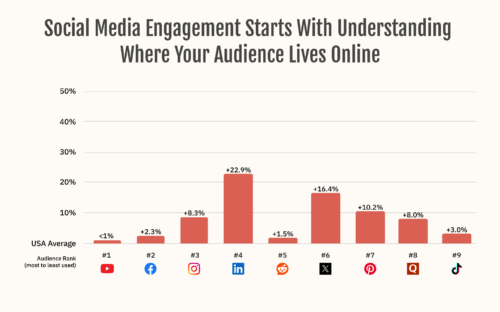
Then use an audience research tool to analyze where your target audience actually spends time online. Don’t assume — confirm. Posting to the wrong platform means wasted effort, no matter how strong the content.
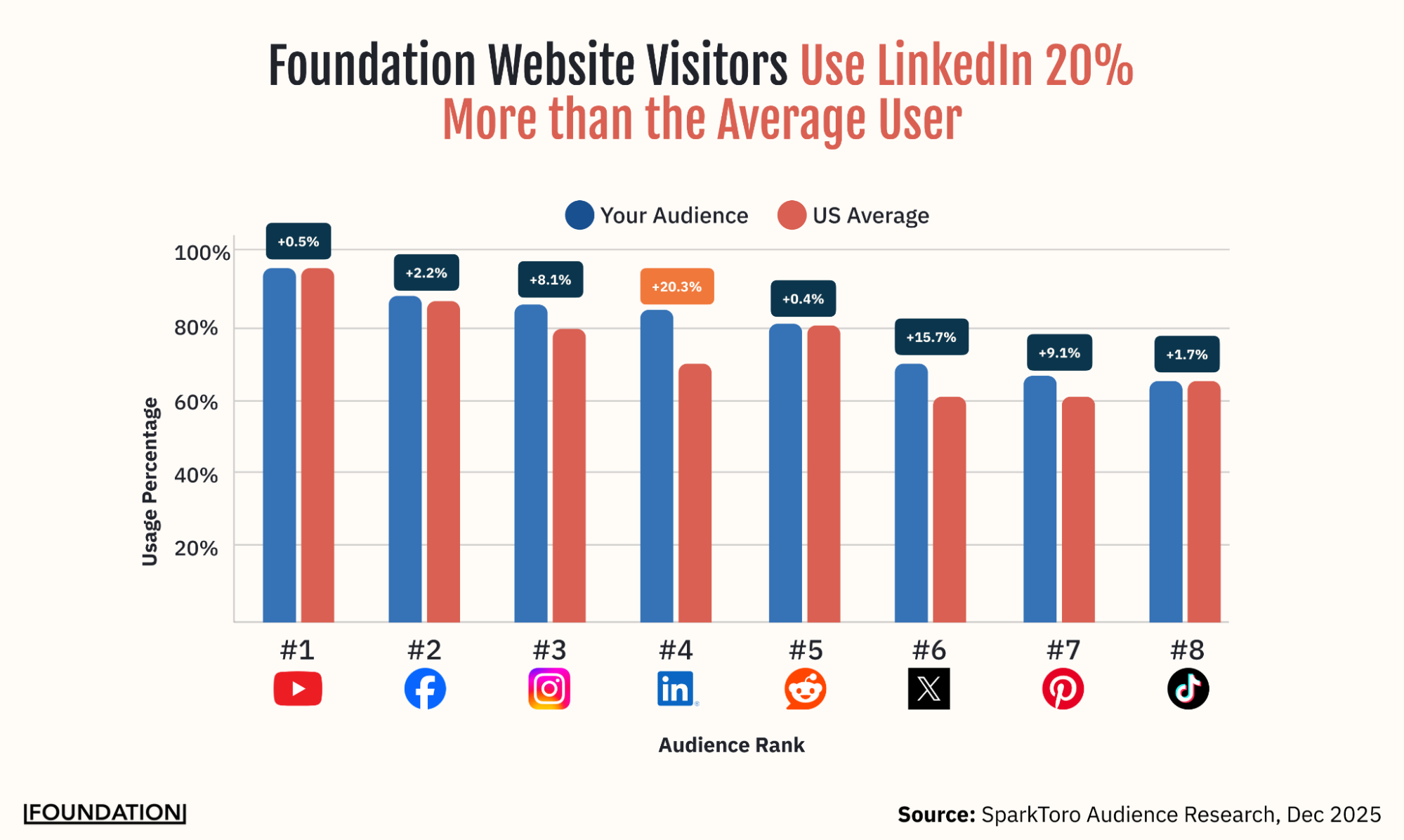
For example, when we analyze Foundation’s website audience using SparkToro, we find that they use LinkedIn 20% more than the US average.
Even though LinkedIn ranked fourth in raw usage behind other platforms, the professional context makes it the most relevant channel for our B2B content.
Here’s another trap many companies fall into: they grow a LinkedIn following without checking whether those followers actually match their ICP.
In a recent audit, Ari found that only 23% of one company’s LinkedIn followers matched their target roles, while over 50% came from completely different functions. Regular audits of follower demographics against your ICP will save you from this mismatch.
2. Set Up & Optimize Your Company Page
Ross sums up the importance of company and user pages simply: “Your profile isn’t just a resume. It’s a landing page.” Every element of your company page should communicate who you help and how:
- Your company description should include relevant keywords that help people find you in LinkedIn search.
- Your banner image is prime real estate treat it like a billboard that tells visitors what they’ll get if they follow.
- Your best-performing content or most important lead magnets should be pinned to the featured section.
- Your logo should be crisp and your URL customized.
Here’s another important tip from Ross: don’t be humble. Your “About” section should highlight results you’ve delivered for customers, not a bland corporate description. Make it for your prospects, not your peers.
If you want to learn more about different LinkedIn Pages features available to brands, Product Leader Mary Yang has a great article on it.
3. Align Your Team’s Profiles
If you’re only posting from a company page, you’re leaving reach on the table.
Company pages tend to have limited organic reach on LinkedIn — we see it with the posts from our own Foundation account versus team members’. Personal profiles get better distribution, especially with a regular posting cadence. When your leadership team posts, their networks see it. When the company page posts, almost nobody does.
Take it from Chris Eberhardt, the Clarify Marketing Lead who helped them turn LinkedIn into their top lead source: “If you’re only posting from a company page, you’re missing out. Founder and employee voices — that’s the compounding engine.”
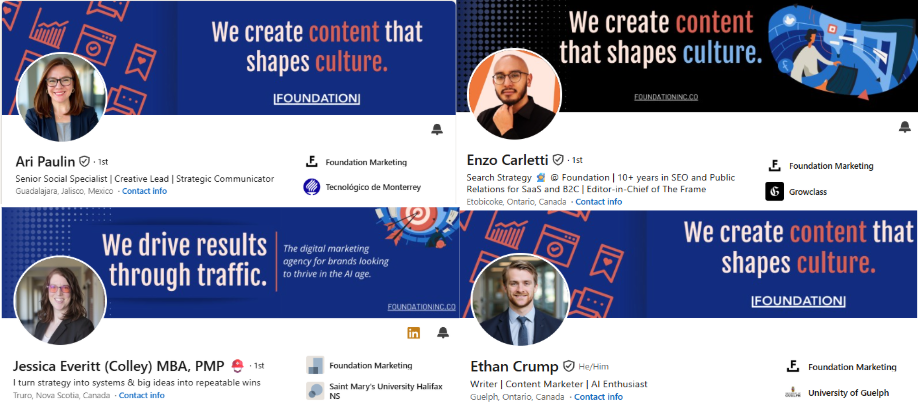
Create visual consistency across your team by providing branded banner options and photo guidelines. This is something we Foundationites (or Foundation Knights, TBD on that) have embraced over the last year through headshots and updated graphics.
It creates a visual consistency that is hard to miss, and it reinforces brand recognition with every employee interaction.
Once you have a unified front across your company and team accounts, you can start using some of the strategies that help brands like Clarify, Gong, and HootSuite stand out.
What Actually Works: LinkedIn Marketing Strategy & Best Practices
After the setup comes the real work: investing time and energy into building a
Post Consistently (Timing Matters Less Than You Think)
Here’s something that surprises most marketers: the “best time to post” obsession is largely outdated.
As Ari explains: “The LinkedIn algorithm is changing. Recently, it’s started suggesting content that’s about two weeks old. So, it doesn’t really matter if you posted it at the ‘best time possible.’ If the algorithm is going to surface it weeks down the line, it doesn’t matter whether you posted it at 10 a.m. or 4 p.m.”
That said, the first few hours after posting (especially the golden hour right after pressing publish) are critical for engagement. The LinkedIn algorithm watches how your content performs early and uses that signal to decide whether to show it to more people. So while the exact hour you post matters less, being available to respond to comments in that initial window matters a lot.
What does matter is showing up regularly. “Consistency is number one — that does the heavy lifting. And then the second one is making sure you’re reaching out to your network. That creates bigger ripples than posting at the right time,” Ari tells us.
Look at Gong’s LinkedIn strategy for proof: they share 10–15 posts on their company page every single week. That’s more than most B2B companies post in an entire quarter. The volume and consistency help them maintain presence in their target audience’s feed — and it’s a major reason they’ve built a following of over 315,000.
Use Content Themes to Stay Strategic
Random posting leads to random results. Using defined content marketing themes that reinforce expertise and serve your audience helps build consistent results. Dividing your content into themes — like thought leadership, lead generation, and company culture — helps maintain freshness and relevance to your target audience.
The 40-40-10-5-5 framework is one of many distribution approaches that works well for driving engagement on social media:
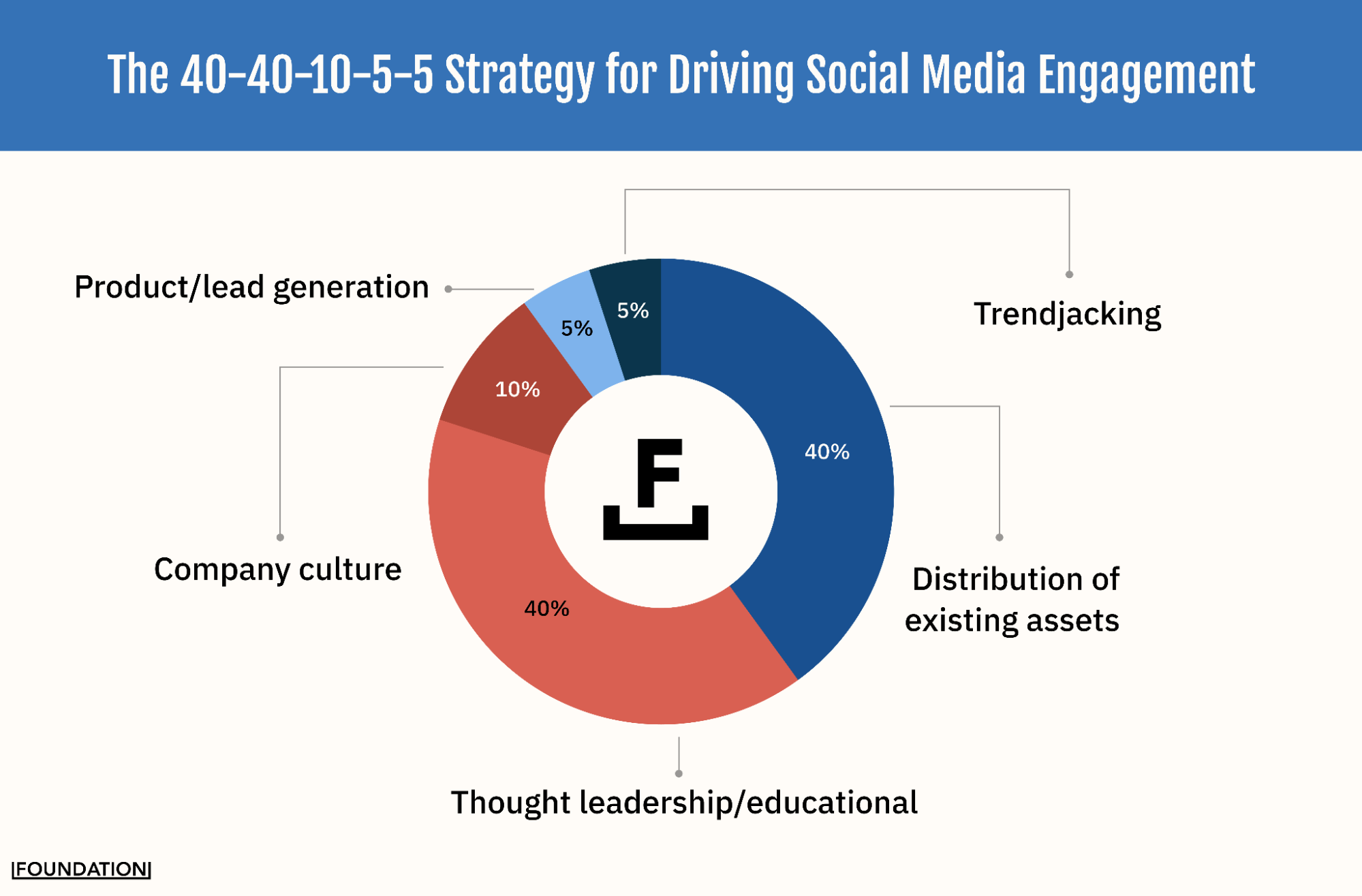
As Ross puts it: “Identify a few content pillars. These are themes and ideologies and concepts that you want people to associate with your brand. And every single week, you should be putting out video content, written content, image content that reinforces these ideas.”
Nail Your Hooks
The first line of your post decides whether people keep reading or scroll past. You need a hook that sparks curiosity, delivers value, or provokes emotion.
Three formats work especially well:
- Data/Insight hook — Lead with a stat or data point that proves the value of your content.
- Question hook — Open with a thought-provoking question your audience wants answered.
- Contrarian hook — Lead with a hot take that challenges assumptions and sparks discussion.
Gong’s team has mastered this. One of their content leads, Devin Reed, posted an article with this hook:
“We analyzed 304,174 emails. But only one word made the difference. The answer WILL surprise you.”
Four sentences that hit multiple triggers: simplicity (“only one”), credibility (big sample size), and curiosity (bold claim). The post generated 275 comments and 1,200+ reactions.
Make the first 125 characters count — that’s what shows before “see more.” Put the value upfront, save context for the body.
Diversify Your Formats
LinkedIn rewards variety. The formats driving the best engagement in 2025 are:
- Carousels — The golden child of brand accounts. They require active participation and reveal exactly where engagement drops off.
- Native video under 60 seconds — Direct uploads consistently outperform YouTube links in the algorithm.
- Polls — Quick engagement drivers. One client got 42 votes on their very first company poll.
- Data-driven graphics — Clean visuals with specific insights that tell a compelling story.
- Memes — Increasingly effective as LinkedIn’s culture loosens up with younger users.
“I love text — it builds authority,” says Ross. “I love audio — it builds connection. But with video, you build trust faster than anything else.”
Ross Simmonds, CEO @ Foundation & Distribution.ai
One thing that doesn’t work: simply repurposing blog posts. As Clarify’s Chris Eberhardt learned: “You can’t just repurpose blog posts into LinkedIn posts. It’s an entirely different channel and has a culture/style of content of its own.”
LinkedIn rewards native content that sparks conversation, not links that pull people away. The algorithm prioritizes posts that keep users engaged on the platform.
Beyond the algorithm, there’s a cultural mismatch — LinkedIn users want conversational, first-person storytelling, not polished marketing copy. Lead generation comes from impactful native content.
This is why channel selection matters so much. As Foundation’s Senior Social Specialist Ari Paulin notes: “If you know who you’re talking to and you choose the right channel, then the rest will follow. But you have to adapt your message so it aligns with the channel.”
Leverage Native Articles & Newsletters
Since LinkedIn gives preferential algorithmic treatment to native content over external links, creating short versions of your blogs as native articles and newsletters is a great way to provide upfront value and drive readers back to your website for the full piece.
The difference between LinkedIn articles and newsletters matters. “If you call them articles, they’re just isolated articles with no real commitment to their frequency,” Ari explains. “And that’s fine for a person. But if you want to build a devoted following, you better have a newsletter.”
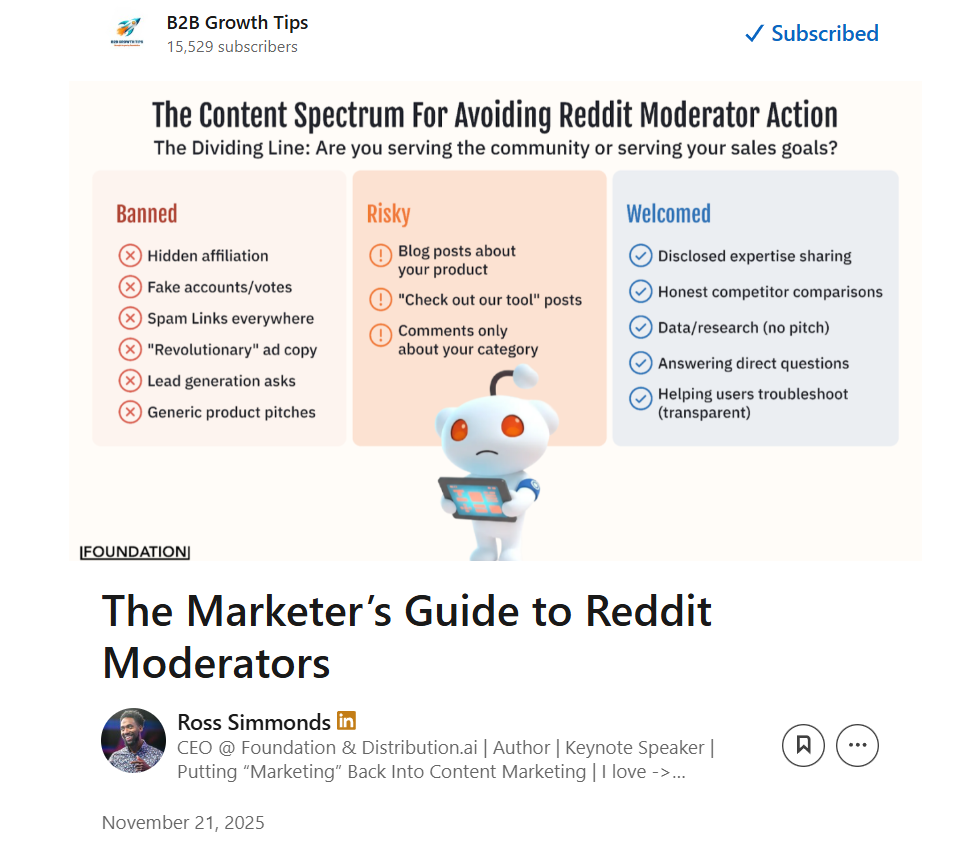
Newsletters attract subscribers who get push notifications every time you publish — a direct line to your audience that the algorithm can’t throttle. If you want to see a great one in action, check out Ross’s B2B Growth Tips.
Don’t forget about the visibility benefit: native articles are more likely to be indexed and cited by AI systems. If LLM visibility matters to you — and it should — publishing original content directly on LinkedIn is one of the fastest paths to getting cited.
Build Relationships, Not Just Reach
LinkedIn often looks like a broadcast medium, but remember it’s really a network. Relationships matter more than reach, especially for lead generation.
Tag collaborators and sources when sharing content. Respond to every comment on your posts within the first hour (the algorithm notices, and according to HootSuite and Social Element, comments get 1.6x more engagement when the original poster responds). Comment meaningfully on posts from your ICP and industry peers.
“So many people send out these connection requests with no context, with no articulation of why they are interested in the connection,” Ross notes. “They assume and expect people to accept. It doesn’t work that way. You have to show people why, tell people why.”
Here’s a pro tip from Ross: before reaching out to your main target, connect with a few other people within their organization first. “People check on LinkedIn if you have mutual connections.” Those shared connections create trust before you ever send a message.
Showcase Your Team
Most B2B brands get employee advocacy completely wrong. They either force rigid posting guidelines that kill authenticity (making employees sound like corporate robots) or leave it entirely to chance, and nothing happens.
If you’re having trouble brainstorming or striking the right balance, create shareable content that employees can personalize. Showcase real team wins rather than generic corporate announcements.
Help team members develop their own thought leadership by supporting their individual content efforts. And sometimes, you can even just post to say hello:
Cross-amplification between company and personal accounts can boost reach, especially in early growth stages. As Ross emphasizes: people trust people more than brands.
Double Down on What Works
Most brands post content, glance at the engagement numbers, then move on to creating something entirely new. They never stop to ask: “What made that post work? How can we do more of that?”
Clarify actively identifies high-performing content and deliberately creates more like it. As Chris Eberhardt advises: “Boost posts that take off. Recycle winning angles with new data or stories. If it worked once, it’ll work again.”
Case in point: when Patrick Thompson posted that Clarify doesn’t use Product Managers — a controversial stance that “struck a nerve” — it generated nearly over 170 reactions, 150 comments, and a handful of reposts. So Thompson doubled down a couple weeks later with a follow-up post expanding on the concept. It generated even more discussion.
Wait 7–14 days, then repost winning content with a new hook, angle, or format. One long-form asset can become a carousel, a poll, a video clip, an infographic, and a quote graphic — each reaching different segments of your audience.
Hootsuite’s content repurposing strategy has turned this into an art form, turning single assets into multiple formats across platforms, keeping their calendar full of high-quality, low-lift content.
Using this approach for your organic LinkedIn marketing strategy is a great way to build momentum for your brand. Momentum that you can amplify with LinkedIn’s paid advertising features.
Take Advantage of LinkedIn Targeting
While this guide focuses primarily on organic strategies, LinkedIn’s paid capabilities deserve a mention. The platform offers targeting precision that no other social network can match for B2B — you can reach people by job title, company size, industry, skills, and more. It’s perfect for lead generation.
LinkedIn’s audience data stands apart because members have professional incentives to keep their profiles accurate and up to date. You’re targeting based on real, member-generated information: job titles, company names, industries, seniority levels, skills, and more. This means your ads reach actual decision-makers, not lookalike audiences built on assumptions.
Three LinkedIn targeting capabilities make it a particularly powerful platform for B2B marketers:
- Company Targeting — Run account-based marketing campaigns to reach specific companies and the decision-makers within them.
- Contact Targeting — Upload your own contact lists or connect your CRM to market directly to known prospects and customers.
- Retargeting — Segment audiences based on their previous interactions with your brand and deliver content tailored to where they are in their journey.
LinkedIn also offers the Audience Network, which extends your reach to millions of professionals across partner publishers — giving you more touchpoints beyond just the LinkedIn feed.
For best results, combine organic content with targeted promotion.
- Use Sponsored Content to amplify your top-performing posts.
- Leverage Sponsored Messaging for personalized outreach.
- Experiment with formats like carousel ads and video ads to see what resonates with your audience.
The key is to let your organic strategy inform your paid efforts — boost what’s already working, and use paid to accelerate results.
Of course, none of this matters if you can’t measure the impact. Let’s look at the metrics that really matter.
Measuring What Matters
What gets measured gets managed. Here’s how to track what actually matters.
The Metrics That Count
Forget vanity metrics. Focus on signals of real interest:
- Engagement rate (not just raw likes) — What percentage of people who saw the post actually interacted?
- Comment quality and depth — Thoughtful responses vs. “Great post!” drive-bys.
- Profile visits and connection requests — Is content driving people to learn more about you?
- Content saves — Signals someone found your content valuable enough to reference later.
For B2B brands, also track profile views from ICP companies and clicks to pricing or demo pages. The attribution challenge is tricky — platforms penalize external links, and traffic often shows up incorrectly. Use UTMs consistently with clear naming conventions to improve accuracy.
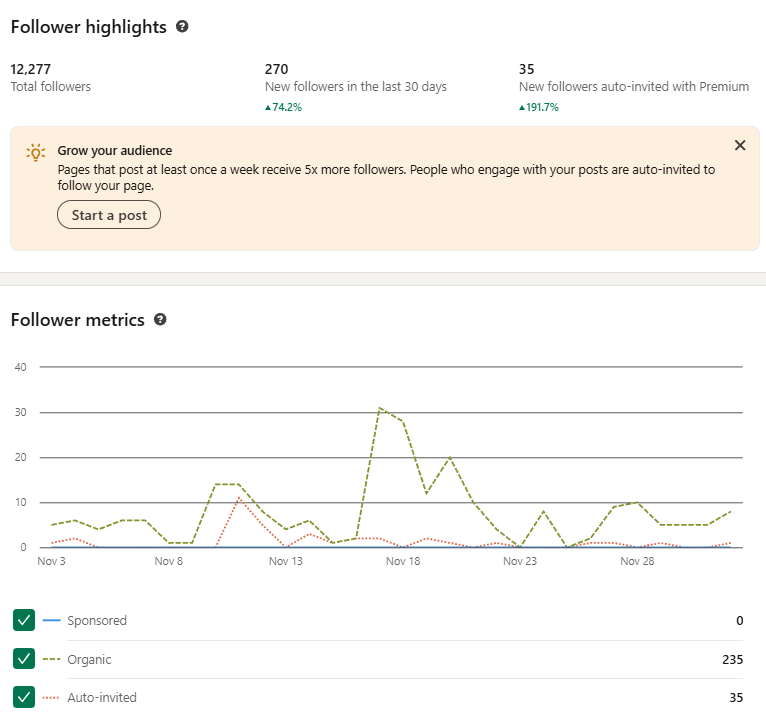
Analyze Your Followers
Compare follower demographics to your ICP regularly. LinkedIn’s analytics show job functions, seniority levels, industries, and company sizes. If there’s a mismatch — like the company that discovered only 23% of their followers matched their target audience — adjust your content strategy to attract the right people.
What matters is the quality of followers you’re attracting, not the quantity. Track whether new followers match your ICP, and prioritize engagement from decision-makers at target accounts.
Track Competitors
LinkedIn lets you track up to 10 competitors directly in the platform. You can see follower growth, engagement rates, and top-performing posts. Export this data and calculate monthly audience growth rate, average engagement rate, and posts per week.
In one competitor audit, Ari found that a smaller player (15,000 followers) was growing at 8% monthly while the industry leader (119,000 followers) grew at only 0.5%. That kind of insight tells you who to watch and learn from — and where the market might be shifting.
Connect to Website Traffic
Use UTM parameters on every link and track performance in Google Analytics. This connects LinkedIn activity to actual website behaviour — letting you see which posts drive not just clicks, but engaged sessions and conversions.
Measurement is the last crucial piece of the puzzle you need to launch a winning LinkedIn marketing campaign for B2B. What’s next is up to you.
Turn LinkedIn Into Your Lead Engine
LinkedIn offers B2B marketers unmatched access to decision-makers, a platform that rewards thought leadership, growing AI visibility, and organic reach that still delivers. But results require an intelligent strategy.
There’s a common thread here. Every tactic we covered works better when you stop thinking of LinkedIn as a place to post and start treating it as a place to build relationships, authority, and trust that compounds over time. Most importantly, the brands winning on LinkedIn show up consistently.
Ready to turn LinkedIn into your top lead source? Get in touch with the leading social media marketing agency for B2B to learn how we can accelerate your growth.