
Article's Content
Article's Content
Google’s AI search optimization guide tells us not to chase mentions or use structured data for AI visibility. But they also spent five years saying they didn’t use click signals, and we all know how that went.
The search giant published their official guide to optimizing websites for AI search features. The headline is that SEO fundamentals still apply:
- Write first-hand, non-commodity content
- Follow existing technical SEO best practices
- Skip the mythbusted GEO tactics.
It’s a solid baseline, but the bigger story is what the guide doesn’t tell you.
AI visibility actually comes from across the broader ecosystem: where off-site presence on Reddit, YouTube, and LinkedIn does more work than the guide acknowledges, and where the line sits between distribution and the “inauthentic mentions” Google warns against.
Here’s what the guide actually says, the GEO myths Google explicitly debunks, and the three things you need to carry into a real GEO strategy.
The Google Guide to Optimizing for AI Search Features
The core argument of Google’s AI search feature guide is that SEO fundamentals haven’t changed. AI Overviews and AI Mode are powered by the same underlying ranking and quality systems that rank traditional Search results.
What has changed is that two AI techniques sit on top of Google’s search engine systems to produce generative answers.
- Retrieval-augmented generation: grounds AI responses in indexed web pages for relevant, recent information.
- Query fan-out: generates concurrent related queries to gather more context before producing an answer.
If your content is eligible to rank in Google Search, it’s eligible to appear in generative AI features. To improve the chances that your content appears in AI Overviews or AI Mode, Google updated their guidelines for content quality and structure.
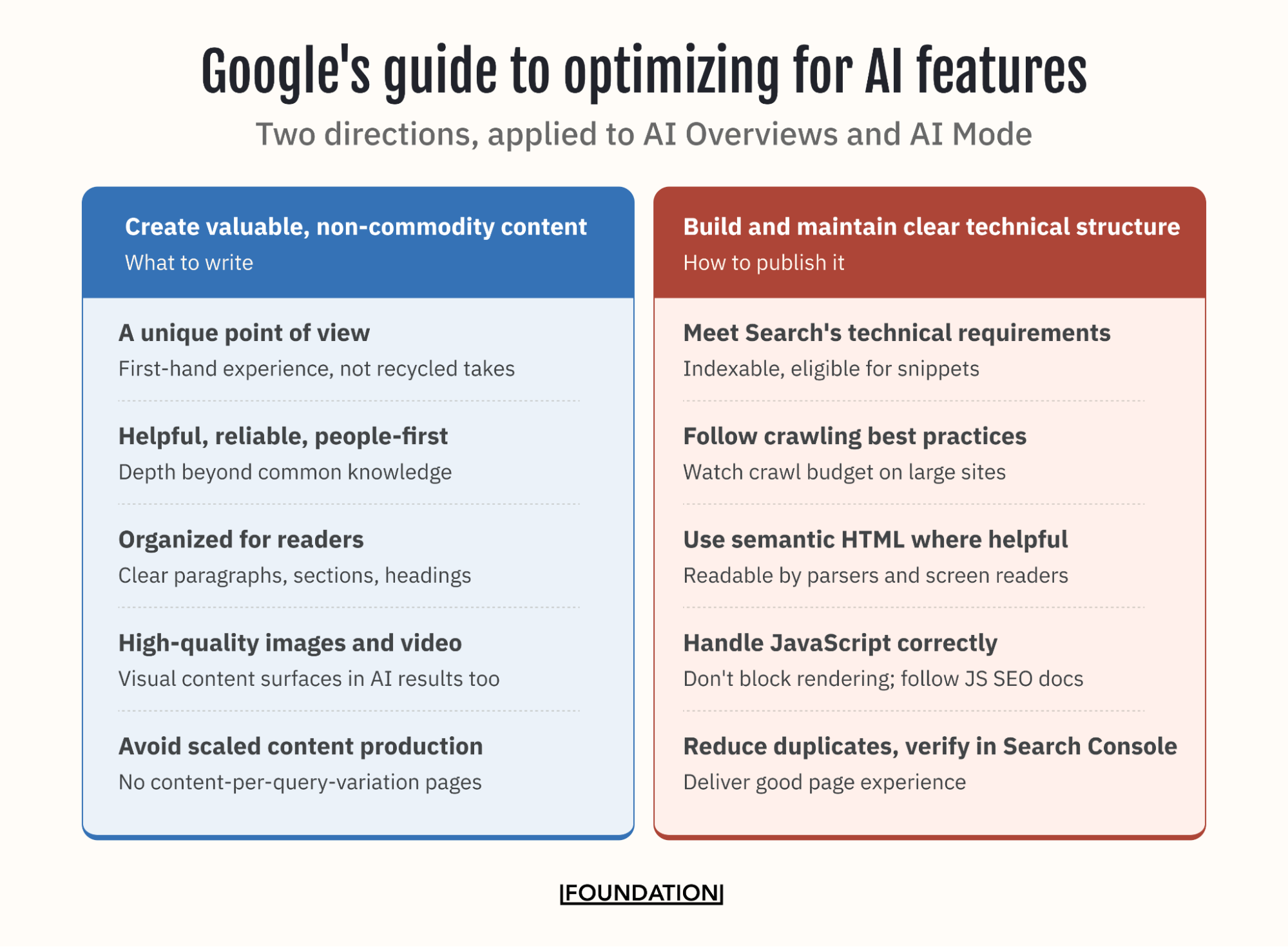
1) Create valuable, non-commodity content
Like the search engine they’re built on, Google’s AI systems still prioritize helpful, reliable, and people-first content.
But they are shifting to prioritize content that comes from first-person experience and expertise, instead of “simply restating information already available elsewhere”.
Danny Sullivan announced the shift from commodity to non-commodity content at Search Central, and their guide provides further details on the content Google’s AI systems are more likely to surface.
- Offer a unique point of view. Google’s AI features are looking for content that contains a unique first-person perspective and experience that an AI can’t produce from training data alone. For example, instead of “7 Tips for First-Time Homebuyers”, Google recommends “Why We Waived the Inspection & Saved Money: A Look Inside the Sewer Line”.
- Create non-commodity content. The framing here is unchanged from Google’s helpful content guidance over the past few years. Write for human readers. Cover topics with depth that goes beyond common knowledge. Don’t recycle what’s already on the internet.
- Organize information to help readers. The content you create should make it easy for the reader to follow: clear paragraphs, sections, and headings. Content humans can navigate is content AI systems can parse.
- Include high-quality images and video. Generative AI features can surface visual content alongside text, which means images and video are additional opportunities to appear in responses. The existing image SEO and video SEO documentation still applies.
- Avoid scaled content production. Don’t forget about Google’s spam policies. They’re drawing a hard line against scaled content production aimed at AI visibility. They specifically mention tactics like creating separate pages for every variation of a query, or generating many pages to chase fan-out coverage.
Considering the hundreds of brands falling victim to the scaled content abuse penalties in Lily Ray’s recent analysis, the last point is a necessary reminder.
Google’s guidance is to focus on what visitors would find satisfying, not on producing content for the model’s benefit.
2) Build and maintain a clear technical structure
The technical section is shorter and reads as a checklist of existing best practices, reframed for the AI context. It aligns firmly with the “best practices for SEO still apply” messaging that Google leads off with.
Keep following Google’s SEO Guidelines, and you’re likely to show up in their AI search features as well:
- Meet Search’s technical requirements. Pages must be indexed and eligible to be shown with a snippet to appear in AI features. Indexing isn’t guaranteed even when requirements are met.
- Follow crawling best practices. AI features rely on publicly accessible, crawlable content. Large or frequently updated sites should review their crawl budget to make sure the search engine (and AI features) can find key pages.
- Use semantic HTML where it helps human readability. Google notes that perfect semantic HTML isn’t required, but it makes content easier for screen readers and other parsers to navigate.
- Handle JavaScript correctly. Google can process JavaScript-rendered content as long as it isn’t blocked, but JavaScript-heavy sites need to follow the JavaScript SEO documentation.
The technical section is the least novel part of the guide. It’s a reminder that the floor for AI visibility in Google is the same floor that’s been required for organic visibility for years.
Google’s list of AI search myths
The most pointed part of the guide is the section titled “mythbusting generative AI search.” Google directly addresses several tactics that have become standard talking points in GEO content and takes a position on each one.
“While terms like Answer Engine Optimization (AEO) or Generative Engine Optimization (GEO) are common online, many suggested ‘hacks’ aren’t effective or supported by how Google Search actually works.”
— Google Search Central
- LLMs.txt files and other “special” markup. You don’t need to create machine-readable files, AI text files, markup, or markdown to appear in Google’s AI search features. While they may discover and crawl many file types in addition to HTML, doing so doesn’t mean the file is treated specially.
- Content chunking. There’s no requirement to break content into small pieces for Google’s AI systems. Their systems understand pages that cover multiple topics and can surface the relevant section to a user.
- Rewriting content specifically for AI. AI systems understand synonyms and general meaning. Writing in a particular style or capturing every long-tail variation of a query isn’t necessary.
- Seeking inauthentic mentions. Google’s core ranking systems prioritize high-quality content, and other systems block spam. Pursuing mentions for their own sake across the web isn’t as helpful as it might appear.
- Overfocusing on structured data. Structured data isn’t required for generative AI search, and there’s no special schema markup to add. Google still recommends structured data as part of a broader SEO strategy because it enables rich results.
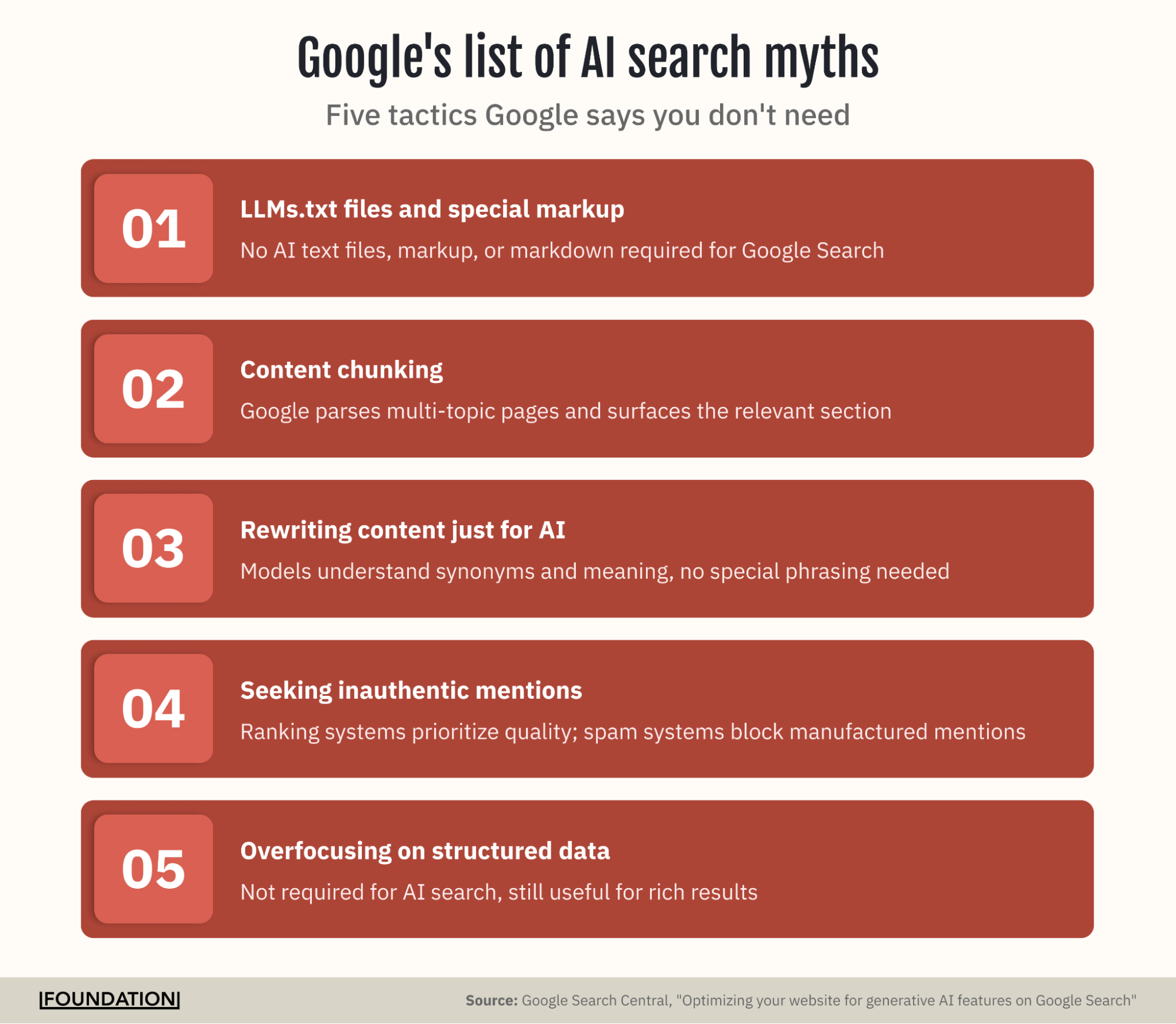
Several of these GEO tactics have been promoted heavily in industry content over the past year, and Google’s guidance is that, at least for Google Search’s AI features, they aren’t necessary.
An Important Note on Google’s Track RecordGoogle has a documented history of describing its systems one way in public and operating them another way in private. The 2024 API leak showed they used click signals, Chrome clickstream data, and site-level authority scoring for years — all while spokespeople denied it on record. That doesn’t mean this guide is wrong. It means the absence of something from Google’s guide is not proof it doesn’t matter. |
What Google’s AI Optimization Guide Means for Your GEO Strategy
The Google guide is a useful resource for brands, but it’s also specific to Google Search.
And while Google is unquestionably the leading search tool, generative engine optimization is a broader practice than optimizing for AI Overviews. The buyers running prompts through ChatGPT, Claude, Perplexity, and Grok are being influenced by retrieval and training systems that work differently from Google’s.
Some of the tactics Google says aren’t required for AI Overviews are observably effective in those other surfaces. There’s no detailed discussion of how off-site signals, brand mentions, or community presence influence retrieval.
Three points are worth carrying out of the guide and into a real GEO program.
1) The content guidance is the floor, not the ceiling
Google’s guide tells you what kind of content to make. It doesn’t tell you how far to take it. The content types it recommends include first-hand experience, unique perspectives, original research. These are the minimum required to be competitive on Google Search.
At SEO Week, Ross Simmonds reminded everyone about the EEAT — experience, expertise, authority, trustworthiness — approach for AI visibility.
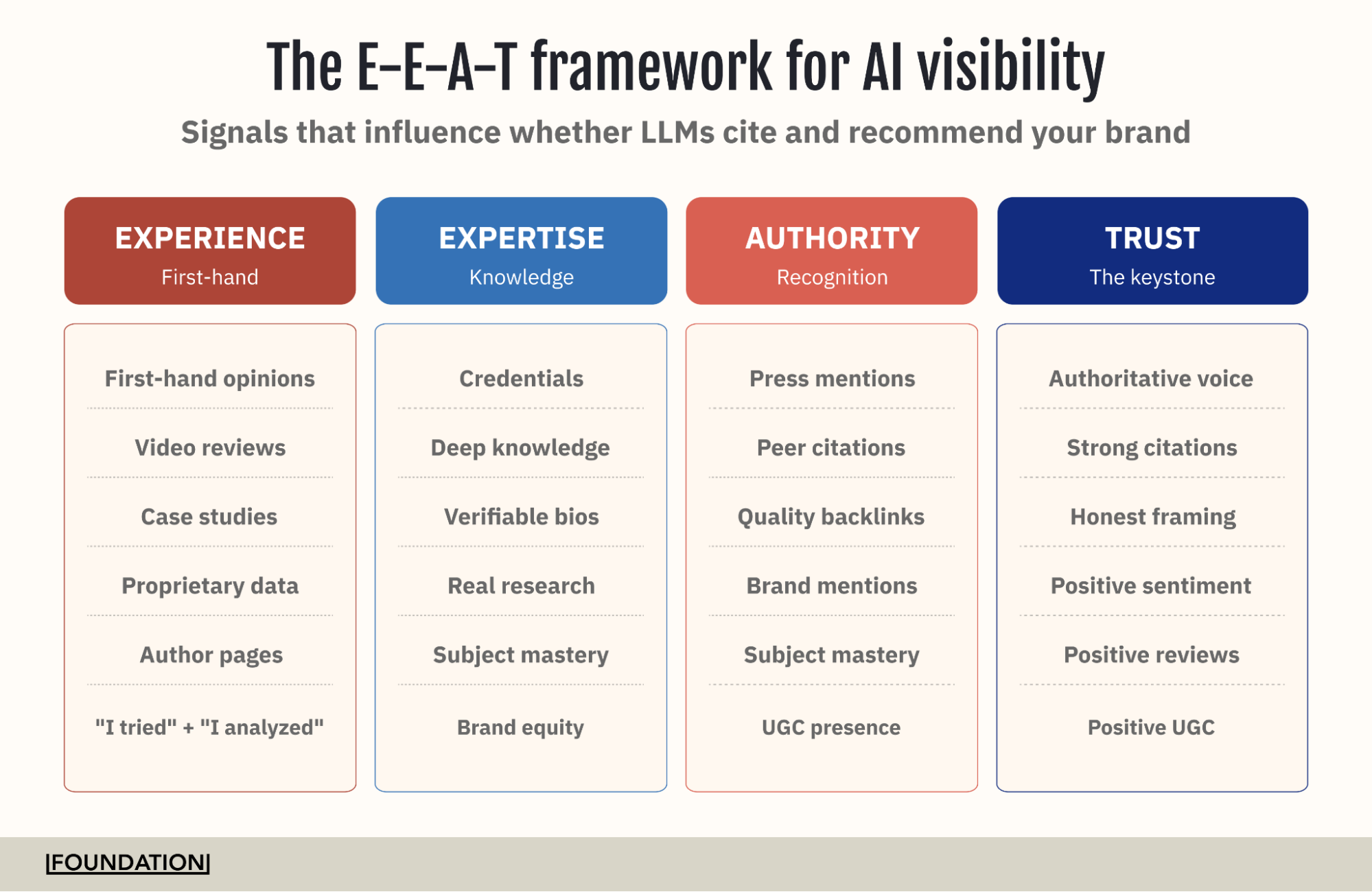
An EEAT-first content approach includes first-hand opinions, video reviews, case studies, and proprietary data as the experience layer, and brand mentions, peer citations, and positive sentiment as the authority and trust layers.
The vocabulary differs from Google’s, but the underlying argument is the same: content that carries verifiable, original evidence gets cited.
2) Off-site is doing more work than Google’s guide acknowledges
Google’s guide focuses almost entirely on your own content. It says little about where citations actually come from, and that gap is significant.
Our Hidden Selection Phase report with AirOps analyzed 5.1 million AI responses and 57.2 million citations across seven B2B SaaS verticals. The majority of citations didn’t come from company blogs or owned assets. They came from third-party surfaces that Google’s optimization guide doesn’t cover.
- Reddit accounted for 20.8% of the top-50 external citation domains and was the top external source in six of seven B2B verticals studied, with its share jumping to 30.9% during unbranded discovery queries when buyers are still building shortlists.
- YouTube ranked second among external sources at 13% of citations, signaling that AI models are pulling from video content alongside written sources when generating answers.
- LinkedIn came in third at 11% and was the only source to outrank Reddit in any vertical, narrowly edging it out in Sales and Revenue queries.
- Review sites like G2 made up just 4% of citations, roughly five times smaller than Reddit’s share, suggesting AI models weight community discussion more heavily than the review platforms most B2B brands have historically optimized for.
If your GEO strategy stops at your own site, you’re optimizing for a minority of the citation sources that actually drive AI visibility. Building that presence means showing up on Reddit, YouTube, LinkedIn, and trade publications — not just creating content, but contributing to the conversations those platforms are built around. Your content distribution strategy feeds the AI mention and citation ecosystem.
3) The line between distribution and manipulation matters
Google’s guidelines use the phrase “inauthentic mentions” to describe the tactics they’re warning against. The problem is that the phrase bundles together behaviours that are very different in kind.
Astroturfed Reddit accounts and hidden prompt injection in markdown files are manipulation tactics. Earning genuine community presence and pitching expert sources to trade publications is distribution. Google provides little guidance on the distinction between the two, so here’s a quick overview:
- Content distribution means showing up in places your audience already trusts, contributing value those platforms recognize as real, and letting AI systems discover your presence naturally.
- Content manipulation means inserting instructions, fabricating credibility, or engineering outputs in ways the system and its users didn’t consent to.
At SEO Week, Ross framed this distinction as the difference between earning memory in LLMs and gaming it. The framework maps cleanly onto Google’s guidelines.
Earning looks like distributing original content authentically across surfaces. Gaming looks like hidden prompt injection, force-recommending via memory manipulation, suppressing competitor mentions, and exploiting open-source model vulnerabilities.
Both approaches can increase AI visibility in the short term, but only one is a viable long-term strategy.
Start Driving AI Visibility Across All Platforms
Google’s guide is a useful baseline. Use it as the foundation of content and technical work. Build your distribution and AI visibility strategy on top of it, with a clear sense of which tactics earn long-term trust and which trade short-term visibility for long-term risk.
Ready to build out your AI visibility strategy? Get in touch with the leading generative engine optimization agency.