
Okay, so this week Stripe and Advent International put $53.4 billion on the table for PayPal. $60.50 a share. A 28% premium. PayPal’s board has not said a word yet, so this is still an offer, not a deal.
The internet did what the internet does… It reached for the calculator.
And the calculator math is fascinating.
Stripe ran about $1.9 trillion in payment volume last year. PayPal ran about $1.8 trillion. Put them together and you get a roughly $3.7 trillion payments machine. So the takes wrote themselves:
- It Creates A Two-sided Network: Stripe owns the merchant plumbing. PayPal owns 430 million consumer accounts, Venmo, and a checkout button people actually recognize. Together they touch both ends of the transaction
- It Provides Wallet Distribution: PayPal hands Stripe a consumer wallet and a mainstream audience overnight
- Fewer tolls. Route more volume inside the combined platform and you pay Visa and Mastercard less on the way through
- It Gives Stripe Stablecoin Reach: Stripe has been buying its way into stablecoin infrastructure. PayPal’s user base is a distribution channel for it
- It Helps Stripe Kill A Competitor: PayPal owns Braintree, a direct Stripe competitor. The deal takes it off the board and brings Venmo, licenses, and data along with it
All good takes. It seems at first glance like a brilliant move.
I’m a long term fan of what the team at Stripe has built.
I’ve written about their marketing engine in the past:
- How Stripe Grew $63B in 12 Years Using The Power of Content & Design Excellence
- A Million Dollar Stripe Page: Why Some Content Is Worth Millions
- Why API Documentation Is Actually SEO & LLM Gold
PayPal’s organic traffic is worth roughly $130 million a year.
I’m a marketer.
So let’s do some marketing math too…
Every transaction in this category starts as a question:
Someone types “best payment gateway.”
Someone asks ChatGPT how to accept payments online.
Someone Googles “buy now pay later options” at 11pm.
And then… These people land on websites that help them do exactly that.
PayPal earns about 361 million organic search visits a year. Stripe earns about 49 million.
READ THAT AGAIN.
PayPal earns 361 million organic search visits a year…
Stripe generates 49 million.
Paypal generates over 300 million MORE visits organically a year than Stripe. But together they become a media engine capturing over 400 million organic visits a year.
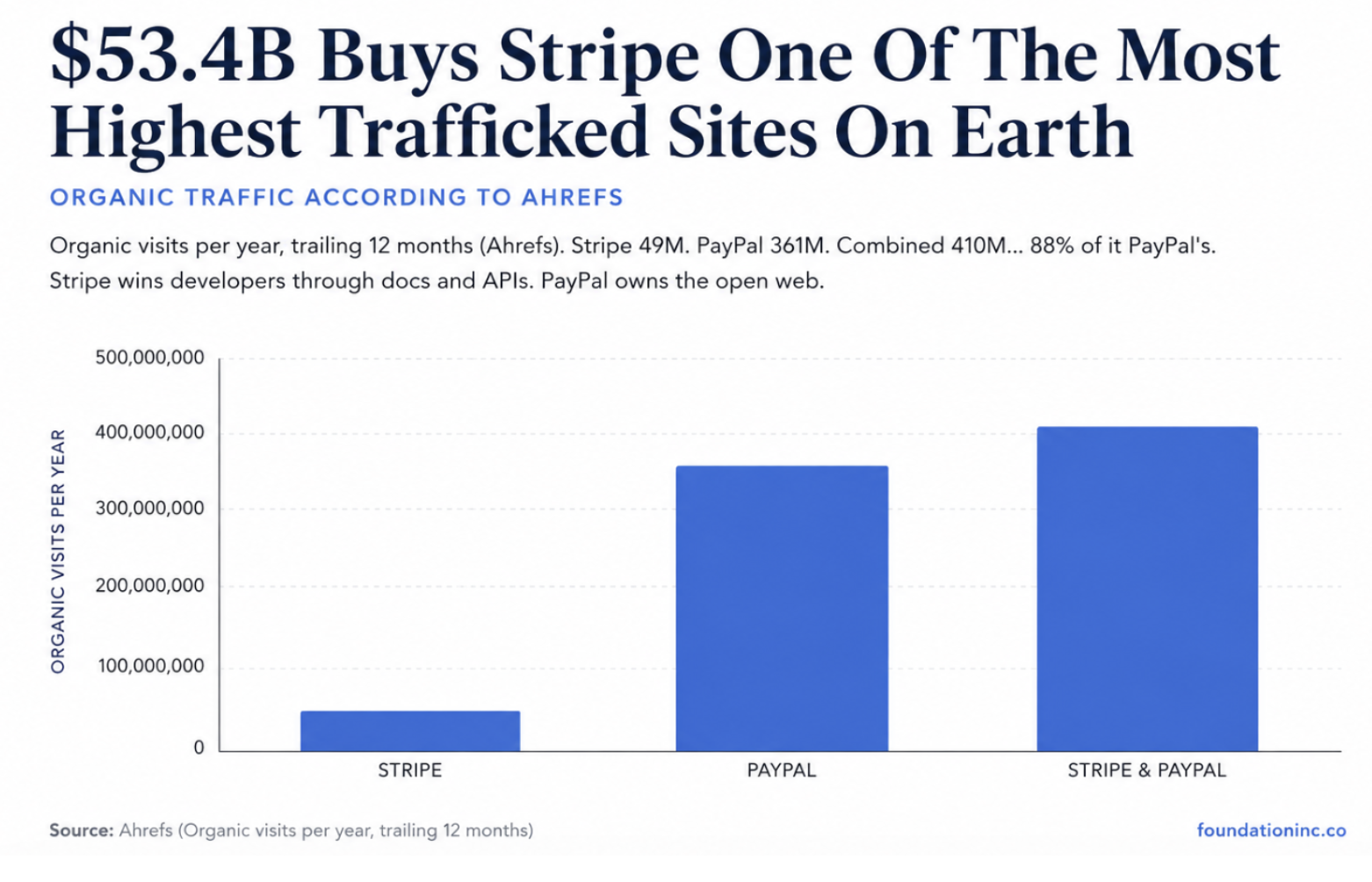
No media spend. This is the start of a content moat that will pay dividends for decades for years to come. It comes with another advantage that goes beyond traffic too. It’s something that in the age of AI is actually becoming more important: Authority.
PayPal has decades of brand equity built up with the market. It’s been around long enough to have a clear association with digital payments. This has resulted in their brand search volume being so high but also a domain that has 1.15 billion backlinks. Stripe carries 208 million.
Twenty years of the internet wiring itself to a “Pay with PayPal” button has given PayPal it’s current dominance in the minds of many. Time built it, and time is the one input you can’t buy back.
Here’s the part that turns a good deal into a marketer’s dream:
The two websites that could come together in this acquisition barely compete when it comes to keywords. According to our research, we’re seeing around 4% keyword overlap. Which makes sense…
Stripe owns the build side of payments… “payment processing systems,” “embedded finance,” “what is a chargeback.”
PayPal owns the spend side… “buy now pay later,” “pay in 4,” and a brand name typed into search millions of times a month. The combination of these two websites will cover the whole payments conversation, from a developer’s first “how do I take payments” to a shopper’s final “pay later” query.
Impressive eh?
Don’t get me wrong:
I don’t think Stripe is buying PayPal exclusively because of their search dominance.
But I do think it’s a signal that more marketers should pay attention to.
The more media properties you can own… The more training data you can influence… The more training data you can influence… The more power you have in both the SERP & the LLMs.
Acquisitions aren’t just a smart business move.
Acquisitions are a smart marketing move.
Want an analysis conducted of your market to identify what media properties might be worth acquiring? Get in touch with our strategists and we’d be happy to share how we support firms value media properties from the lens of search and AI visibility.