
Article's Content
Article's Content
Most SaaS companies obsess over the product, but great SaaS distribution is what actually gets it seen. They pour money into features, design, and engineering, and then wonder why nobody shows up.
The best SaaS companies figured out something different early. The product gets you in the game. Distribution wins it.
I’ve been saying this for years. Back in 2018, I was telling B2B marketers to build on Reddit while most of the industry called it a wasteland. As a result, the pattern repeats every cycle: the teams that win are the ones who get their product and their message in front of buyers before the competition shows up.
That’s what this guide covers. So, what SaaS distribution actually means, how it works, the companies doing it best right now, and how to build a distribution engine of your own.
Let’s get into it.
What is SaaS distribution?
SaaS distribution is how a software product reaches the people who use and buy it. Specifically, it covers two things: the go-to-market motion that delivers the product (self-serve, sales, partners, or marketplaces) and the marketing channels that put the product in front of buyers so they choose it.
The phrase gets used two ways, and both matter.
The first is the delivery and sales side. It’s the path the software takes to reach a customer… a website signup, a sales rep, a reseller, a cloud marketplace, or a spot baked inside another product.
The second is the demand side. In other words, it’s how buyers discover you in the first place… content, communities, search, social, review sites, and now AI assistants like ChatGPT and Claude.
Great SaaS distribution connects both. After all, you can build the smoothest signup flow in the world, and it means nothing if buyers never hear your name.
How SaaS distribution works: the 6 core models
There’s no single way to distribute SaaS. Most companies run a mix. So, here are the six models that matter and when each one fits.
1. Self-serve SaaS distribution: product-led growth (PLG)
The user signs up, tries the product, and pays without ever talking to sales. Freemium and free trials power this motion. It works best for products with fast time-to-value and a clear “aha” moment. For example, Slack, Figma, and Calendly all grew this way. If you want to go deeper on the pricing side of this model, here’s how the freemium SaaS model works.
2. Sales-led SaaS distribution (direct sales)
A rep guides the buyer through a demo, a trial, and a contract. This fits complex, higher-priced products where buyers need hand-holding and procurement gets involved. Think Salesforce in its early enterprise days.
3. SaaS distribution through channel partners and resellers
Other companies sell your software for you… agencies, consultants, value-added resellers, and managed service providers. They own the customer relationship and take a cut. Meanwhile, they extend your reach into markets and regions your own team can’t cover. This is the world the term “SaaS distributors” usually points to.
4. SaaS distribution via marketplaces
Cloud and app marketplaces put your product in front of buyers who are already shopping. For instance, AWS Marketplace, Google Cloud Marketplace, Salesforce AppExchange, the Shopify App Store, the Atlassian Marketplace. Buyers discover, buy, and often pay through infrastructure they already trust.
5. Embedded SaaS distribution: white-label and OEM
Your software ships inside someone else’s product. In fact, the end user might never see your brand. Payments, mapping, and communications APIs like Stripe, Twilio, and Mapbox built enormous businesses being the layer other software runs on.
6. Content and community: the SaaS distribution demand engine
A recent analysis from Comcast & SurveyMonkey found that Reddit is reaching more B2B decision makers than LinkedIn:
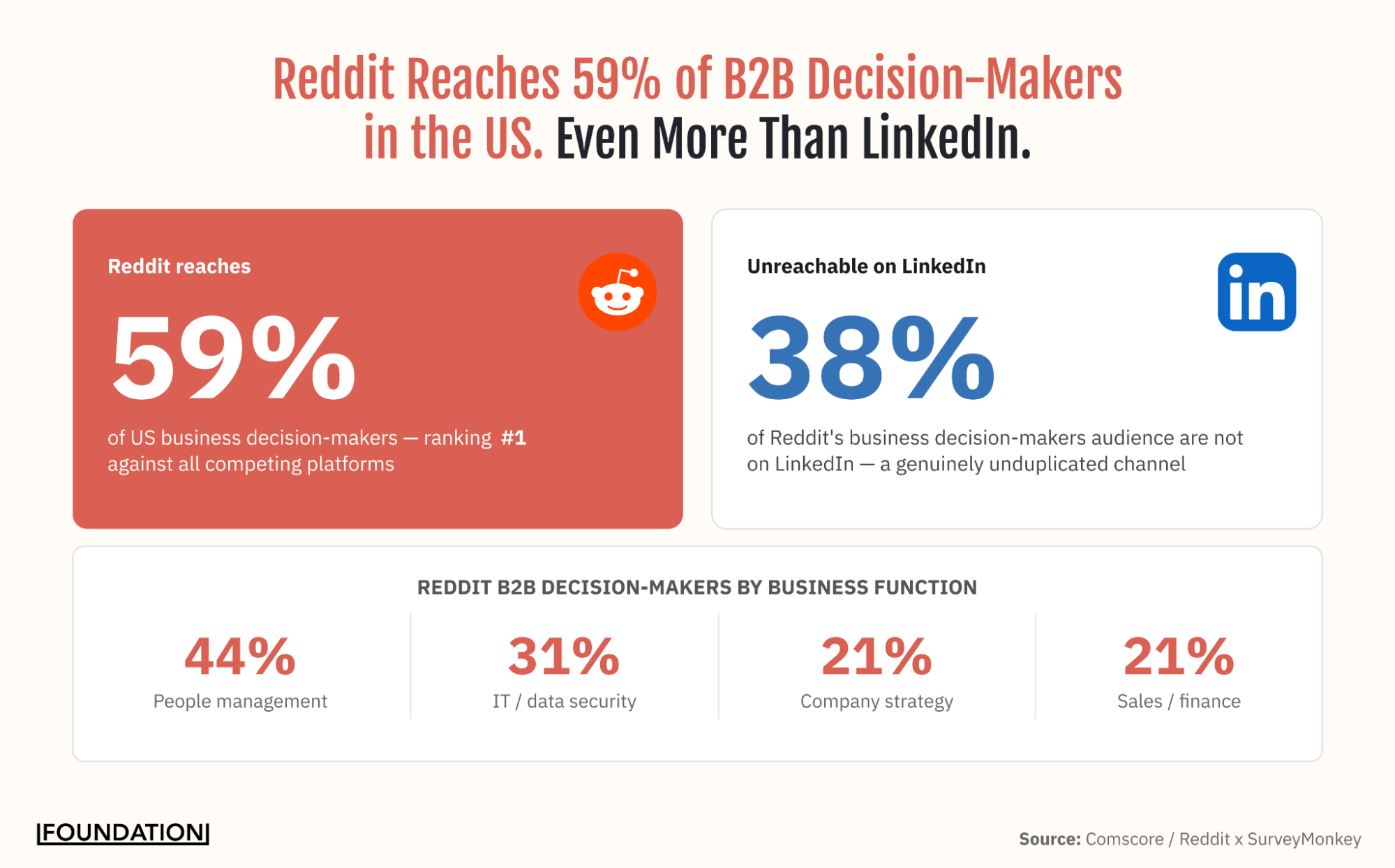
This is the demand engine that feeds all of the above. Essentially, it’s how buyers find you before they ever hit a signup page or a marketplace listing. Blog content, YouTube, LinkedIn, Reddit, newsletters, podcasts, review sites, and third-party mentions all play a role.
Most SaaS teams treat that last one as an afterthought. They press publish and move on. That’s the exact mistake. The work starts at publish, it doesn’t end there, and a real plan puts distribution channels behind every asset you create.
The old playbook split distribution into three buckets: owned (your site and email list), earned (PR, mentions, backlinks), and paid (ads). Those still help you organize the thinking, but they no longer capture how influence actually spreads. Instead, buyers and AI systems now lean on communities, creators, forums, newsletters, and third-party publications to decide who’s worth trusting. Our full breakdown of a modern content distribution strategy walks through that stack layer by layer.
Who does SaaS distribution well: 8 examples
Talk is cheap. So here are companies that turned distribution into their biggest growth lever, and the specific play behind each one.
1. Slack: word of mouth as a growth engine
Slack spread team by team inside companies. One group started using it, invited others, and usage climbed floor by floor before any executive signed a contract. Free access removed the friction, and as a result, the product did the selling.
2. Figma: collaboration as distribution
Figma lives in the browser and invites everyone into the file. Designers shared links with developers, PMs, and clients, and every share pulled new users in. Meanwhile, community templates and plugins turned the user base itself into a distribution channel. You can see this play out on Figma’s own community page.
3. Notion: templates and community
Notion turned its users into evangelists. Free templates, an ambassador program, and a swarm of creators building Notion content on YouTube and X meant the community did the marketing. As a result, someone searching “notion template for X” lands on Notion whether the company published that template or not.
4. Canva: freemium plus template SEO
Canva pairs a genuinely useful free tier with one of the largest template libraries on the web. Search almost any design need… a poster, an Instagram post, a resume… and Canva is waiting with a template page built to rank. In short, free product, massive search footprint. The Canva Case Study on how they built a backlink empire is a must read for anyone looking to understand the power of search and scale.
5. HubSpot: inbound before it had a name
HubSpot helped invent modern content marketing for SaaS. Free tools, a free CRM, HubSpot Academy, and a mountain of educational content pull millions of buyers in every month. In other words, they gave away the education and earned the pipeline.
The Hubspot Case Study on how they used content to build rapport, community and SERP visibility is one worth studying.
6. Salesforce: the ecosystem play
AppExchange turned Salesforce into a platform other companies build on. Thousands of partner apps, consultants, and integrations mean Salesforce distributes through an entire economy it created, well beyond its own sales team.
7. Atlassian: growth without a sales army
Atlassian built Jira, Confluence, and Trello into a giant while running lean on traditional outbound sales for years. Low-touch self-serve signups plus the Atlassian Marketplace let the products and partners carry the load.
8. Ahrefs: teaching as distribution
Ahrefs built a content and YouTube operation that teaches SEO to the exact people who become customers. Instead of letting videos sit idle, they organize their YouTube channel into tutorial playlists so one visit turns into a dozen views.
Social channels play into almost every example above. If you want more brand playbooks like these, see our roundup of 5 brands doing social media right.
How to build your own SaaS distribution strategy
You don’t need all six models. You need the right ones for your product and your buyer. So, here’s the playbook.
1. Pick your primary SaaS distribution motion
Match the motion to your price and complexity. Low price, fast value, and a self-explanatory product point to PLG and self-serve. High price and complex buying, on the other hand, point to sales-led. Most companies eventually blend two or three.
2. Map channels to where your buyers actually research
There’s no universal channel mix. A team selling to security buyers distributes differently than one selling to developers or RevOps leaders. Some platforms overlap… Reddit, LinkedIn, YouTube, search, review sites… but the real mix should reflect where your audience validates decisions.
3. Create once, distribute forever
Most teams create a piece of content, publish it, and abandon it. Flip that. For example, one webinar becomes a dozen clips, a blog post, an email, a LinkedIn carousel, and a Reddit comment. Hootsuite took a single evergreen blog post that was barely pulling 5,000 monthly visits and grew it into 980,000 monthly sessions by updating and repurposing it.
That’s the D.R.E.A.M. mindset: Distribution Rules Everything Around Me….
For more ways to stretch a single asset, see our list of content distribution ideas.
4. Earn third-party credibility
Your own website is one voice. Buyers, however, trust other voices more. Reviews on G2 and Capterra, mentions in newsletters, coverage on industry sites, and honest recommendations in communities all shape shortlists before a buyer ever visits your site.
5. Get cited by AI
This is the newest layer, and most SaaS teams are asleep on it. More on that in a second.
6. Measure what compounds
Track which channels bring buyers who stick around. Clicks feel good, but retained revenue pays the bills. Distribution that compounds (content, SEO, community, AI citations) keeps paying off long after you hit publish, while paid stops the moment you stop spending.
SaaS distribution in the age of AI
Here’s the shift that changes everything.
When a buyer asks ChatGPT or Claude for the best tool in your category, the answer gets assembled from sources across the web. Foundation ran a study with AirOps analyzing 5.1 million AI responses and 57.2 million citations across 50 B2B brands, seven SaaS verticals, and five major AI platforms. As it turns out, roughly 90% of the citations in those B2B AI answers came from third-party sources, not the brand’s own website.
Read that again. Nine out of ten sources shaping AI recommendations live outside your domain.
So distribution is now the whole game for AI visibility. If your product only lives on your own site, you’re invisible to the systems buyers increasingly trust. Instead, the brands that get recommended are the ones distributed across the sources the models read… communities, review sites, publications, and creators.
I called Reddit early. I also called AEO and GEO roughly 18 months before most of the industry caught on. This is the next one. Ultimately, distribution decides who AI recommends, and the teams building that footprint now will own their category for years.
SaaS distribution FAQ
What is SaaS distribution?
Distribution in SaaS is how a software product reaches its users and buyers. Specifically, it covers both the go-to-market motion that delivers the product (self-serve, sales, partners, or marketplaces) and the marketing channels that create demand (content, search, social, communities, and AI).
What are the main SaaS distribution channels?
The main channels are self-serve and product-led signups, direct sales, channel partners and resellers, cloud and app marketplaces, embedded or white-label deals, and content and community distribution across search, social, Reddit, YouTube, newsletters, and review sites.
What is a SaaS distributor?
A SaaS distributor is a company that resells or delivers another company’s software to end customers, often bundling, supporting, and billing for it. Cloud marketplaces and value-added resellers both play this role.
What does SaaS stand for?
SaaS stands for Software as a Service. In short, it’s software delivered over the internet on a subscription, instead of installed and maintained on your own machines.
How do you build a SaaS distribution strategy?
Pick a primary go-to-market motion that fits your price and product, match your channels to where your buyers research, create content once and distribute it everywhere, earn third-party credibility through reviews and mentions, and build a presence in the sources AI assistants cite.
The takeaway
Distribution is the difference between a great product nobody uses and a category leader. Pick your models. Match your channels. Create once and distribute forever. And start building the footprint that both buyers and AI systems trust.
That’s how you win.
If you want a partner to build that distribution engine with you, that’s the work we do every day at Foundation. Here’s how we approach content distribution for B2B SaaS.