Article's Content
Article's Content
Welcome back to What Matters This Week.
Last week we previewed our joint research report with AirOps on B2B brand visibility across 5.1 million AI prompts.
This week, we’re looking at Google’s recent revelation about the content types winning and losing AI search in their ecosystem (and how you can start producing them today).
Google Wants Non-Commodity Content. These B2B Brands Show You What It Looks Like.
Here’s the TL;DR:
- Danny Sullivan from Google split content into two buckets: commodity and non-commodity. Non-commodity wins in AI search.
- The commoditization of content isn’t a search problem. It’s a problem that shows up across all media platforms.
- To produce non-commodity content, you need systems that extract authentic insights from the people inside your organization who actually lived it.
- If you want examples of non-commodity content in B2B, look at brands that are founder-led, like 6Sense, Clarify, and Beehiiv.
What Happened
At Google Search Central in Toronto last week, Danny Sullivan presented a slide that sent the whole marketing world into a tizzy. It divided content into two categories: commodity and non-commodity.
- Commodity content is the type of generic content that brands create to appease algorithms and fit neatly into content calendars. Top 10 listicles, well-trodden how-tos, and superficial thought-leadership.
- Non-commodity is the content that only you (or your team) could write because you lived it. A genuine founder story, a strategy that went wrong, and content that’s actually useful for your audience.
The latter is what wins AI and search visibility.

The content commoditization call-out has been a long time coming. Ross called it way back in July 2023:
“Content is becoming a commodity. It’s easier to create than ever before. The sea of mediocre content marketing has never been more full than it is today.”
According to Search Engine Roundtable, Sullivan named three attributes that separate non-commodity content from the rest:
- It’s unique: It brings a viewpoint others can’t easily replicate.
- It’s specific: It covers a particular instance or situation, not general rules.
- It’s authentic: It demonstrates first-hand knowledge from someone who did the work.
Then he added the note that should have been obvious from the start — these same attributes align with what’s always worked in traditional SEO.
The last bullet in Sullivan’s “Tips for AI Search Success” slide is what you need to focus on: for AI search success, you need unique, authentic, non-commodity content.
Why It Matters
The commodity problem doesn’t stop at search. It’s a content strategy problem that shows up everywhere.
Every channel has its own immune system against commodity content. Reddit’s is the most visible and the most brutal, but the same reflex exists on LinkedIn, YouTube, and X. Content that’s blatantly optimizing for an algorithm instead of a user is going to miss the mark (at best), especially if the insights are all derived from Claude and ChatGPT instead of a living, breathing expert.
To do it the right way, take inspiration from companies putting out the kind of non-commodity content Google is looking for:
- 6Sense built their content moat around proprietary data and first-hand observation of how B2B buyers actually behave.
- Clarify turns their founder’s real decisions, hiring mistakes, product pivots, and hot-takes, into high-performing LinkedIn content that drives pipeline.
- Beehiiv shares their founder-led growth playbook in real time, including what failed, to give their audience a glimpse into how SaaS Unicorns grow.
The throughline across all of it: upvotes, follows, views, and organic rankings are all the same signal. Audiences reward content that carries proof of work.
The brands that built content engines fuelled by genuine experience are already winning that signal game without having explicitly optimized for it: 6Sense’s Dark Funnel research, Clarify’s founder decisions, Beehiiv’s documented growth story. That’s what it looks like when E-E-A-T is baked into how a team thinks about content.
To scale non-commodity content, you need systems.
It’s easy enough to recognize non-commodity content and even come up with a few ideas. But few brands have built the infrastructure to produce it consistently across every channel.
Clarify’s content supply chain is the operational model worth studying (especially if you’re a startup, like them):
- 30-minute weekly leadership interviews
- Question banks organized by content pillar
- Recordings processed and formatted natively per channel
Most B2B content calendars are built around a publishing cadence. The ones that compound are built around source material — who inside the organization lived something worth writing about this week, and what’s the fastest path from that experience to a format that distributes.
What To Do About It
1) Audit your content calendar against one question.
Pull whatever’s planned for the next six weeks. For each piece, ask whether a competent writer could produce it without any support from subject matter experts at your company.
If yes, it’s commodity content.
Now, that doesn’t mean you shouldn’t publish it. Commodity content fills coverage gaps and supports search infrastructure. But it shouldn’t represent the majority of your production, and it won’t generate citations in AI search results.
2) Find the non-commodity material that already exists.
You don’t need Claude or ChatGPT for this. The ideas, insights, and information worth building from already exist inside your organization:
- Strategic decisions your C-Suite made in the last 90 days
- Client situations you navigated and what actually drove the call
- Tests you ran where the results surprised you
- Discovery call transcripts where a customer described a problem in language your team would never have chosen
None of this requires new research. It requires a content supply chain that captures information from across your organization and makes it available to your marketing team.
3) Separate the jobs AI should do from the jobs it can’t.
Use AI to accelerate the parts of content production that don’t require lived experience: research, structure, formatting for different channels, repurposing into short-form.
Keep humans accountable for the source material. The opinion, the test result, the specific decision, and what it cost.
The teams that conflate these two jobs are the ones that will spend Q3 wondering why their AI-assisted content program isn’t moving the needle.
What 57.2 Million Citations Reveal About the AI Visibility Gap in B2B.
We partnered with AirOps to track how 50 B2B brands appear in AI-generated responses across five major platforms over 60 days.
The headline finding: when buyers search for your category without your brand name, only 2.2% of citations in AI responses point to content you own.
In 85% of those responses, no brand-owned source appears. And the mention rate drops by at least 42% the moment a buyer switches from a branded to an unbranded prompt.
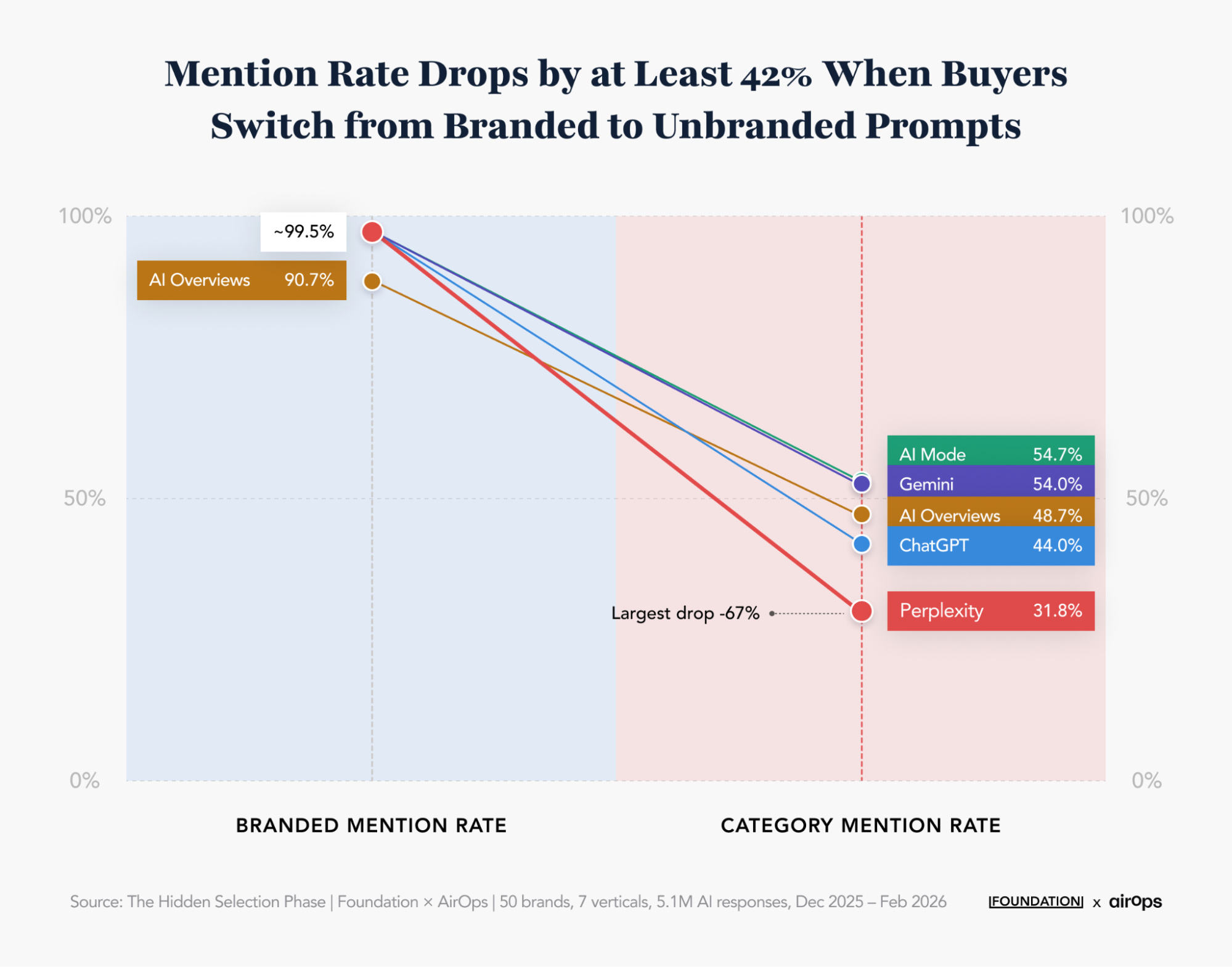
Your brand’s AI narrative is being written by Reddit threads, YouTube videos, and competitor pages at the exact moment buyers are building their shortlists.
The full report maps where those citations come from, how the fingerprint shifts by vertical, and what the brands earning more citations are doing differently.
Read The Hidden Selection Phase Report: The 14x Gap Between Branded and Unbranded AI Citations.
Go Deeper on Authentic Content
→ How Clarify Turned LinkedIn Into Their #1 Lead Machine — A breakdown of how Clarify built a content supply chain around founder expertise, turned real decisions into native LinkedIn content, and made the platform their top inbound lead source in six months. The operational model behind everything in point three above. [Foundation Labs]
→ Google Search Central Live Toronto — Full Slide Recap and Community Reactions — JC Chouinard’s complete recap of the April 2026 event, including photos of nearly every slide and a roundup of how the broader SEO industry responded. The primary source if you want the full picture of what Sullivan and the Google team actually said. [JC Chouinard]
→ We Asked 7 B2B Reddit Strategists What “Good” Content Looks Like. Here’s What They Said. — Foundation’s full framework for Reddit content that earns upvotes, drives AI citations, and builds community trust over time. The immune system analogy in this issue comes directly from what our team sees on the platform every week. [Foundation Labs]
That’s it for this week.
If something landed, tell us. If something felt off, tell us that too. Reply to this email or DM me on LinkedIn.
Have a great weekend,
Ethan Crump