Article's Content
Article's Content
By every conventional SEO measure, Brex’s content strategy is working. Since our first breakdown last year, their Spend Trends library has nearly doubled in estimated traffic value to $536,000. Brex ranks #1 for “business credit cards for startups,” a query aimed directly at their core market.
The AI answer above that #1 result draws on Reddit and Nav and presents Brex as one option rather than the lead recommendation.
Across 348 responses on eight AI engines, Brex appeared in 51.7% of answers. Yet only 6.5% of citations pointed to brex.com. Brex is recognized in the category. Other sources do the explaining, comparing, and recommending.
That split matters because AI answers are where vendor shortlists now start to form. Our buyer research found that 35% of companies with fewer than 250 employees already use AI search for product research, compared with 47% using Google. A rankings report records a #1 position but can’t show which company the answer above it actually favours.
Brex’s data makes the pattern concrete: ranking well, appearing in AI answers, and being the company those answers recommend are three different outcomes built by three different source ecosystems.
How We Measured Brex’s AI Visibility
Using US data from August 2026, we pulled Brex’s organic rankings, estimated traffic, keyword footprint, and page-level traffic value from Ahrefs. Using Profound, we measured how often Brex appeared in AI responses, how often those responses cited brex.com, and how their visibility compared with other companies in the category.
The dataset tracked six unbranded buyer queries across eight AI engines, including ChatGPT, Perplexity, Google AI Overviews, and Gemini, for a total of 348 responses.
We excluded two branded comparison queries from the visibility measurement because naming Brex in the prompt makes them more likely to appear. We analyzed those responses separately to examine which company each answer favoured.
The screenshots are dated illustrations, not part of the cross-engine measurement. Each captures one US response to one query and shouldn’t be read as evidence of a broader pattern.
AI responses shift as models and their source sets evolve, so the Profound findings represent the August 2026 measurement window rather than a permanent result.
Organic positions fluctuate too, so every ranking in this breakdown reflects the latest verified US result from the same research window. Google AI Mode was still processing part of the dataset when we exported the results, and its figures are marked as partial.
This analysis tracks three distinct outcomes. Appearance measures whether Brex is named in an AI response at all. Citation share measures how often brex.com supplies a source link in that response. Recommendation captures which company the answer positions as the best fit for the buyer’s question. A brand can score well on one and poorly on the others, and the sections that follow are organized around that distinction.
Where Brex Ranks vs. Where Brex Gets Cited
Brex enters this comparison with 268 pages in their Spend Trends library, an estimated traffic value of $536,000 (nearly double the $280,000 recorded in April 2025), and the #1 organic position for “business credit cards for startups.” That baseline makes the AI results that follow harder to explain away.

Brex’s Rankings Don’t Stop AI Overviews From Leading With Other Sources.
“Business credit cards” receives an estimated 54,000 US searches a month. Brex ranks #2 for that query, while their competitor Ramp is five positions down at #7.
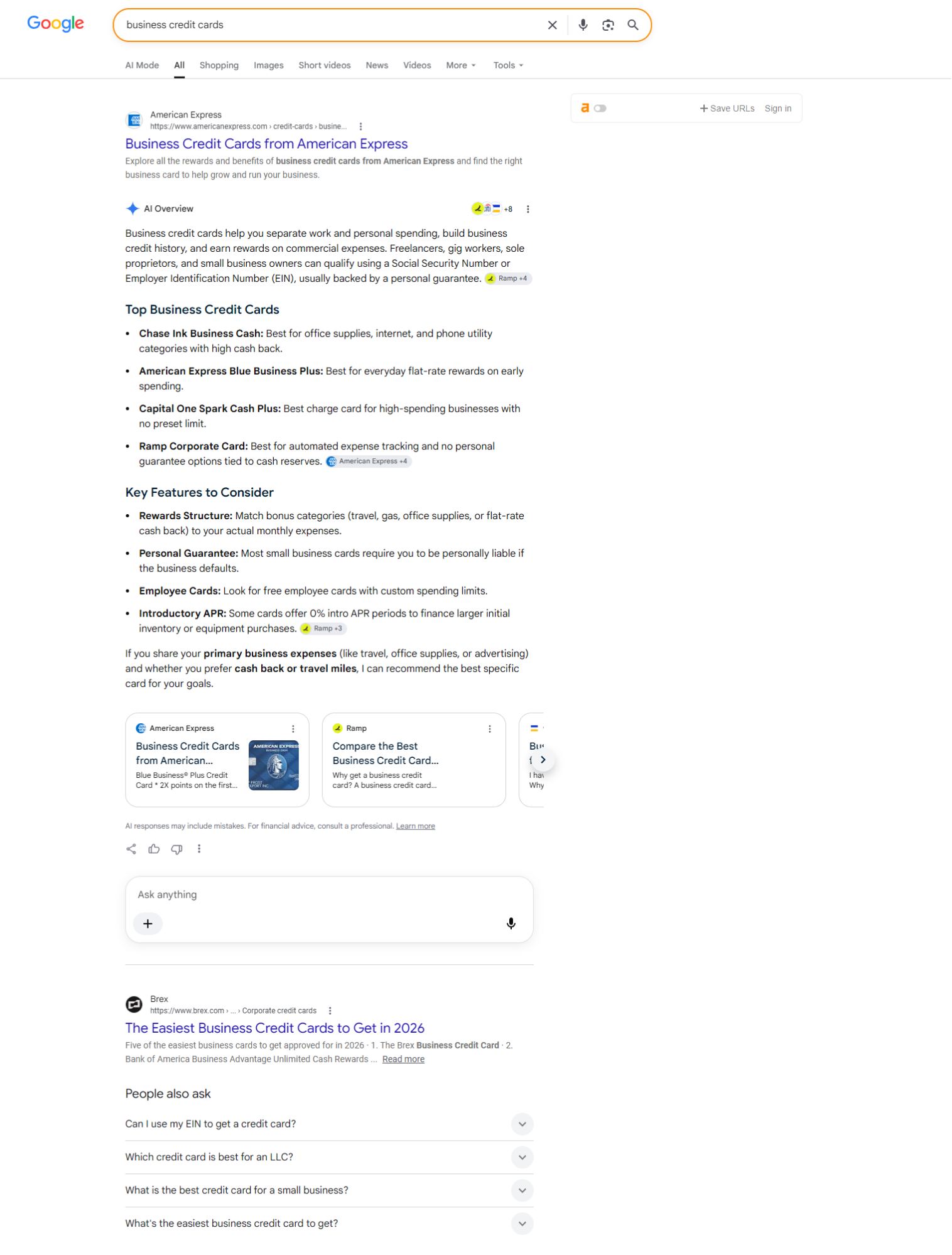
Yet, in the AI Overview we captured, Google cited Ramp, American Express, Visa, Citi, Wells Fargo, and NerdWallet. Brex didn’t appear even once among the cited sources, despite its SERP ranking.
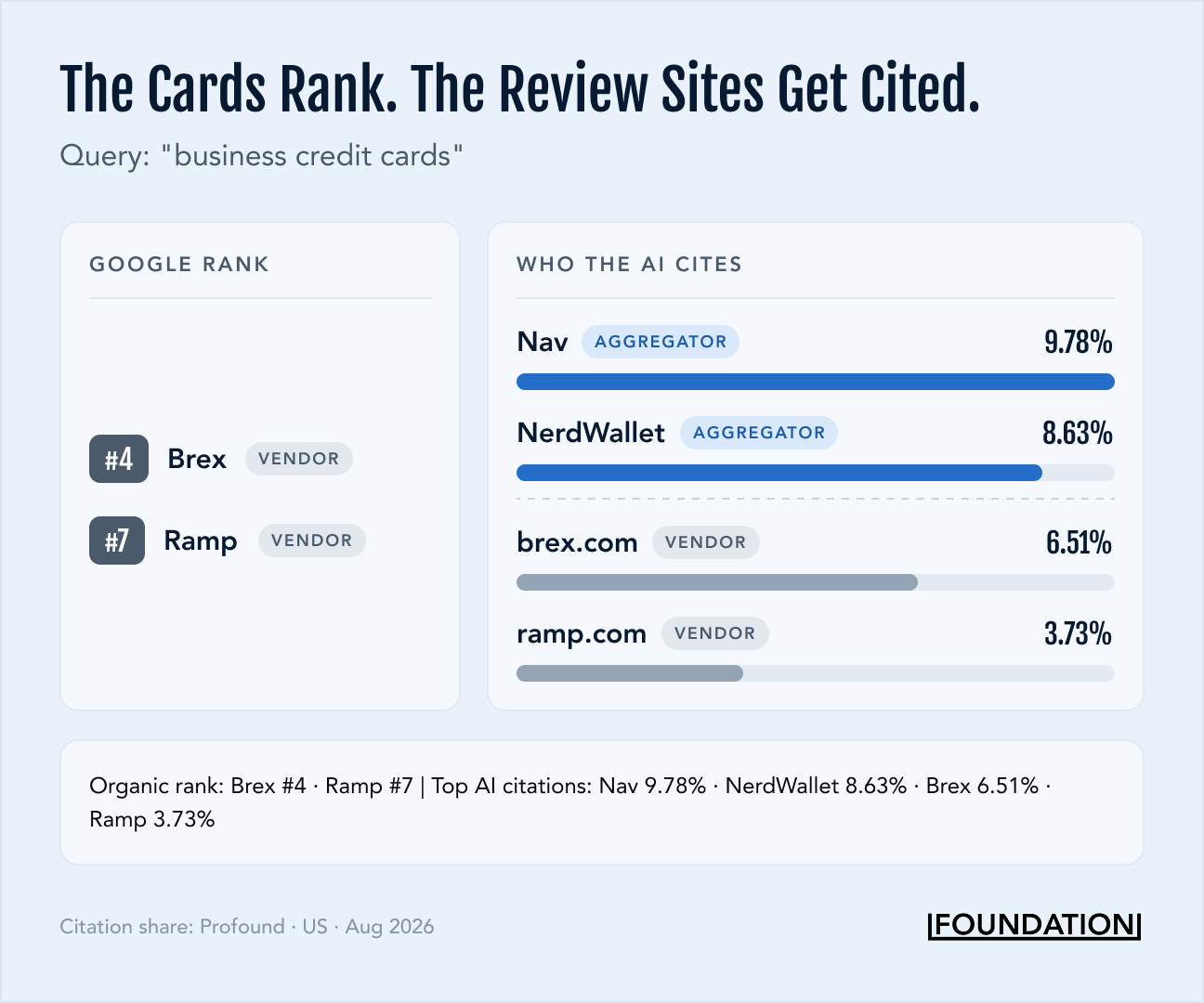
So Brex’s stronger position didn’t secure a citation. But perhaps reaching #1 would change the result.
The query “business credit cards for startups” lets us test that hypothesis because Brex holds the top organic position for that keyword.
In this case, the AI Overview above Brex’s #1 page drew on a Reddit discussion and cited Nav.
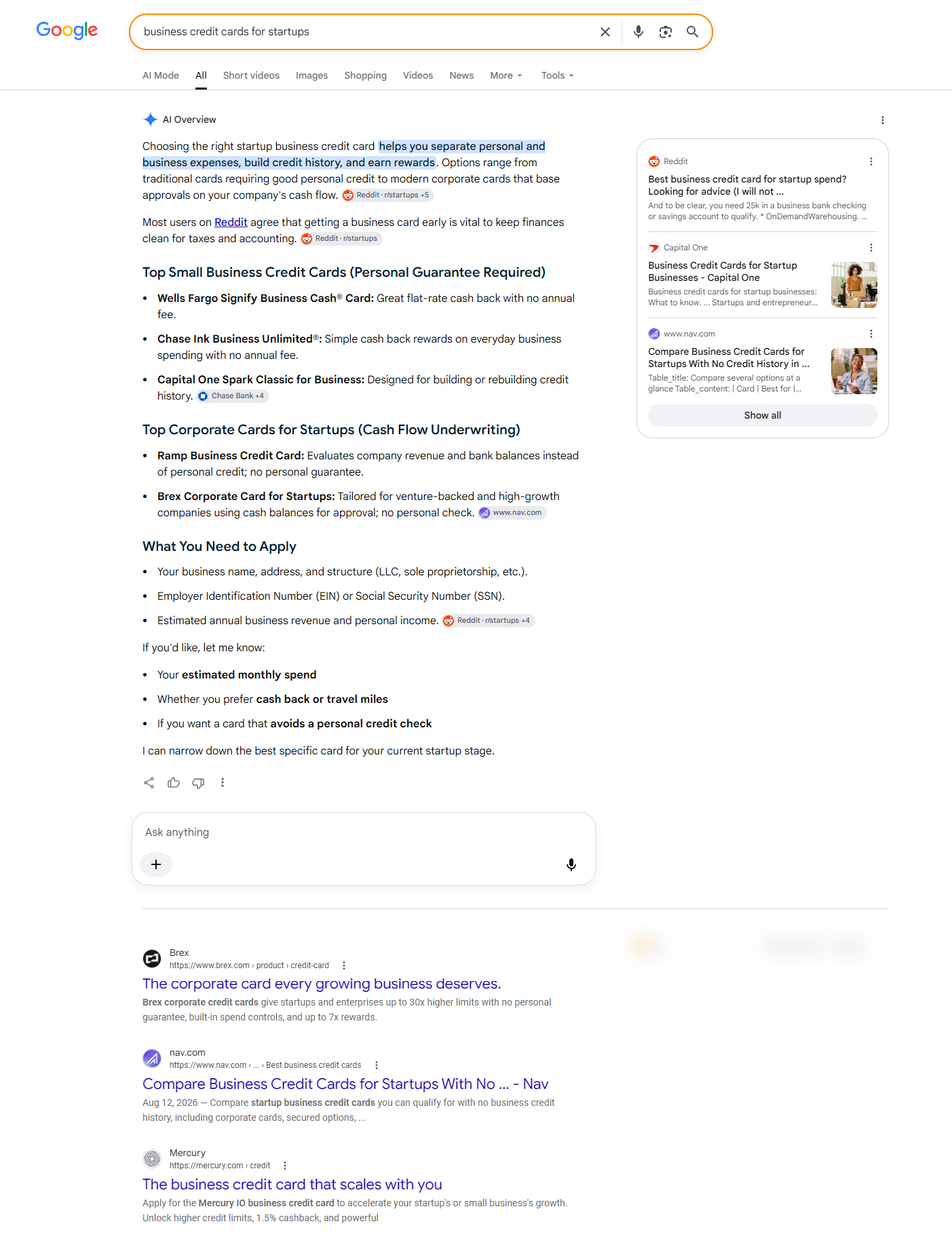
Brex did appear among the startup-card options, but they didn’t lead the recommendation.
These two results suggest the gap isn’t about ranking higher. It’s about which sources the AI Overview treats as authoritative enough to build the answer from, and a brand’s own page isn’t automatically in that set.
Brex Appears in 51.7% of AI Answers, but Their Site Accounts for Only 6.5% of Citations
No vendor dominates the citation set. Nav captured 9.78% of citations across the dataset and NerdWallet 8.63%, compared with 6.51% for brex.com and 3.73% for ramp.com. The aggregators outperformed every vendor in the category, including Ramp, the company with the highest appearance rate.
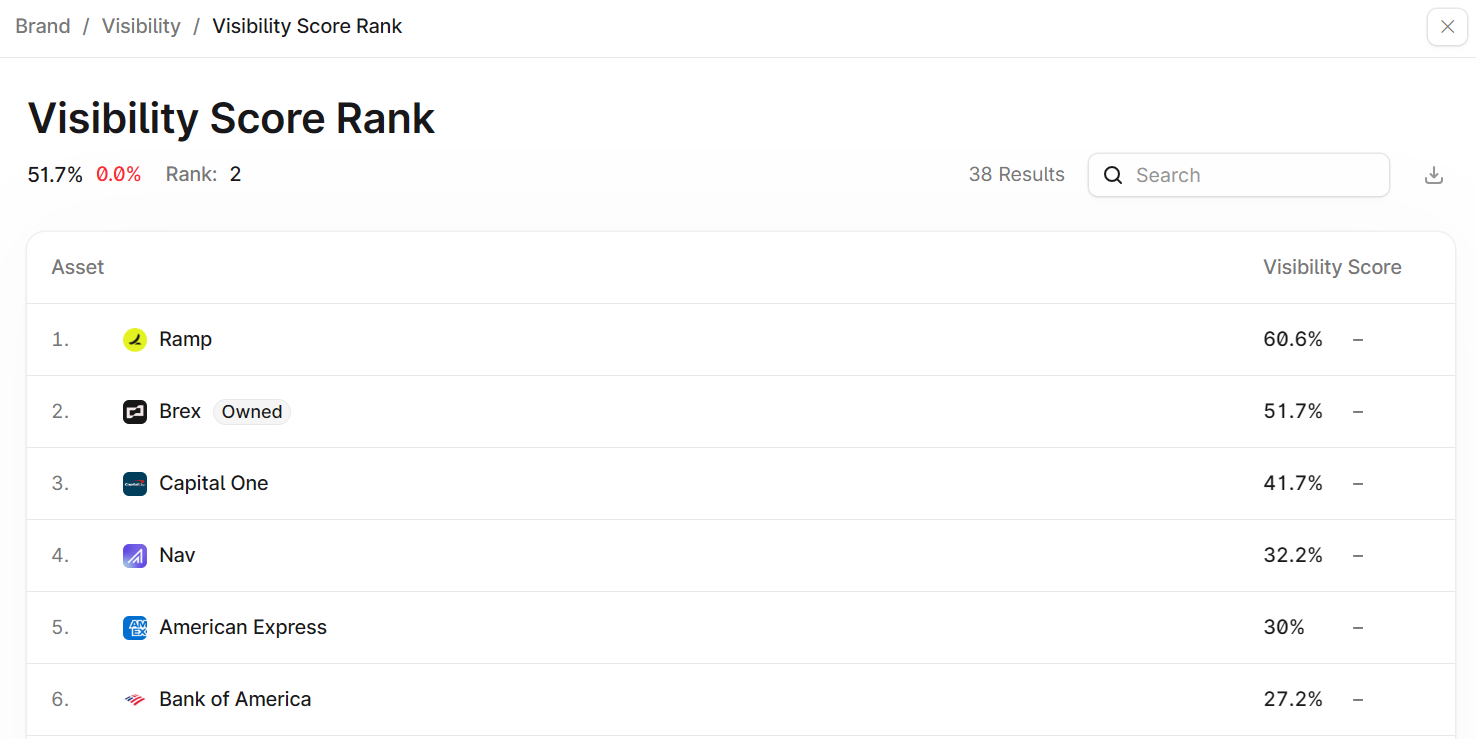
Brex’s 51.7% appearance rate is the second highest in the dataset, behind Ramp at 60.6%. AI tools recognize both companies as part of the category. But recognition and source authority are different. When models build the answer, they draw from the domains that compare and explain the options, not the vendors themselves.
The engine-level data shows how brex.com’s citation share varies:
| AI engine | Brex citation share |
| ChatGPT | 13.8% |
| Google Gemini | 10.0% |
| Google AI Overviews | 8.1% |
| Perplexity | 4.6% |
| Google AI Mode* | 2.5% |
*Google AI Mode data was partial during the measurement window.
Brex.com received the highest citation share on ChatGPT at 13.8%. Even there, fewer than one in seven citations pointed to Brex’s pages. Across the available engine data, other domains supplied most of the citations used to build the answers.
Being named in an answer and supplying the source behind it are different forms of influence. Brex has the first. Aggregators and publishers have the second, and that’s what shapes what the answer actually says.
Brex’s performance also changed with query wording. The prompts where they performed better reveal the part of the category AI tools most strongly associate with Brex.
Brex’s Appearance Holds on Startup Queries and Weakens on Broad Category Prompts
Brex performed better when queries specified startups, venture-backed businesses, or cards without a personal guarantee. On broader questions such as “business credit cards,” AI tools presented Brex as one option while relying more heavily on issuers, aggregators, and financial publishers.
More startup-card articles would add to the part of Brex’s strategy that already works. The larger gap sits in broad category queries, where Brex doesn’t control the narrative. Aggregators and financial publishers write those comparisons, and right now, they’re the ones AI tools trust to frame the category.
Competitors and Earned Media Supply 46% of the Sources AI Answers Draw From
The ranking examples show the disconnect. The source data helps explain where it comes from.
Profound classified 24.6% of citations in the Brex dataset as competitor sources and 21% as earned media. Together, those categories accounted for 45.6% of citations, compared with 6.5% from Brex-owned sources. The remaining citations fell across social and institutional sources and Profound’s broader “Other” category.

That source mix aligns with Foundation’s broader finding that nearly 90% of AI citations for B2B SaaS come from outside the cited brand’s website. Card issuers and competitors supply product information. Aggregators and financial publishers compare the options. Reddit contributes buyer discussions, including objections and examples of who a product may not suit.
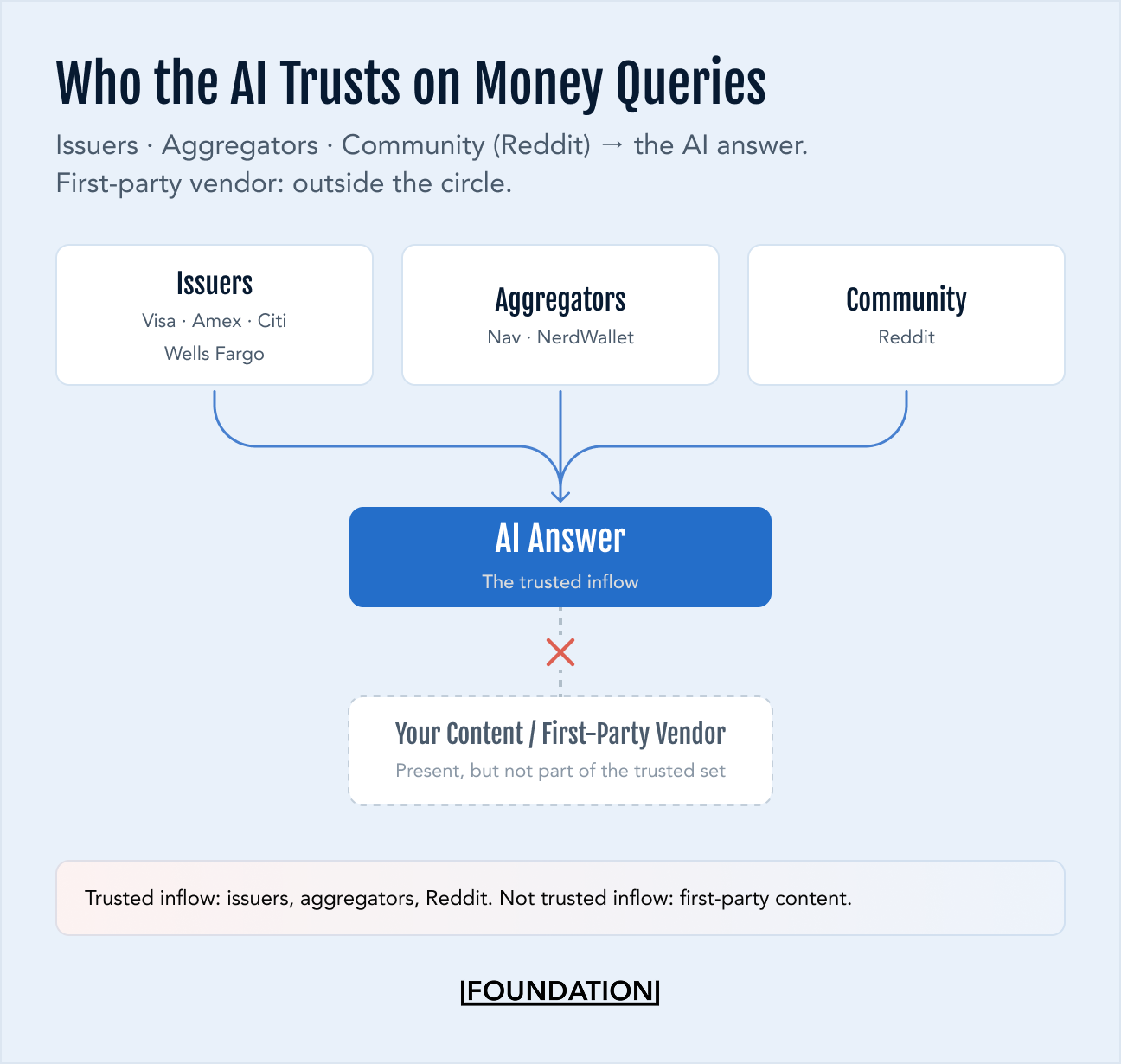
When nearly half the source material comes from competitors and earned media, optimizing your own site addresses less than 7% of the inputs shaping the answer. The rest requires influencing content you don’t own.
ChatGPT Pulled From Reddit Discussions and Recommended Ramp Over Brex
We ran “What business credit cards do founders recommend?” in ChatGPT Search from a US location.
The response presented Ramp as the strongest founder recommendation alongside Amex and Chase, citing Reddit discussions.
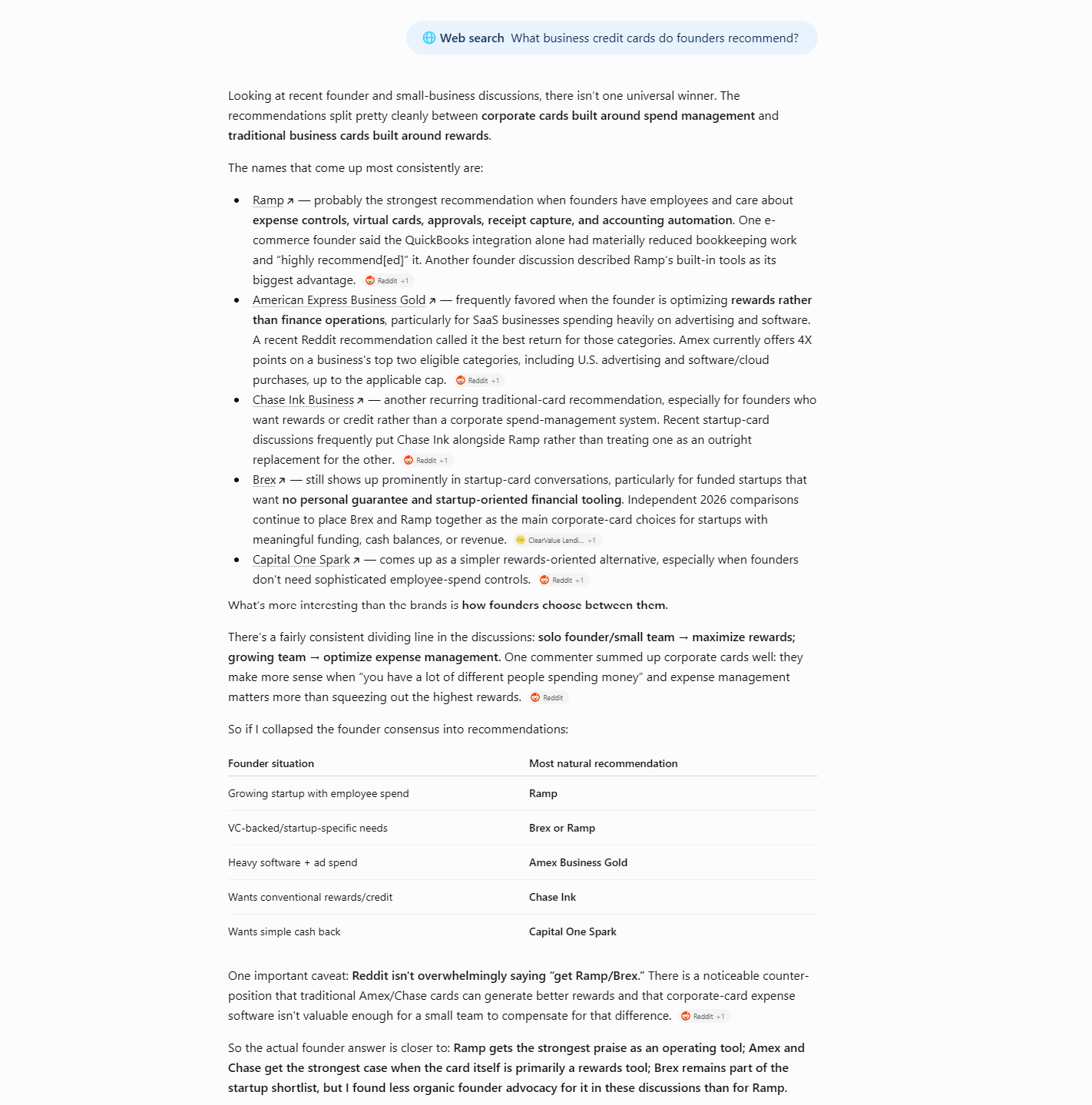
It named Brex but noted less organic founder advocacy than Ramp.
In our Reddit impact report, we found Reddit pages outranking every major B2B vendor across keywords representing roughly 957,000 monthly searches.
Buyer conversations already prominent in search can also become source material when AI tools answer recommendation queries.
Troi Leemuel Lamboon, Reddit specialist on Foundation’s strategy team, explains why those discussions can be more useful than a vendor page when the question asks for a recommendation:
A vendor is not going to say ‘don’t buy this, you’re too small for this.’ But Reddit will. The AI tool is just picking the result that actually answers the question, and sometimes it’s the comments.
In other words, buyer discussions contain raw experience that vendor pages rarely include: poor-fit cases, objections, implementation frustrations, and corrections from people with different experiences.
Those details help an AI tool distinguish between products that look similar on a feature list.
A stronger guide on brex.com can’t control what founders say when they compare cards. When the question is “what do founders recommend,” the answer comes from founders, and right now they’re recommending Ramp.
Perplexity Cited Brex But Recommended Ramp
We reviewed “Brex vs. Ramp” separately because naming both companies makes them more likely to appear. In the captured Perplexity response, Brex appeared as both a subject and a source: Perplexity cited brex.com/versus/ramp, then named Ramp the better default for most small and mid-sized US businesses. It presented Brex as stronger for venture-backed or larger companies with heavier travel and international needs.
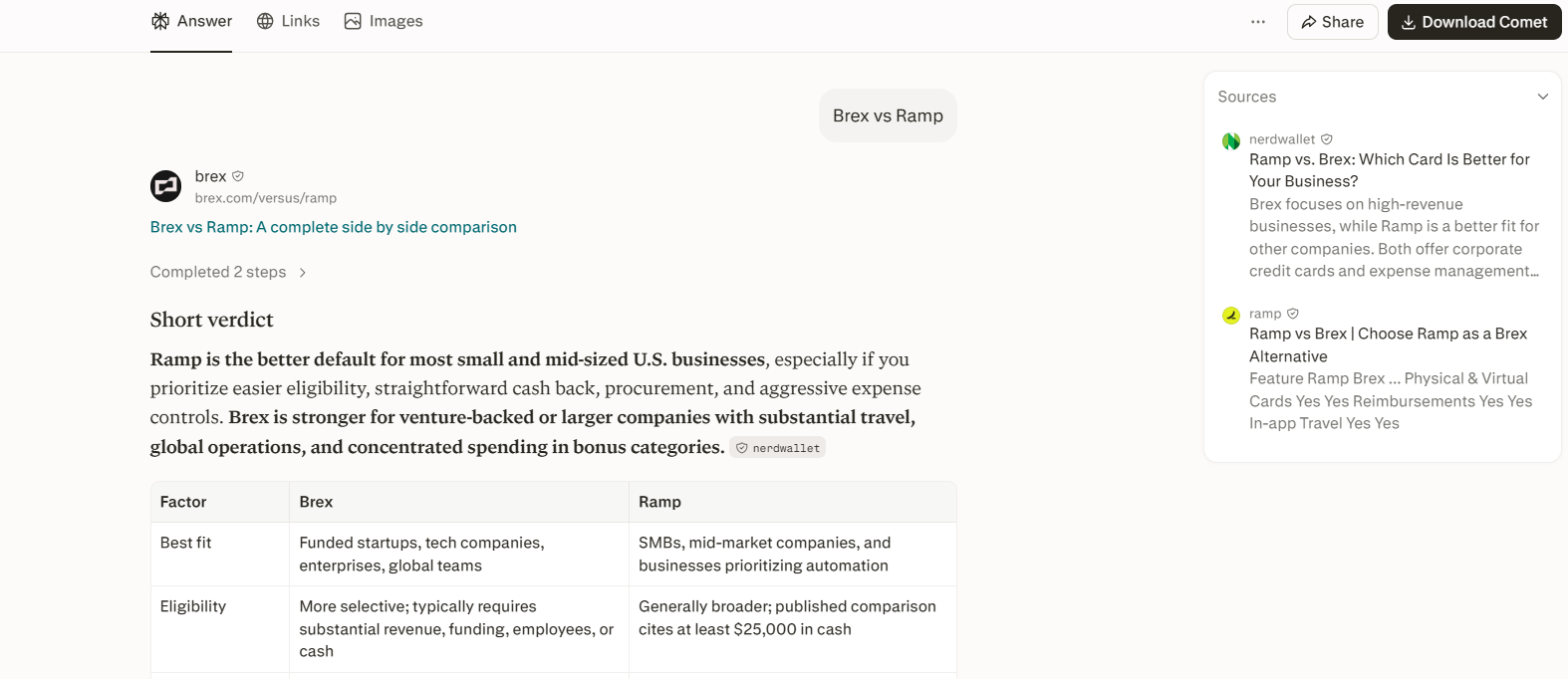
The result separates citation from influence. Brex’s page entered the source set, but the answer still favoured a competitor. Citation tracking can show whether a brand contributes information but teams also need to record which company the answer recommends.
Brex’s comparison page did exactly what it was designed to do: it entered the source set. The answer still picked a competitor. That’s the gap between being a source and winning the recommendation.
What Brex Can Teach You About AI Visibility Strategy
Brex’s rankings and traffic remain valuable. But a rankings report can’t show whether an AI response cites the brand, recommends them, or uses their content while favouring a competitor. Buyers are forming shortlists inside these answers. To know where your brand stands in that process, you need to add AI visibility to your search reporting and optimization.
Measure Citations and Recommendations Alongside Rankings
Start with the buyer questions closest to a commercial decision. For each query, record the organic position, whether the brand appears in the AI answer, which domains are cited, and which company receives the recommendation. Those columns expose discrepancies a rankings dashboard can’t show.
A single query can return different results across engines and over time. The goal isn’t to track every fluctuation. It’s to baseline where your brand consistently appears, where it disappears, and where competitors receive the recommendation instead.
Map the Source Gap and Fill It
When a competitor appears ahead of you, identify the sources supporting the answer. Separate vendors from aggregators, review platforms, publishers, and community discussions. Then record which sources mention your brand, which favour competitors, and which omit you entirely.
Run the same comparison across query types. The result is a source-level map of where your category authority holds and where it thins out. For Brex, the map would show strong association with startup-card queries and weaker presence in broad category comparisons where aggregators and financial publishers carry the answer.
Closing that gap requires presence in the sources AI tools already draw from. In one of our GEO engagements, that meant a financial services client going from 12 of 100 priority Reddit threads cited by LLMs to 73, appearing above competitors in 53. The threads were already in the citation set. The work was earning a place inside them.
That doesn’t mean adding Reddit to the distribution calendar beside LinkedIn and email. Reddit operates under community moderation and platform rules, which gives brands far less control than their own blog. As Lamboon explains:
“If Reddit bans your account, your previous posts may stay live even though you can no longer manage them or respond to the conversation around them.”
The principle applies across off-site sources: earn an accurate place in the sources buyers and AI tools already trust.
Rankings, Citations, and Recommendations Measure Different Things
Brex’s SEO engine continues to deliver. The Spend Trends library has grown in traffic value, and Brex holds the #1 organic position for a query aimed directly at their startup market. Nothing in this analysis makes those results less valuable.
When a strong ranking doesn’t carry into the AI answer, another owned page may not address the gap. The missing influence may sit in third-party comparisons, publisher coverage, reviews, or buyer discussions that shape how AI tools understand the brand.
For Brex, the next step is to identify which outside sources shape recommendations on the queries where their rankings already lead.
See where your brand appears, which sources shape the response, and where competitors receive the recommendation. Contact us to learn how Foundation can measure and close your AI visibility gap.