Article's Content
Article's Content
There’s a moment in every B2B purchase that you never see.
It happens before a demo gets booked, before a form gets filled, before a buyer lands on your homepage. Someone opens ChatGPT or Perplexity, asks for the best tools in your category, and gets a ready-made shortlist.
Your brand is either on it or it isn’t. There’s no page two.
This is the hidden selection phase, and it’s determined by your brand’s AI visibility in large language models. G2’s recent Answer Economy Report shows exactly how important this phase is in shaping B2B buyer behavior:
- 71% now rely on AI chatbots for software research, up from roughly 60% just seven months ago.
- More than half (51%) start their research with an AI chatbot more often than with Google.
- 69% of buyers say AI led them to select a different vendor than they initially planned.
- One in three purchased from a vendor they’d never heard of before AI mentioned them.
Now for the uncomfortable part: the selection phase happens mostly off your site, which means you’re not in control of it. Today we’ll look at what you can control.
But first…
Nearly 90% of AI Visibility Comes From Off-Site Sources
AI chatbots are now the #1 source influencing which vendors make it into buyer shortlists — ahead of review sites, market research firms, vendor websites, and peers. That’s not a content marketing problem. It’s a citation problem.
We partnered with AirOps to track how 50 B2B brands across seven verticals appear inside AI responses. Our corresponding Hidden Selection Phase report covers 5.1 million responses and 57.2 million citations across five platforms over 60 days. Two key findings from this research have massive implications for marketing strategy:
- Only 10.15% of citations across all AI responses pointed to brand-owned domains.
Depending on the vertical, the other 80-90% came from off-site sources like Reddit threads, YouTube videos, LinkedIn articles, review sites, industry publications, and more.
- In 68% of AI answers, the brand’s own content doesn’t appear at all.
More than two out of three times an AI describes a brand to a buyer, that brand’s website contributed nothing to the answer. In unbranded discovery queries, the category-level searches that actually build shortlists, brand-owned citations fall to 2.24%.

Sit with that number. In the exact searches where buyers are deciding who to shortlist for their next big software purchase, your website has about a 2% chance of being cited.
That’s a discovery gap that you simply can’t make up with your website alone.
Of course, you can and should take steps to optimize your site for generative engines. But these changes aren’t going to influence the vast majority of off-site sources that shape AI answers for your category.
Before we get into the domains shaping visibility in B2B SaaS, you need to know why off-site sources are so influential in shaping these answers in the first place.
Why Off-Site Sources Earn AI Visibility
The reason third-party sources show up so often in AI answers is structural.
When a buyer types a prompt into an LLM, the model doesn’t run a single search. It conducts a query fan-out that generates dozens of variations of that original query — best, top-rated, most reviewed, highest-rated, alternatives to — and scrapes across Reddit, YouTube, LinkedIn, review sites, and traditional search simultaneously.
Here’s how Ross described this process on The Nick Standlea Show:
“The LLM is going to modify that question in a bunch of different ways. It’s going to ask for the best, the top, the highest rated, the most reviewed. It’s going to create a bunch of variations of that word that you asked. And then it’s going to scrape the internet and look for information.”
Your website is one input in that process. Off-site sources are represented in the hundreds, even thousands.
This helps explain why brand-owned citations fall to 2.24% in unbranded discovery queries. It’s not that your site is invisible — it’s that Reddit threads, YouTube walkthroughs, and comparison pages have generated far more indexed, crawlable, frequently-linked content on your category than your domain ever will. The fan-out mechanic doesn’t evaluate sources by ownership. It tallies them by volume and variety across the open web. Third-party platforms win that tally almost by design.
Which means optimizing your website is necessary but insufficient. To maximize influence you need to show up across the key platforms and channels shaping AI visibility.
Prioritize the Domains Shaping AI Visibility
The findings from our Hidden Selection Phase report also revealed which of the countless off-site sources are most influential in building AI visibility for B2B SaaS: Reddit (21%), YouTube (13%), and LinkedIn (13%) are heavily cited in answers to B2B prompts, along with a mosaic of third-party websites and platforms.
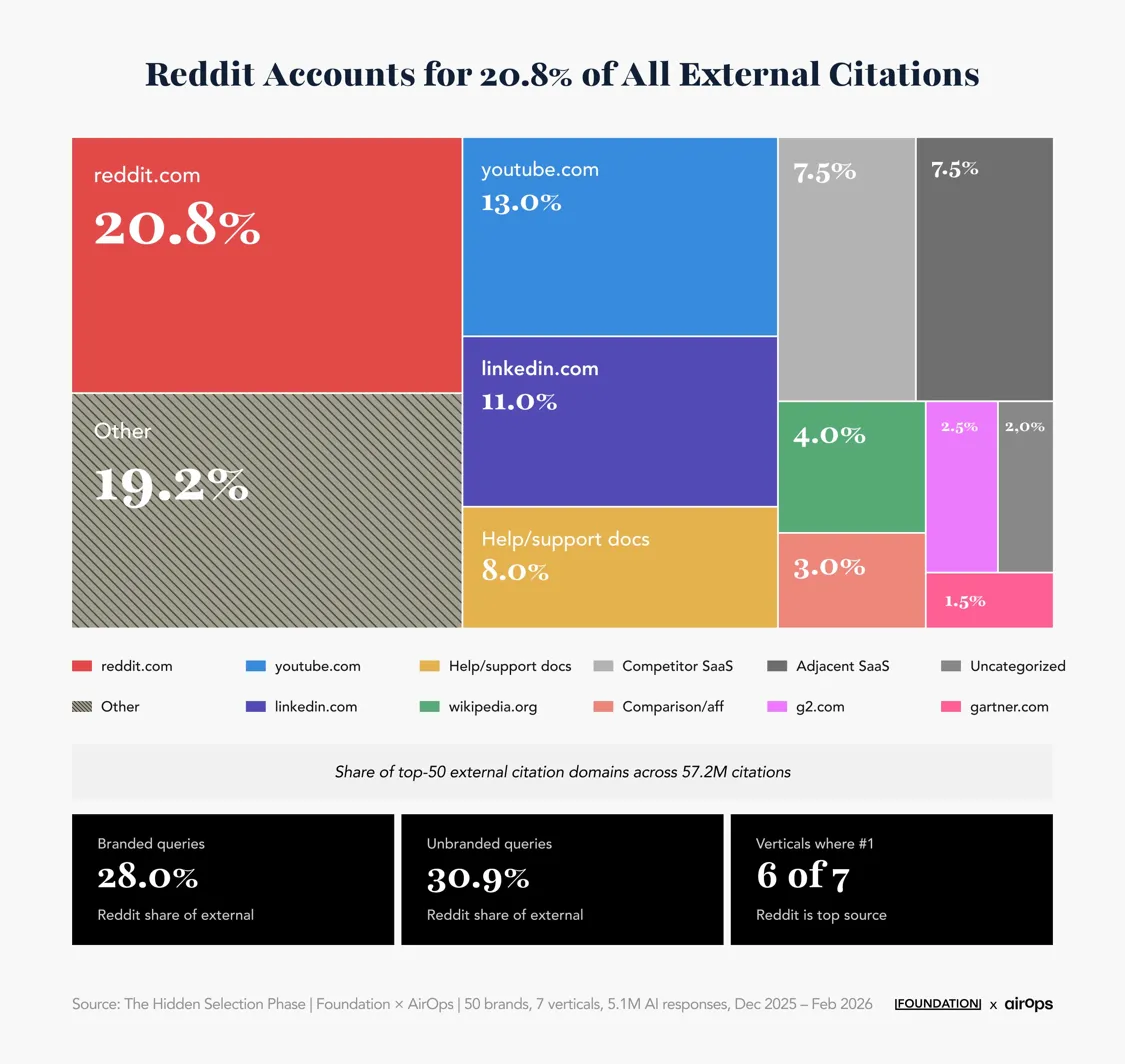
The off-site sources dominating the treemap above aren’t arbitrary. In fact, many of them are channels we’ve recommended B2B brands invest in as part of their distribution strategies. The same channels that influenced buyers are also influencing the AI models these buyers now use.
To maximize AI visibility, we recommend brands focus on six channels. Only the first two correspond to your brand’s domain:
- On-site content: topical authority that forms the foundation AI systems index and trust
- Technical GEO: schema, crawlability, and structured data that makes your content machine-readable
- Reddit: community trust signals that AI models weight heavily, particularly for unbranded discovery queries
- YouTube: video and transcript authority, dominant in evaluation-driven verticals
- LinkedIn: professional authority signals, especially in B2B discovery
- Earned media: third-party citations, digital PR, and review presence; the trust layer AI models rely on to validate claims
The six channels are a starting point for your AI visibility strategy. How much you prioritize each of them ultimately depends on your industry and vertical.
Your Path to AI Visibility Depends on Your Vertical
One of the most interesting findings from our research with AirOps is that every B2B SaaS vertical has its own citation fingerprint.
Translation: your path to AI visibility shifts depending on the industry you sell into.
The core visibility channels, Reddit, YouTube, and LinkedIn, are influential across all verticals, but there are notable industry-specific domains that you need to be aware of.
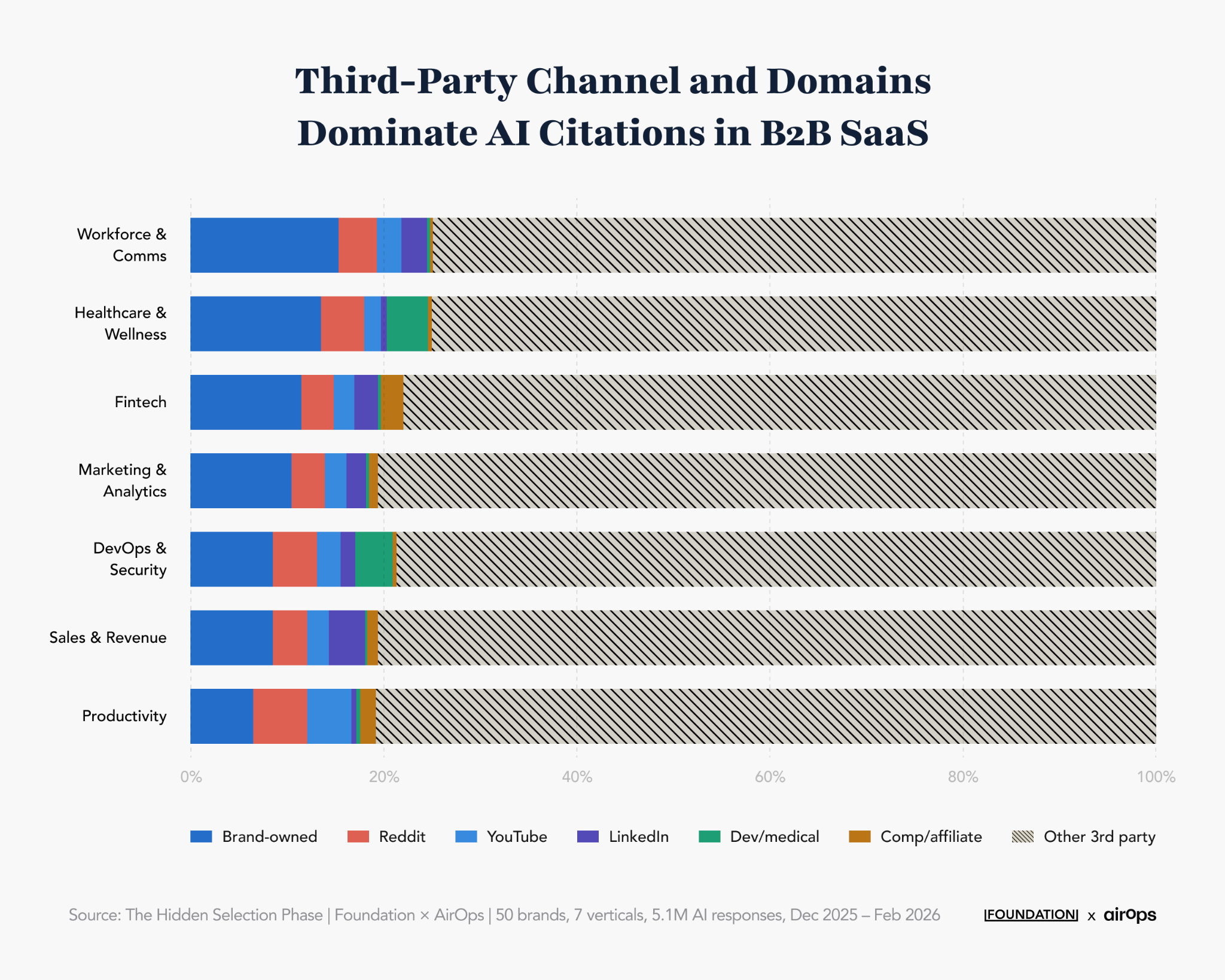
- Fintech had the highest concentration of comparison and affiliate citations of the verticals we studied, with NerdWallet and Bankrate standing out as particularly influential for shaping AI visibility.
- DevOps and Security prompts surface citations from developer communities. GitHub, Medium, and dev.to surface the code examples, tutorials, and practitioner write-ups that technical buyers trust.
- Healthcare and Wellness is shaped by authoritative domains like PubMed, Healthline, and Mayo Clinic, which carry outsized influence. Brands here compete with rival vendors and clinical and academic institutions.
- Productivity prompts produced the highest share of YouTube posts of any vertical, which fits the demo-driven way those tools get evaluated.
The conclusion is the same in every case: to win a bigger slice of the AI visibility pie you need to compete off-site. What changes is the specific map. Figuring out which off-site sources move the needle in your category, and earning a presence in them, is the actual work.
Map Where You Stand (and Where Off-Site Sources Are Winning)
Your instinct after reading all of this might be to feel like you’ve lost control. But you haven’t. You just need to know where you have AI visibility and where you need to win it back from off-site sources.
Which Reddit threads or YouTube videos are being cited when a buyer asks about your space? Which review sites, comparison pages, and industry publications does the LLM pull from for category queries? Where are competitors showing up that you aren’t?
To understand where you stand today, you first need to compile a list of prompts that are most important to your category and then audit your AI visibility for three key GEO metrics:
- Citation Share: how often AI links to your domain versus a competitor’s when describing your category
- Sentiment: whether AI describes your brand positively, neutrally, or negatively when it does surface you
- Share of Voice: the percentage of relevant category prompts where your brand appears at all.
Those metrics tell you which channels are already working, where competitors are winning ground you don’t know you’re losing, and where the fastest path to the shortlist actually runs.
The AI Selection Phase Is Already Happening. It’s Time You Show Up.
The selection phase is already happening. Right now, an AI is describing your brand to a buyer who will never tell you they asked. The answer is being assembled from sources you don’t own, in a mix specific to your category and the way that buyer phrased the question.
And remember, 80–90% of it is off-site. That’s an opportunity if you spread your influence correctly.
If you want to see what your off-site map looks like and what it would take to change it, get in touch with the leading AI visibility agency today.