Article's Content
Article's Content
In 2020, we published a breakdown of how Canva built a backlink empire: 4.24 million links from 100,000 domains, landing pages for every conceivable use case, and an outreach team with sales-style quotas.
Since then, the question has changed. Buyers now start with a prompt as often as with a query, and Canva’s own COO told TechCrunch that LLM referrals have reached double-digit percentages.
So we went back to the empire with a new question: When a buyer asks an AI about this category, does Canva show up, and why?
The short version: Canva is the cited answer for nearly every “make me an X design” query, and it owns none of the answers where buyers compare tools.
In this article:
- Why the page type that won Canva’s SEO era is losing its AI era
- How anchor text outreach quietly became entity training for LLMs
- Why Canva turned its landing pages into free tools, and what that earns in AI answers
- How Canva’s AI visibility is consolidating around its own brand name, and what that concentration exposes
- The comparison gap we flagged in 2020, and what it costs in citations today
Want to learn how to execute a similar strategy? Book a call with our team today. [BOOK A CALL]
The Canva Empire, Then and Now
Canva, for the three people who haven’t heard of it, is the drag-and-drop design platform Melanie Perkins, Cliff Obrecht, and Cameron Adams launched from Australia in 2013 with a simple pitch: design for people who can’t design.
That pitch now serves 265 million monthly active users, 31 million of whom pay, generating $4 billion in annual revenue at a $42 billion valuation.
When we first covered the company in 2020, those numbers would have sounded like a founder’s fantasy. Today, they’re the baseline.
Here’s how the engine we documented compares to what it’s become.
| Signal | 2020 breakdown | July 2026 |
| Backlinks | 4.24M | 90.2M |
| Referring domains | 100K | 434K |
| US organic traffic | (global: 270M visits/year) | 40M visits/month |
| Monthly active users | 20M | 265M+ |
| Valuation | $6B | $42B |
The list of referring domains reads like a who’s who of the modern web: Wikipedia, Apple, Microsoft, Calendly. Adobe, a direct competitor, links to Canva. In 2020, we noted that even competing sites linked to Canva’s child pages. That pattern held, and it scaled.

Backlinks from sites like Wikipedia, YouTube, and LinkedIn now carry more weight, given that these sites are either disproportionately present in the training and grounding data of every major LLM or are among the top-cited domains.
A brand woven into these sites’ link graph is a brand the models learned about before they ever ran a web search.
And there’s a new scoreboard now. Ahrefs’ AI Index shows Canva appearing in 91.5K AI Overviews and earning 1.8K ChatGPT citations across 2.2K pages, alongside placements in Gemini, Perplexity, and Copilot.
The empire we documented didn’t just survive the arrival of AI search. It became part of what the machines were trained on.
Search Intent Still Runs the Machine
Canva’s strategy reduces to one fundamental: match the page to the intent behind the query, whether that intent is informational, navigational, transactional, or investigational.
Two of those four do all the work in this story.
Transactional intent (“create invitation”) is a person who wants something made. Investigational intent (“Canva vs Adobe Express”) is a person deciding what to use.
Generative queries collapse into two buckets because people prompt an AI either to help them accomplish a task or to help them make a choice. Canva’s biggest win lives in the first bucket. Its one lasting miss lives in the second, and the rest of this breakdown is the story of what each became.
The Page Type That Won SEO Is Losing AI Search
Canva runs two core landing page types for each use case.
“Create” pages serve people who want to do something (“create certificates”).

“Template” pages serve people who want to discover something (“free certificate template”).
In classic search, template pages won on volume: the certificate template page once pulled 33,000 visits a month against the create page’s 16,000.
Run the same comparison on AI citations, and the result turns on its head.

The templates section has more backlinks than the create section and has earned three ChatGPT citations. Not three thousand. Three.
The explanation lies in how each page type is built.
Generative queries are typically verb-shaped: “how do I make,” “best tool to create.”
A create page answers in kind.
Its H1 states the query’s answer outright (“Free Online Resume Builder”).
It carries a step-by-step “How to make a resume” section that an AI Overview can lift wholesale.
Its FAQ headings are written the way people type (“Is the Canva resume builder really free?”), which pre-answers the exact trust question a skeptical buyer asks a chatbot.
A template page, by contrast, is a search bar above a grid of thumbnails. Beautiful for human browsing designs. Nearly empty for a model looking for something to quote.

The backlinks made Canva the entity that models associate with design. The citation itself points to whichever page provides a model with something to extract.
Canva has both, which is why it wins. Brands that copied only the template-directory half of Canva’s playbook have a problem.
For a deeper look at why extractable structure drives citations, see our guide to generative engine optimization.
From Landing Pages to Free Tools
The “Create pages” themselves evolved, and the clearest evidence is in the URLs.
Canva’s landing pages originally lived inside the /create/ and /templates/ directories.
Today, Canva’s biggest use cases have moved to root-level slugs that exact-match the query: canva.com/qr-code-generator/, canva.com/website-builder/, canva.com/pdf-editor/.
These read as products Canva ships, and that’s how they behave.
The QR page generates a working QR code. The website builder builds.
I filtered Canva’s US top-3 rankings to exclude branded terms, and the free-tool strategy is the whole leaderboard:
| Keyword | Monthly volume | Position | Ranking URL |
| faq templates | 940K | 1 | /templates/s/faq/ |
| AI image generator | 840K | 4 | /ai-image-generator/ |
| QR code generator | 776K | 3 | /qr-code-generator/ |
| Resume builder | 370K | 2 | /create/resumes/ |
| PDF editor | 292K | 2 | /pdf-editor/ |
| Business cards | 288K | 1 | /business-cards/ |
| Website builder | 132K | 1 | /website-builder/ |
| Logo creator | 43K | 1 |
/create/logos/ |
The “faq templates” page, for instance, sits at #1 with 365K monthly visits, capturing ~39% of the total search volume.
Clearly, template pages still win plenty of classic SERPs. What they’ve stopped winning is citations, which is exactly why the tool pages are still important.
Two things make the free-tool pivot compound in AI answers.
First, a working tool earns a different class of link. Template galleries get linked as resources. Tools get named in “best free X” roundups, and those roundups are precisely the third-party sources LLMs retrieve from when a user asks for a tool recommendation.
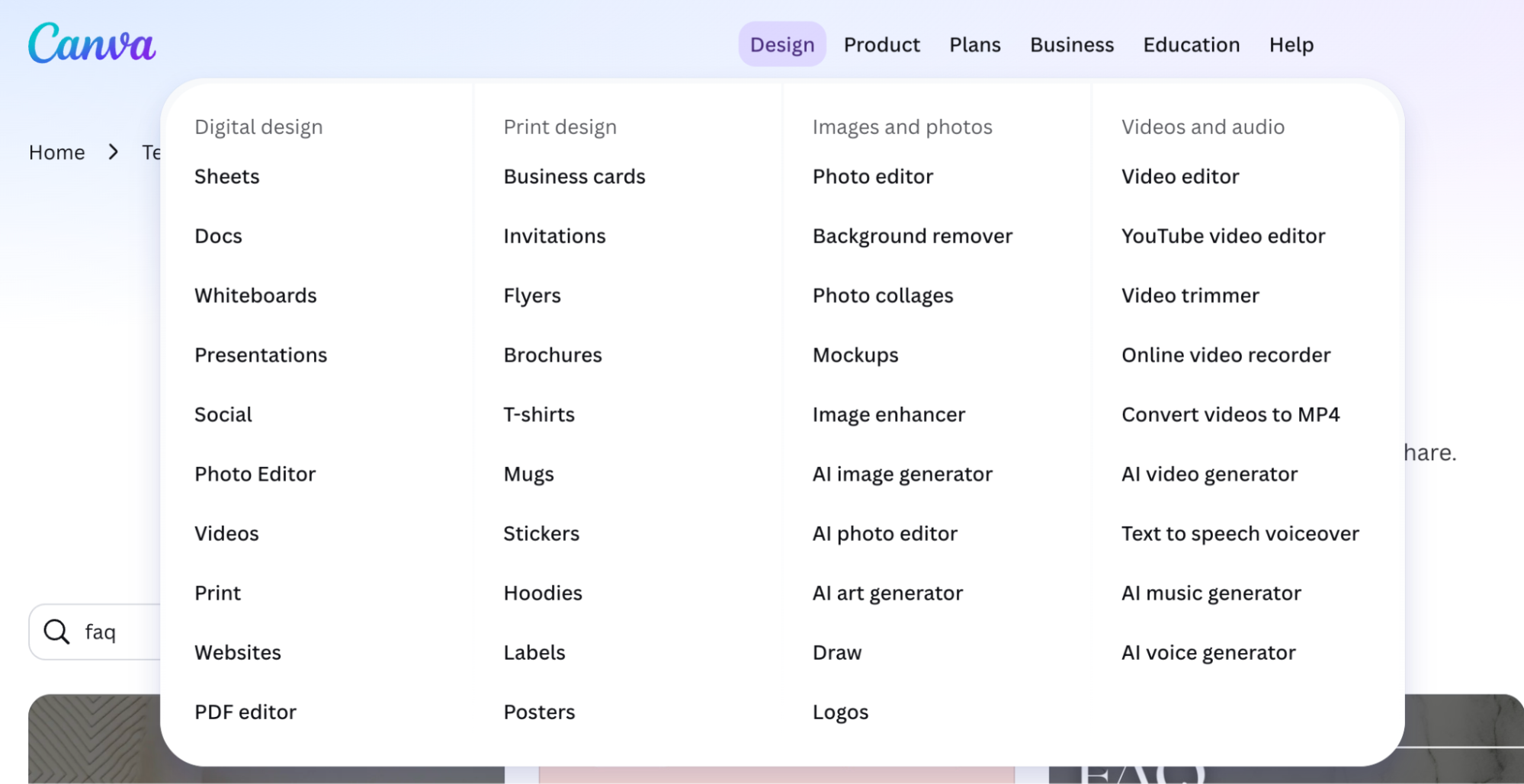
Second, the tools are now the site’s information architecture, not a side project. Open Canva’s main Design menu, and it reads like a directory of tool queries: photo editor, background remover, AI image generator, video trimmer, logo maker.
Every entry is an entity association between “Canva” and a job-to-be-done.
Adobe copied Canva’s create-page format years ago. If history repeats, the root-level free tool is the next thing everyone borrows.
Canva’s Oldest SEO Habit Is Its Biggest AI Advantage
Canva has over 90 million backlinks, and getting them didn’t happen overnight. It’s a process that requires long-term investment if you want it to pay dividends in organic traffic and AI visibility.
The Outreach Program Behind 90 Million Backlinks
Canva has developed a team of outreach specialists who identify content that mentions terms such as “invitations,” “posters,” or “digital marketing tools.” Then they reach out to the creators.
Here’s an email that Canva sent to a blog owner back in 2016:

And here’s one that I received in 2020:

A few things to note that Canva did right with this outreach:
- Leading with an empathetic message
- Including the name of my article in the email
- Saying “here” and linking the URL vs. showing the full URL
- Using an image to stand out from most emails
- Bolding the ideal anchor text (inception)
Whether that exact program still runs today, only Canva knows. What’s visible from the outside is the artifact it left behind: a link profile where that anchor pattern repeats across hundreds of thousands of referring domains, still growing by tens of thousands of new domains each month.
That discipline was about as good as it gets for classic SEO. Each such link told Google that Canva’s page was the definitive source of templates for that niche.
What the Anchor Text Actually Predicts
Now consider what else the artifact accomplishes. Ahrefs studied 75,000 brands to find which factors predict AI visibility, and branded anchor text ranked among the strongest correlates they measured: 0.527 for AI Overviews and 0.628 for Google’s AI Mode, 2.4x and nearly 3x backlinks alone, respectively (0.218).
Put plainly, the input Canva industrialized over a decade is one of the strongest known predictors of appearing in AI answers.
Correlation isn’t causation, as Ahrefs is careful to note. But if you wanted to design an experiment to see whether a decade of consistent brand-plus-use-case anchors influences how AI systems describe a company, you’d struggle to find a better test subject than Canva. The outcome is on the scoreboard: when ChatGPT answers a certificate question without running a search, Canva is the name it reaches for.
The Internal Link Layer Does the Same Job
The same discipline runs inside the site. Canva carries 114.9 million internal links, and the anchors from the homepage alone stack entity terms the way the outreach emails did: “AI image generator AI photo editor AI art generator,” pointing at /draw/ and the feature pages.
Retrieval systems read that cluster the same way Google always has: as a map of what this domain is an authority on.
No brand can buy this footprint at Canva’s price today. The window where a few hundred thousand exact-anchor links cost only an outreach team’s salary has closed. What’s replicable is the principle: consistent entity-plus-use-case language, everywhere your brand gets mentioned, compounds into how machines describe you.
Want SaaS teardowns delivered to your inbox? Sign up for the Foundation Labs newsletter today. [JOIN THE LAB]
The Empire Is Concentrating Around the Brand
Canva’s AI visibility is consolidating around its own name, growing on Google’s surfaces while contracting almost everywhere else.
For example, in June 2026, AI Mode responses fell by 54.9K, Perplexity responses fell by 2.1K, and Copilot dropped by 649.
Referring domains went net negative (down 4.3K) over the same window, and the count of distinct organic pages is roughly half what it was a year ago.
The traffic mix tells a related story. Of Canva’s 40M monthly US organic visits, 28M are branded searches. People searching for “canva” and variations account for 70% of the traffic. Transactional keywords, the empire’s original foundation, now drive about 3M.
None of this reads as collapse. It reads as concentration. Canva increasingly wins when the brand is already the query, which is the natural endgame of a decade of entity-building.
But concentration creates a specific exposure: the moments when a buyer hasn’t decided yet and asks a machine to help them choose, which brings us to the gap.
The Comparison Answers Canva Wins but Doesn’t Own
Canva has built content for every search intent except one: investigational.
There are no Canva-owned comparison or alternatives pages, and review sites moved into that vacuum years ago, part of the broader Yelpification of B2B that swallowed vs-queries across every category.
That gap used to cost SERP clicks. Now the cost is steeper because investigation-intent queries are exactly what buyers route to AI engines. I ran manual spot checks across ChatGPT, Google’s AI surfaces, and Perplexity to see who fills those answers.
Three patterns emerged.
Pattern One: Canva Wins Verdicts on Borrowed Ground
Ask “Canva vs Adobe Express, which is better for a small business?” and Google’s AI Overview opens with “Canva is the better choice.”

ChatGPT reaches the same verdict with a detailed comparison table.

A win, until you look at the citations: the sources are Phil Pallen’s reviews, Style Factory’s pricing breakdowns, third-party YouTube comparisons, and Adobe’s own comparison page. Canva contributes nothing to an answer about Canva.
Today the borrowed ground is friendly, and the verdict goes Canva’s way.
But a verdict you don’t own is a verdict that can be rewritten without your input.
One pricing backlash, one botched feature migration, one aggressive Adobe Express release cycle, and the same reviewers who currently hand Canva the win will hand it to someone else. Canva has no owned asset to argue back with.
Pattern Two: On Defection Queries, Canva is Structurally Absent
“Best Canva alternatives” is the query a customer types on their way out the door, and it’s where the gap costs real money. The AI Overview cites Zapier, Alai, and competitor blogs.

ChatGPT answers from training data with no citations at all, confidently recommending Adobe Express, VistaCreate, and Microsoft Designer.

When a model answers based on training data, publishing a page tomorrow doesn’t fix the answer for next week. The association between “Canva alternative” and “Adobe Express” is already baked into the model’s weights. Leaving investigational intent unaddressed for years means the miss is now stored in places a landing page can’t quickly reach.
Pattern Three: Canva’s Best Comparison Asset Is One It Built by Accident
Canva doesn’t just monitor Reddit, it operates r/canva as an official community: 110K weekly visitors, 661 weekly contributions, brand-run megathreads. Google licenses Reddit’s corpus and LLMs over-index on it, which makes an owned, active subreddit one of the highest-leverage assets a brand can hold in AI search.
On the “Canva vs Adobe Express” SERP, the #2 organic result is a thread inside that same community, where the top comment comes from a pro user who owns both products and uses Canva, in their words, “pretty much 100%.”

An owned community, ranking for a decision-stage query, answering it with UGC more credible than anything a marketing team could publish.
So the sharpest brand in search taught the machines it’s the answer to “make me an invitation,” and left “should I choose Canva” to strangers and one lucky Reddit thread.
That’s the unclaimed real estate. For Canva, it’s a defensive gap. For every challenger in the design space, it’s an open lane: the citations for these queries are won by review sites, YouTube reviewers, and Reddit threads, and all three are channels a brand can earn its way into. Our breakdown of how AI visibility works covers the mechanics.
The Moat Was Never the Links
Empires still aren’t built in a day. What Canva’s trajectory shows is that the empire and the moat were never the same thing.
The 4 million backlinks were never the moat. Neither are the 90 million. The moat is the machine behind them: a system that reads intent, ships a page (now a working tool) for every job a buyer wants done, wires consistent entity language through every link it earns, and floods the channels that machines trust with text that says “Canva” next to a use case. The playbook that built the backlink empire manufactured links. Today’s version manufactures citations, whether or not Canva’s org chart uses that word.
That machine was built for Google, and it turned out to be almost perfectly shaped for AI search, years before anyone was optimizing for citations.
Almost. One intent went unclaimed while the empire was being built, and it remains unclaimed today, at the exact moment buyers started outsourcing their comparisons to machines that answer from whatever sources exist.
Canva’s story tells you both halves of the playbook: how to become the answer and what it costs to leave one question to everyone else.
Your buyers are already asking AI engines to compare you against your competitors. Someone’s content is writing those answers. If it isn’t yours, that’s the most expensive content gap on your roadmap.
Get cited where buyers compare tools. Foundation helps B2B brands win citations across ChatGPT, Gemini, Perplexity, and AI Overviews, starting with the comparison queries that decide deals. [EXPLORE OUR AI VISIBILITY SERVICES →]