



Article's Content
Article's Content
As enterprise marketing teams set their 2027 budgets, many have an AI search mandate without the operating practices to deliver it.
A Brandlight and Censuswide survey of 503 US CMOs at companies with more than $500 million in annual revenue, conducted in October 2025, found that 87% had a board or CEO mandate for AI search, but only 21% had operational AI visibility practices with dedicated teams.
Assigning AEO to SEO gives the program a starting point. It doesn’t automatically give anyone authority over Reddit, YouTube, LinkedIn, review platforms or earned media. Hiring an AEO lead leaves the same problem if that person can only request help.
Ownership has to follow the citations. Foundation recommends one in-house lead with authority to coordinate investment across priority channels, named owners for delivery and independently checked measurement. For your 2027 plan, the first question is which decisions that lead can actually make.
Key Takeaways
- AEO often sits with SEO, yet across Foundation’s study of 50 B2B brands, only about 10% of AI citations pointed to brand-owned domains.
- Give one lead authority to coordinate AEO strategy and reallocate the approved budget within limits set by the CMO.
- Assign execution by deliverable: technical GEO and the on-site content plan to SEO; research, source packs and on-site articles to Content; platform assets and participation to Community and social; and earned-media outreach to PR.
- Run measurement on one agreed method, checked independently of delivery, because AI answers vary from run to run.
- Keep accountability in-house. Partners can support strategy and run execution where you lack people or channel expertise.
Why Does AEO Keep Landing on the SEO Team?
SEO is the natural first owner for AEO. The SEO team already has the rank trackers, the query data and access to the website. According to Minuttia’s State of AEO 2026, a survey of 599 SEO, content and growth professionals, 52.8% say their existing SEO team manages AI search strategy, and 19.4% run AEO as a cross-functional effort.
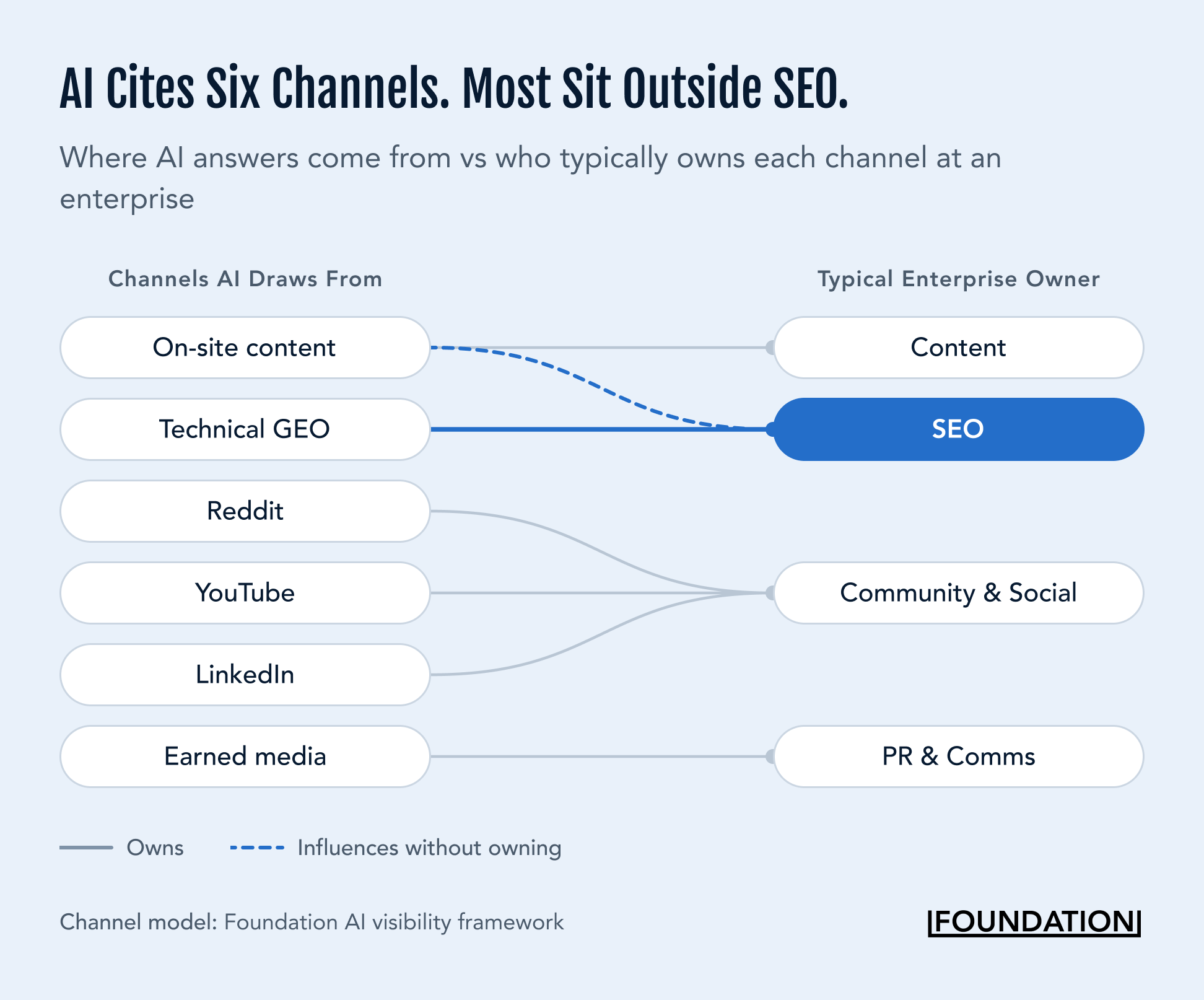
The limit of website-centered ownership is reach. Foundation organizes AI visibility work across six areas: on-site content, technical GEO, Reddit, YouTube, LinkedIn and earned media. A typical SEO remit covers the first two.
When we analyzed 5.1 million AI responses for 50 B2B brands with AirOps, only about 10% of citations pointed to the brands’ own domains.
If most of the sources in your priority answers sit off your site, a remit built around the website will miss most of them.
Retooling the SEO team into a GEO team isn’t enough if its remit and decision authority stay limited to the website. An SEO leader can run the broader program when the mandate, capacity and governance support it. In that case, the SEO leader takes on the AEO lead role described below.
Marketers also disagree on who should carry this. In an August 2026 Sword and the Script survey of 200 US marketing and communications professionals, a mixed sample with 18% from B2B organizations, marketing ops was the most-named function at 17%, while 8% chose SEO and 3% chose PR and comms.
Start here: Sample your priority prompts, group the cited sources by channel and name the internal team responsible for influencing or monitoring each priority channel. Flag gaps in responsibility or capacity.
The Enterprise AEO Ownership Model
The model works through three mechanisms: one shared priority prompt set, AEO delivery commitments in each function’s plan and a quarterly budget review run by the AEO lead. The prompt set tells every team which buyer questions matter. The commitments put AEO work into plans that teams already deliver against. The review is where the lead moves budget based on evidence.
Assign the responsibilities to named people in your existing organization. The AEO lead coordinates the program, functional leaders own delivery and a measurement owner maintains the reporting method. The model assigns responsibilities, not new hires. One person may hold several responsibilities, but every deliverable still needs a named accountable owner.
Give each function delivery commitments it can control, then assess the program against shared visibility measures.
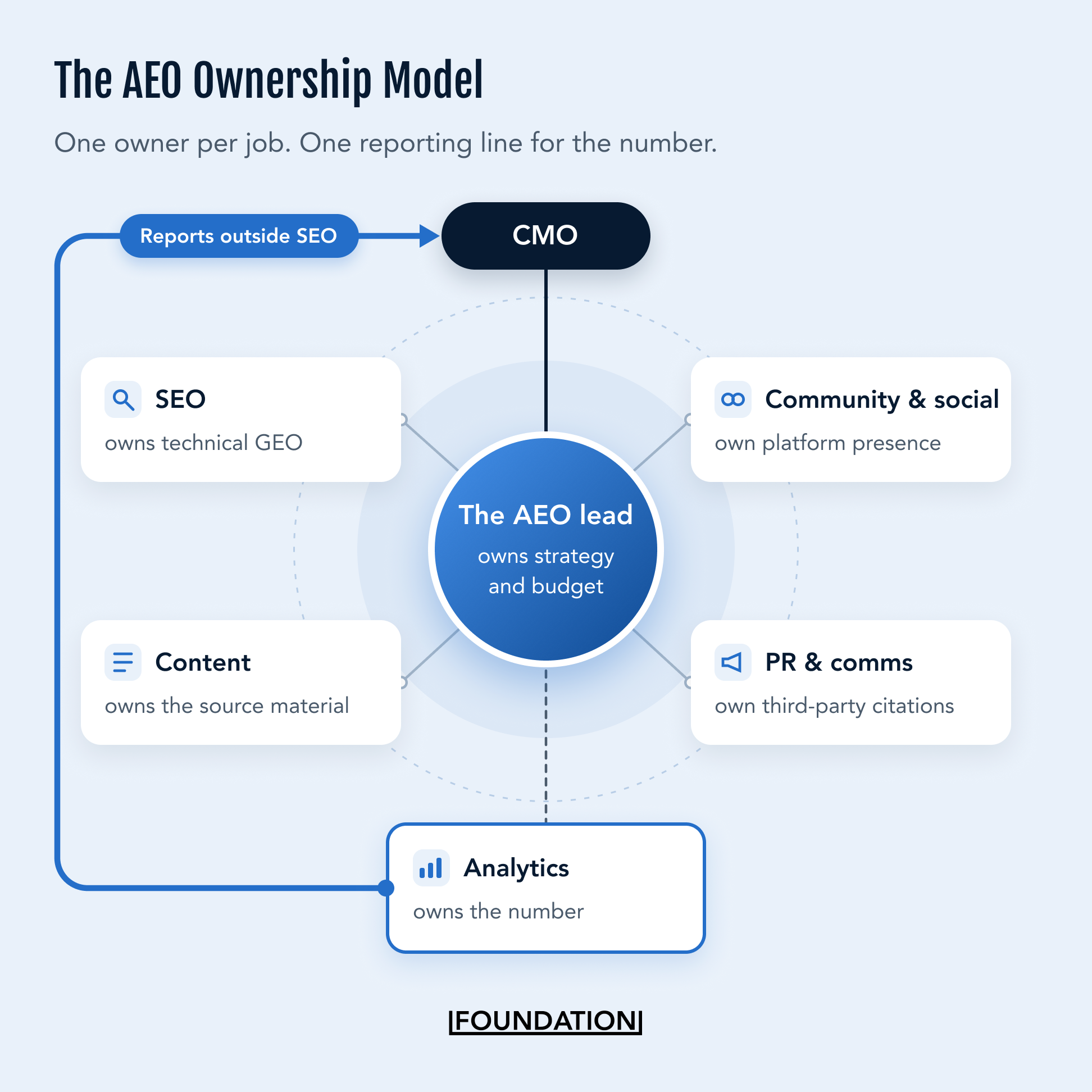
The AEO Lead Owns Strategy and Budget Decisions
An AEO title won’t reserve time on anyone else’s calendar. Give the lead authority to resolve competing priorities, or they’ll spend their time asking other teams for help.
The core job is to decide where the next dollar and the next hour of team capacity go across channels.
If the lead is measured on only one channel, cross-channel priorities will conflict with existing targets. Give the AEO lead direct access to the CMO and a mandate that reaches beyond one channel.
Those choices need more than citation counts. Where AI answers source their information is one input. Where the company can realistically improve its presence is another. The AEO lead weighs citation gaps alongside buyer relevance, existing assets, delivery capacity, cost and evidence of results.
If priority answers lean on video, for example, YouTube becomes a candidate. It becomes the next investment only if the company can produce credible video and the measurement supports it.
The AEO lead owns five things:
- The priority prompt set, which is the list of buyer questions where the brand needs to appear.
- Channel priority, set using the criteria above.
- The distribution plan for each flagship asset, which sets which channels get it and in what order.
- Quarterly reallocation within agreed limits.
- Reporting to the CMO, which turns Analytics’ consolidated results into context and recommendations. The AEO lead interprets the results but doesn’t change the method or the data.
Authority needs limits that a CMO can sign off on. We recommend a simple delegation rule:
- The CMO approves the AEO budget and the business objectives.
- The AEO lead reallocates within that budget, up to agreed limits per channel, using the measurement report as evidence.
- Changes beyond those limits, or conflicts with another team’s commitments, go back to the CMO.
The mandate should also specify who can commit staff time, approve changes to team plans and resolve delivery conflicts. Otherwise, a lead can move a budget allocation while still lacking the people needed to execute it.
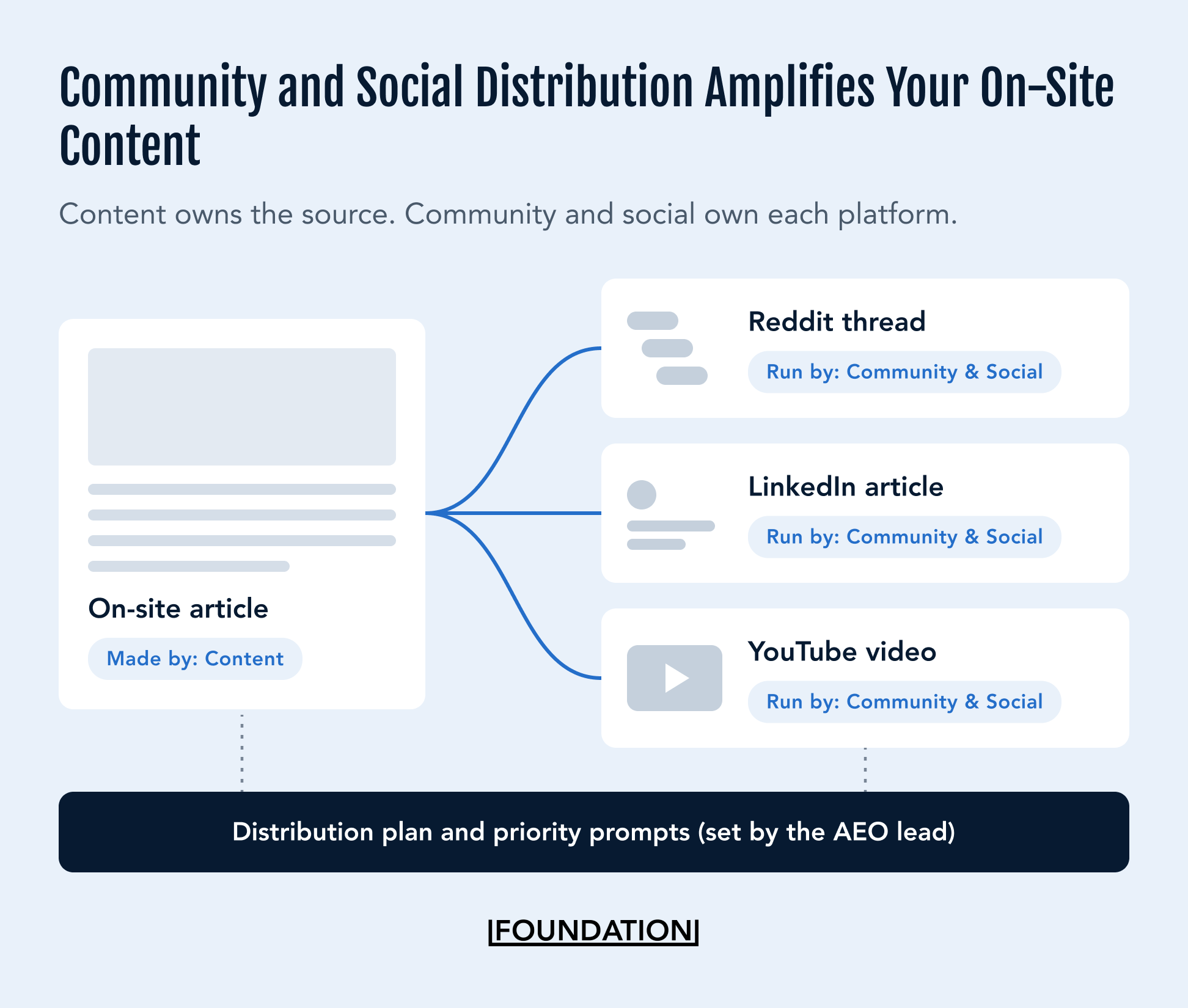
Distribution sits with the AEO lead because choosing where an asset goes, and in what order, is a strategy call. We recommend that research into the priority answers sets that order before production starts.
The AEO lead role doesn’t have to start as a new hire. According to Gartner’s 2026 CMO Spend Survey, 54% of CMOs report insufficient resources, so a new role will compete with other priorities. An existing SEO or content leader can take on the role at first, as long as the CMO puts the delegation rule in writing.
Start here: Agree the delegation rule with your CMO, then build the priority prompt set.
SEO Owns Technical GEO and On-Site Planning
SEO owns crawlability, site architecture, structured data and on-site diagnostics. The audit should distinguish controls for Search inclusion from permissions for model training and other AI uses, because those controls serve different purposes. SEO owns the technical requirement. Web or engineering teams often implement the fix.
SEO also owns the on-site content plan: citation and keyword tracking for owned pages, gap analysis against the priority prompt set and the list of pages to create or update. Content produces those pages. SEO’s diagnostics also feed the AEO lead’s channel decisions and the program report.
Owned pages remain important destinations for buyers and sources for AI answers. Keep them accessible, accurate and consistent with the claims distributed elsewhere.
Start here: Audit AI crawler access and structured data before any new content push.
Content Owns Research, Source Packs, and On-Site Articles
Content is accountable for original research, a verified source pack for every flagship asset and the on-site articles in SEO’s plan. A source pack holds the verified claims, source links, approved quotes, data and guidance on how each channel can adapt the material. Content coordinates subject-matter experts and verification where required.
A research report, YouTube script and LinkedIn post are different assets, but they should use the same verified research. A shared source pack reduces duplicated effort and inconsistent claims while leaving each team room to adapt the material.
Informational content can be a significant source for AI answers, as our Clio analysis found.
Start here: Build the source pack before anyone writes a script, post or article.
Community and Social Own Platform Assets and Participation
Community and social teams are accountable for the brand’s presence on Reddit, YouTube and LinkedIn. They build platform-native assets from the source pack, such as video scripts and LinkedIn posts, then publish them, reply and run the executive LinkedIn program. Where a separate video or brand team produces video, that team handles production, while Community and social remain accountable for the channel.
These platforms matter in AI answers. In our AirOps study of 50 B2B brands, Reddit accounted for 20.8% of third-party citations, with YouTube and LinkedIn also prominent.
Sustained participation requires ongoing capacity for publishing, replies and platform-specific adaptation. Regular, useful participation, such as answering questions in the same subreddit or executives posting a clear point of view, gives these platforms something worth surfacing.
Platform sourcing also changes. Foundation’s Reddit analysis found that Reddit’s share of ChatGPT’s citations fell from roughly 4% to below 1% around the August 2026 retrieval changes.
The measurement owner should flag changes in citation patterns so the AEO lead and channel teams can reassess their priorities. The priority prompt set decides which threads and channels come first.
Start here: Set Reddit operating rules before anyone posts. Use a clearly branded account, follow each subreddit’s rules, disclose your affiliation, lead with value and never drop a bare link.
PR and Comms Own Earned-Media Outreach
PR and comms are accountable for earned-media relationships, analyst outreach and placements in industry publications. Assign review-platform activity, such as G2, to the team that already runs that program.
Third-party sources often appear in AI answers where the brand’s own pages don’t. Our G2 analysis captured an AI Overview citation for “zendesk alternative” while G2 ranked 48th organically for that query. In fintech, independent sites such as NerdWallet and Bankrate are among the most-cited sources.
PR already has the relationships. What changes is the target: a placement is judged by press value and by whether it serves a question on the priority prompt set.
PR keeps its existing reporting line. Its functional leader agrees AEO deliverables with the AEO lead and includes them in the team’s plan.
Start here: Map earned-media targets to the priority prompt set.
Analytics Owns the Measurement Method
One function should own how AEO is measured, separate from the teams that deliver the work. In most enterprises, that’s marketing analytics, marketing ops or RevOps.
If the team that does the work also sets the measurement, the CMO can’t trust the number. Five functions now contribute to AEO, and each could choose the prompts, engines or time windows that suit its channel. Someone has to hold the prompt sample, the metric definitions, the collection conditions, and a change log, so every team is measured the same way.
Method matters because AI answers vary. SparkToro’s study collected 2,961 responses across 12 prompts and three AI tools and found substantial variation in recommendation lists. That supports repeated sampling and trend lines over single checks.
Measurement remains difficult. In Minuttia’s survey, 40.6% selected a lack of measurement and attribution tools as their biggest AEO challenge. Reporting AI referral clicks alone also misses every answer that mentions the brand without a link.
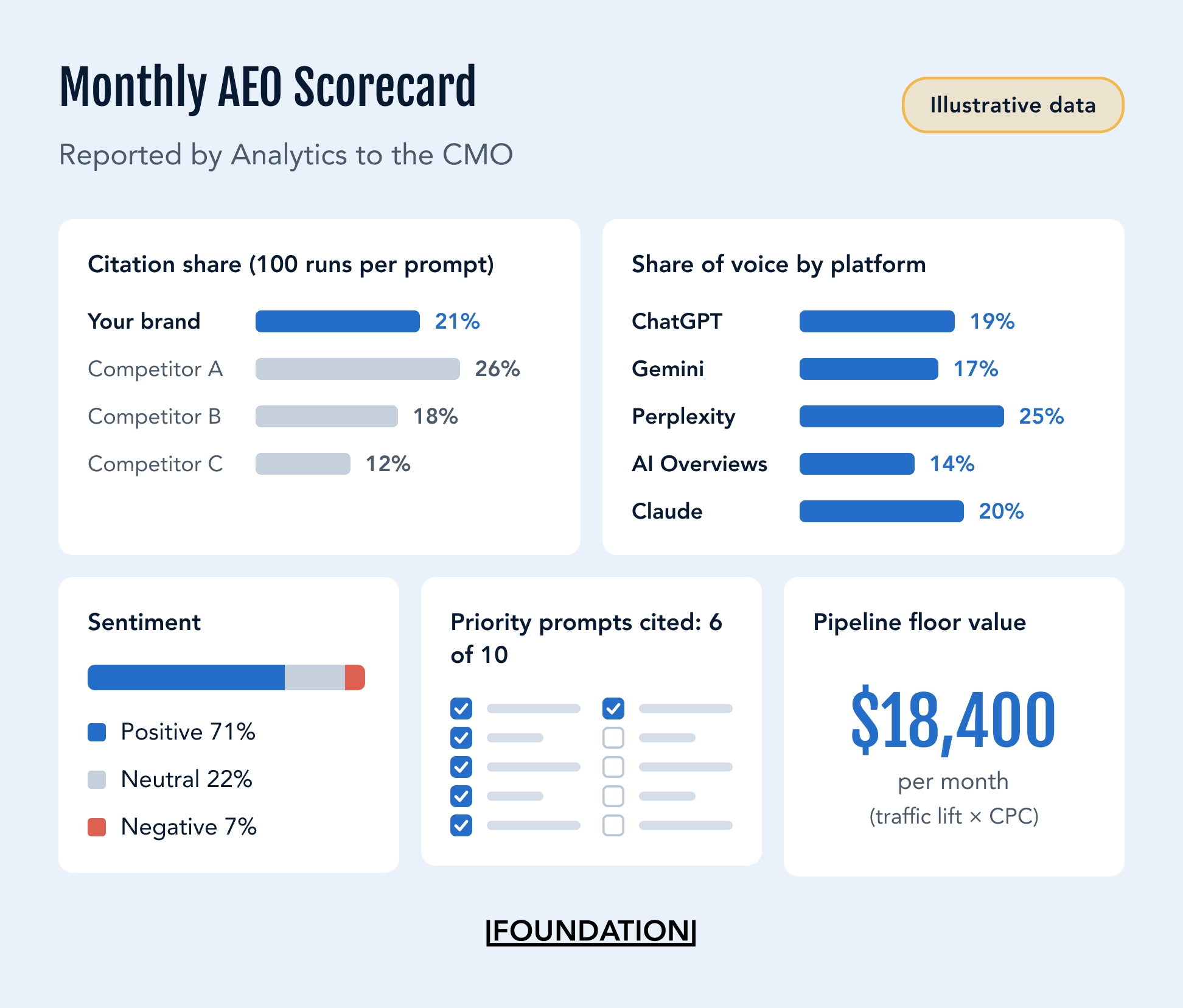
Agree on definitions before the first report. Foundation tracks five AEO KPIs. Our GEO metrics guide covers the supporting diagnostics.
- Share of Model: the percentage of responses to your priority prompts that mention the brand.
- Citation share by engine: the share of cited sources that point to your domains, reported for each engine, with owned and earned sources (such as Reddit, G2, YouTube, and press) as separate lines.
- Sentiment and accuracy: the tone AI uses to describe the brand, and the percentage of mentions where the facts are right, audited monthly against a fact sheet that product marketing maintains.
- AI referral traffic: sessions that start from a link in an AI answer, tracked in GA4. AI Overview clicks still report as organic search.
- AI-assisted pipeline: pipeline where an AI assistant played a documented role, captured through a self-reported attribution field that RevOps owns.
Then agree the collection rules:
- Report branded and unbranded prompts separately.
- Report each engine separately, and define how engine results are weighted before combining them.
- Keep collection conditions comparable from period to period, including fresh sessions, location and the number of runs per prompt.
- Treat a materially changed prompt set as a new series, or keep a comparable subset.
- Record known platform changes in the change log, annotate the affected reports and state which decision each report informs, usually the quarterly budget review.
Start here: Set the reporting cadence. Analytics reports monthly to the AEO lead, and the AEO lead reports quarterly to the CMO.
What the RACI Looks Like
Here is the model in one table. Each row has one A, and every A sits inside the company. Add the accountable person’s name beneath each function. Add columns where your review or video teams sit elsewhere.
| Activity | CMO | AEO lead | SEO | Web & eng. | Content | PR & comms | Community & social | Analytics |
| AEO objectives and approved budget | A | R | C | I | C | C | C | C |
| Priority prompt set and channel priority | I | A/R | C | I | C | C | C | C |
| Distribution plan for flagship assets | I | A/R | C | I | C | C | C | I |
| Quarterly reallocation within limits | C | A/R | C | I | C | C | C | C |
| Technical GEO requirements and on-site diagnostics | C | A/R | C | I | C | |||
| Technical implementation* | I | A | R | I | I | |||
| On-site content plan | C | A/R | I | C | I | |||
| Original research, verified source packs and on-site articles | C | C | I | A/R | C | C | I | |
| Platform assets from source packs | C | C | A/R | I | ||||
| Video production** | I | C | A/R | I | ||||
| Reddit, YouTube and LinkedIn publishing and engagement | C | I | I | A/R | I | |||
| Earned-media and analyst outreach | I | C | C | A/R | I | I | ||
| Review-platform program*** | C | C | A/R | I | ||||
| Measurement method and consolidated data | I | C | C | I | I | I | I | A/R |
| AEO reporting and recommendations to the CMO | I | A/R | C | I | I | I | C |
R = Responsible (does the work). A = Accountable (owns the decision or deliverable, one per row). C = Consulted. I = Informed. *Web or engineering implements the fix, and SEO keeps A for the requirement. **Move R to your production team if a separate video or brand team produces video. ***Move both A and R to the team that runs your review program, or add its column. Publish as an HTML table
The AEO lead is accountable for the strategy rows and the report to the CMO. Delivery rows belong to the functional owners, and the measurement method and data belong to Analytics.
How to Know When You Need an AEO Partner
You need an AEO partner when you need several channels live faster than your team can staff them, when you lack expertise on a channel such as Reddit, YouTube or earned media, or when you have budget but no headcount. Hand off the work, not the accountability.
Only 2.7% of Minuttia’s respondents reported outsourcing AEO to agencies. In the same Brandlight and Censuswide survey, only 10% of CMOs said they had trained their full marketing teams on AI visibility.
Before you hire, name what your team can’t deliver. You may need specialist help on one channel rather than another full-time role.
Build internally when you have a named lead, sufficient channel expertise, delivery capacity and a repeatable reporting process. Consider a partner when a defined gap would otherwise delay the program.
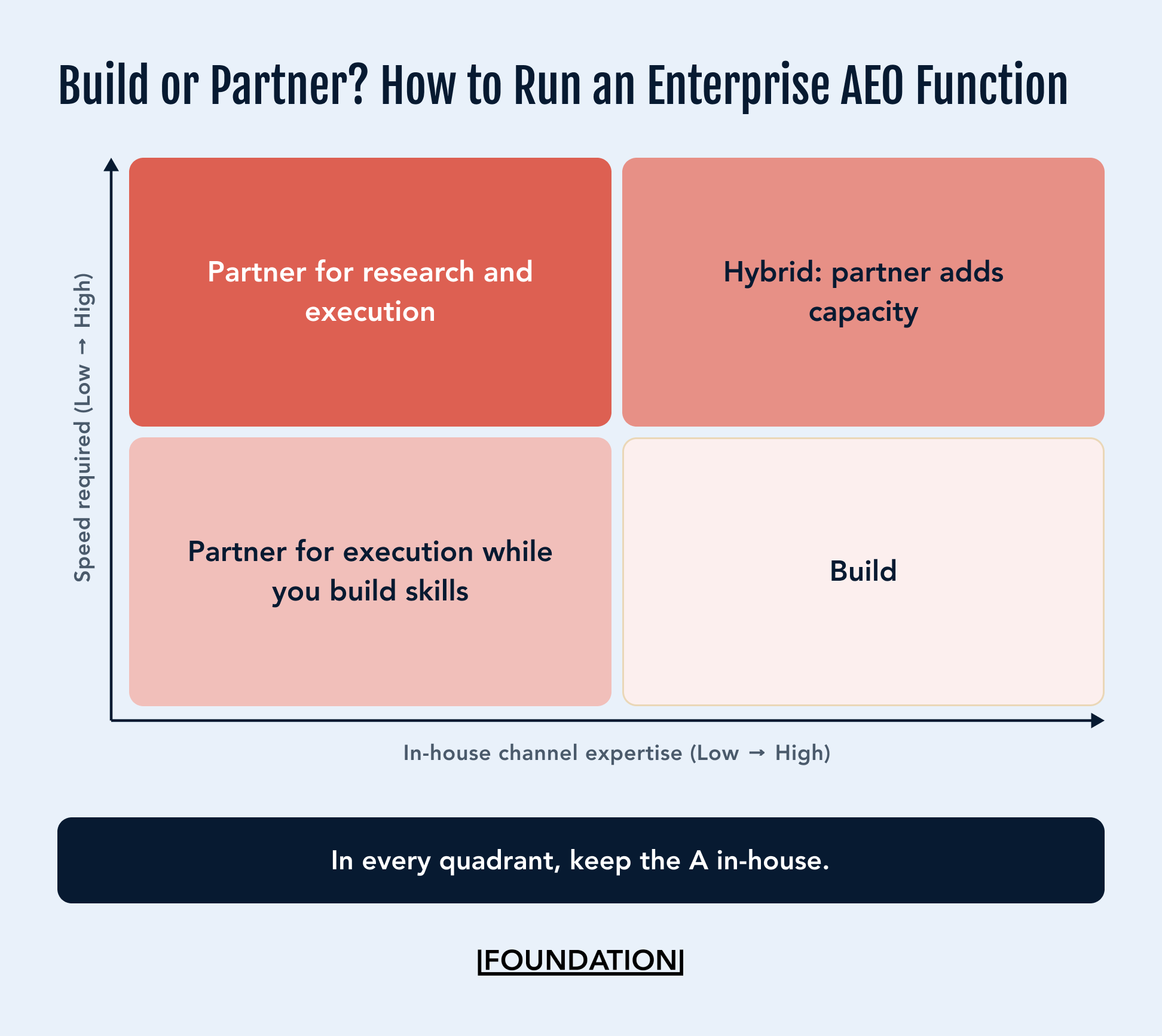
The AEO lead and the measurement owner stay inside. A partner can support strategy work, such as baseline research, prompt research and channel plans, and can take R on execution. If a digital experience team runs your website and you have no SEO team, a partner can take R on technical GEO, with the A staying with the website owner.
Bitly is a single-channel example of this split. Reddit shaped many of the answers buyers saw for link and QR code tools, and it’s a platform where promotional posting tends to be filtered or ignored.
We ran the channel day to day: building account credibility, publishing native posts, and reviving a dormant branded subreddit. Bitly approved the approach and reviewed the work. After 12 months, Bitly’s citation share for link shortener prompts reached 11.7%, and YouTube became the second channel based on what the first year showed.
Choose partner work from the gaps you find, not a fixed sequence. Programs rarely mature evenly, so check each area on its own:
| Area | The gap looks like… | Where a partner can help |
| Baseline | No measured baseline for your priority prompts. | Baseline research and a channel-gap diagnosis. |
| Decision authority | No named AEO lead, or no written delegation rule. | The CMO names the lead and sets the rule. A partner can help draft it, not own it. |
| Channel ownership | A priority channel has no accountable owner. | Not a partner job. Name the owner first. |
| Channel capacity | A named owner lacks the people or expertise to deliver. | Execution on the channels with the largest gaps. |
| Handoffs | Teams research the same topic separately, with no source packs. | Setting up the source-pack process and adding production capacity. |
| Measurement | No agreed definitions or collection rules. | Method design and data collection, with Analytics keeping the A. |
Start here: Mark each area as in place or missing, then use our guide to writing a GEO RFP to brief a partner on the gaps you choose to hand off.
Start With The Decisions Your AEO Lead Can Make
Name the person who can resolve cross-channel priorities and agree their decision limits with the CMO. Baseline research can begin in parallel, but committing resources across teams requires that mandate.
If you want help putting the model into practice, from the first baseline to a program running across your priority channels, talk to Foundation. We help B2B brands get found, cited and chosen by AI.
FAQ
Should the SEO team own AEO?
SEO should own technical GEO, on-site diagnostics and the on-site content plan. An SEO leader can also take on the AEO lead role if the mandate covers off-site channels and the CMO delegates budget authority.
Do we need to hire a Head of AEO?
Not necessarily at the start. An existing leader can take on the role if the CMO puts a delegation rule in writing. Consider a dedicated hire when the coordination workload exceeds an existing leader’s capacity or the program’s investment and complexity justify a full-time role.
Who should report AEO results to the board?
The CMO should report them. The AEO lead prepares the results and recommendations, using data from the measurement owner and the agreed method.
Can you outsource AEO?
You can outsource execution and get partner support on strategy work. Keep accountability for the strategy and for the measurement method in-house.

