



Article's Content
Article's Content
Search a B2B brand name in Google and the AI Overview mostly sticks to the brand’s own site and a Wikipedia entry. Add one buying word, like “pricing”, “alternatives”, or “reviews”, and a competitor starts writing part of the answer.
We tracked 15,716 Google AI Overviews on branded B2B buying searches in the Foundation B2B Citation Index, powered by Writesonic. In 21.7% of them, Google cited a direct competitor’s own site. In 11.9%, it cited the competitor and left out the brand the buyer named.
These are the searches buyers run right before they shortlist. Here’s where the risk concentrates, how AI Overviews compare with AI Mode and ChatGPT, and what the pages winning these citations do differently.
What Happens to AIO Citations When You Add Commercial Intent to Brand Terms
When replacing your running shoes, you probably don’t search “Nike”. You search “best Adidas alternatives for runners”.
The same dynamic applies in B2B.
Buyers don’t shortlist software vendors based on brand name searches alone. They use commercial intent qualifiers like “alternatives”, “pricing”, and “reviews” to prune the options that don’t fit their specific needs. Often they include audience or date modifiers to make sure the results reflect their company and are up to date. Think queries like:
- “Kustomer annual contract pricing”
- “Mixpanel alternatives for startups”
- “Chanty customer reviews 2026”
When we searched the Kustomer pricing query in Google, it triggered an AI Overview where a direct competitor, Gorgias, was cited in the opening line of the AI search feature.
That happened on one of the most commercially important branded searches there is: pricing.
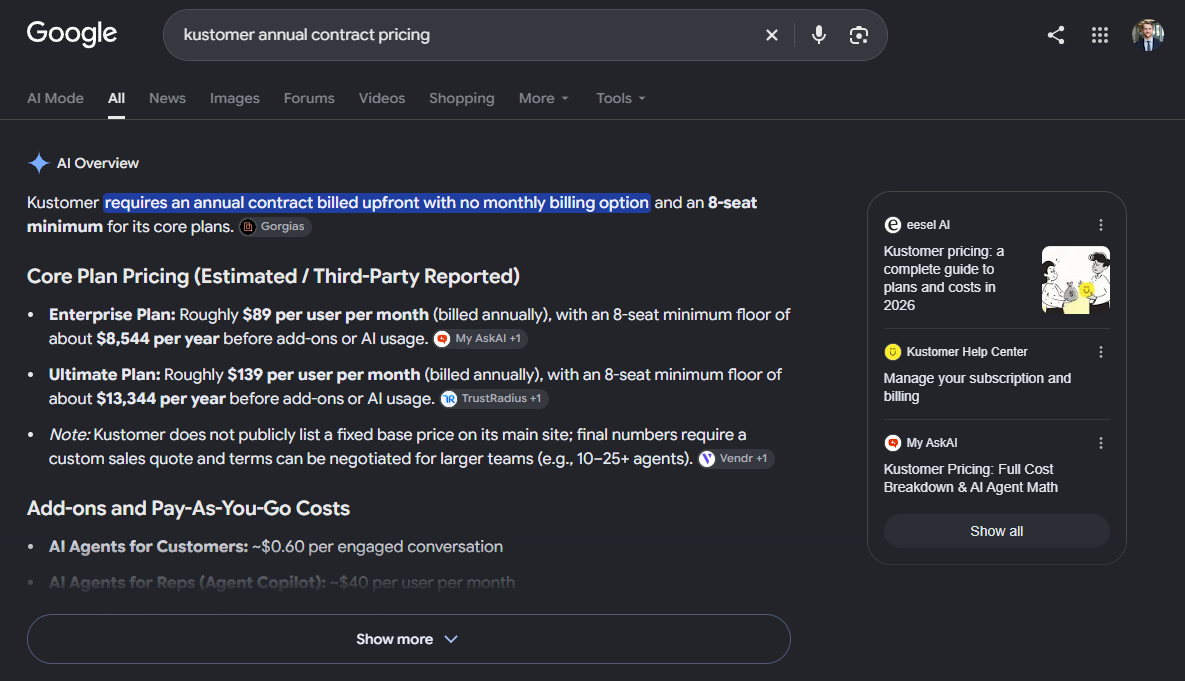
One search doesn’t make a pattern, so we wanted to see what the competitive citation rate looked like at scale and how it changed across other answer engines.
How We Measured Competitive Citation Rate
The Foundation B2B Citation Index, powered by Writesonic, tracks 5,000 bottom-of-funnel B2B SaaS prompts across 80 software categories. Writesonic runs every prompt weekly and records which sources each AI engine cites.
For this analysis we pulled out prompts that name exactly one brand plus a buying word (or words). Altogether, that left us with 1,235 prompts that the Writesonic team ran for 13 weekly runs, from June 29 to September 21, 2026, for a total of 15,716 Google AI Overviews.
We also ran the same 1,235 prompts through Google AI Mode (15,705 answers) and ChatGPT (14,571 answers), for 45,992 answers across all three engines. ChatGPT’s count is lower because some of its weekly runs returned fewer cited answers.
A citation counts as a direct competitor when it comes from a brand in the same software category that the prompt didn’t name. If someone searches “Kustomer annual contract pricing” and the AI Overview cites a page from Gorgias’s site, that’s a competitive citation.
Key Findings From Our B2B Citation Index Data
Our analysis of the Writesonic citation data reveals three benchmarks for how AI search engines handle branded commercial queries compared to traditional bare brand searches:
1) 21.7% of branded buying searches cite a direct competitor
Across the 15,716 AI Overviews we tracked for branded buyer searches, 21.7% cited a direct competitor’s own site. In 11.9%, the competitor was cited and the brand the buyer asked about wasn’t.
Keep in mind, these are neutral questions. The buyer asked for details about a specific brand, and Google went to a competitor for part of the answer. The Writesonic data also shows how volatile the competitive citations are on a week-over-week basis. Across the quarter, the competitive citation rate fluctuated between 12.7% and 30.2% for our prompt set.
Recent Ahrefs data found one competitor site in 57 source lists, for a competitive citation rate of about 1.8%. The rate for our B2B SaaS sample is roughly 12x that. The brands, queries, and scale are quite different, so keep in mind this is a directional finding. Once a buyer adds intent to your name, competitors start shaping the answer.
The sources behind the answer change too. On bare brand names, Ahrefs found Wikipedia doing most of the work. On B2B buying searches, Wikipedia almost disappears while competitor sites rise:
- Wikipedia: 71.9% on bare global brand names, 0.9% on B2B buying searches
- YouTube: 38.6% against 29.6%
- LinkedIn: 22.8% against 7.3%
- Competitor pages: 1.8% against 21.7%
Ahrefs didn’t report review sites or Reddit, and on B2B buying searches those lead. Review sites such as G2 and Capterra appear in 58.8% of these AI Overviews. Reddit appears in 46.4%. The brand’s own site appears in 52.4%, so Google cites you about half the time.
2) The modifier decides the risk: a 28-point spread
The rate swings hard depending on what the buyer asks for. Breaking each question type down by its modifier shows where the risk sits.
Alternatives searches (541 prompts): 35.8% cite a direct competitor, 32.9% cite the brand’s own site
- Plain alternatives (Workable alternatives): 39.5%
- Alternatives based on company size or stage (Akamai alternatives for Series B startup): 37.2%
- “Competitors” and “tools like” searches (Tools like LanceDB): 34.5%
- Cheaper, free, or open-source alternatives (Free UserVoice alternatives): 31.0%
Pricing searches (298 prompts): 13.4% cite a direct competitor, 75.7% cite the brand’s own site
- Price for a company size, contract, or pricing model (Recruitee enterprise pricing): 14.2%
- ROI, value, and total cost (Cloudflare ROI): 13.4%. The brand’s own site drops to 64.3% here, its weakest pricing answer.
- Pricing tiers and plans (Langfuse pricing tiers): 8.5%, with the brand’s own site cited in 85.1%
Reviews searches (377 prompts): 7.8% cite a direct competitor, 61.4% cite the brand’s own site
- Reviews and ratings (Weaviate reviews): 8.8%
- Case studies and customer lists (Companies that use Gladly): 6.4%, with the brand’s own site cited in 84.8%
- Security, reliability, and support (Productboard security review): 5.4%
Migration searches, like “Optimizely migration checklist,” fell between alternatives and pricing at 26.2% competitor citations, but with only 19 prompts in our set, we’re treating it as an early signal.
The chart below breaks down how competitor citation rates vary across alternatives, pricing, and review queries:
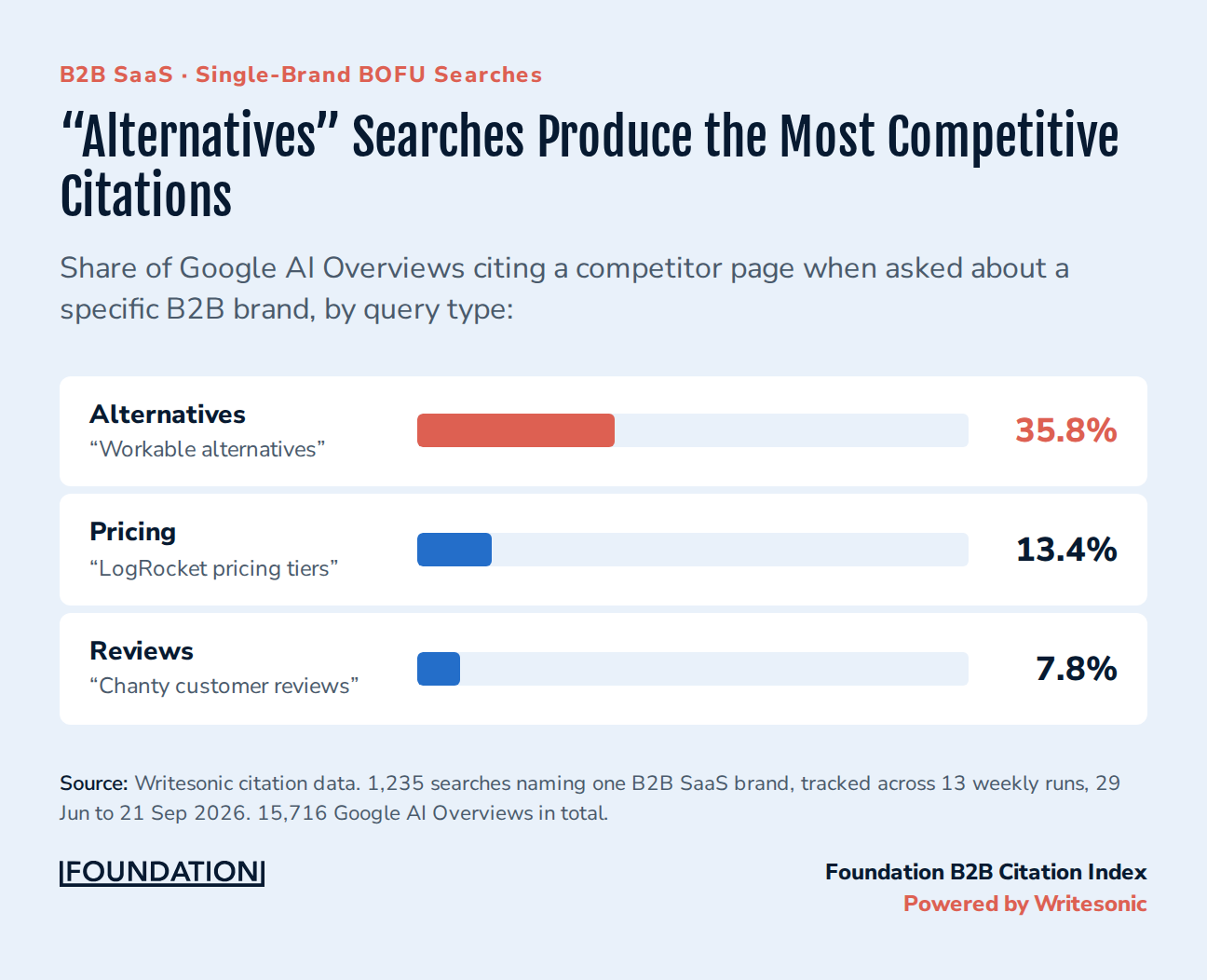
It isn’t surprising that “alternatives” searches lead the way in competitive citations.
Someone searching “Mixpanel alternatives for startups” is asking to see other vendors. That might be a buyer, or an AI agent building a shortlist on their behalf. Either way, a competitor’s page is a fair answer to that question.
What stands out is who gets left out. The brand’s own site appears in only 32.9% of those AI Overviews. In 22.0%, a competitor is cited and the brand isn’t, even though the buyer named the brand in the search.
Pricing and reviews ask for something else. A pricing search wants facts only the brand can give, so Google goes to the brand’s own site. A reviews search wants an outside opinion, so Google goes to review sites. Neither one is asking for a competitor, and competitors show up far less.
When a buyer asks something only you can answer, like your price, Google cites you. When a buyer asks what else is out there, Google goes looking for whoever wrote about it.
3) AI Overviews cite competitors more often than AI Mode or ChatGPT
To see how competitive citations work across other leading AI surfaces, we also ran the same set of single-brand prompts through ChatGPT and Google AI Mode:
- Google AI Overviews cited a direct competitor in 21.7% of 15,716 answers
- Google AI Mode cited a direct competitor in 19.4% of 15,705 answers
- ChatGPT cited a direct competitor in 16.2% of 14,571 answers
AI Overviews cited competitors most often, though AI Mode was close behind.
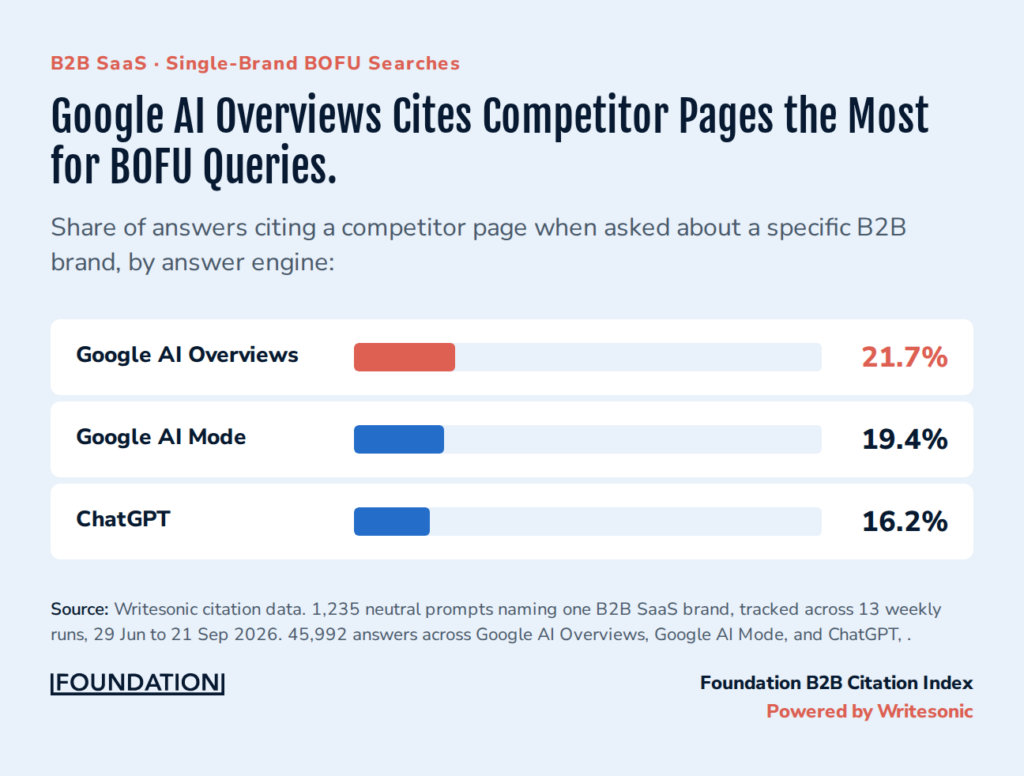
Whichever surface a buyer uses, somewhere between one in six and one in five branded buying searches pull a competitor’s page into the answer.
How Gorgias, Amplitude, and Pumble Win Citations on Their Competitors’ Searches
Three of the stand-out pages from our Writesonic data come from Gorgias, Amplitude, and Pumble. One is an alternatives page straight out of Foundation’s list of must-have SaaS landing pages. The other two, a pricing guide and a review, follow the same idea: a page about a competitor, built for the searches buyers run right before they decide. Each was cited in at least 11 of 13 weekly runs on a search that names a competitor.
Gorgias: “Kustomer Pricing Guide 2026: What You’ll Actually Pay”
Cited in 12 of 13 weekly runs on “Kustomer annual contract pricing.”
The page answers the pricing question before the article body starts. A TL;DR at the top gives Kustomer’s two plan prices ($89 and $139 per seat per month), and the first paragraph repeats them. From there, every H2 and H3 is a pricing question a buyer would ask: each plan, AI add-ons, storage overages, annual billing, and seat minimums. Most come with a table and a dollar figure, including the minimum annual cost for each plan.
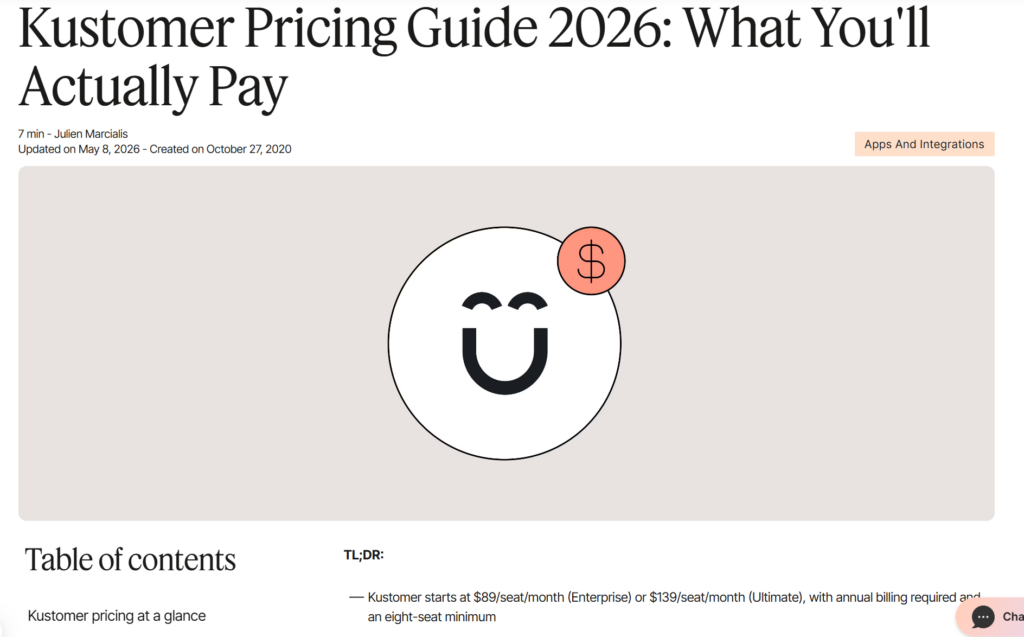
That’s the part Google can lift straight into an answer. A buyer asking about annual contract pricing wants the minimum commitment. Gorgias works it out for them ($8,544 and $13,344 a year) and puts it in a table.
The page is also old and kept current. Gorgias published it in October 2020 and last updated it in May 2026. The URL has been building authority for six years, and the 2026 in the title tells Google and the reader the numbers are recent.
Gorgias shows up in the answer too. A comparison table puts Kustomer next to Gorgias, Zendesk, and Intercom for a 10-agent team, so a buyer who started with Kustomer’s pricing ends up looking at Gorgias’s as well.
Amplitude: “7 Best Mixpanel Alternatives: Compared on Features, Pricing, and Scale”
Cited in all 13 weekly runs on “Mixpanel alternatives for startups.”
This is a textbook example of the must-have SaaS landing pages that we tell brands to invest in. Amplitude lists seven tools and gives each one the same structure: what it is, key strengths, limitations, and who it’s best for. A comparison table sums them up by pricing model, best fit, and main limitation. Six FAQs at the bottom match the follow-up searches buyers run, such as “free alternative to Mixpanel” and “open-source alternative.”
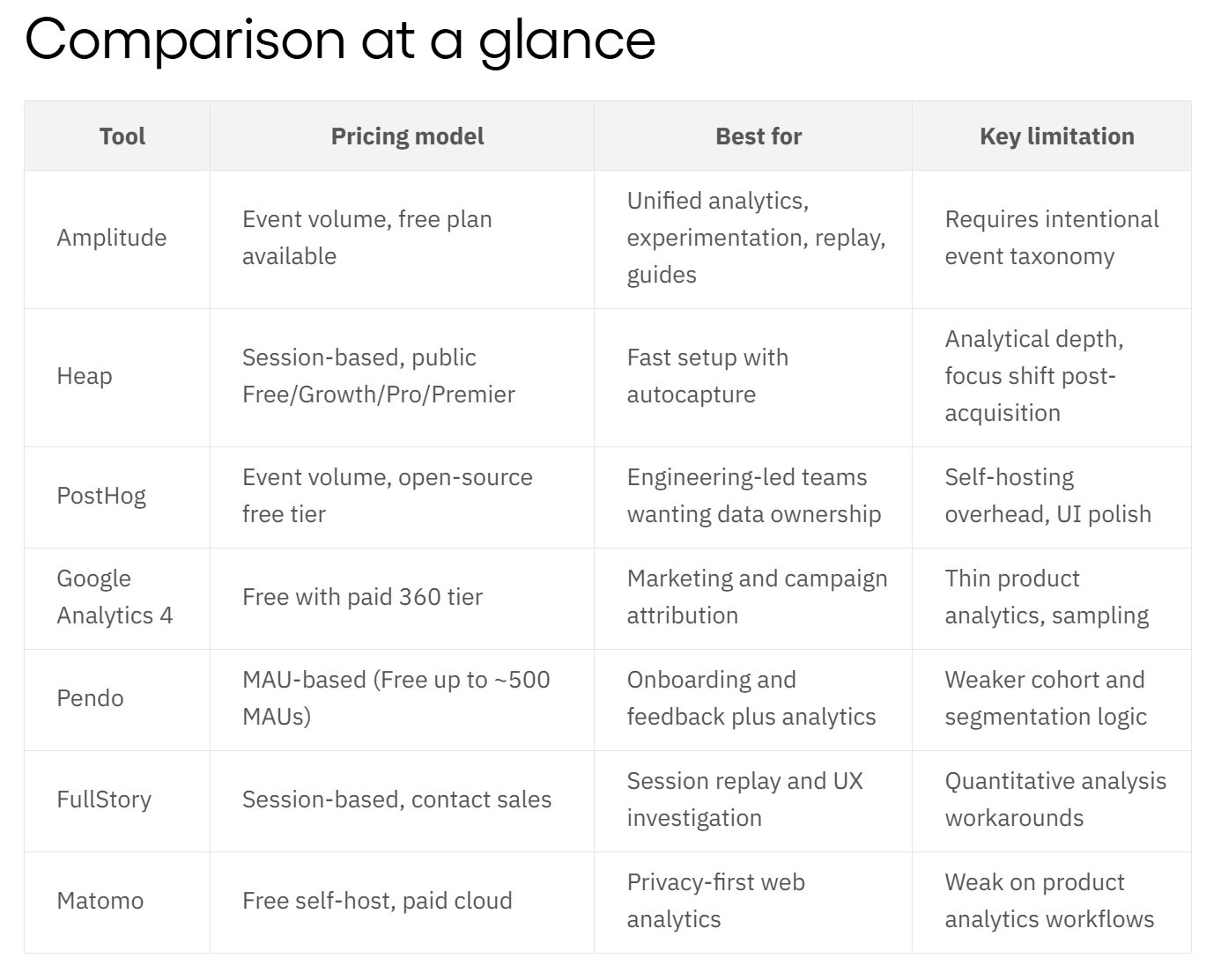
Amplitude ranks itself first and gets the longest section. It also keeps the tone fair toward Mixpanel, calling it “a real product that real teams use” and making cost the main reason to switch. A page that treats the competitor fairly is easier for Google to quote than one that blatantly attacks it.
One detail stands out. The page has no section written for startups, yet it was cited every week on a startup-specific search. Its free-tier details and “best for” labels gave Google enough to answer the startup version of the question. A strong general alternatives page can cover a lot of long-tail modifiers on its own.
Pumble: “Chanty Review 2026: An Honest Analysis by a Competitor”
Cited in 11 of 13 weekly runs on “Chanty customer reviews 2026.”
Pumble says who it is in the title. The H1 and the intro repeat that Pumble makes a competing product. That disclosure lets the page compete on a reviews search, where Google mostly cites third-party sites.
The review works through Chanty feature by feature: free plan limits, paid pricing, interface, messaging, video, file storage, integrations, support, and security. It has about 20 captioned screenshots and specific, checkable details like Chanty’s Business plan price. A comparison table with Pumble closes it out.
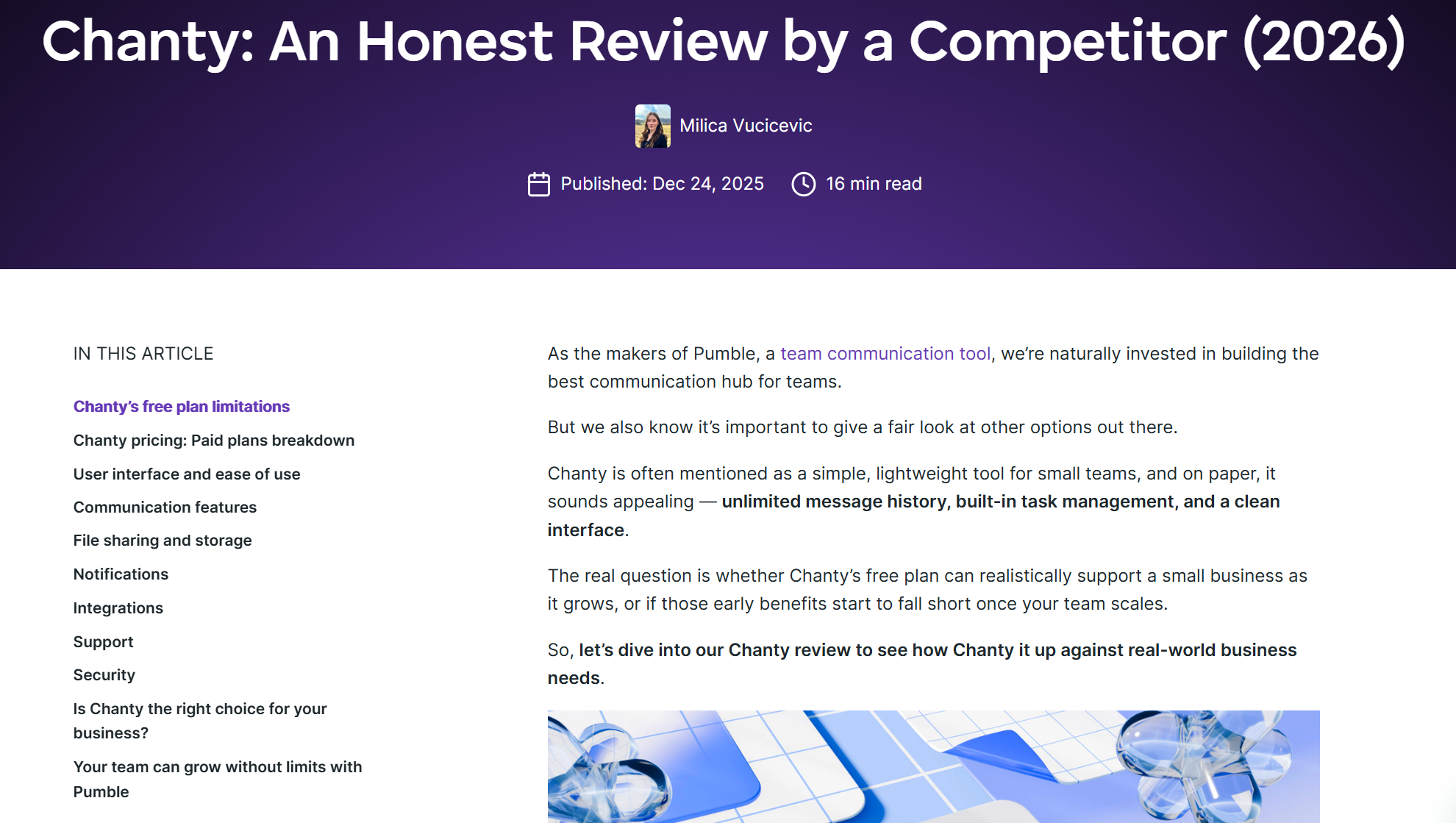
It also has an author byline with a photo, and it links to a review methodology page. On a reviews search, signs that a real person tested the product carry weight.
What the Three Pages Have in Common
The three pages share five traits:
- The title matches the search. “Kustomer Pricing”, “Mixpanel Alternatives”, and “Chanty Review” lead each title and URL slug, and two of the three add the current year. The page is the obvious match for the question the buyer typed.
- The answer comes early and in a form Google can lift. Prices, plan limits, and “best for” labels sit in TL;DRs, tables, and short sections. Google can quote a line from a table without rewriting it.
- They’re fair to the competitor. Each page credits the rival brand before making its own case. Amplitude says Mixpanel works. Gorgias credits Kustomer’s CRM depth and enterprise security. Pumble labels itself a competitor up front.
- The publisher is in the answer. Each page closes with a comparison table that includes its own product, so the buyer sees the publisher next to the brand they searched for.
- They’re kept fresh. Gorgias has updated the same URL since 2020. Amplitude and Pumble both put 2026 in their titles.
The bar is also lower than you might expect. None of the three cite the competitor’s own pricing page or documentation for their claims. Amplitude’s page shows no author or date. Pumble’s has no visible update date and no FAQ section. These pages win because they exist and answer the question directly, and few brands have built the same page about themselves or their rivals.
That cuts both ways. If you publish these pages about your competitors, you can earn the same citations. The same pages are likely being written about you, and the best defence is to publish the strongest version of each page on your own site: your pricing with the full annual cost, your alternatives page, and your migration guides.
How to Play Offence and Defence in the AI Overview
Offence means publishing pages about your competitors. Defence means owning the answers buyers look for about you. Here is how B2B marketing teams can take proactive measures across both fronts:
- Audit your branded buying searches, not just your name. Extend the list of branded prompts you track past your bare brand name. Add “alternatives”, “pricing”, “reviews”, “migration”, and other qualifiers relevant to your ICP, then record every site the AI Overview cites. Repeat these audits, because the weekly rate in our data moved between 12.7% and 30.2% over the quarter.
- Own your alternatives answer. This is where you’re weakest. Your site shows up in a third of these AI Overviews. An honest page on who you’re a good fit for, and who should pick someone else, gives Google a first-party source to cite.
- Protect the answers you already win. Pricing is home turf at 75.7%. Keep your pricing page current and specific. A vague one leaves room for a competitor’s pricing guide to fill the gap.
- Show up where the decision gets described. Review sites appear in 58.8% of these AI Overviews and Reddit in 46.4%. Your G2 profile and the threads where buyers compare tools are part of your brand answer now.
Start with the alternatives page. It’s the answer you’re most likely missing today.
Build the Pages Buyers Search Right Before They Choose
Your brand name is still mostly safe. Your buying searches aren’t. In one of every five branded buying searches we tracked, Google’s AI Overview cited a direct competitor’s page. On alternatives searches, it was one in three, and the brand’s own site showed up in only a third of those answers.
The pages doing it aren’t hard to build. They’re alternatives pages, pricing guides, and honest reviews that answer the buyer’s question early and keep it current. Some of your competitors already have them. The question is whether yours exist for the searches buyers run about you.
Foundation can map the branded buying searches that matter to your pipeline, show you whose pages get cited on each one, and build the pages that get your brand cited.

