Article's Content
Article's Content
Ask AI to compare your product with a named competitor. You might get an answer built from vendors that were never in the prompt.
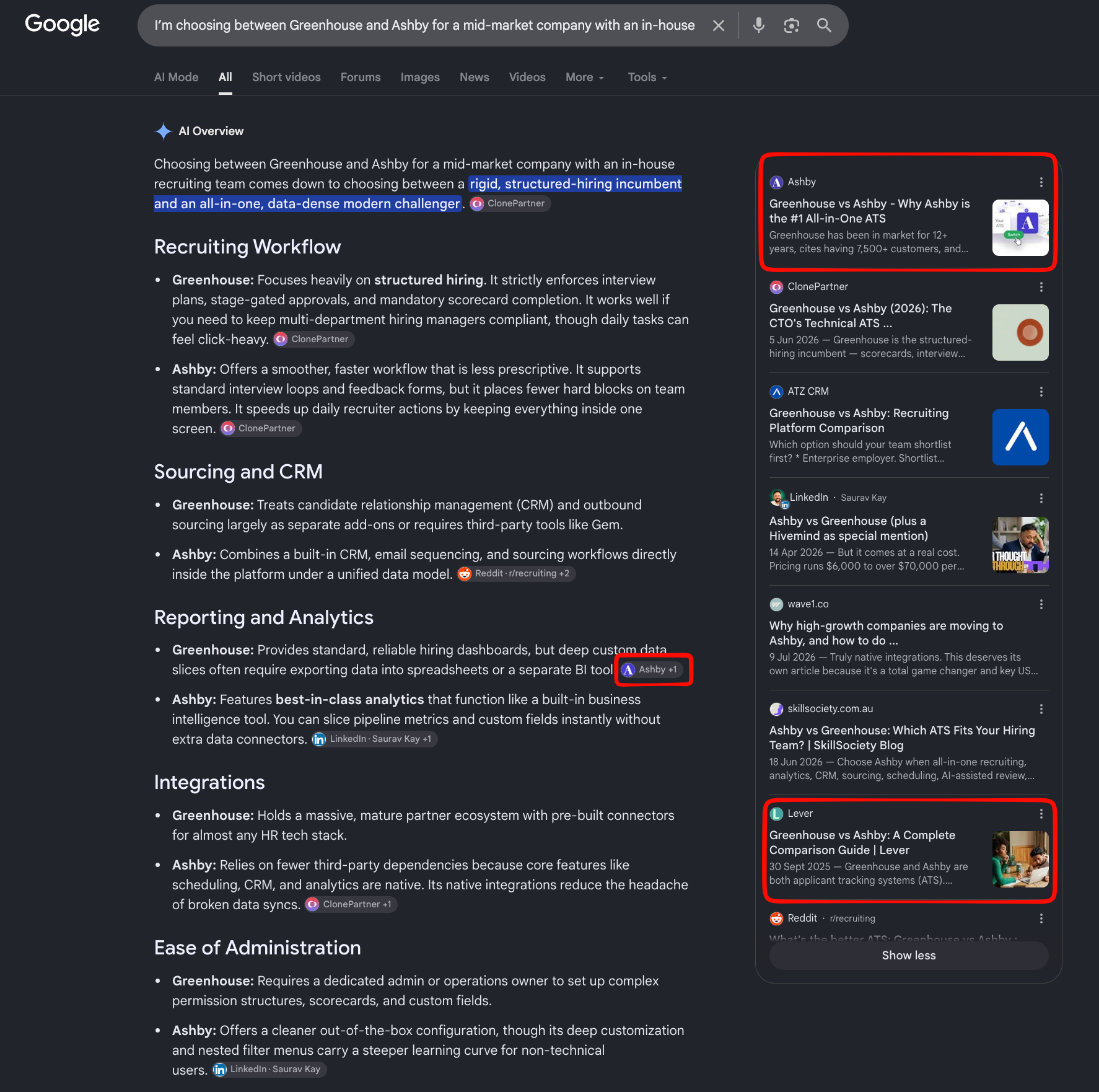
That’s what happened in our Applicant Tracking Systems (ATS) study. We asked Google AI Overview “I’m choosing between Greenhouse and Ashby for a mid-market company with an in-house recruiting team”, one of 20 ATS buying questions we tested across six AI surfaces. Ashby’s comparison page backed a claim about Greenhouse’s reporting. Lever’s Greenhouse-versus-Ashby guide appeared too. Our audit found no dedicated Greenhouse page for that matchup at all.
Across the full test, comparison pages and listicles accounted for 58.7% of surface-weighted source presence. On direct two-product questions, dedicated comparison pages hit 42.1%.
We call this source set the Versus Layer: the comparison, review, and category pages AI draws on to explain product differences and pick a winner.
This teardown shows who owns that layer in ATS, where first-party coverage is weak, and which pages to build first.
Methodology: We Tested 20 ATS Buying Questions Across Six AI Surfaces
The Four ATS Vendors Supplied Only 27% of the Evidence on Direct Comparisons
AI Reached for Different Pages as Buyers Narrowed the Shortlist
ChatGPT Used a Different Source Mix
Competitor Pages Can Also Shape How AI Explains Your Product
Lever, Greenhouse, and Venture Harbour Won Different Parts of the Versus Layer
What Each Vendor Is Leaving on the Table
Build the Versus Layer in This Order
If You Don’t Supply the Evidence, Somebody Else Will
Methodology: We Tested 20 ATS Buying Questions Across Six AI Surfaces
The Setup
We chose ATS because the category gave us a clean test of the Versus Layer. Buyers compare ATS vendors on many of the same criteria, several credible products compete for similar use cases, and first-party comparison coverage varies widely.
We focused on Greenhouse, Ashby, Lever, and Workable, creating six possible direct matchups between the four vendors.
The ownership gaps were visible before we ran a single AI prompt. Lever had dedicated pages for all three of its matchups. Ashby and Workable covered two each. We found no dedicated Greenhouse page for any of its three matchups.
We built 20 buying prompts around that category. Six were direct head-to-head comparisons. One example prompt for Greenhouse versus Ashby was:
“I’m choosing between Greenhouse and Ashby for a mid-market company with an in-house recruiting team. Compare them on recruiting workflow, sourcing and CRM, reporting and analytics, integrations, ease of administration, and ability to scale. Which would you recommend, and why?”
The other five covered the remaining matchups. Four prompts asked for alternatives to a named vendor. The final 10 were neutral category questions covering scalability, analytics, CRM, integrations, administration, candidate experience, and value for money.
We ran all 20 prompts twice across ChatGPT, Perplexity, Gemini, Claude, Google AI Mode, and Google AI Overview.
How We Counted
A source presence is one page appearing as a visible source in one answer. Repeated appearances of the same URL within an answer counted once. We calculated source shares separately for each AI surface, then averaged the six surfaces equally so interfaces exposing more sources did not dominate the results.
The Data
The two runs produced 240 AI answers:
- 120 from named-vendor prompts
- 120 from neutral category prompts
Across those answers, we recorded 2,695 answer-to-page source presences.
That dataset lets us compare more than which brands appeared in the answers. We can see who owned the pages AI relied on, which content formats surfaced at different stages of the buying decision, and how that changed once a buyer named specific vendors.
Unless otherwise stated, source-presence figures throughout this article come from Foundation Labs’ September 2026 controlled ATS test.
The Four ATS Vendors Supplied Only 27% of the Evidence on Direct Comparisons
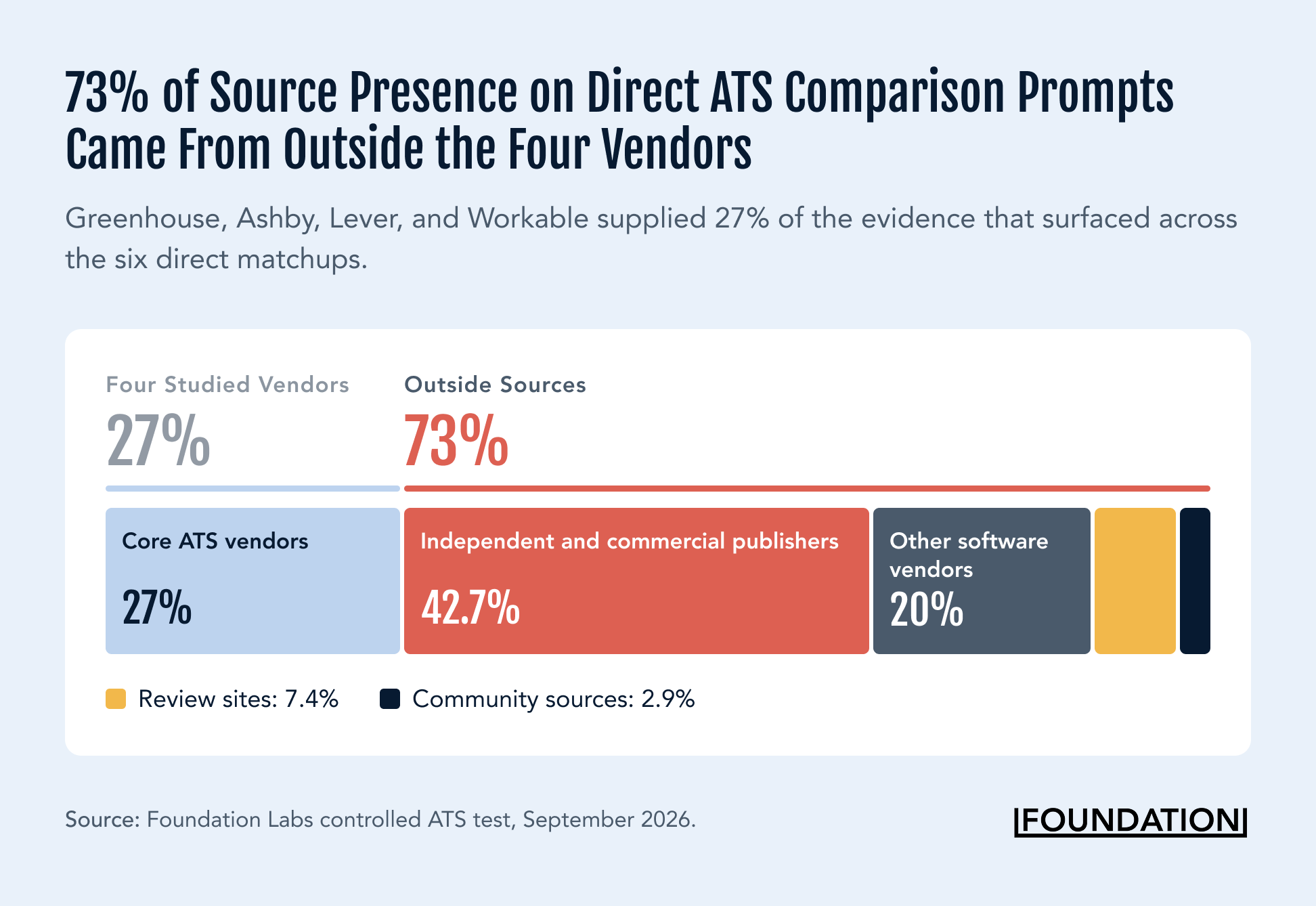
Across the six direct ATS matchups, Greenhouse, Ashby, Lever, and Workable accounted for just 27% of visible source presence.
The remaining 73% came from sources outside the four vendors:
- independent and commercial publishers such as Venture Harbour and ClonePartner (42.7%),
- other software vendors such as Pinpoint and SmartRecruiters (20%),
- review sites such as G2 (7.4%), and
- community sources such as Reddit (2.9%)
None of the six matchups was led by a first-party comparison page from either product being compared.
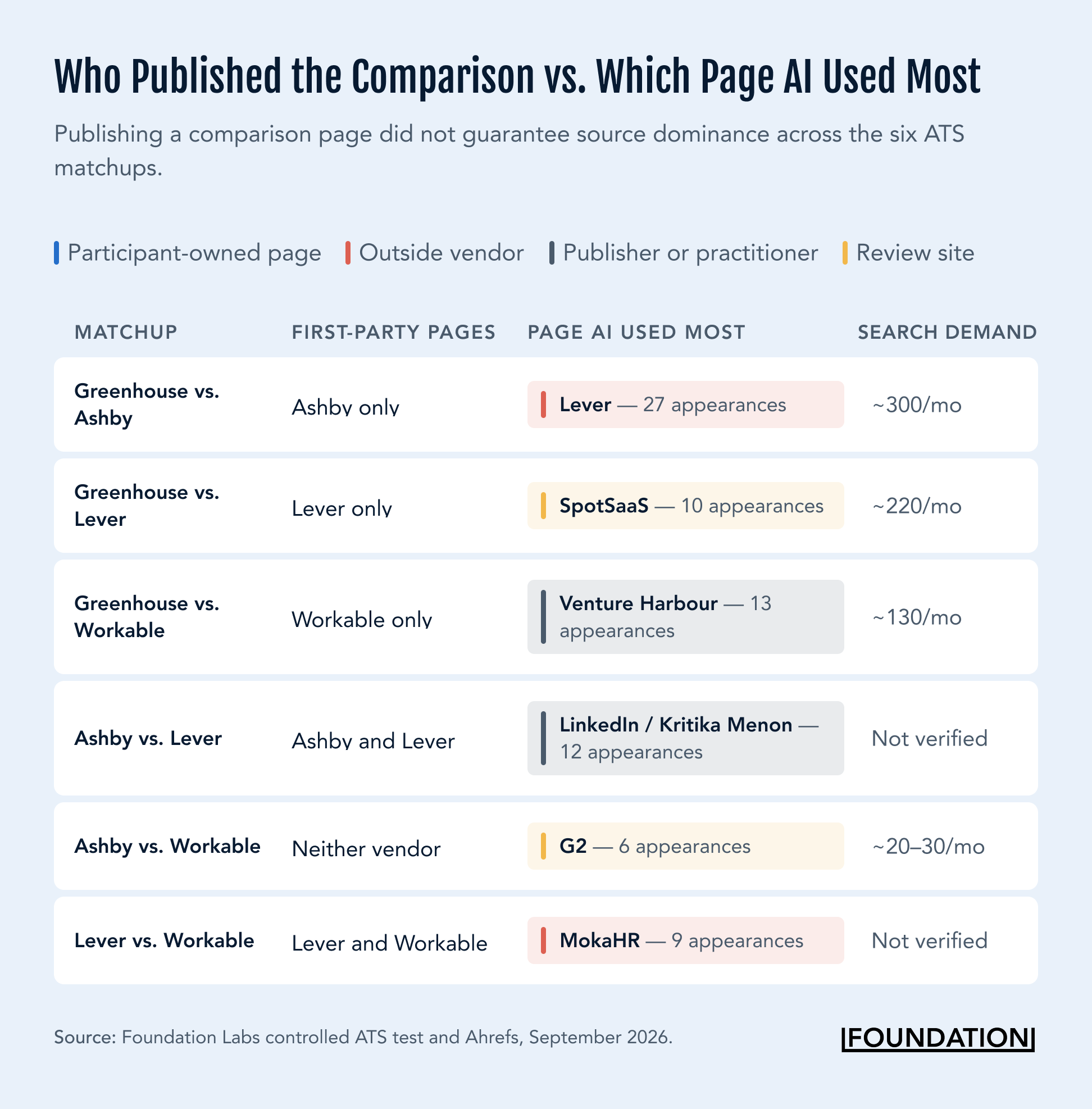
Across the full test, no matchup’s most-used dedicated comparison source belonged to either vendor being compared. Lever’s Greenhouse-versus-Ashby guide appeared in 27 answers across 14 prompts, while Venture Harbour’s Workable-versus-Greenhouse page appeared in 13 answers across seven prompts.
Elsewhere, SpotSaaS led Greenhouse versus Lever, LinkedIn/Kritika Menon led Ashby versus Lever, G2 led Ashby versus Workable, and MokaHR led Lever versus Workable.

Publishing a comparison page gave vendors coverage, but it didn’t mean their page became the evidence AI surfaced most often when buyers are comparing options.
AI Reached for Different Pages as Buyers Narrowed the Shortlist
The source mix changed as the buying question became more specific. On the 10 neutral prompts, listicles accounted for 51.1% of surface-weighted source presence, compared with 12.6% for dedicated comparison pages.
Once a vendor appeared in the question, comparison pages rose to 33.8% and listicles fell to 21.4%. On the six direct head-to-head questions, comparison pages reached 42.1%.
The difference makes sense when you look at what each question asks AI to do.
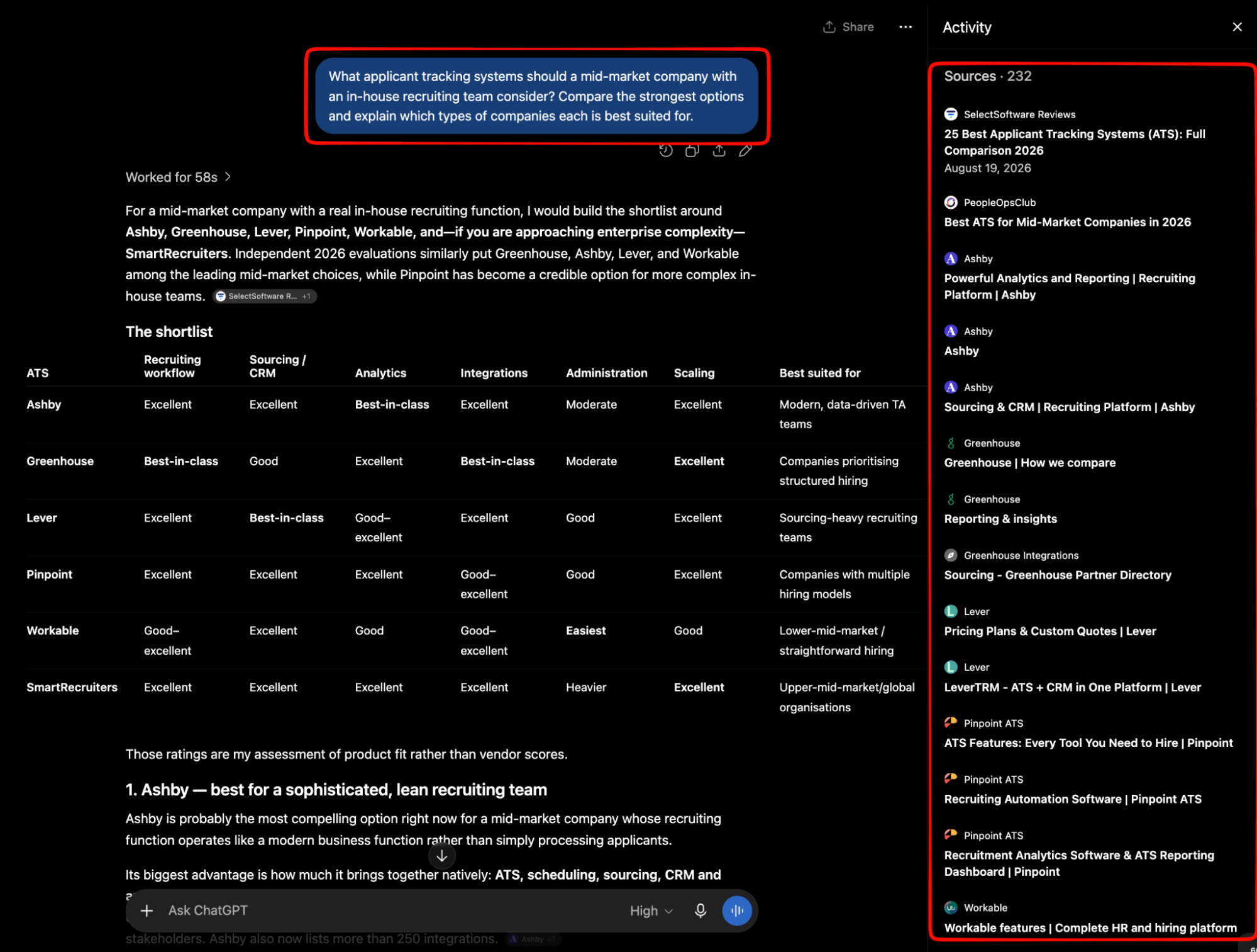
For the neutral category-discovery prompts, AI had to build the shortlist itself. One of those prompts asked:
“What applicant tracking systems should a mid-market company with an in-house recruiting team consider? Compare the strongest options and explain which types of companies each is best suited for”.
ChatGPT responded with a six-product shortlist, matching each platform to a different recruiting need.
That is also where broad category pages travelled furthest in our test. Pages such as Pinpoint’s Best Applicant Tracking Systems and Greenhouse’s 13 Best ATS Software could cover several candidates, use cases, and trade-offs in one place.
The source mix changed again once we gave AI the shortlist. When the prompt narrowed to Greenhouse versus Ashby, Perplexity’s second run drew eight of its nine unique sources from dedicated Greenhouse-versus-Ashby comparison pages, including AIHRAtlas, ClonePartner, BestRecruitingTools, Prepzo, RecruitCompare, and HireTruffle.
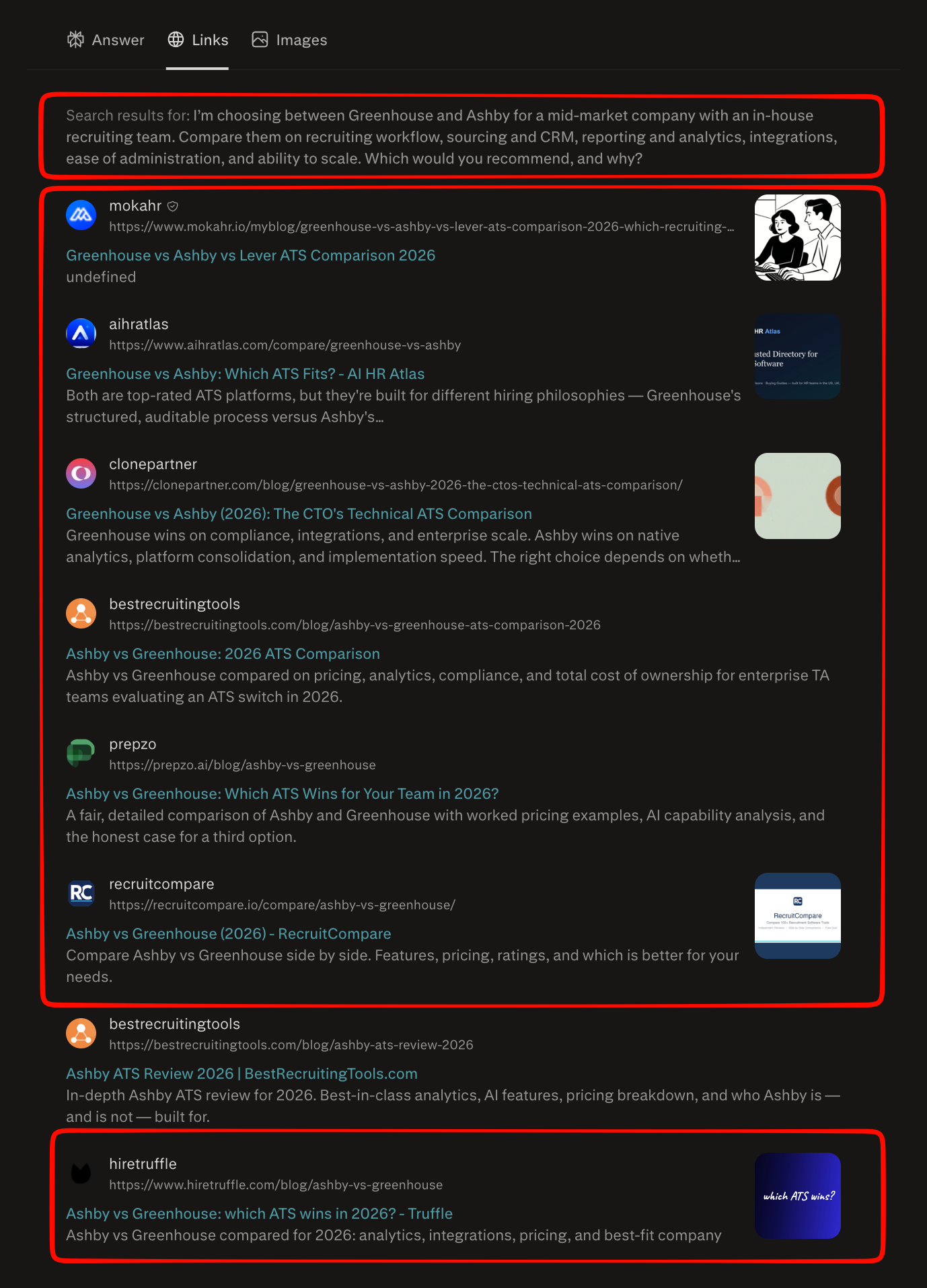
The source list changed when the question became more specific. But it also changed across platforms, with ChatGPT being the standalone with what sources were cited.
ChatGPT Used a Different Source Mix
Five of the six surfaces relied heavily on comparison pages and listicles. But ChatGPT leaned much more on first-party product and support content.
When we asked ChatGPT to compare Lever and Workable for a mid-market recruiting team, its visible citations pointed mainly to Lever pages on CRM, candidate nurturing, and pricing, alongside Workable Help pages on pipelines, automation, AI sourcing, and reporting. Lever’s dedicated Workable comparison appeared in the broader source set, but it was not the main evidence shown in the answer.
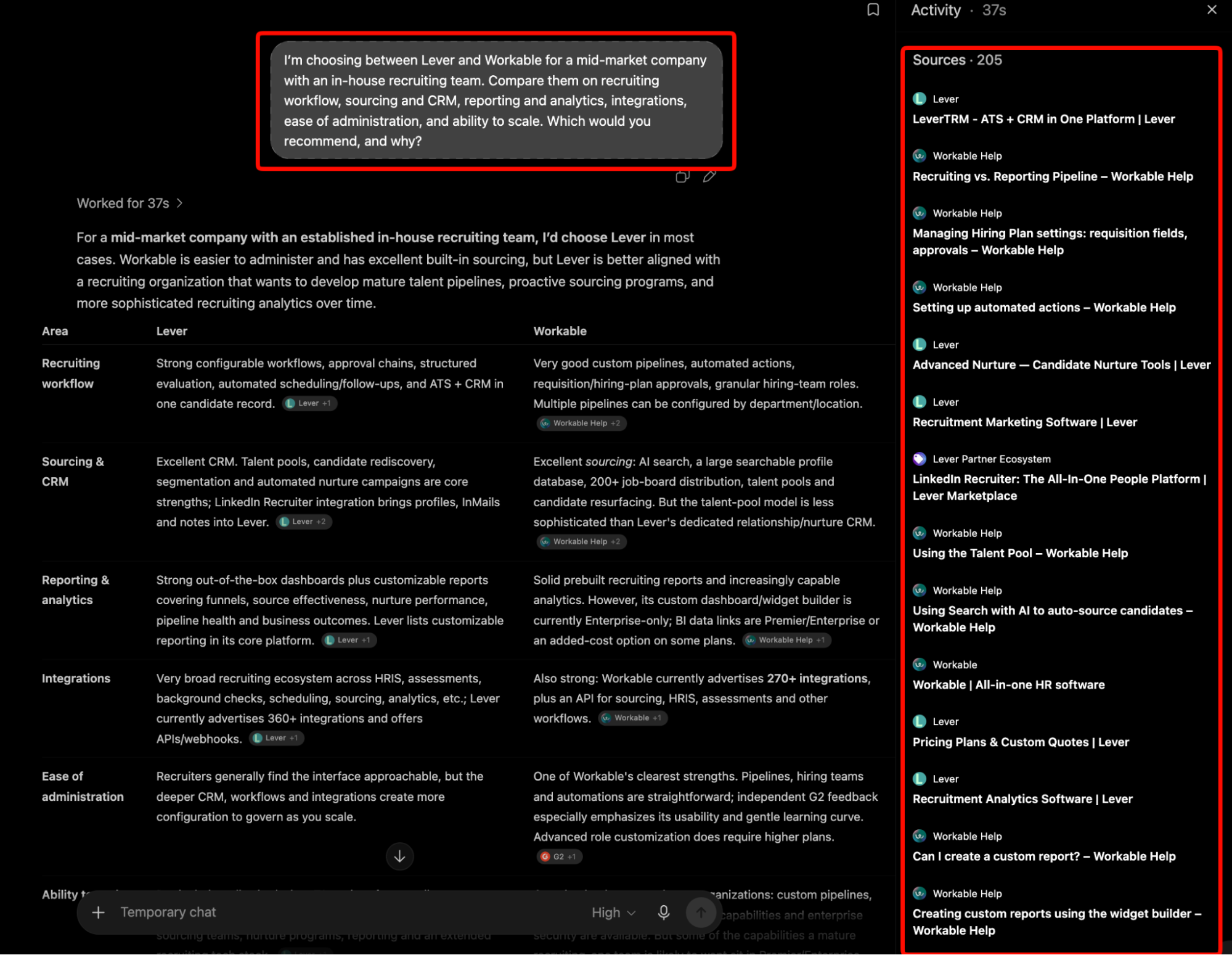
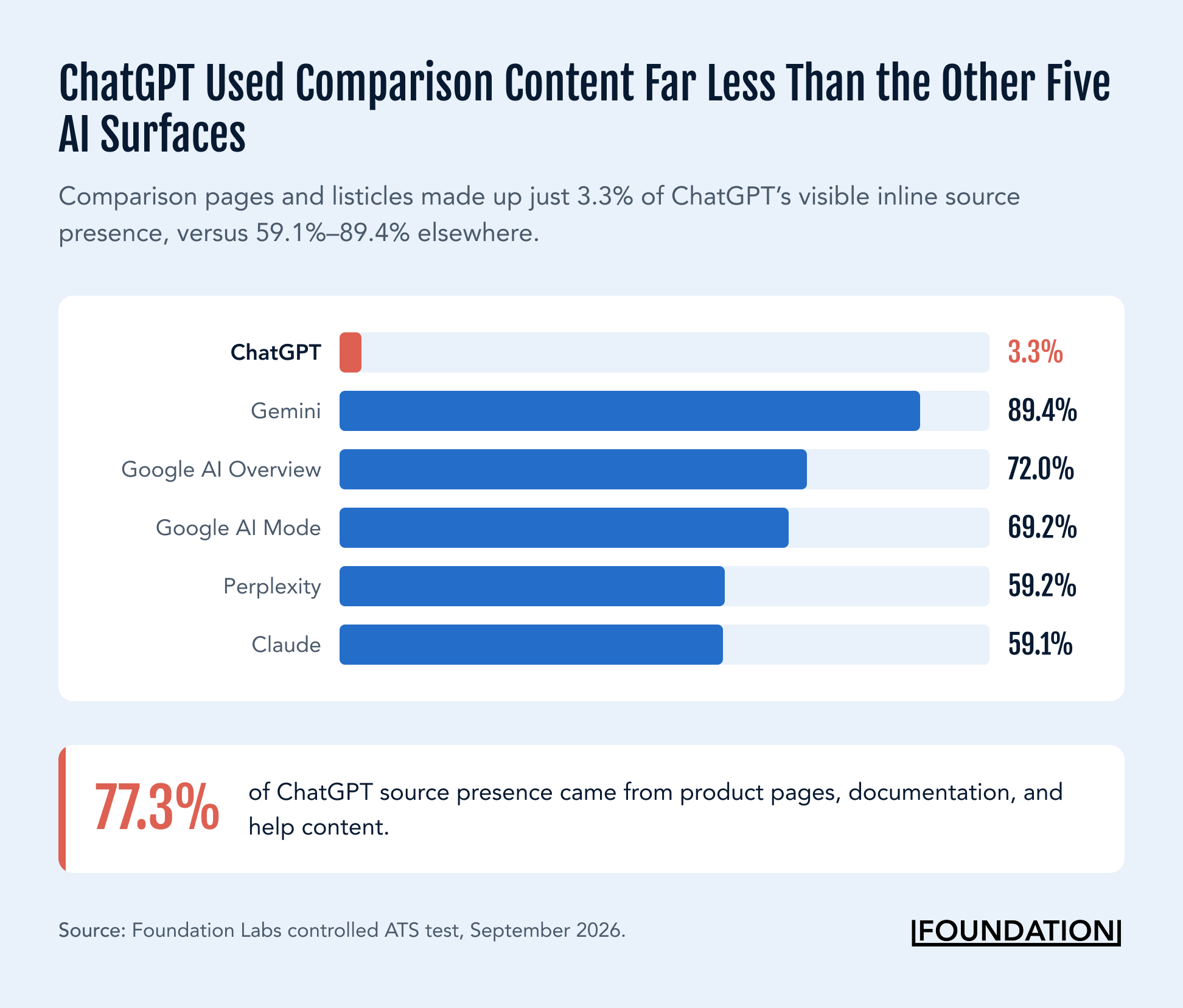
Across the full ChatGPT test, product pages, documentation, and help content accounted for 77.3% of visible inline source presence, including 63.8% from product pages alone. Dedicated comparisons and listicles accounted for just 3.3% combined.
The other five surfaces were far more comparison-heavy. Comparison pages and listicles made up 89.4% of source presence on Gemini, 72% on Google AI Overview, 69.2% on Google AI Mode, 59.2% on Perplexity, and 59.1% on Claude.
What the Platform Split Means for Content Strategy
The Versus Layer isn’t owned through comparison pages alone. In our test, comparison and list-style content carried most of the evidence on five surfaces, while ChatGPT relied far more on product and support pages.
As Ross Simmonds, CEO of Foundation Marketing, puts it:
Every platform is going to be different. Every LLM shows links differently and will pull your content differently.
That means coverage has to extend across several page types, each serving a different part of the buying process:
- Category pages can earn visibility when AI is building a shortlist.
- Comparison pages can enter the source mix when buyers ask about named vendors.
- Product and support pages can supply the first-party evidence ChatGPT uses for features, pricing, workflows, integrations, and setup.
The right mix also depends on the platform. If Perplexity repeatedly draws on outside comparison pages while ChatGPT already relies on your first-party product content, those are two different gaps. The first calls for stronger evaluation content; the second may require improving the product evidence already available on your site.
We explore that platform-level variation further in Model Drift.
Competitor Pages Also Shape How AI Explains Your Product
In several answers, AI used one company’s comparison page to explain another company’s weaknesses and who it was best suited for.
When Google AI Overview compared Greenhouse with Ashby, it described Greenhouse reporting as reliable for standard dashboards but said deeper analysis could require spreadsheets or a separate BI tool.
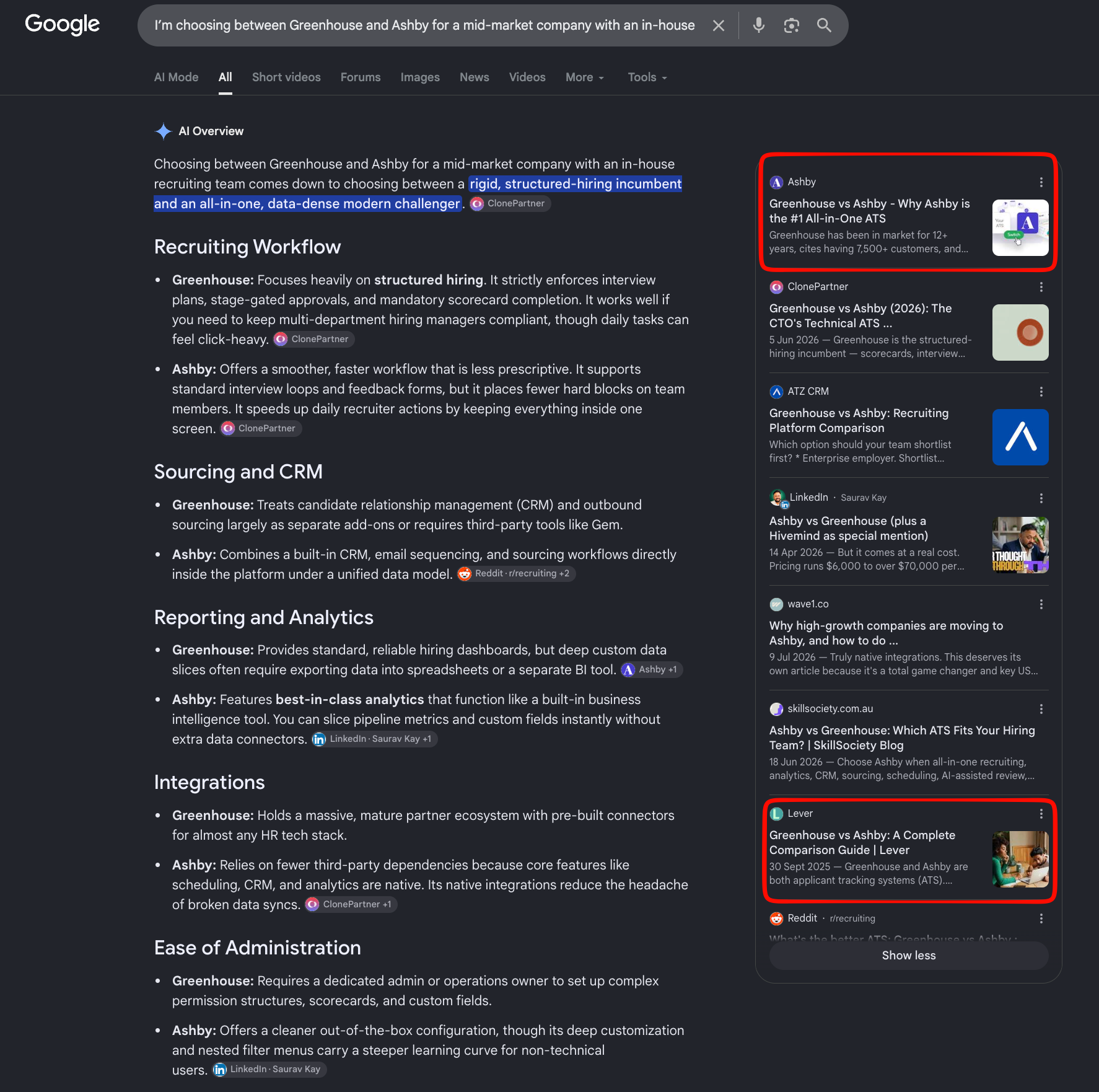
Ashby’s Greenhouse-versus-Ashby page was attached directly to that assessment, while Lever’s guide for the same matchup also appeared among the sources. Greenhouse had no dedicated first-party page for the matchup in our audit.
The pattern also appeared in Google AI Mode. When we compared Ashby with Lever, Google said Lever’s unified pipeline could feel rigid for teams that need different hiring stages. The evidence for that weakness came from Ashby’s own Lever comparison page.
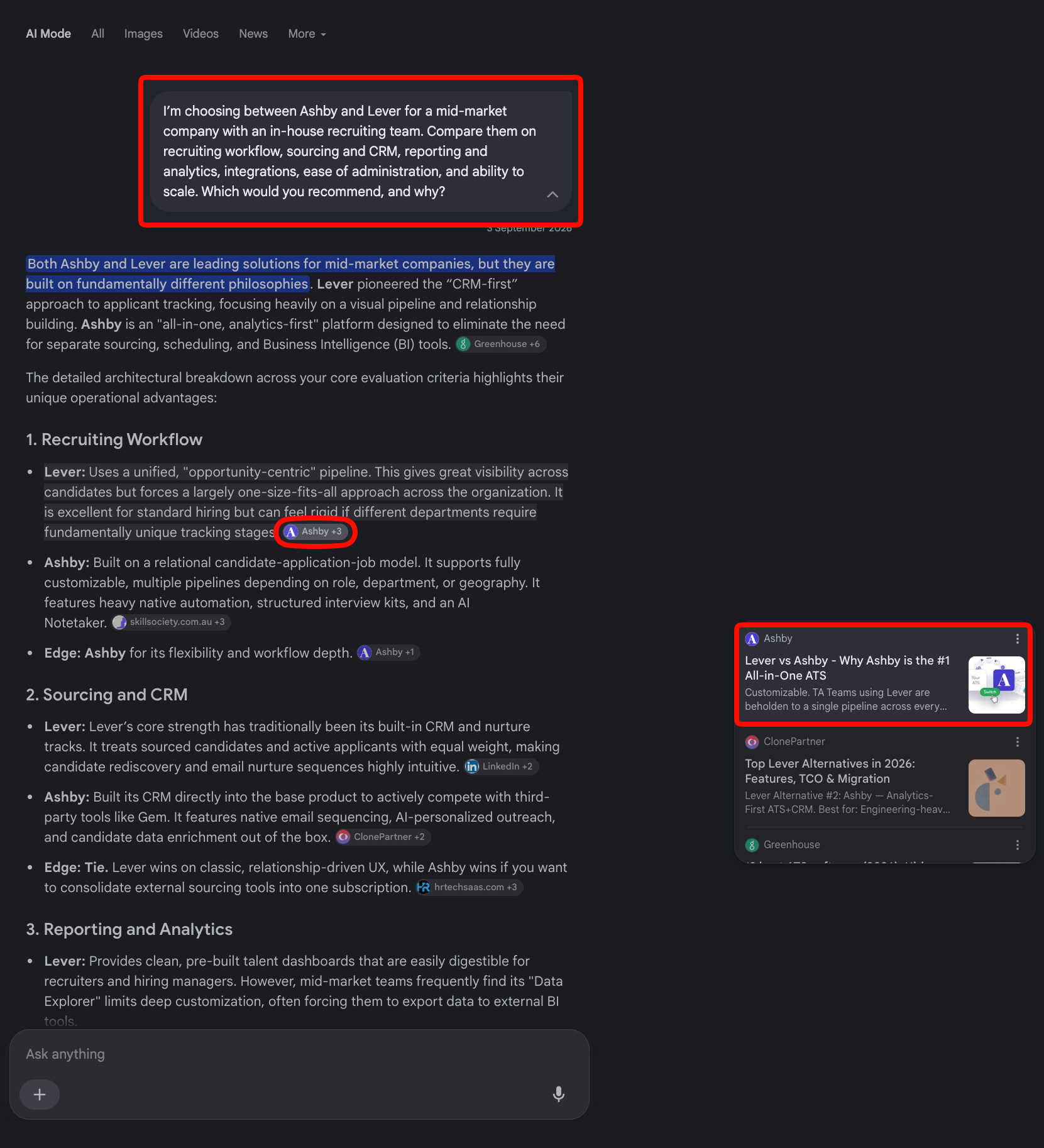
The answer ultimately favored Ashby for workflow flexibility.
When we ran that same Ashby-versus-Lever prompt in Gemini, it described Lever as strong on standard recruiting dashboards but said custom report building could feel restrictive.
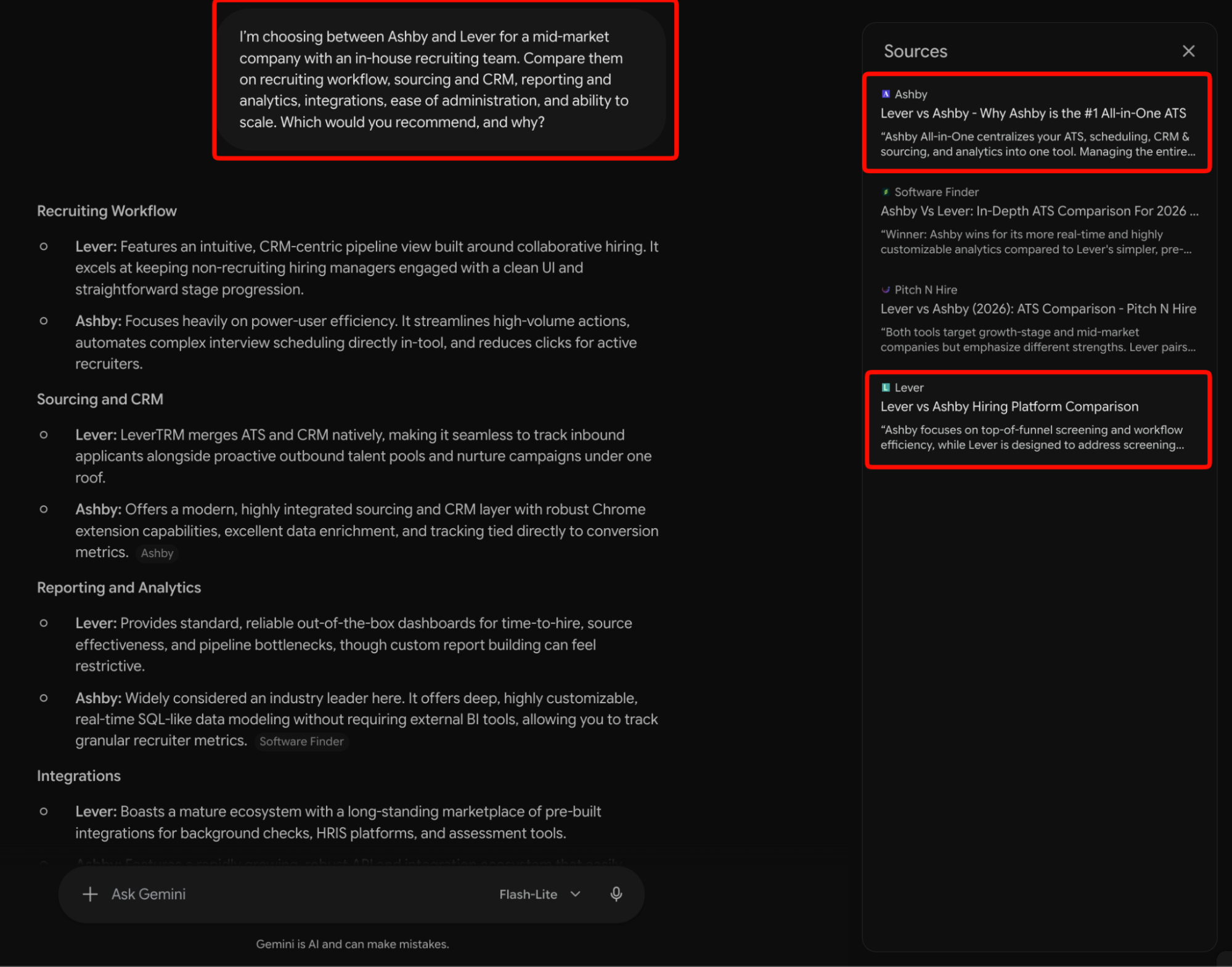
Ashby’s own Ashby-versus-Lever page was among the visible sources used for the answer, alongside Lever’s comparison page and independent comparisons.
Perplexity did the same with Lever versus Workable. It recommended Lever for teams prioritizing CRM, collaboration, and structured workflows, while positioning Workable for simpler, high-volume inbound hiring.
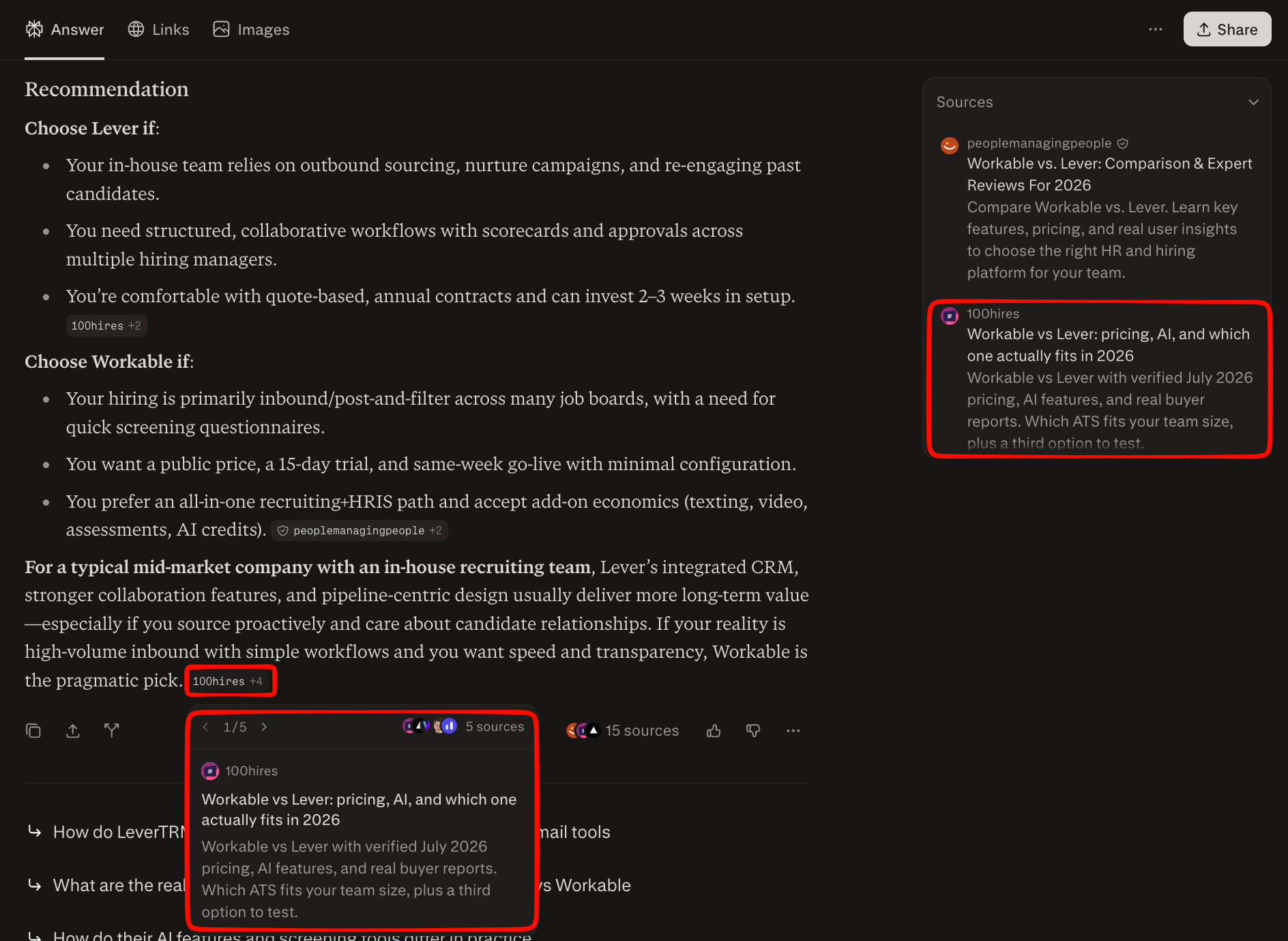
100Hires’ Workable-versus-Lever page was attached to the recommendation, giving an outside ATS vendor a place in the evidence used to define the recommendation.
Across these examples, competitor comparison pages appeared in the evidence used to explain a rival’s weaknesses, trade-offs, and buyer fit. The next question is which pages entered that evidence set most consistently and what role they played in the decision.
Lever, Greenhouse, and Venture Harbour Won Different Parts of the Versus Layer
The pages that travelled furthest in our AI test weren’t always the pages with the strongest conventional search metrics.
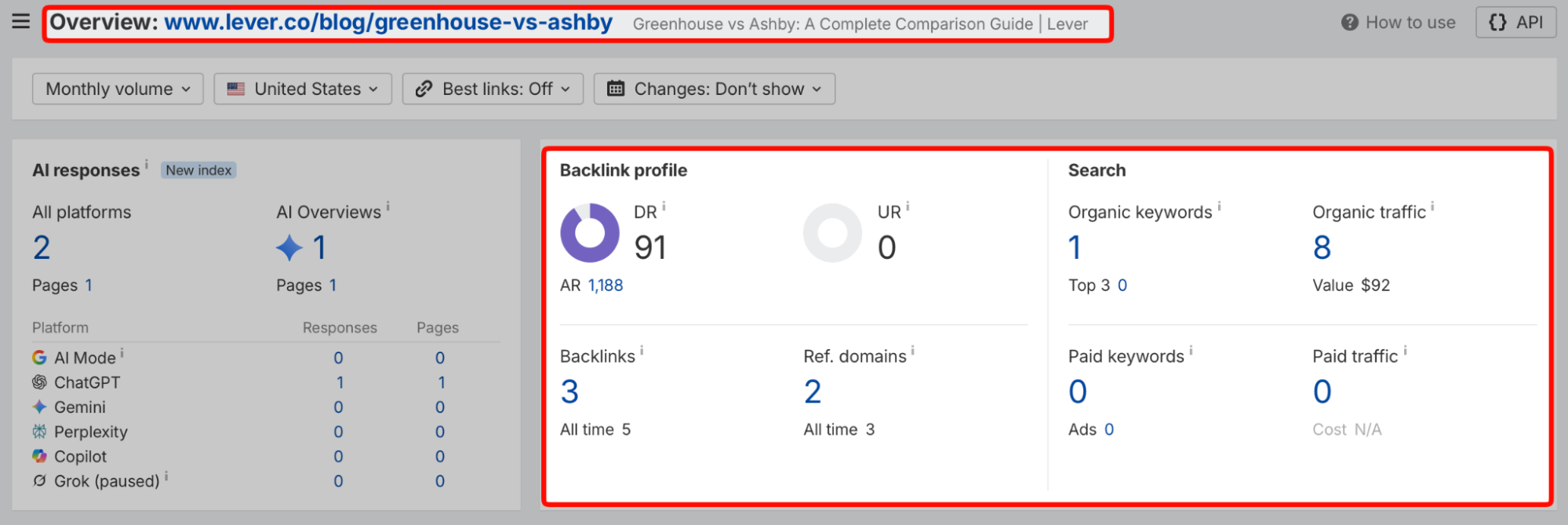
Lever’s Greenhouse-versus-Ashby page appeared in 27 answers, even though Ahrefs estimated eight monthly organic visits, a URL Rating of 0, and two referring domains.
Ashby’s own page appeared in 18 answers, while having 20 estimated monthly organic visits, a URL Rating of 19, and six referring domains.
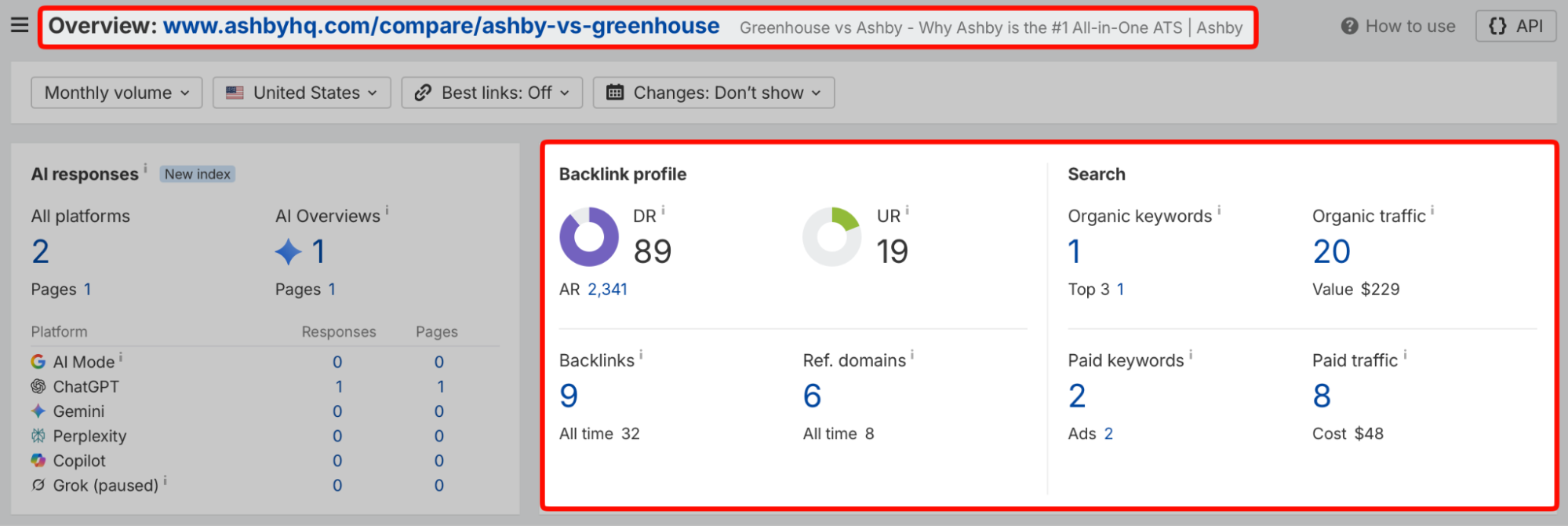
Venture Harbour’s Workable-versus-Greenhouse page appeared in 13 answers across seven prompts and five surfaces, while Ahrefs estimated 11 monthly organic visits, a URL Rating of 4.5, and three referring domains.

The gap is clearest in the Greenhouse-versus-Ashby matchup. Ashby’s page had the stronger organic footprint, but Lever’s page appeared in nine more answers in our test. Venture Harbour showed a similar pattern from a smaller search base: modest organic traffic, but repeated source presence across five AI surfaces.
So we looked beyond traffic and rankings and asked what role each page played in the buying decision.
Lever Expanded the Competitive Decision
Lever covered all three matchups, then published a Greenhouse-versus-Ashby guide for a decision it wasn’t part of. That page appeared in 27 answers across 14 prompts and five surfaces, including 12 neutral prompts. Its Lever-versus-Workable page appeared eight times, compared with one appearance for Workable’s first-party page.
The Greenhouse-versus-Ashby guide broadens the choice near the top into “Lever vs. Ashby vs. Greenhouse”. Lever gets six stated advantages and a verdict, while Ashby and Greenhouse each get their own advantages, disadvantages, and verdict.
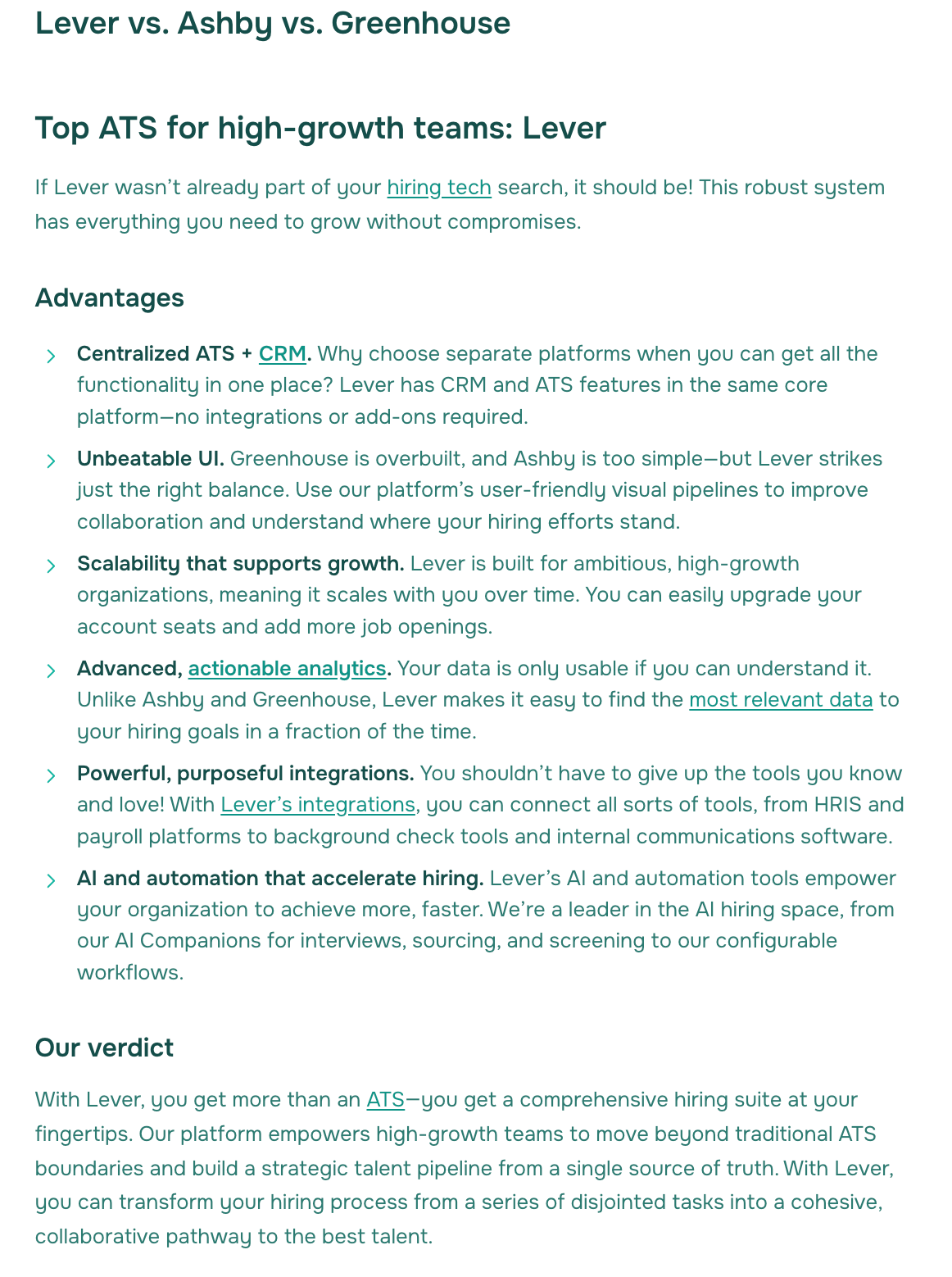
The page contains enough evaluative material to answer questions about either competitor while also inserting Lever into the consideration set.
Greenhouse Helped Buyers Build the Shortlist
Greenhouse took a different route. We found no dedicated first-party page for its matchups with Ashby, Lever, or Workable, but its “13 Best ATS Software” article appeared in 38 answers, including 31 neutral answers, across all six surfaces.
The page is built for category discovery. An early table compares 13 products by best-fit use case, strengths, considerations, and place in the hiring stack, before Greenhouse explains the criteria buyers should use to evaluate an ATS.
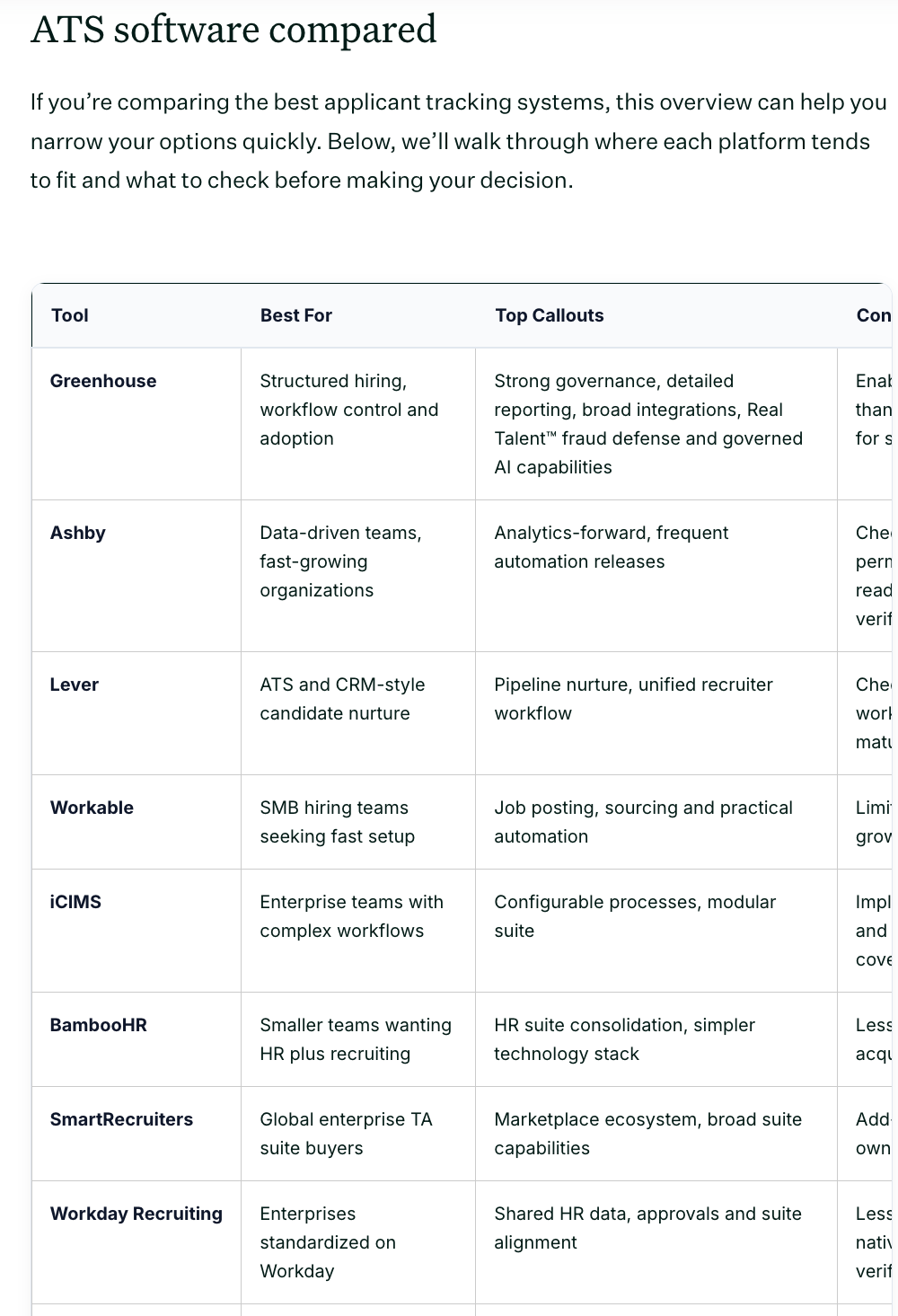
That makes the page useful when the buyer is still asking which products belong on the shortlist, rather than which of two named products should win.
Venture Harbour Helped Buyers Resolve the Matchup
Venture Harbour is an AI automation venture studio that has published software research and testing for more than a decade, including category guides, reviews, alternatives pages, and direct product comparisons.
One such comparison is their Workable-versus-Greenhouse page, which appeared in 13 answers across seven prompts and five surfaces. The page gives the recommendation early, then compares the products across six decision criteria: pricing, sourcing, structured hiring, setup, reporting, and integrations.

Each section names a winner, and the article closes by explaining who should choose Workable, who should choose Greenhouse, and when neither is the better fit.
What Each Vendor Is Leaving on the Table
The comparison gaps look different for each vendor. Greenhouse has no dedicated page for any of its three audited matchups. Ashby and Workable each cover two of three, but the missing coverage has different demand. Lever covers all three, yet outside sources still appeared more often in each matchup.
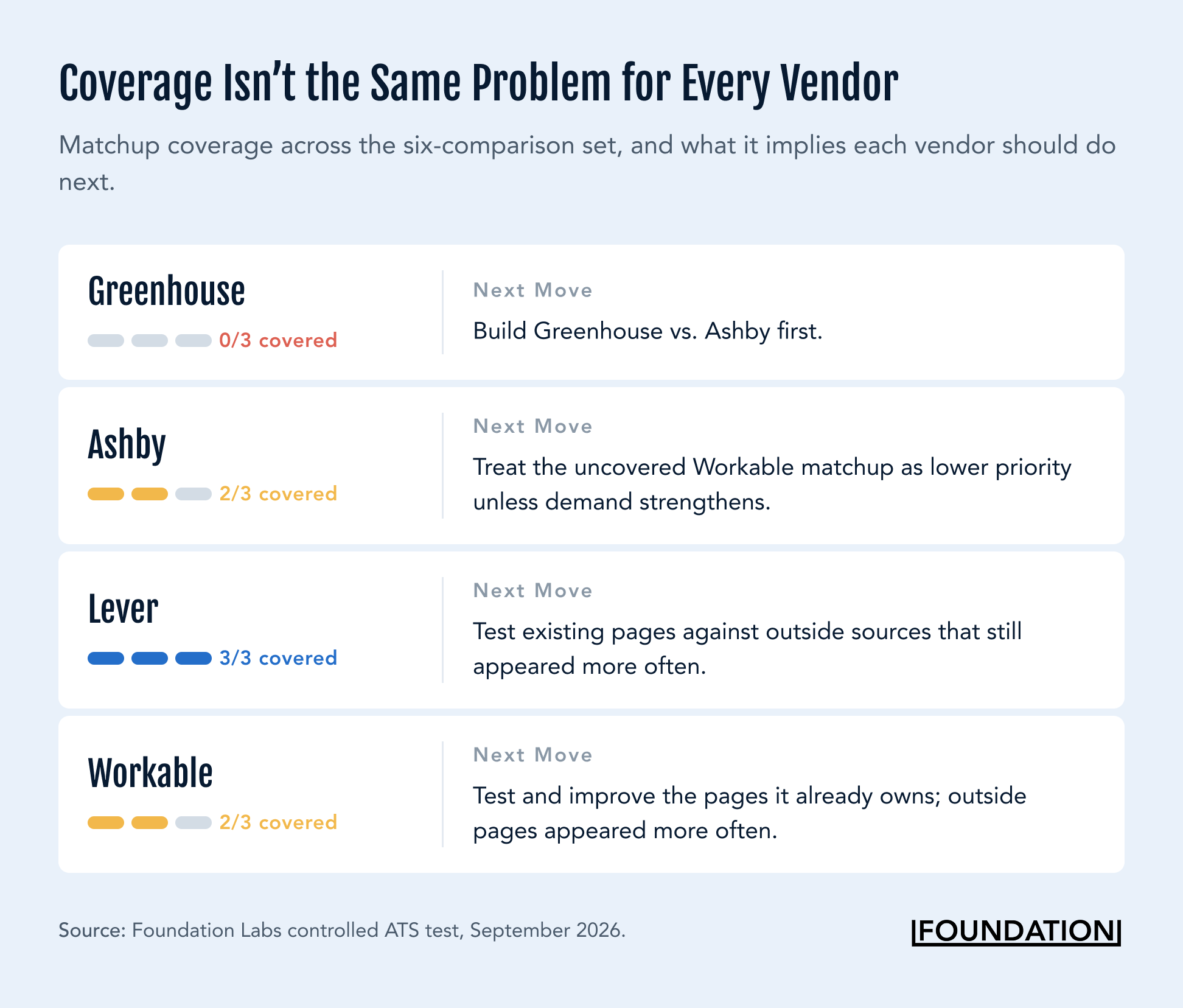
Publishing a page didn’t guarantee source ownership. In some matchups, outside pages appeared 5–11 more times than the vendor’s own; in uncovered matchups, competitor pages surfaced in up to 27 answers.
That’s where comparison content can compound: one strong page can support multiple buyer questions across multiple AI surfaces, creating repeated first-party visibility throughout the evaluation journey.
The sections below break down what that means for each vendor and where we would focus next.
Greenhouse is Missing the Evaluation Layer
Greenhouse’s “13 Best ATS Software” article appeared in 38 answers across all six surfaces, including 31 neutral prompts. But once buyers compared Greenhouse with a named alternative, we found no dedicated first-party page for Ashby, Lever, or Workable.
Of those three gaps, Greenhouse versus Ashby has the strongest SEO demand. Our September 2026 Ahrefs baseline showed about 300 monthly searches for that matchup, compared with 220 for Greenhouse versus Lever and 130 for Greenhouse versus Workable.
AI source data points in the same direction. Ashby’s Greenhouse comparison page appeared in 18 answers across eight prompts and five surfaces. Lever’s page on the same matchup appeared in 27 answers across 14 prompts and five surfaces. Those counts aren’t a forecast for Greenhouse, but they show the reach a single comparison page could earn across related buyer questions.
Greenhouse’s best bet is to start with Ashby, where search demand is highest, then build pages for Lever and Workable. The goal is not just to rank for three comparison keywords, but to give AI systems first-party evidence they can reuse across the wider evaluation journey.
Workable Has Coverage, But Weak Evidence Ownership
Workable published dedicated pages for two of its three matchups, but those pages rarely appeared in our test. Its Workable-versus-Greenhouse page appeared in two answers, compared with 13 for Venture Harbour’s page. Its Workable-versus-Lever page appeared once, while Lever’s appeared eight times.
That leaves Workable 11 appearances behind the leading source on Greenhouse and seven behind Lever, a gap other publishers are currently filling across the same buyer questions.
Workable’s pages spend more of the opening on product benefits and demo-oriented messaging, while higher-appearance pages tended to surface buyer fit, decision criteria, trade-offs, and recommendations earlier.
That’s a useful hypothesis to test by tightening the pages around the comparison and rerunning the prompts. If we ran the content strategy for Workable, we would test whether moving buyer-focused comparison evidence higher on the page increased its source appearances.
Ashby Has a Real Gap, But a Weaker Demand Signal
Ashby covered Greenhouse and Lever but had no dedicated Ashby-versus-Workable page in our audit. G2, SourcrLab, RecruitmentCRM, and other outside sites filled the matchup instead.
Our September 2026 Ahrefs baseline put combined Ashby/Workable demand at only 20–30 searches per month. Unlike Workable and Lever, there is no owned page here to measure against those outside sources, so we cannot put a precise citation gap on the opportunity.
That makes this a lower-priority build unless sales, win-loss, or AI-source data shows stronger buyer demand. Ashby has more to gain from protecting the higher-demand comparison pages it owns before expanding into this matchup.
Lever Has Full Coverage, But Not Source Dominance
Lever published dedicated comparison pages for Greenhouse, Ashby, and Workable. In each matchup, however, at least one outside page appeared more often in our test.
For Greenhouse versus Lever, Lever’s page appeared five times, compared with 10 appearances for SpotSaaS. For Ashby versus Lever, Lever appeared 10 times, behind a LinkedIn practitioner comparison at 12. For Lever versus Workable, Lever appeared eight times, while MokaHR appeared nine times.
Across those three matchups, Lever was eight appearances short of matching the leading source. That is not a forecast of eight additional citations, but it shows the size of the visibility gap present in our test.
With all three matchups covered, Lever’s opportunity is optimization. The higher-appearance sources provide a benchmark for strengthening buyer fit, trade-offs, and decision criteria, then rerunning the same prompts to see whether Lever’s pages surface more often.
Build the Versus Layer in This Order
We created a Comparison-Page Audit you can use to identify which matchups in your category deserve attention first and what each page is missing. [Download the template →]
Once you download it, follow the steps below:
1. Write the Pages Where Demand and Evidence Leakage Overlap
Start with matchups buyers already search for or ask about (hint: looking at search volume data and prompt data in your tracking tool of choice is the place to start here), then check whether you have a dedicated first-party page and which sources AI currently uses to answer the question. The template combines those signals into an Evidence Leakage Score, so the highest-priority pages are the ones with meaningful buyer demand, weak first-party coverage, and strong outside source presence.
That would put Greenhouse versus Ashby near the top of Greenhouse’s queue in our sample: it had the strongest demand of its three audited matchups, no dedicated Greenhouse page, and Lever’s comparison appeared in 27 answers across 14 prompts and five surfaces. Lower-demand gaps such as Ashby versus Workable can wait until stronger commercial or AI evidence justifies the investment.
2. Structure the Page So the Decision Is Easy to Extract
A comparison page should quickly explain who each product suits, which criteria separate them, where each is stronger, and which trade-offs affect the recommendation. In our analysis, Workable’s pages delayed that information behind product benefits and demo-focused messaging. Pages with higher source presence surfaced buyer fit, trade-offs, and decision criteria earlier. We did not test whether page structure caused the difference, so this is a pattern to test rather than an explanation for performance.
Support that with the details buyers need to decide, including pricing, implementation, integrations, workflow, administration, scalability, and limitations. The Page Audit tab scores these elements so you can see whether an existing page needs improvement before creating a new one.
3. When Someone Else Owns the Matchup, Audit Their Evidence First
If an outside page appears repeatedly in AI answers, study what it supplies before rebuilding yours. Compare the two pages and identify where the outside source has stronger pricing information, implementation detail, product differences, trade-offs, or evidence.
Where a competitor’s page is being used to explain your product, focus on the claims it supplies about your limitations or capabilities. Publish current first-party evidence that addresses those same decision points and then retest the query to see whether your page begins entering the source mix. If your page starts replacing outside sources, move to the next highest-leakage matchup and repeat the process.
If You Don’t Supply the Evidence, Somebody Else Will
Winning the Versus Layer comes down to supplying clearer evidence than the pages AI already relies on. Start with the matchup where buyer demand is strongest and your first-party coverage is weakest. Run that question across the AI surfaces your buyers use, record which pages appear as sources, and use the gaps to set your build order.
That priority list will differ by category because each buying decision has a different mix of demand, first-party coverage, and outside-source ownership. If you would rather not build that map yourself, our GEO team runs the same type of analysis used in this study. Contact us today