Article's Content
Article's Content
Your CEO asks whether the company shows up when buyers ask ChatGPT or Gemini for a vendor. Rankings show where your pages appear in search results, and analytics show visits from AI tools.
However, neither tells you which pages an AI answer cited, or how often. That’s why you need AI citation tracking.
In their account of adapting SEO for AI search, Vercel’s Kevin Corbett and CTO Malte Ubl described searching for Vercel’s domain and topics in AI answers, then checking referral traffic separately. Neither check gave them a reliable count of how often Vercel’s content appeared as a source.
A tracker can produce one number, while another tracker may give you a different one for the same brand. The way to answer your CEO is to test the questions buyers ask, count the citations and show leadership the sample behind the rate. This guide shows how.
Key Takeaways
- AI citation tracking records which pages AI engines such as ChatGPT, Gemini, and Perplexity link to as sources when they answer your buyers’ questions, measured across repeated runs of a fixed set of prompts.
- Four metrics cover a first report: citation frequency, share of voice, source mix, and share of model, which is how your results split by platform. Report each one with the prompt set, sample size, and time period.
- Profound, Semrush, Ahrefs Brand Radar, AirOps and Peec AI each suit a different team. Choose one that tracks the questions and engines your buyers use, checks them consistently, and lets you inspect the answers behind its numbers.
- AI answers are assembled from a small set of cited sources rather than ranked. In AirOps’ study, ChatGPT cited only 15% of the pages it retrieved, so ranking or being found doesn’t put you in the answer. Tracking citations shows whether you’re in it and which sources are.
What Is AI Citation Tracking?
AI citation tracking is the practice of recording which pages an AI answer links to as sources, how often, and for which questions.
The method is the same whichever tool you use:
- Pick a fixed set of questions your buyers ask
- Run them across the engines your buyers use, such as ChatGPT, Gemini, Claude and Google’s AI Overviews
- Record which pages each answer links to, whether that’s your page, a competitor’s, or someone else’s entirely
- Repeat on a schedule so you end up with a rate instead of a snapshot
Citation tracking is part of the measurement side of generative engine optimization, the work of earning a place in AI answers. At any real scale it runs through a tool like Profound, AirOps or Ahrefs Brand Radar, though the logic stays the same as doing it in a spreadsheet.
The questions you track decide your number more than anything else does. Your company can (and should) be cited in the answers to prompts that mention it by name, but that doesn’t guarantee placement in the category questions buyers use to build their shortlist. A citation rate with no prompt set attached to it doesn’t mean anything.
Citations vs. Mentions vs. References: What’s the Difference?
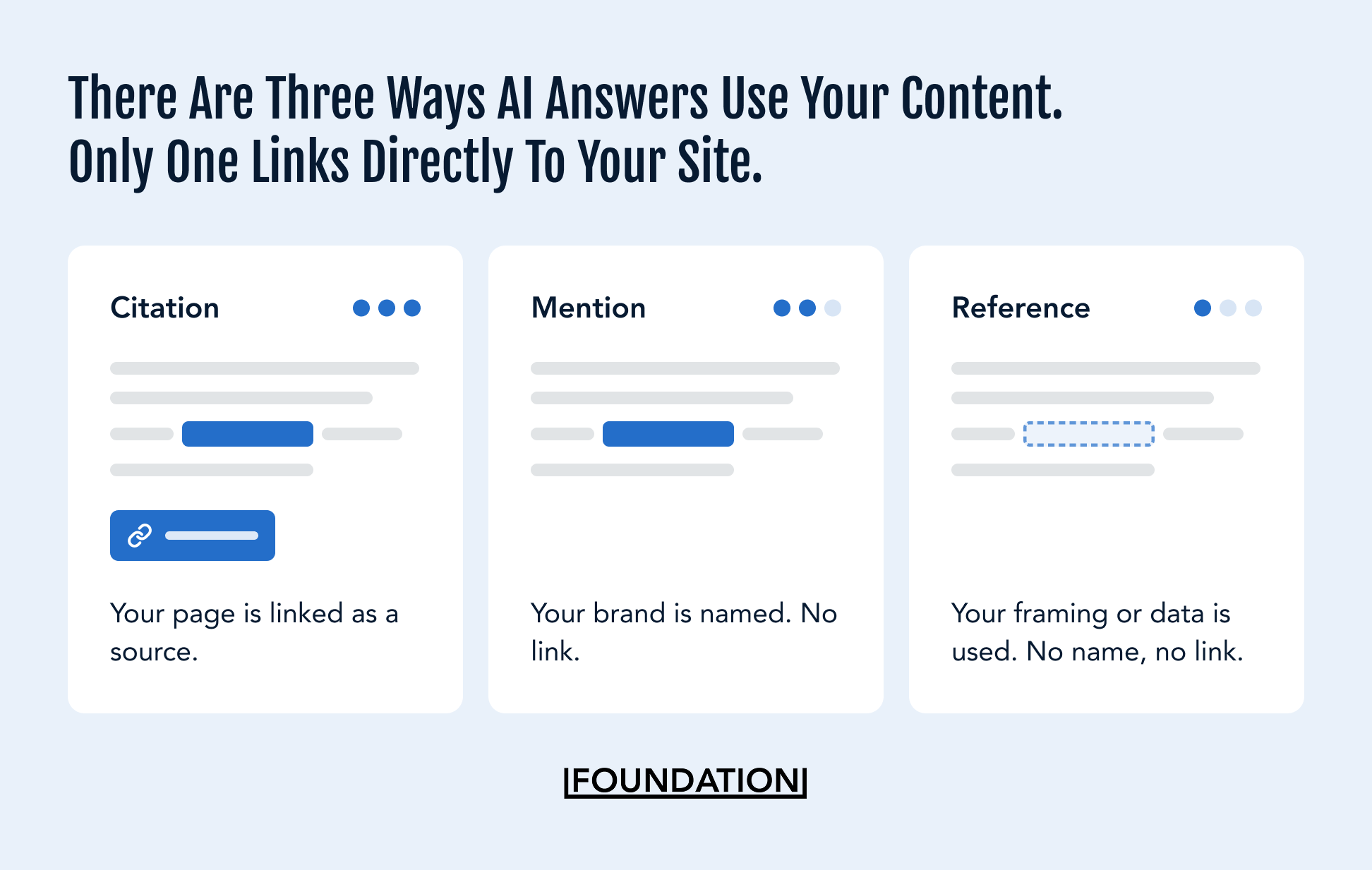
An AI answer has three layers, and your brand can appear in any of them independently.
The body text is what the model writes. Brand names inside that text are mentions. The source list, which shows up as inline superscripts, as links in the body, or as a panel beneath the answer depending on the engine, holds the citations.
- Citation: The answer links to your page as a source it used. It sits in the source list or as a link in the body, and a reader can click through to you.
- Mention: The answer names your brand in its text, usually inside a recommendation or a comparison, with no link to your domain. The engine knows who you are. It learned that somewhere other than your site.
- Reference: The answer uses an idea, a framing or a figure that originated on your page, without naming you or linking to you. You can rarely prove where it came from, so review these case by case and keep them out of any automated rate.
The gap between the layers is the diagnostic. If an answer names you and cites five other domains, those five domains are the ones telling your story. Open them and read what they say about you.
It runs the other way too. A citation tells you the answer used your page as material. It doesn’t tell you what the answer concluded. Semrush found an AI answer citing their content while recommending a competitor.
How AI Citation Tracking Differs From SERP Tracking
SERP tracking answers one question. Where does this page sit in a list of results? The list is stable enough to check daily, and position one means the same thing on Monday as it does on Friday.
Citation tracking answers a different question. Did this page get used as a source in an answer the engine assembled from scratch? Three things follow from that.
- There’s no position to hold. An answer cites a handful of sources, and the same prompt can return a different set on the next run. You measure a rate across repeated answers rather than a rank on a given day.
- A ranking doesn’t carry over. In Ahrefs’ March 2026 study of 863,000 search results, about 38% of URLs cited in AI Overviews also ranked in the top 10, down from roughly 76% in July 2025. Among cited pages that also appeared as regular blue links, 36.7% ranked beyond position 100. Ranking still helps. It no longer decides which page the answer cites.
- The unit is a question, not a keyword. Buyers type full sentences into AI tools, and a tracked prompt set looks nothing like a keyword list. That changes what you can compare period over period.
Connecting either measure to pipeline is a separate step, covered in how to measure the ROI of GEO.
Both measures still matter. The reason citations have become the one leadership asks about comes down to how little of the web an answer actually uses.
Why Is AI Citation Tracking Important for Brands?
Citations are the unit of visibility in AI search. They show which sources and content types models reach for when they answer a prompt.
When answer engines perform their own web search, they pull information from the pages they find and then link to a fraction of the pages they visited as cited sources. This means a brand’s page can rank well, get retrieved, and still be left out of the final answer. Only the citation shows that it made it in.
With LLMs, the search path also extends beyond the buyer’s initial wording. Through query fan-out, an engine runs follow-up searches on keyword variations while building its answer, then combines pieces from what those searches return.
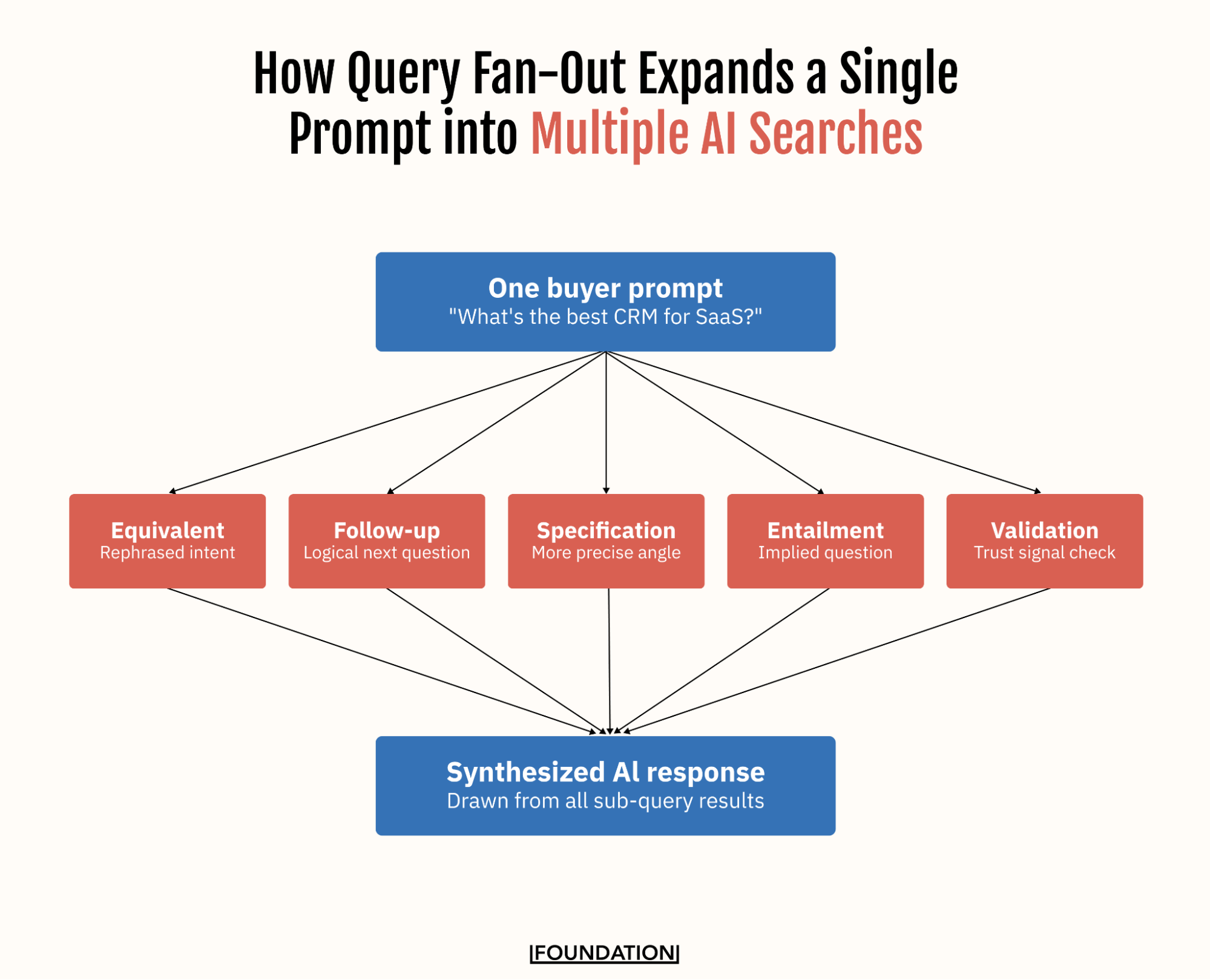
An AirOps analysis saw 15,000 prompts expand into 43,233 searches through the fan-out, nearly three searches for every question a buyer asked. More importantly:
Only 15% of the nearly 550,000 pages ChatGPT retrieved were cited in the answers.
Citation tracking records which domains win during the fan-out stage, highlighting the competing pages that deserve a closer look when formulating your AI visibility strategy.
So, if you don’t track AI citations for the prompts that matter to your buyers, you won’t know whether you’re in the answer or what it would take to get there.
Knowing you need to track citations is the easy part. Deciding what to put in front of your leadership team is where most programs stall.
What Metrics Matter in LLM Citation Tracking?
When you report on AI citation performance, there are four metrics worth keeping in front of you: citation frequency, share of voice, source mix, and share of model.
Here’s what each one measures and how to report it:
- Citation frequency: the share of answers that link to your domain across your tracked prompts. This is the headline number. Compare it with how often answers mention your brand, because an answer that names you but links elsewhere shows where third-party pages are telling your story.
- Share of voice: how often answers name or cite you relative to the competitors you track on the same prompts. State which brands and which appearances the calculation includes, because tools count this differently.
- Source mix: the domains and page types the answers cite on your priority prompts, such as your own site, competitors’ sites, publications, review sites and forums. It shows where the work needs to happen, on your own pages or on the outside sources the engines rely on.
- Share of model: your citation frequency split by AI platform. Decide early whether you’re tracking chat interfaces only or also Google’s AI Overviews and AI Mode, because that choice changes the numbers. In Profound’s analysis, AI Overviews and AI Mode cited social sources at about 1.3 times ChatGPT’s rate.
Unlike in SEO reporting, average rankings don’t belong in the headline reporting.
In SparkToro’s 2,961-run experiment, ChatGPT and Google’s AI returned the same list of recommended brands in fewer than one in 100 comparisons and the same order roughly once in 1,000. That study tested recommendation lists, not citation stability, but it gives us a good reason to avoid presenting “rank three in ChatGPT” as a durable result.
Source mix and share of model also vary widely by platform and industry.
In Profound’s analysis of 11.84 billion citations across eight AI models and 29 industries, collected from April to July 2026, company-operated sites accounted for about 69% of Gemini citations and 47% of ChatGPT citations. The industry spread was just as wide.
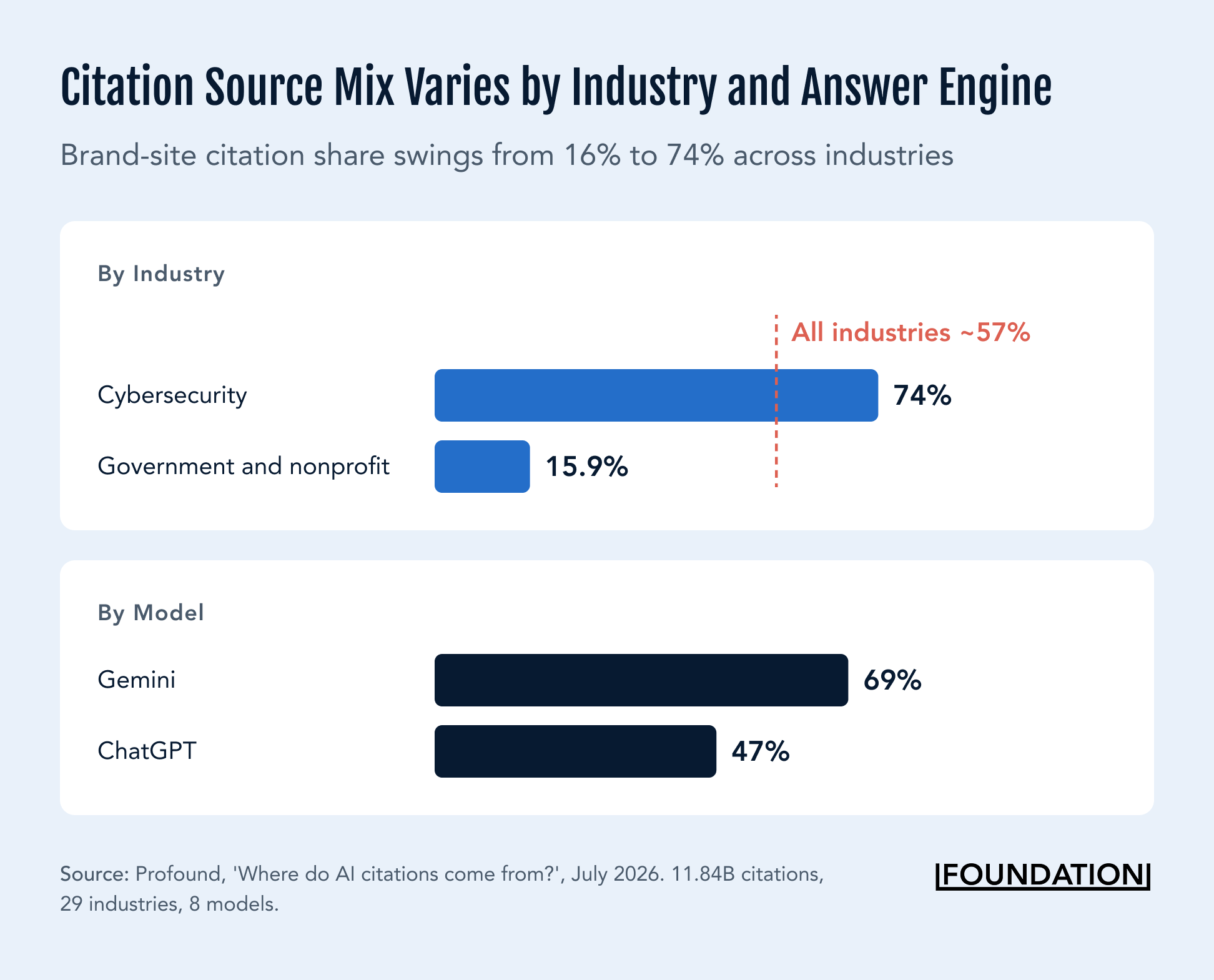
Company-operated sites drew about 74% of citations in cybersecurity but only 15.9% in government and nonprofit. Those percentages describe citations to any company’s site, not the tracked brand’s own domain, so they can’t serve as your citation-rate target. But they can serve as benchmarks to understand if you are under or over performing for citations.
Now that you know which metrics you need to track, and why, let’s look at some of the citation tracking tools available.
5 AI Citation Tracking Tools (and Which Team Each One Fits)
Choose the tool for the job: broad discovery, a fixed reporting panel or a content workflow that acts on citation gaps. Check engine coverage, region, prompt capacity, cadence, answer-level exports and competitive views before buying. An entry price doesn’t guarantee every listed feature. The five tools below are built for tracking. Tools for GEO content and optimization work form a separate category.
| Disclosure: Foundation is a verified Profound Partner and we use Profound as our AEO tool of record. |
| Tool | Best for | Entry price (public) | What to check before choosing |
| Profound | Enterprise programs across engines and regions | Free 7-day trial.
Enterprise pricing is custom based on your needs |
Engine coverage and prompt volume in your quote |
| Semrush AI Visibility Toolkit | SEO teams already working in Semrush | $99/mo per domain, billed annually
25 prompts |
Prompt cap and competitive reporting in the entry plan |
| Ahrefs Brand Radar | Broad question discovery plus a custom panel | Lite costs $129/mo with five prompts
AI index from $199/mo |
Index refresh versus custom prompt cadence |
| AirOps | Content teams connecting source gaps to production | Free Solo plan (ChatGPT only). Pro and Enterprise pricing on request. | Engine limits on the free plan |
| Peec AI | Lean teams monitoring a fixed prompt panel | Starter $95/mo, Pro $245/mo, Advanced $495/mo. | Model coverage and collection method |
Pricing and documentation checked September 2026. Confirm current plan terms before buying.
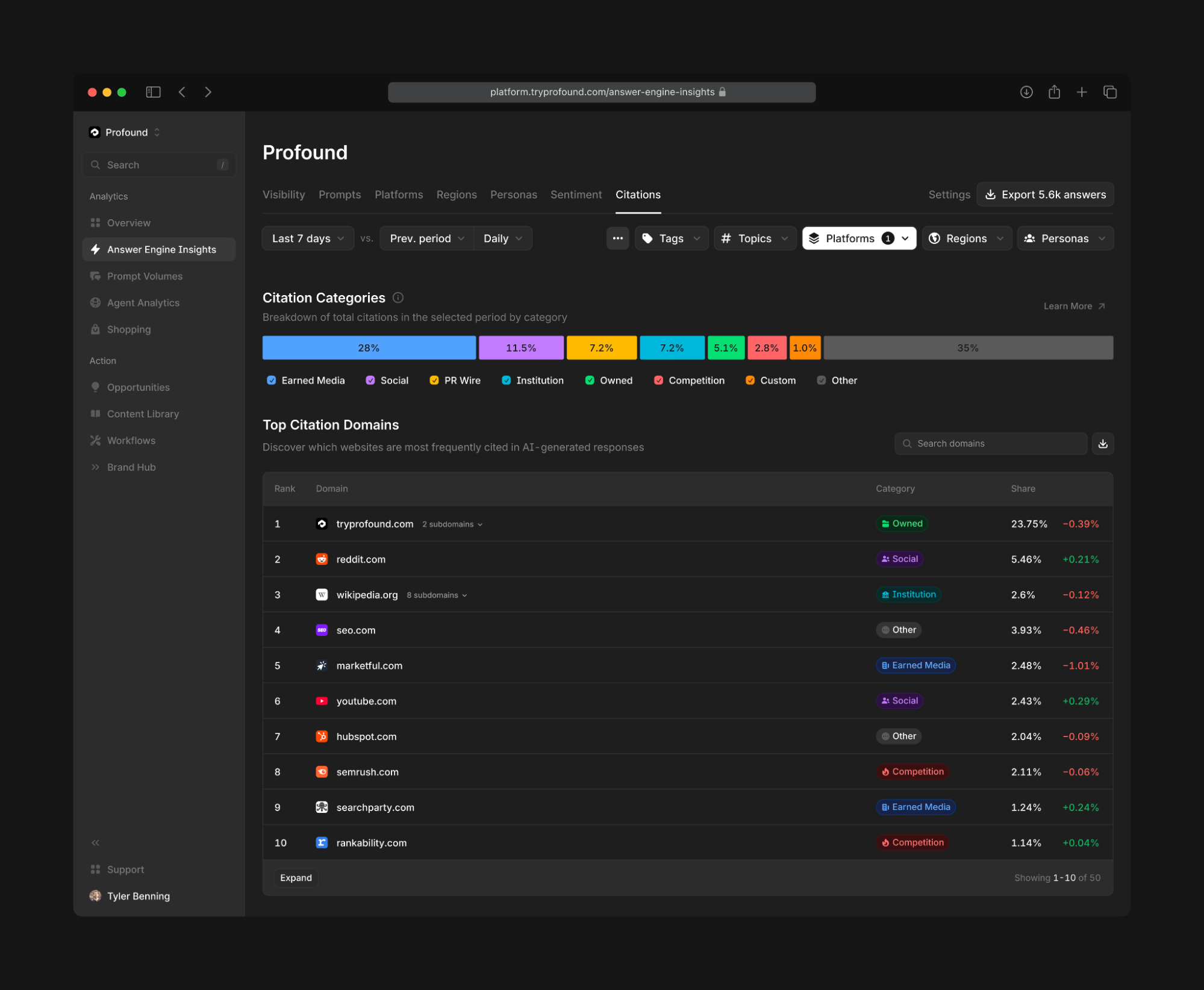
Profound: Best for Enterprise Teams Running AI Visibility as Its Own Program
Profound tracks up to nine answer engines on their Enterprise plan and offers source and competitor analysis by region and persona. Their pricing page lists two options for brands: a free trial that runs 50 prompts daily for seven days across ChatGPT, Gemini, and Google AI Overviews, and custom Enterprise pricing. Profound publishes no monthly price for brands, so you can’t compare their cost with other trackers until you’ve spoken to sales.
Agencies have a separate plan, which starts at $99 a month for prospect audits, with each full client workspace costing $399 a month more. The depth suits a team accountable for a program across engines and markets. A team that needs only a small panel on one or two engines may find a better fit among the self-serve tools below.
Semrush AI Visibility Toolkit: Best for SEO Teams Already Working in Semrush
Semrush draws on real requests rather than model APIs for their broader dataset. The $99 monthly entry plan, billed annually, runs 25 custom prompts daily. That can suit a focused panel inside an existing SEO workflow. Prompt Tracking doesn’t yet show share of voice, so check your reporting needs before choosing the entry tier.

Ahrefs Brand Radar: Best for SEO Teams That Want Broad Discovery Plus a Controlled Panel
Ahrefs runs search-backed prompts in chatbot web versions and identifies pages that an engine retrieved but didn’t cite. Lite starts at $129 a month with five tracked prompts. Their broad index helps identify questions you hadn’t planned to track, and custom prompts let you follow a selected panel. Check the refresh setting: the broad chatbot index updates monthly, while custom prompts can run daily.

AirOps: Best for Content Teams Who Want to Act on Gaps Directly
AirOps groups citations by source type and connects findings to content workflows. That fits a team that wants to turn repeated gaps into briefs and updates. Their free plan covers ChatGPT only, so ask about paid engine coverage and price if your reporting panel needs more.
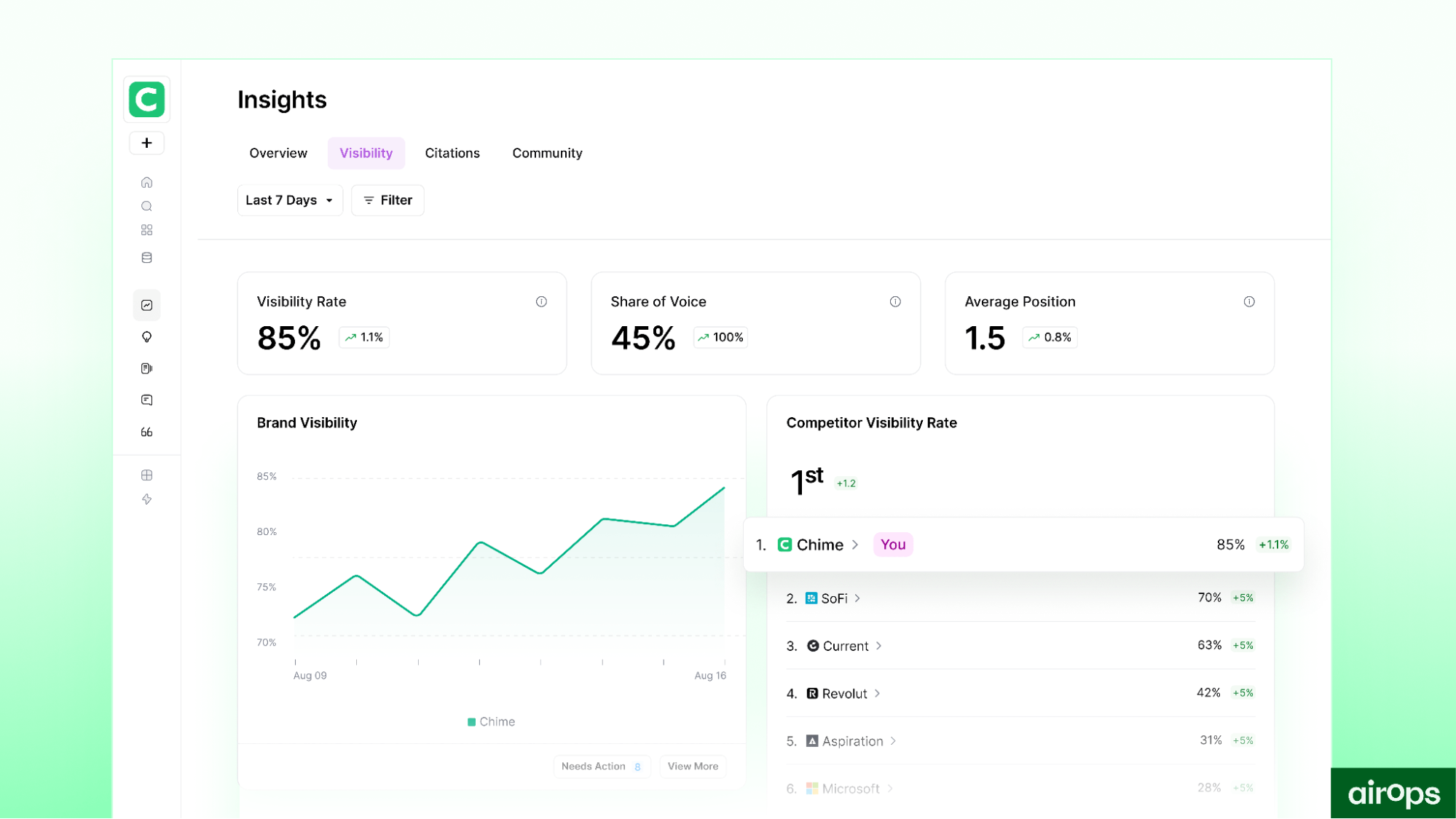
Peec AI: Best for Lean Teams That Want Simple Daily Tracking
Peec runs prompts daily and publishes their metric formulas. Their plans list 50, 150 or 350 prompts across three chosen models. Check whether those models cover your buyer’s platforms and ask about runs per prompt and collection method if you need to reproduce their numbers.
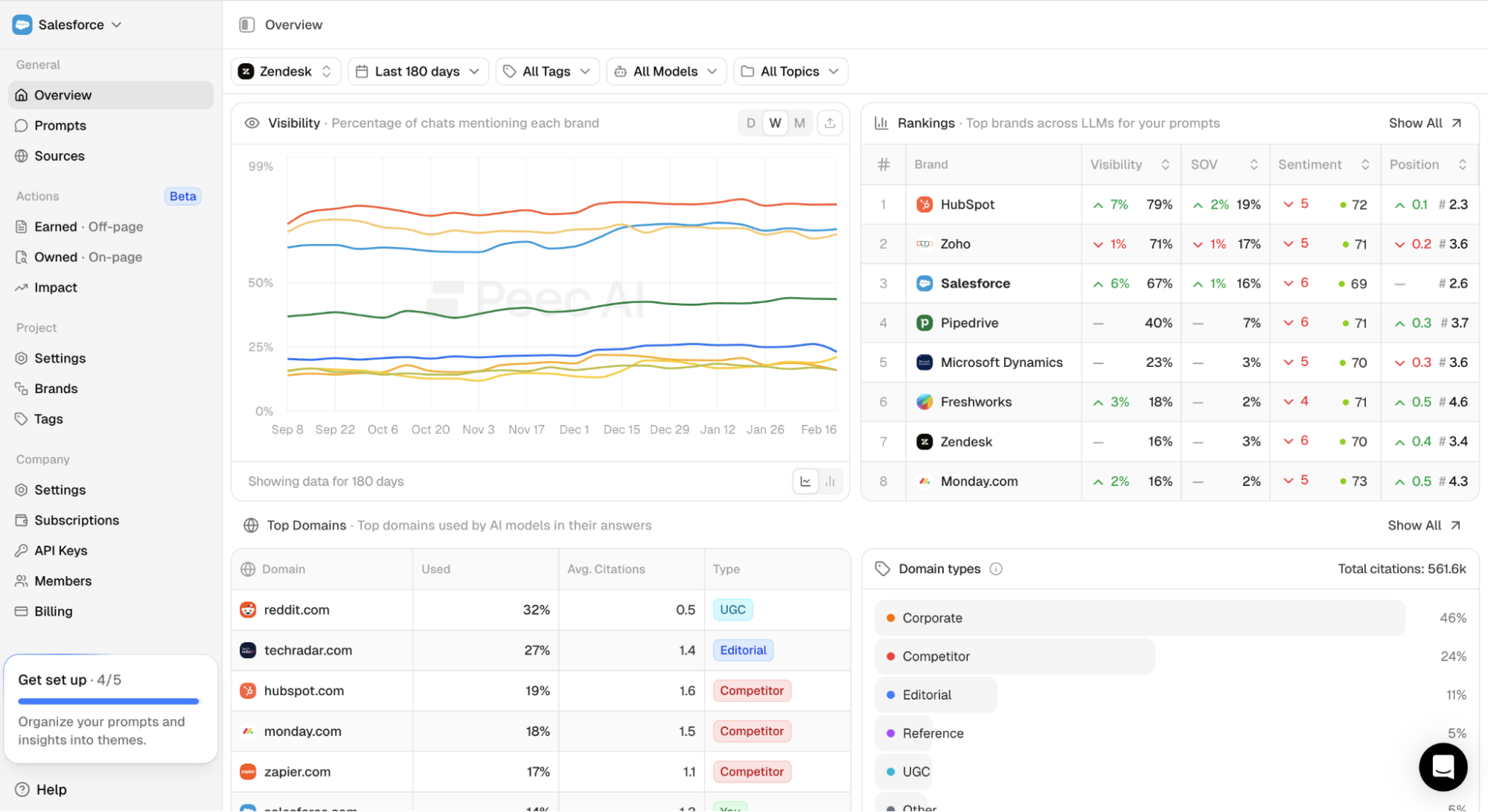
Whichever one you land on, the tool is only half of it. What makes a citation rate defensible is the method you use to capture it.
How To Set Up AI Citation Tracking in 4 Steps
Your citation tracking tool absorbs the collection, keeps the archive, and classifies sources the same way each time, but it doesn’t absorb the judgment.
You still choose which questions go in the panel, decide what counts as a citation, and read the answers behind the rate. Here’s the 4-step process we use for citation tracking:
- Choose the questions. Build a library of 25 to 50 buyer questions. Separate branded, category and product-comparison questions so one group’s citation rate can’t hide another’s. Tag each question by funnel stage and intent so you can report a rate for each group.
- Set the conditions. Choose engines, country, mode, and user state. Record whether you logged in and enabled memory. Keep the setup consistent across periods, but remember a controlled check can’t reproduce every buyer’s session.
- Save each run. Record the prompt, engine, country, settings, date, brand mention, cited URLs, and the full answer. Run important prompts more than once. A small sample can reveal sources, but it produces a noisy rate. We collect for at least a week before reading a rate, then report 4-week rolling averages so a single unusual run doesn’t move the trend.
- Review a fixed panel. Calculate mention and citation rates by engine and prompt type, with sample sizes. If you change prompts or collection methods, start a new baseline.
This process gives you the citation data, but that still leaves the question of what it’s telling you. Two brands with an identical citation rate can need completely different work, and the only way to know which is yours is to read the answers behind it.
What To Do With Your Citation Tracking Data
A rate that moves tells you something changed. It doesn’t tell you what, and it doesn’t tell you whose job it is.
Three patterns account for most of what you’ll find, and each one points at different work:
1) You’re Mentioned, but Not Cited
See which sources the answer cites, what they say about your company, and whether your own relevant pages are accessible to crawlers. A mention alone can’t tell you why the engine left out your URL. If the answer gets product facts wrong, treat accuracy as a separate problem.
At HubSpot, Aja Frost’s team found AI engines quoting the wrong prices, traced the problem to pricing pages that rendered in JavaScript, and published plain-text pricing posts.
2) Third Parties Dominate Priority Prompts
Read the pages before choosing whether to improve owned content or participate on external sites. Our CEO, Ross Simmonds, puts it this way: “Buyers now ask AI before they ever visit a website, and those answers are increasingly shaped by community conversations.”
When the cited sources are forum threads and reviews, publishing more on your own site may not change the answer, so the work has to happen where those conversations take place.
In our Bitly case study, answers drew on Reddit, YouTube and reviews. We worked across 48 subreddits and published more than 130 posts over 12 months, with YouTube as a second channel. Bitly’s citation share for link shorteners reached 11.7%, nearly double the next competitor, and their AI visibility for QR codes reached 27.3%. That case shows one documented approach, not a promise that the same activity will produce the same lift elsewhere.
3) Follow-Up Searches Cite Other Pages
Inspect the query fan-outs, not just the initial prompt. Take note of the extra queries each engine generates and the pages the answer links to. If the question matters to buyers and your content doesn’t address it, decide whether to improve an existing page or make a distinct one. An extra search doesn’t automatically justify a new content cluster.
Give changes time to register. At HubSpot, Aja Frost described the sequence as “crawls happen first, then citations, then visibility,” with one set of pages moving from 16% to 92% citation. Treat that as her team’s observation, not an expected result for your program.
Make AI Citation Tracking Part of Your Reporting
AI citation tracking provides the missing visibility layer that traditional SERP and web analytics cannot offer. By capturing how often and where generative models cite your pages, you shift from guessing to systematically optimizing your brand’s presence in AI-generated answers.
To present a complete picture to leadership, anchor your reporting on four essential metrics: citation frequency, share of voice, source mix, and share of model. Frame these metrics using a consistent 4-step workflow — defining buyer questions, standardizing settings, collecting repeated runs to form rolling averages, and analyzing a fixed panel. Select tracking tools like Profound, Semrush, Ahrefs, AirOps, or Peec AI based on your team’s specific prompt capacity, engine coverage, and content workflow requirements.
When sharing results, ensure your data is always grounded in clear methodologies, such as: “On 30 unbranded buying prompts, ChatGPT cited our domain in 31% of 900 answers in September, up from 26% in August, under consistent settings.” Contextualize these citation rates with brand mentions, domain sources, and direct customer feedback.
If you want expert support in building a comprehensive reporting program, talk to Foundation’s GEO team.
FAQs
Do ChatGPT and Google cite the same sources?
Not reliably. Each engine runs its own retrieval, so the same question can pull a different set of pages on each platform. In Profound’s citation analysis, company-operated sites made up about 69% of Gemini citations but only 47% of ChatGPT citations.
Sourcing also shifts within a single engine. Promptwatch data reported by Search Engine Land showed Reddit’s share of ChatGPT Search citations falling from an average of 3.83% between July 18 and August 7, 2026, to 0.52% between August 14 and 17.
How do AI engines decide which pages to cite?
No shared formula covers every engine. Each interprets the question, searches or retrieves sources, and chooses what to link in its answer. OpenAI says ChatGPT Search considers relevance and reliability, and sites must allow OAI-SearchBot to qualify for its search results. A tracker records the sources in the final answer. Retrieval alone doesn’t count as a citation.
What is LLM visibility, and how does it relate to citation tracking?
LLM visibility describes how often, and in what way, a brand appears in answers from AI assistants such as ChatGPT, Gemini and Perplexity. It covers both mentions, where the answer names the brand, and citations, where the answer links to a source. Citation tracking measures the second part. It records which pages each engine links to across a fixed set of prompts, showing whether your content is shaping the answer. A brand can be mentioned often and still rarely cited. In that case, the answer describes it through other people’s pages. The GEO metrics guide covers the wider visibility scorecard.
Is AI citation tracking the same as LLM rank tracking?
No. An AI answer can change its list and order on the next run. SparkToro’s recommendation experiment illustrates why a single “rank three in ChatGPT” is a weak result. Citation tracking counts how often the same page or domain appears as a source across repeated answers to a stated set of questions.
Can you track AI citations in Search Console or GA4?
No. Search Console includes AI Mode in its performance reporting, and GA4 groups AI tool referrals. Those products report search activity or visits. Neither lists every source an AI answer displayed. Use them alongside citation tracking when you want to relate answer-level presence to site activity.
Are AI citations the new backlinks?
No. A backlink stays on the linking page until someone changes it. A citation belongs to one generated answer and may disappear on the next run. Both can direct a person to your site, but you measure AI citations as a rate across repeated answers rather than counting them as lasting links.