


Article's Content
Article's Content
A high AI visibility score can hide the difference between showing up in the results and getting chosen, and that gap has obvious commercial consequences.
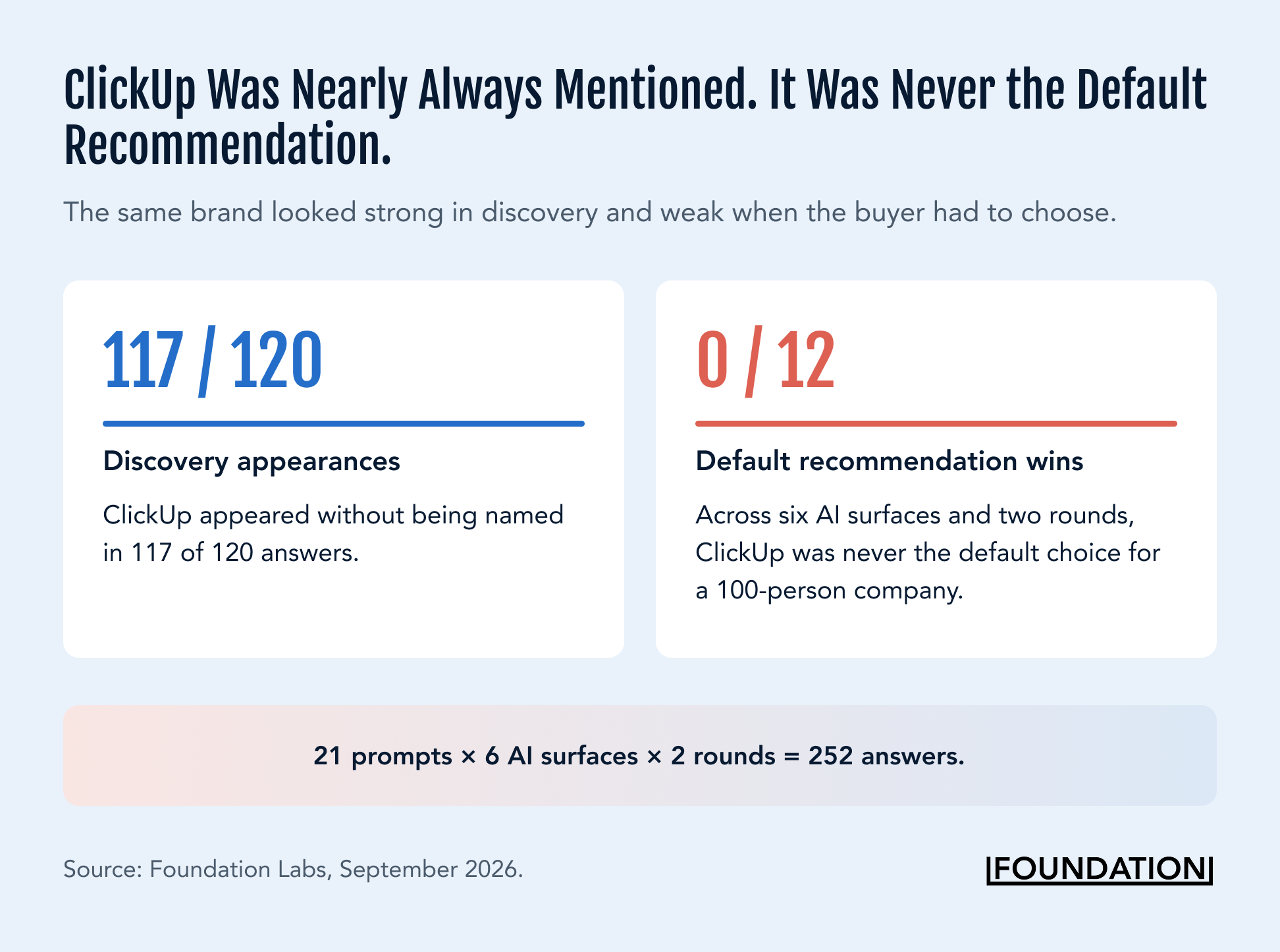
ClickUp, an all-in-one work management platform, is a particularly illustrative example. We ran a sample of 21 prompts twice across ChatGPT, Claude, Gemini, Perplexity, Google AI Overview, and Google AI Mode: 252 answers in total.
The first 10 of those prompts were nonbranded: they only described a product category to test whether ClickUp surfaced without being named explicitly. Across those 120 discovery answers, ClickUp was named in 97.5% of them.
But as we looked beyond ClickUp’s high mention rate, we found that there’s a lot going on behind that big number:
- ClickUp’s position within the answer varied across LLMs
- How AI surfaces described ClickUp’s category shifted
- Positive framing didn’t translate into top recommendations
The clearest example of the commercial impact of this variation occurred during the buyer evaluation stage, when we used the following prompt: “I’m choosing between ClickUp, Asana, and monday.com for a 100-person company. Which should I choose and why?”
None of the answers chose ClickUp as the default recommendation, and a separate user-experience comparison went the same way: ClickUp lost all 12.
We call this Model Drift: the same brand, the same buyer question, a different answer depending on which AI surface is asked.
In today’s teardown, we’ll take a closer look at how this drift played out for ClickUp and outline how to run this Model Drift audit on your own brand.
Why ClickUp Is a Useful Test of Model Drift
What Model Drift Looked Like for ClickUp
ClickUp Wins on Consolidation and Project Execution
The Study Exposed Two Evidence Gaps
How to Run a Model Drift Audit
Turn Model Drift Into Your Next Marketing Move
But first…
Why ClickUp Is a Useful Example for Tracking Model Drift
ClickUp is coming up on their 10th birthday, and in that time the company has worked under several category labels, all of which remain in circulation across the web.
Most notably, ClickUp has competed in project management and work management. Post-LLM, ClickUp now describes the product as a “Converged AI Workspace”, following their earlier “Everything App for Work” positioning. Altogether, we identified five main labels in circulation:
- Project management software
- Collaborative work management
- All-in-one productivity platform
- Everything App for Work
- Converged AI Workspace

So, when a buyer prompts an AI surface looking for a project management, work management, or AI workspace tool, the LLM has to pick one label when it describes ClickUp. This is exactly the kind of drift we want to measure.
Project management puts ClickUp beside products such as Asana and monday.com. All-in-one productivity broadens the comparison toward tools such as Notion. “Converged AI Workspace” asks buyers to recognize a newer category altogether.
Our test asks which version of ClickUp each AI surface returns.
How We Ran the Test: 21 Prompts, Six AI Surfaces, Two Rounds
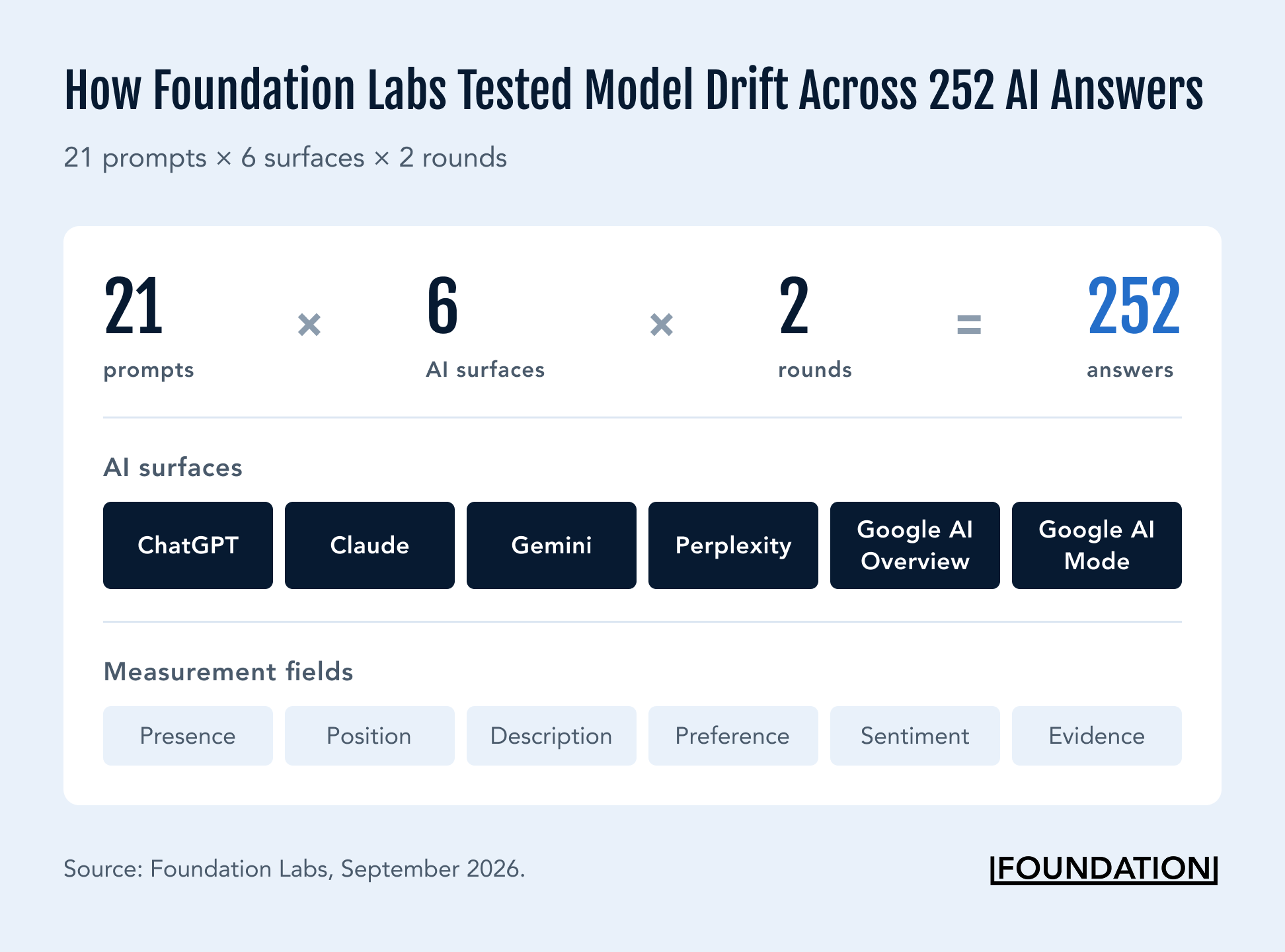
We ran the same 21 prompts across ChatGPT, Claude, Gemini, Perplexity, Google AI Overview, and Google AI Mode. We repeated the full prompt set in a second round, producing 252 answers in total.
The prompts were split across five groups, spanning category discovery to product evaluation:
| Prompt Group | What We Measured |
| Category discovery | Whether ClickUp appeared and where they ranked |
| AI use cases | Whether ClickUp appeared in AI-related buying questions and how they were described |
| Brand understanding | Category, ideal customer, and differentiation |
| Buyer evaluation | Recommendation, UX, adoption, consolidation, and scalability |
| Controlled pros and cons | Recurring strengths and limitations |
The first 10 prompts, across category discovery and AI use cases, never mentioned ClickUp. They tested whether the brand appeared when a buyer described a need without naming a preferred product.
The next nine, across brand understanding and buyer evaluation, introduced ClickUp and tested how each surface described, compared, and recommended them.
The final two, the controlled pros and cons prompts, asked directly about strengths and limitations, so we used those responses to identify recurring themes rather than score neutral sentiment.
How We Measured Model Drift
For every answer, we tracked six dimensions:
- Presence: whether ClickUp was named in the generated answer, not merely cited as a source
- Position: where ClickUp first appeared relative to other products when the answer presented a ranked or ordered set of options
- Description: the category, positioning, and product language the surface used to explain ClickUp
- Preference: whether the surface ultimately recommended ClickUp over the alternatives
- Sentiment: how favourably or critically ClickUp was framed, independent of whether they were recommended
- Visible sources: the citations and links exposed by the interface alongside the answer
For the 10 prompts that didn’t name ClickUp, we recorded the relative position of every brand in the answer set: first, second, third, fourth or later, or not at all.
For visible sources, we only recorded the citations and links present in the AI interface. Because AI products expose sources in different ways, we compared what the user could see rather than assuming access to each system’s internal retrieval process.
What Model Drift Looked Like for ClickUp
ClickUp’s 97.5% answer presence rate across the 10 discovery prompts made their AI visibility look both impressive and stable. Once we compared the six surfaces separately, a different picture emerged.
Their position changed, their category changed, and the product AI described positively wasn’t always the product it recommended. The visible evidence also shifted by surface, with one Google AI Overview result changing within a 24-hour window.
For the discovery analysis, an “unaided appearance” means ClickUp was named in the generated answer even though the prompt didn’t mention the brand.
The two comparisons below show that split at a glance.
That variation continued when we moved from discovery to direct buyer evaluation. ClickUp was featured prominently and described favourably across answers but still didn’t earn top position as the recommended product.
The differences become clearer when we look at where the answers diverged across surfaces.
ClickUp’s Top-Three Position Rate Ranged From 55% to 95% Across Surfaces
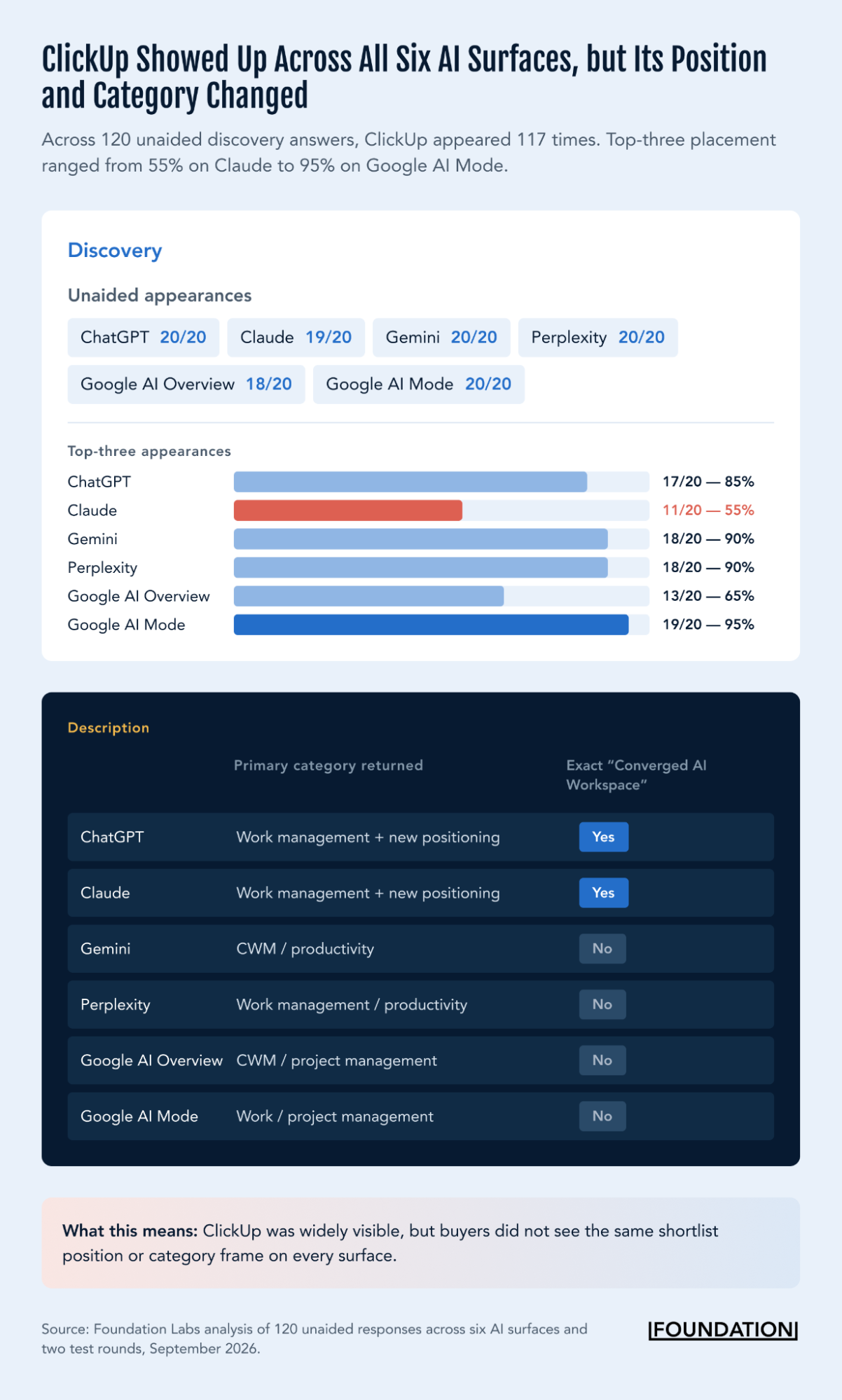
ClickUp appeared in 117 of 120 discovery answers, but their position changed sharply by surface and by run.
The heatmap below shows where ClickUp first appeared in each answer: first, second, third, fourth or later, or absent. That’s where the bigger gap shows up.
For commercially critical category prompts like “best project management tools”, “best work management tools”, and “best collaboration tools”, ClickUp didn’t earn the top spot once.

Across AI models there was also significant variation: ClickUp ranked in the top three in 19 of 20 Google AI Mode runs, compared with 11 of 20 on Claude.
In our runs, ClickUp usually appeared on both surfaces. What changed was how early they showed up. A visibility metric that records only whether the brand appeared would miss that 40-point gap in top-three placement.
Only Two of Six Surfaces Consistently Used “Converged AI Workspace”
High visibility also didn’t guarantee a consistent description of the company.
Only four of 12 answers to brand understanding prompts, where we explicitly asked what category ClickUp belongs to and which products they compete with, used ClickUp’s exact phrase, “Converged AI Workspace.”
We asked:
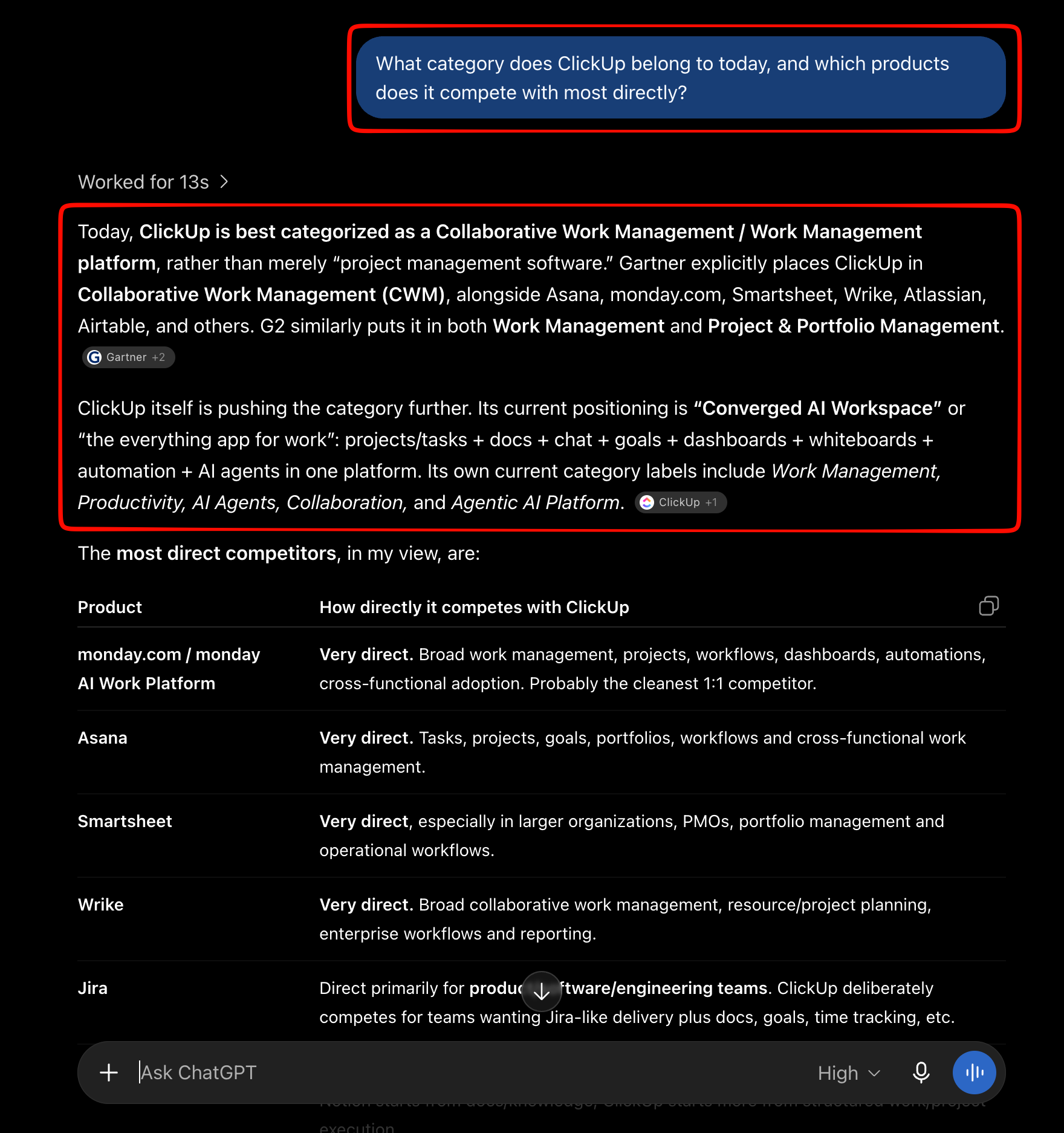
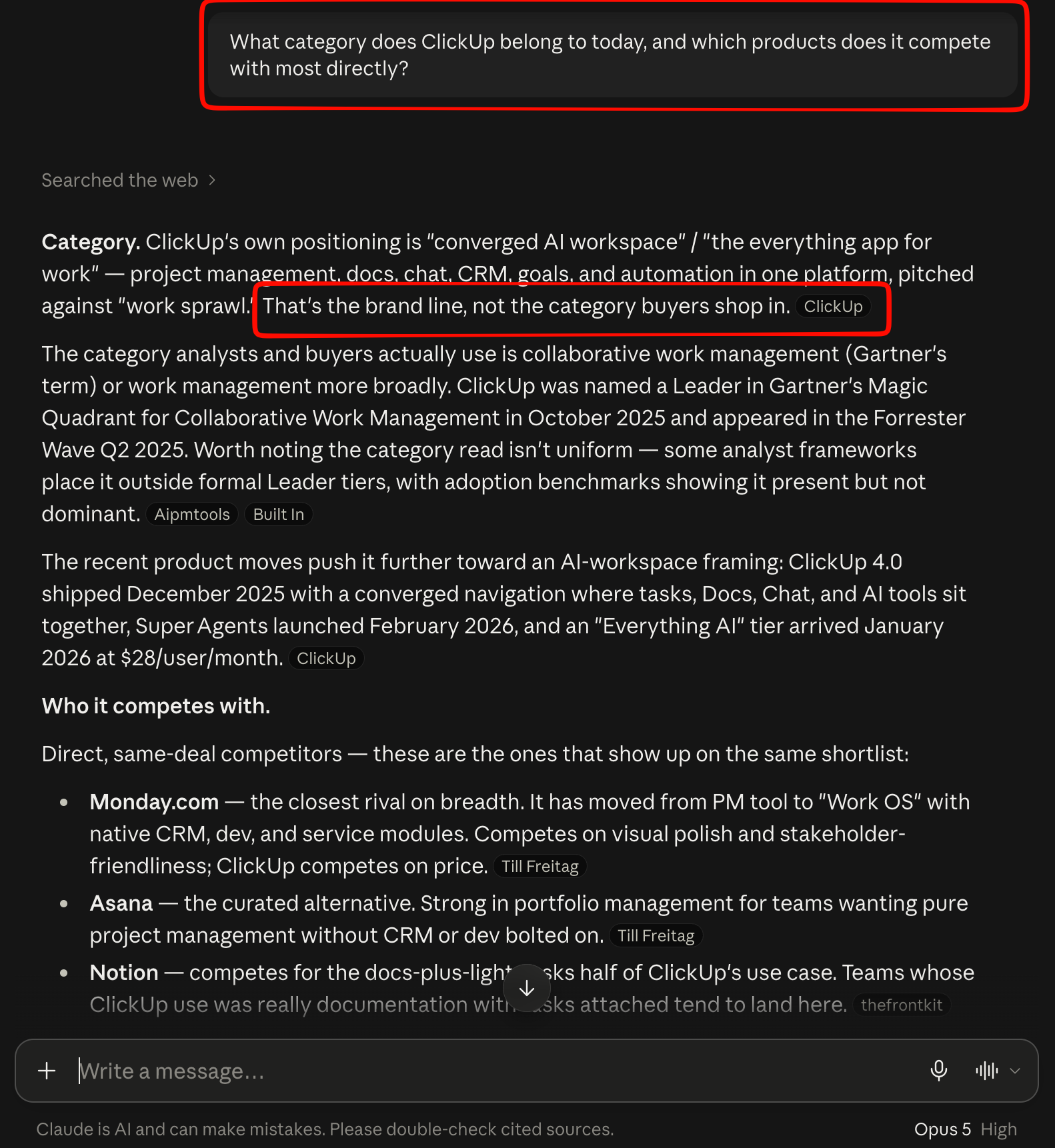
“What category does ClickUp belong to today, and which products does it compete with most directly?”
ChatGPT and Claude used the Converged AI Workspace label in both runs. Gemini, Perplexity, Google AI Overview, and Google AI Mode didn’t.
ChatGPT recognized the newer positioning while still placing ClickUp inside Collaborative Work Management / Work Management.
Claude made the same tension explicit, treating “Converged AI Workspace” as ClickUp’s brand language while placing the company within Gartner’s established “Collaborative Work Management / Work Management” category.
The other four surfaces stayed with labels such as project management, work management, work OS, and all-in-one productivity.
Here we see how Model Drift impacts positioning. On four AI surfaces, ClickUp’s preferred brand category wasn’t used to evaluate them. That kept products such as Asana, monday.com, Smartsheet, and Wrike in the comparison set.
The commercial gaps increased as we moved on to testing ClickUp in “X vs Y vs Z” buyer evaluation prompts.
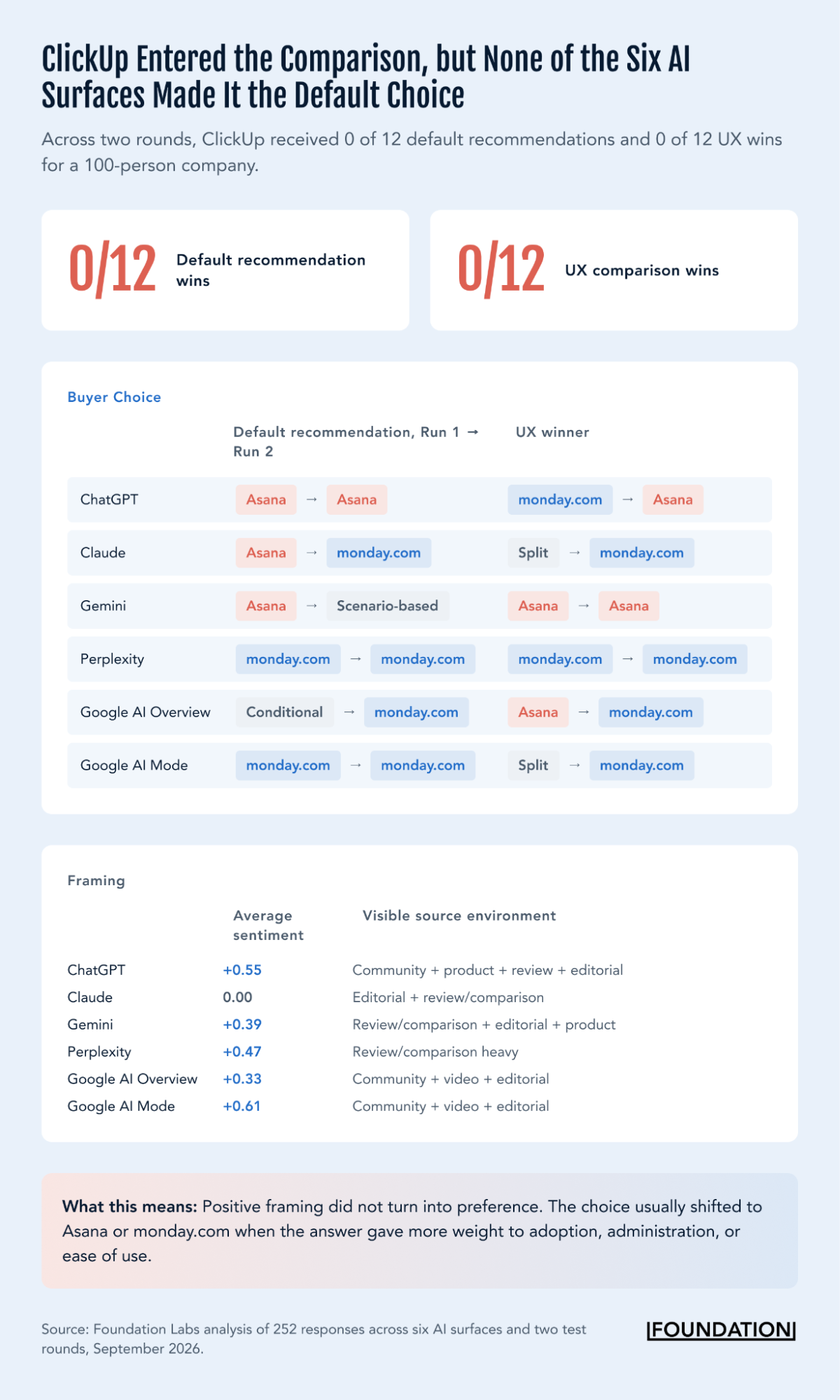
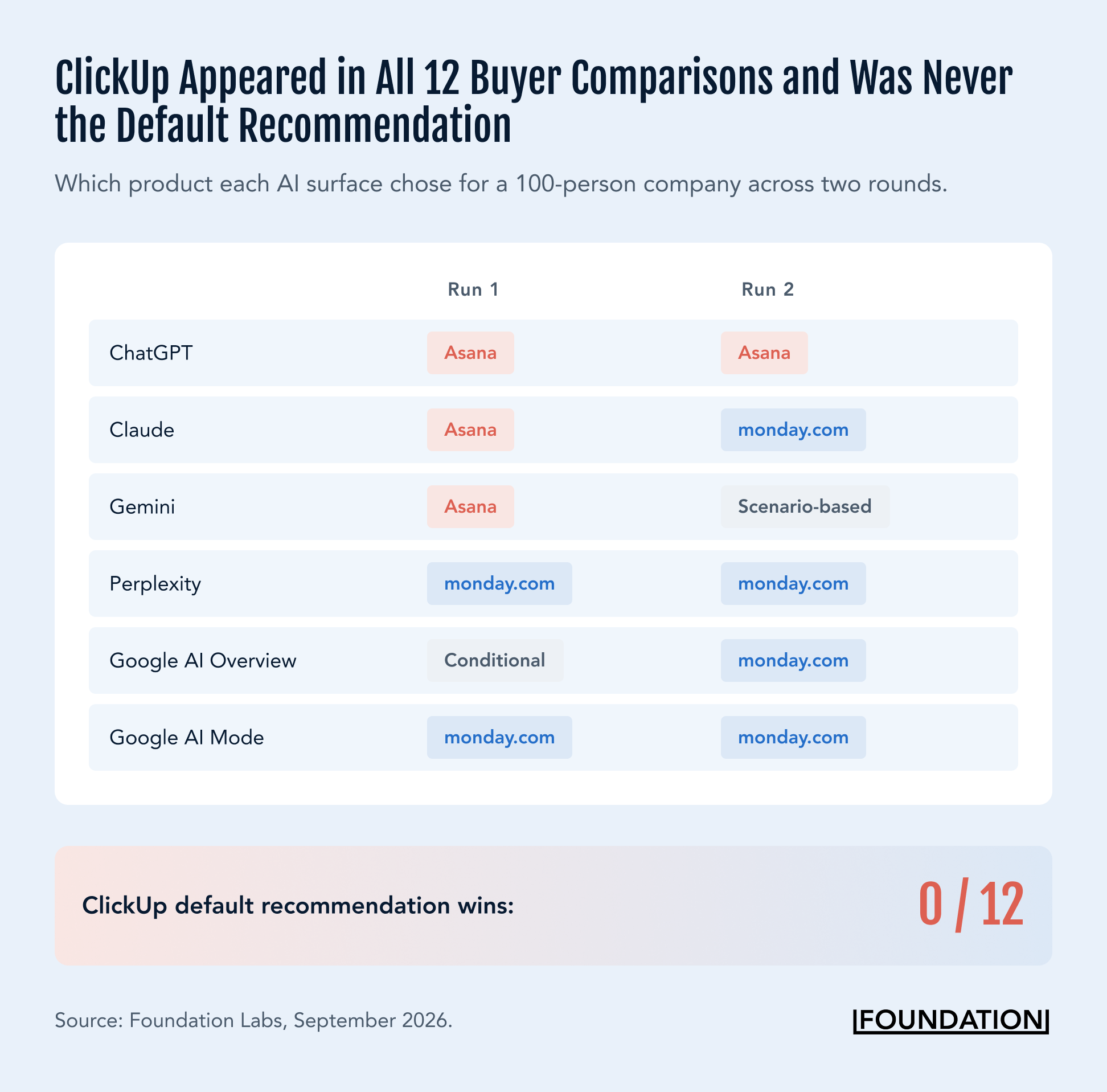
ClickUp Received 0 of 12 Default Recommendations for a 100-Person Company
For the buyer evaluation stage of the test, we asked a harder question: does ClickUp get recommended over competitors when it makes the buyer’s shortlist?
Here’s the prompt we used across all models and both runs:
“I’m choosing between ClickUp, Asana, and monday.com for a 100-person company. Which should I choose and why?”
ClickUp received zero default recommendations across 12 answers.
The answers regularly credited ClickUp for feature breadth, customization, automation, replacing multiple tools, and value. Yet, those distinct advantages failed to secure ClickUp the top recommendation spot.
ChatGPT’s second run shows the trade-off clearly. It ranked Asana ahead of ClickUp due to the former’s combination of adoption, portfolio visibility, governance, and lower administrative burden.
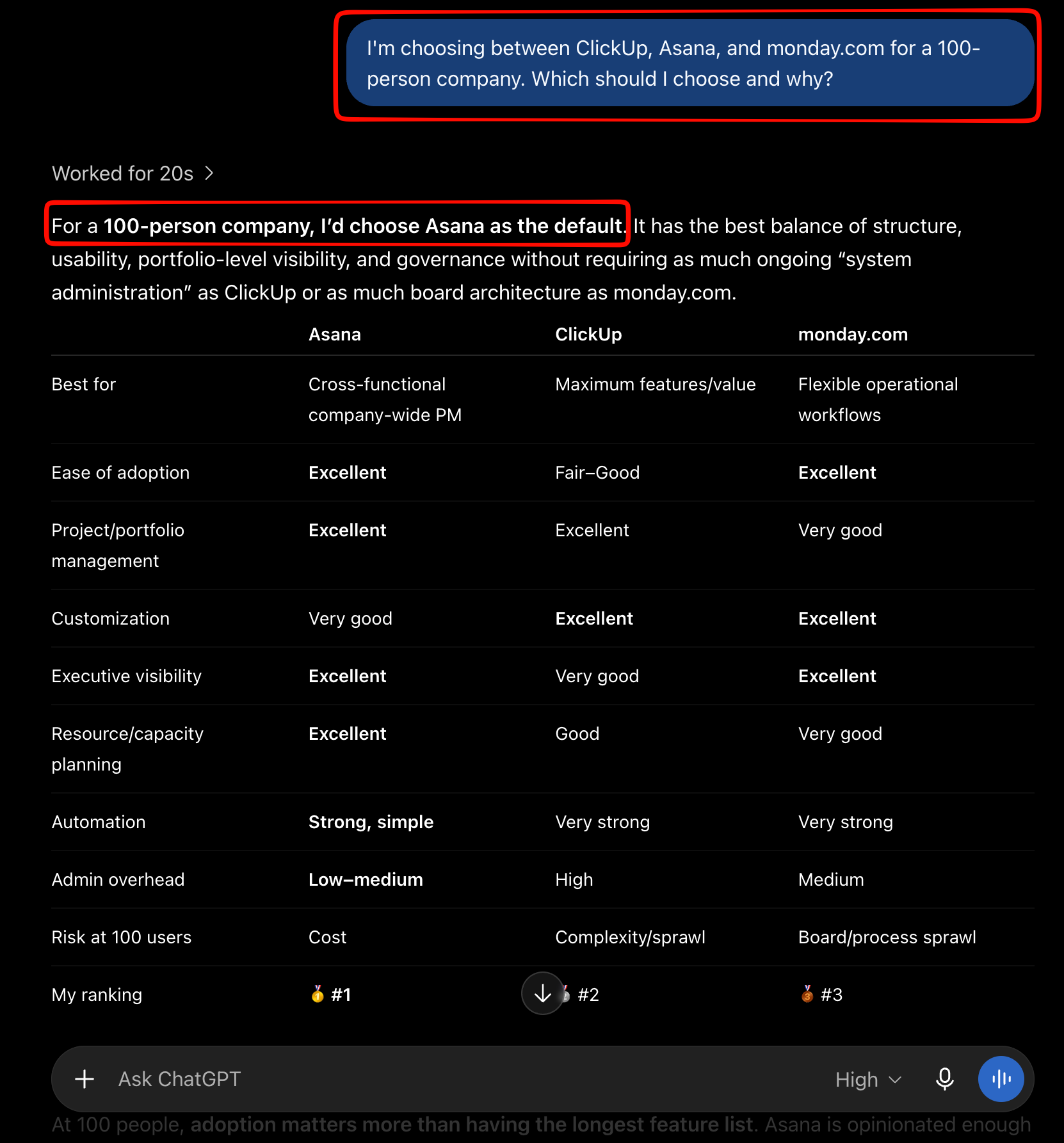
Despite the positive framing, ClickUp lost out at a critical stage of the buyer journey. And this pattern repeated across all models.
Five of Six Surfaces Framed ClickUp Positively
Recommendation and sentiment answer different questions. Recommendation tells us which product each LLM chose. Sentiment tells us how favourably it described ClickUp while making that choice. An answer could praise ClickUp and still recommend Asana or monday.com.
To measure that difference, we scored sentiment from -2 to +2 across four prompt groups:
- Category discovery: whether and how ClickUp appeared when buyers described a need without naming the brand
- AI use cases: how ClickUp was framed in questions about using AI for productivity and project work
- Brand understanding: how each surface described ClickUp’s category, ideal customer, and differentiation
- Buyer evaluation: how ClickUp was framed when buyers compared products on recommendation, UX, adoption, consolidation, and scalability
We excluded the controlled strengths-and-limitations prompts because those questions explicitly asked for positive and negative attributes, which would bias the sentiment score.
| Score | Coding rule |
| +2 | Strongly favourable: ClickUp is clearly the best fit or receives an unusually strong endorsement |
| +1 | Mostly favourable, with meaningful caveats |
| 0 | Neutral, descriptive, or genuinely mixed |
| -1 | Mostly unfavourable on the question being asked while still acknowledging strengths |
| -2 | Strongly unfavourable: a clear warning or recommendation against ClickUp |
Five of the six surfaces averaged above neutral, Claude averaged exactly neutral, and none averaged below zero.
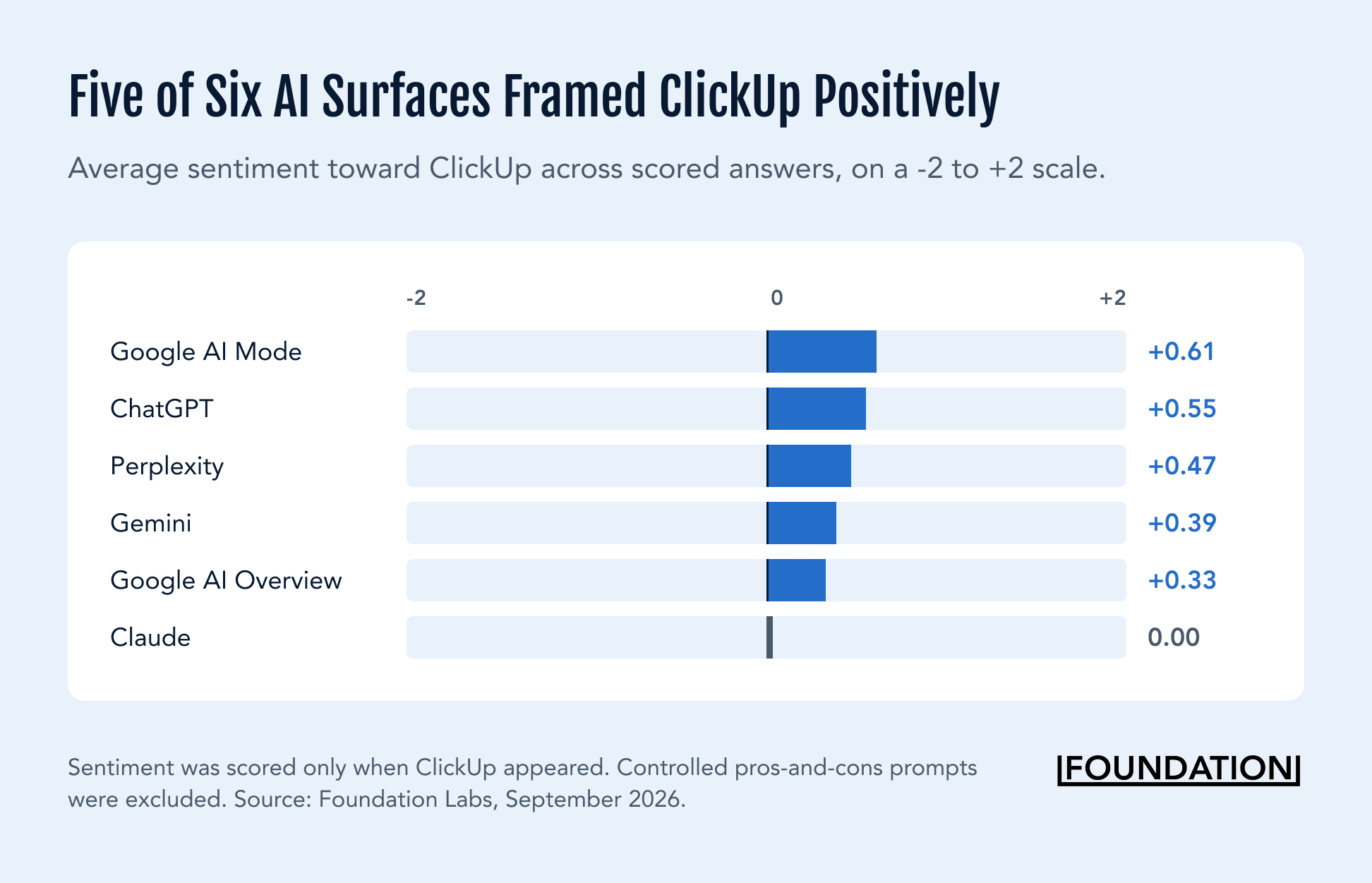
That means ClickUp was generally described positively, even when they weren’t the product being recommended.
ClickUp Lost All 12 UX Comparisons on Ease, Onboarding, and Complexity
When competitors were preferred, the answers repeatedly cited easier adoption, lighter administration, and lower complexity as advantages over ClickUp. We narrowed the next test to the product experience itself.
We asked which of ClickUp, Asana, and monday.com offered the best user experience for a 100-person company, comparing ease of use, onboarding, navigation, learning curve, and day-to-day usability.
ClickUp didn’t earn the top UX recommendation across any of the 12 answers.
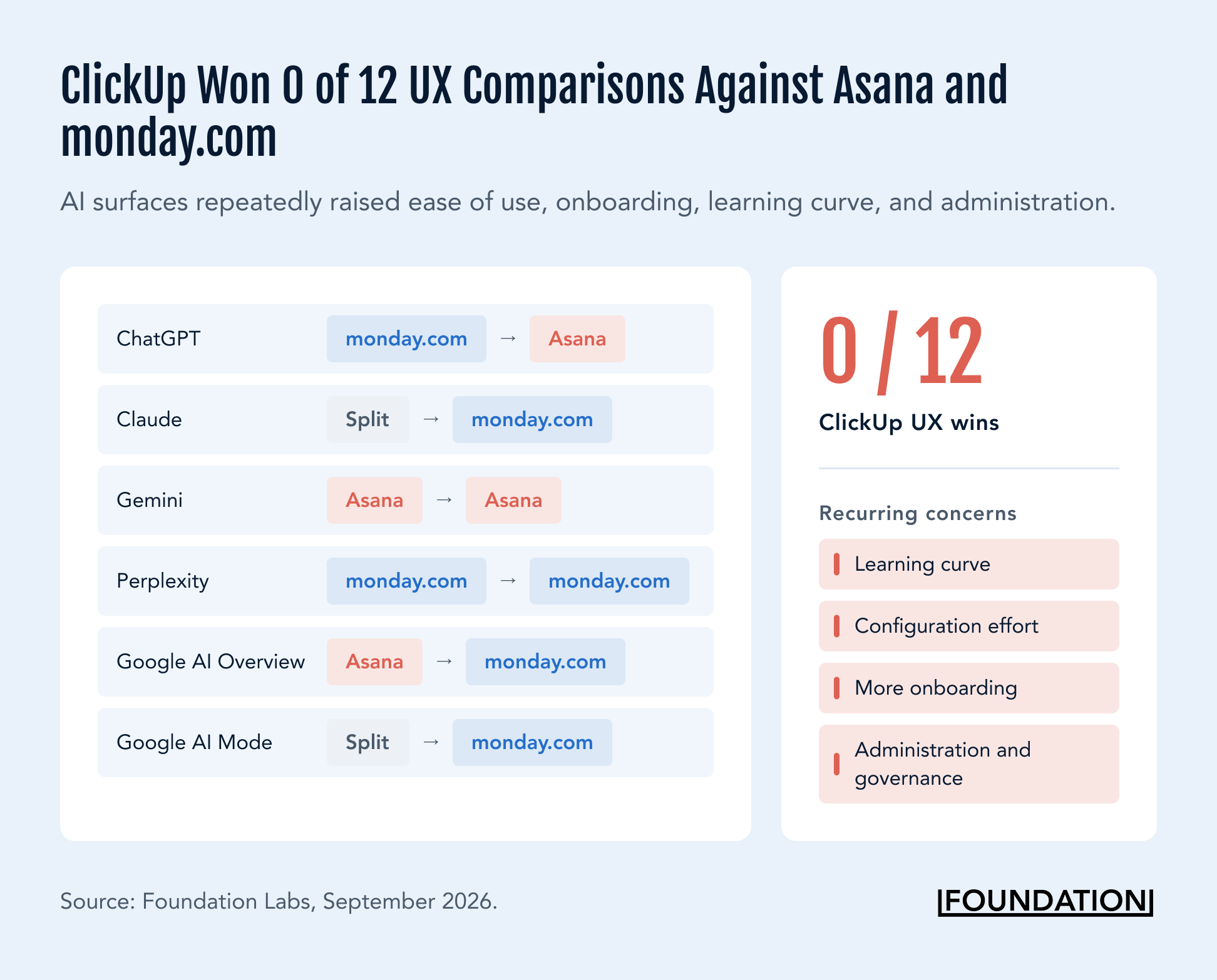
Across the six surfaces, ClickUp was associated with a steeper learning curve, denser configuration, more onboarding effort, and heavier administration.
ChatGPT’s second run ranked Asana first for overall UX, monday.com second, and ClickUp third. The same answer also described ClickUp as the most capable of the three and the option with the highest UX complexity.
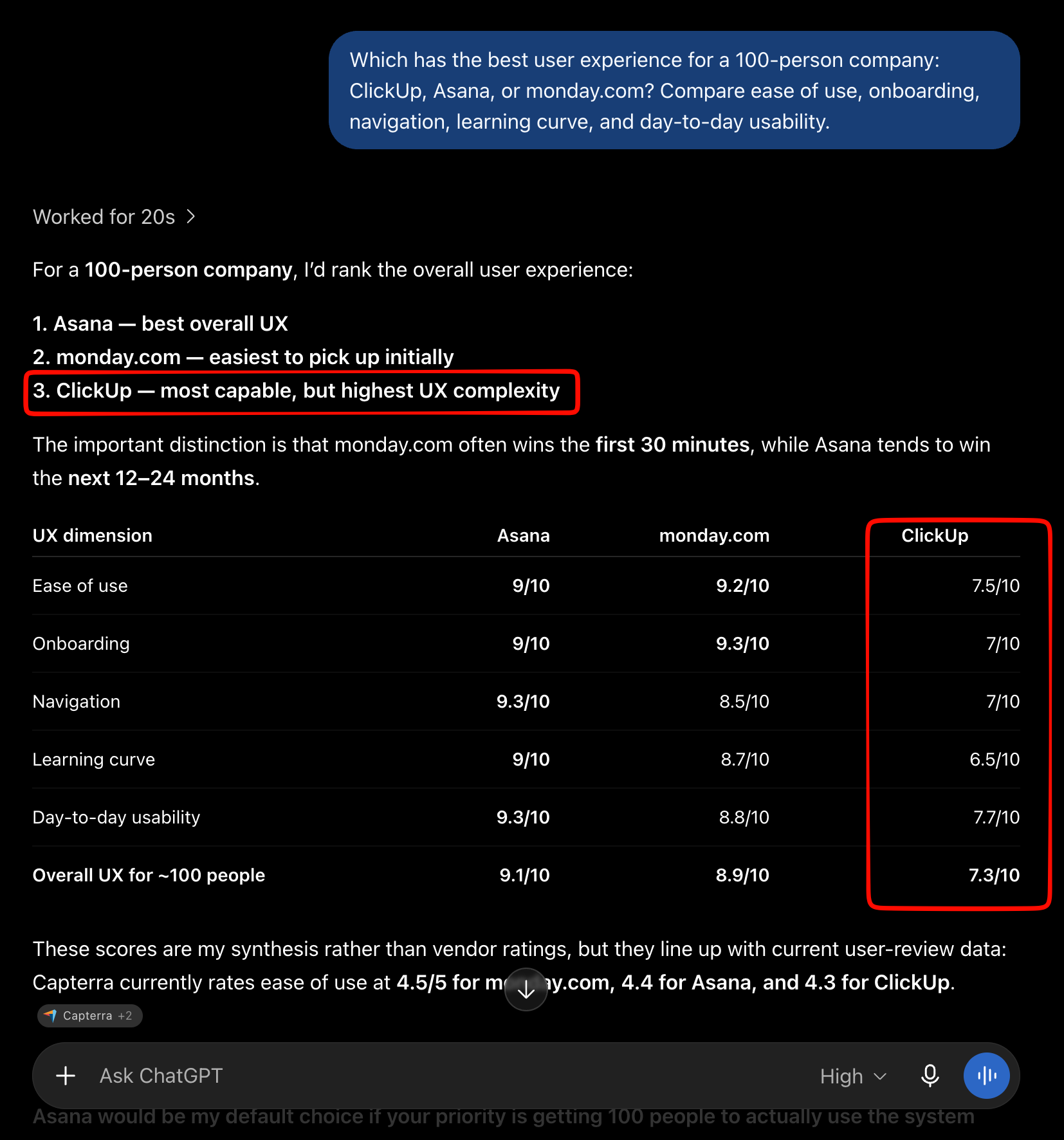
Whether those claims match real customer experience is the first of two evidence gaps we cover below.
The Same Google AI Overview Question Produced a Different Result 24 Hours Later
Model Drift also appeared on the same surface from one day to the next.
We asked Google AI Overview the same question on September 12 and September 13:
“What are the best AI productivity platforms for teams?”
On September 12, ClickUp didn’t appear.

On September 13, ClickUp Brain appeared and was described as a strong option for project management and task tracking.

The question and test setup stayed the same. The result changed.
Two runs are enough to show that an answer moved, but not enough to show that the new result will persist. That variability isn’t especially surprising given that Google’s traditional search results can also change from day to day.
Each Surface Exposed a Different Source Mix
The answers differed in another way: the sources around them changed from one AI surface to the next.
We analyzed those sources in two passes.
For the main comparison, we used four categories that could be applied consistently across all six surfaces: community, review, product/owned, and editorial/media. Social and video links were excluded from those percentages and counted separately.
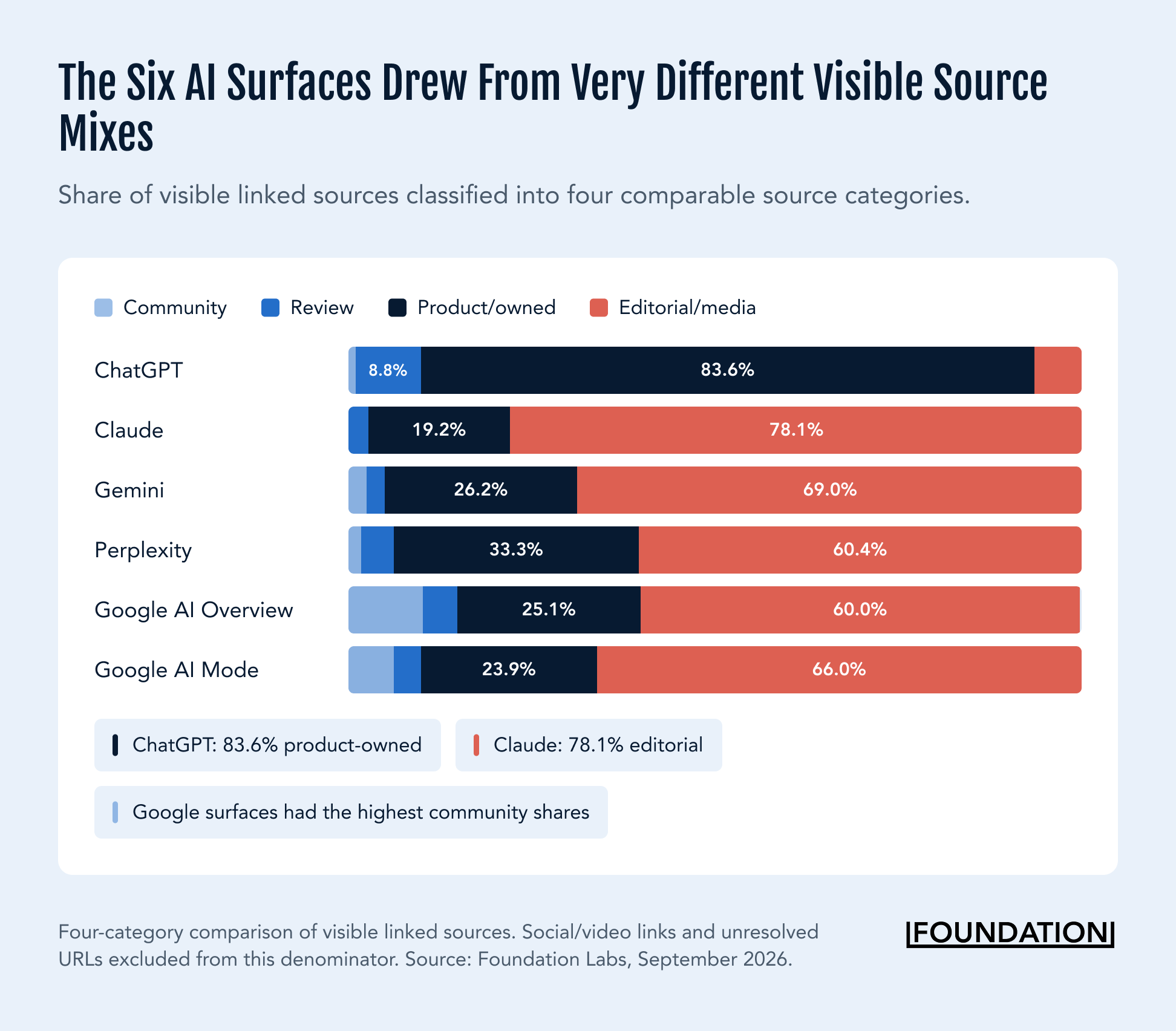
The breakdown includes all visible sources used in answers about ClickUp and its competitors, not only ClickUp-owned pages. The source mix differed sharply by surface:
- ChatGPT: Product-owned pages dominated the visible source set.
- Claude, Gemini, Perplexity, Google AI Overview, and Google AI Mode: Editorial sources made up the majority.
- Google AI Overview and Google AI Mode: These two surfaces also had the highest share of community sources.
We then looked at specific source formats that the four-category chart could obscure.
Reddit falls inside the community category, so it’s included in the chart. YouTube does not. We counted YouTube separately because video links appeared heavily on Google but not on the other surfaces.
We also ran a broader check for review and comparison content. That includes review pages plus pages built around comparisons, alternatives, “best” lists, and versus queries. It’s broader than the Review category in the chart.
Reddit, YouTube, and Comparison Pages Split Differently Across Surfaces
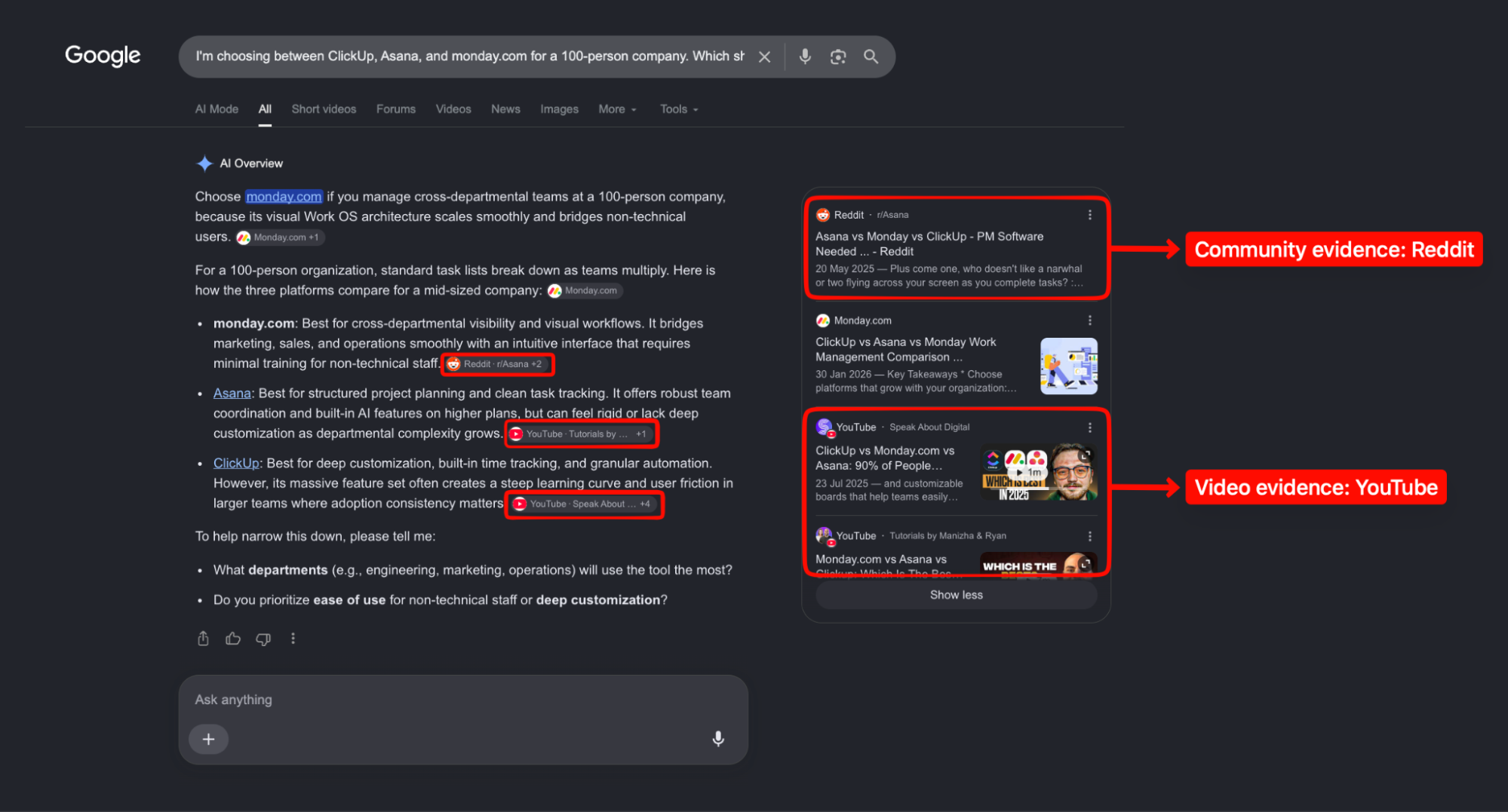
Reddit was prominent on Google, but it wasn’t uniquely a Google source. Google AI Overview and Google AI Mode each cited 24 Reddit links, while ChatGPT cited 20, Perplexity four, Gemini two, and Claude none.
YouTube produced a much clearer divide. Google AI Overview exposed 23 direct YouTube links and Google AI Mode 36. None appeared on ChatGPT, Claude, Gemini, or Perplexity.
The broader review/comparison measure produced a different result. Perplexity had the highest share at 56.9%. Claude reached 46.1%, but it didn’t stand apart from every other surface on the same measure.
The screenshots make those differences easier to see inside the same buying decision.
Google AI Overview surfaced Reddit discussions and YouTube videos when asked which of ClickUp, Asana, and monday.com a 100-person company should choose.
Google AI Mode showed a similar mix, again exposing community discussion and video alongside the answer.

Perplexity presented a different source environment. All six links visible in the buying-comparison panel were comparison pages, including independent publishers and a monday.com-owned comparison.

These counts describe what each interface cited and provide a glimpse at LLM preferences. They don’t explain whether Reddit, YouTube, or comparison pages are inherently better sources.
The differences may also reflect how each system searches. In “Large Language Model Search Engine Optimization (LLM SEO): What It Is & How It Works”, Ross Simmonds captures the idea simply:
| “Your natural-language question gets decomposed into multiple search-engine-shaped queries”. |
Google Search Central describes one version of that process as query fan-out. AI Mode can break a question into several related searches, retrieve information across them, and use those results to generate a response. The sources that appear can therefore reflect the system’s search process, indexing, freshness, and availability alongside the content itself.
ClickUp Wins on Consolidation and Project Execution
Not every comparison went against ClickUp. Two contexts consistently favoured them:
- Consolidation: where buyers wanted one platform to replace several tools
- Project execution: where buyers wanted AI embedded directly into planning, task management, workflows, and agent-driven work.
ClickUp Was Strongest When the Prompt Matched Their Core Product Strengths
ClickUp performed best when buyers wanted fewer tools. We tested that in two ways:
“What are the best tools for a company that wants to consolidate project management, docs, chat, and time tracking?”
ClickUp ranked first in 11 of 12 answers and in the top three in all 12.
We also asked:
“What are the best work management tools for companies trying to reduce software sprawl?”
ClickUp ranked first in seven of 12 answers and in the top three in 10 of 12.
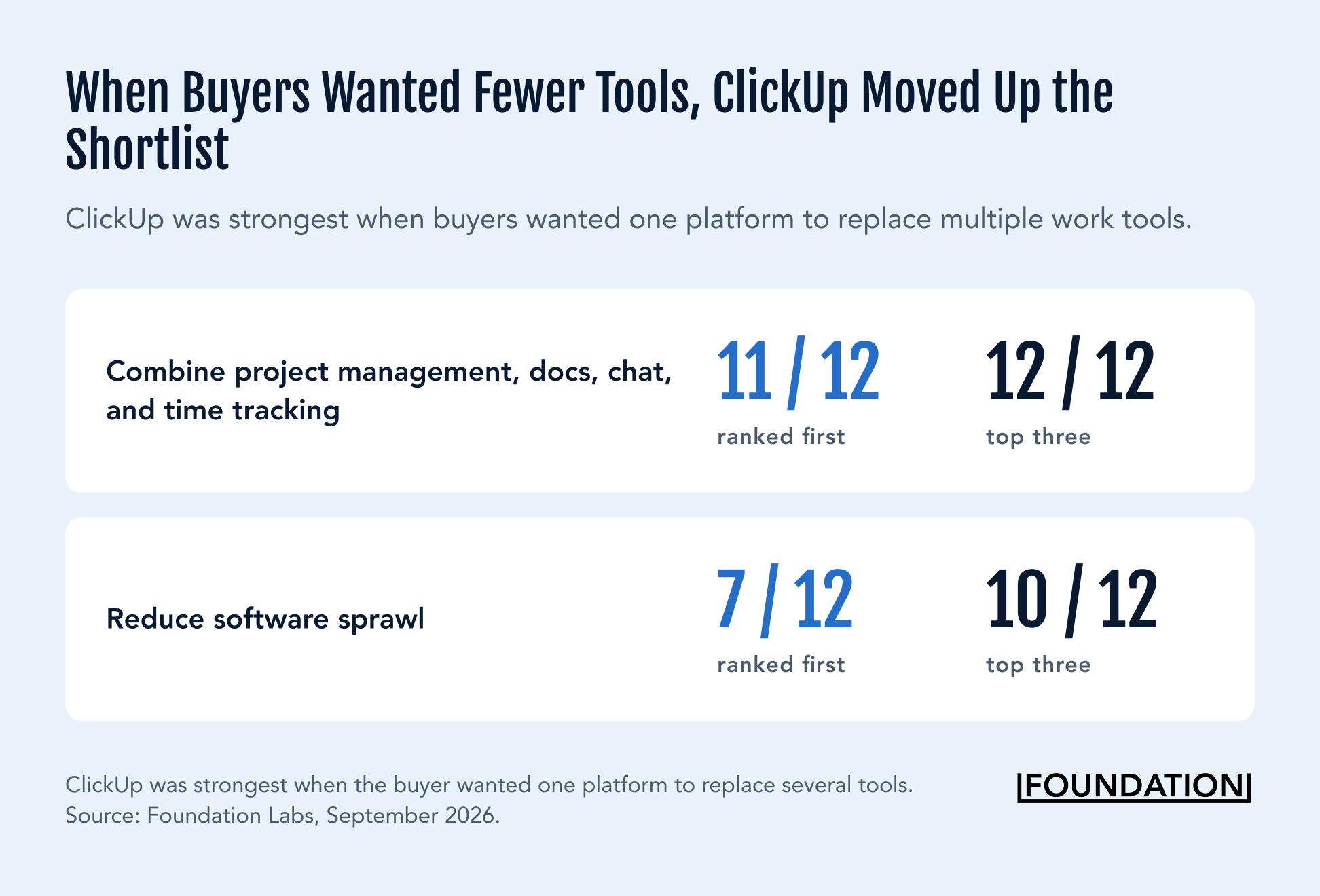
That performance suggests the idea of consolidation travelled farther than ClickUp’s “Converged AI Workspace” label. Across surfaces, AI answers consistently recognized ClickUp as a platform that brings multiple workflows together, even when they didn’t use the company’s newer category language.
ClickUp’s AI Visibility Is Stronger for Project Execution
A second strong context appeared when the AI question moved closer to ClickUp’s core work-management product. ClickUp appeared in 10 of 12 broad AI-productivity answers, but in all 12 when we asked:
“What are the best platforms for teams that want AI embedded directly into project execution?”
The narrower question changed the competitive context. Broad AI-productivity prompts brought in Microsoft 365, Gemini, Notion, Zapier, and other general-purpose products. Project-execution prompts focused more heavily on platforms built around planning, task management, workflows, and agents.
Claude’s second run captures the shift. It described ClickUp as “the most aggressive on agents”, framing its AI around work carried out inside the project system rather than general productivity.

In this study, ClickUp’s clearest AI association was AI applied to project work: planning projects, managing tasks, automating workflows, and coordinating agents.
The Study Exposed Two Evidence Gaps
ClickUp’s data surfaced two places where the gap between brand intent and AI output is wide enough to act on.
1) ClickUp Won on Capability and Lost on the Recommendation
ClickUp went 0-for-12 on default recommendations and 0-for-12 on UX comparisons. Setup, onboarding, administration, and governance repeatedly appeared in the reasoning when competitors were preferred.
Before treating that as a marketing problem, a company in their position should establish whether those concerns match customer experience. Product and customer success teams can measure launch time, onboarding completion, administrator workload, configuration effort, permission setup, and adoption across larger accounts to find out. Recent G2 and Capterra reviews are a fast outside check: look for recurring complaints about setup, onboarding, administration, or complexity.
If those measures reveal friction, it’s a sign for the product team to implement changes. If customer results contradict the AI answers, marketing needs to make sure that experience is reflected on every surface AI touches to shift those responses toward a fairer picture. Implementation benchmarks, customer stories, reviews, comparisons, and deployment examples can speak directly to the concerns AI keeps raising.
2) “Converged AI Workspace” Has Limited Third-Party Reach
Only ChatGPT and Claude used “Converged AI Workspace” in both brand understanding runs. The other four surfaces stayed with more established labels.
AI surfaces pull category language from the sources they retrieve. If the only place “Converged AI Workspace” appears is ClickUp’s own site, most surfaces will default to whatever label the rest of the web uses. The spread of a new category can only happen once people start using the phrase independently when they describe the product.
As that third-party usage changes, the same category questions can be rerun and the number of surfaces that return the new label should see a shift. Earning that independent usage means getting the category language into the places third parties already reference: analyst briefings, customer case studies, review site profiles, conference talks, partner integrations, and the community discussions that AI surfaces retrieve most frequently.
How to Run a Model Drift Audit
ClickUp shows why one AI visibility score isn’t enough. A brand can appear consistently and still change position, category, recommendation, sentiment, and source mix from one surface to the next.
A Model Drift audit turns those differences into a specific action assignment for marketers. Start with a buyer question, run it across the surfaces that matter, and record the same six fields each time:
| Measure | What to Record | What It Diagnoses |
| Presence | Did your brand appear? | Discovery coverage |
| Position | Where did it first appear? | Competitive placement |
| Description | What did the surface call your brand? | Category and positioning |
| Preference | Which product did it recommend, and why? | Criteria shaping the buying decision |
| Sentiment | How did it frame your brand? | Strengths and concerns |
| Evidence | Which sources were visible with the answer? | Source types recurring around the decision |
Keeping those measures separate prevents one healthy average from hiding a different problem underneath it.
That same diagnostic logic shapes our AI visibility services, where we move from measuring how a brand appears to tracing the evidence behind those answers and identifying what needs to change. You can apply that process yourself in four steps.
1) Ask a Buyer Question That Forces a Choice
Start with a decision your buyers actually make. Discovery prompts tell you whether your brand shows up. Buyer questions reveal the criteria that determine whether it gets chosen.
Use prompts such as:
- Which product should a 100-person company choose?
- Which option is easiest to adopt?
- Which scales best for a growing team?
- Which product is the best fit for a specific use case?
For each answer, record three things: the product recommended, the reasons it won, and the concerns raised about the alternatives.
Those concerns are your next research targets. If onboarding, governance, price, or administration keeps appearing, move to the next step and investigate the evidence behind that concern.
2) Check Which Evidence Appears Around That Concern
Once you know which concern is influencing the recommendation, trace which sources the AI surfaces displayed alongside the answers that raised it.
For every answer where that concern appears, record the domain, the source type, and the concern itself. If implementation risk keeps showing up, for example, note whether the visible evidence comes from review sites, Reddit, product documentation, comparison pages, or editorial coverage.
Be precise about attribution. A source shown beside an answer doesn’t automatically support every sentence in it. Only treat a source as evidence for a specific claim when the interface clearly connects the two.
Our Ghost Citation teardown showed how much of an AI-generated brand narrative can come from outside the company’s own website. By the end of this step, you should know which concern is affecting the decision and which source types repeatedly appear around it.
3) Build Proof That Answers the Concern
Turn the buyer concern into something that can be measured and demonstrated.
If onboarding is the issue, define what would resolve it. That might be time to launch, administrator effort, onboarding completion, support demand, or results from a comparable customer.
Then build evidence around that requirement. A benchmark can show implementation speed. A customer story can show what rollout looked like at a similar company. Independent reviews can validate the experience from outside your site.
Use the source analysis to decide where that proof needs to be visible. In the ClickUp study, Google repeatedly exposed Reddit and YouTube, ChatGPT surfaced substantial Reddit evidence, and Perplexity leaned most heavily toward review and comparison coverage.
The assignment should now be specific: create verifiable proof that answers the concern and strengthen its presence in the source types that recur around the decision.
4) Rerun the Exact Question and Measure Change
Keep the prompt, surface, and test setup fixed. Record the date, visible model, and the same six Model Drift fields on every run.
Compare the new run with the previous one across all six fields. Record which results persist and which change.
Google AI Overview shows why repetition belongs in the audit. ClickUp was absent from the same AI-productivity question on September 12 and present on September 13. A one-time check would have produced a different conclusion depending on the day.

This audit should leave you with an assignment this specific:
For [buyer decision], AI answers repeatedly raise [buyer concern]. The visible evidence around that decision comes from [recurring source types]. We need [specific proof] in those places, and we will rerun [exact prompt] across [target surfaces] to understand whether we successfully influenced the results.
Turn Model Drift Into Your Next Marketing Move
Model Drift is the new baseline for any brand that appears in AI answers. As AI surfaces keep changing how they search, cite, and reason, the gap between being visible and being recommended will keep shifting too. ClickUp’s own 97.5% presence rate is proof of it.
The brands that win won’t be the ones with the highest presence score. They’ll be the ones that treat every AI surface separately and mount a strategy based on solid data.
Make your next AI visibility report end with a decision: choose the commercially important buyer questions, watch how the answers change across surfaces, and put marketing efforts behind the evidence gaps that influence those decisions.
As the answers move, your priorities should move with them.
We use the same lens in our AI Visibility work to help teams turn AI discovery data into focused marketing priorities. Contact us today.

