
Article's Content
Article's Content
AI can recommend your brand while citing sources you don’t own.
That is what happened with n8n, the AI workflow automation platform.
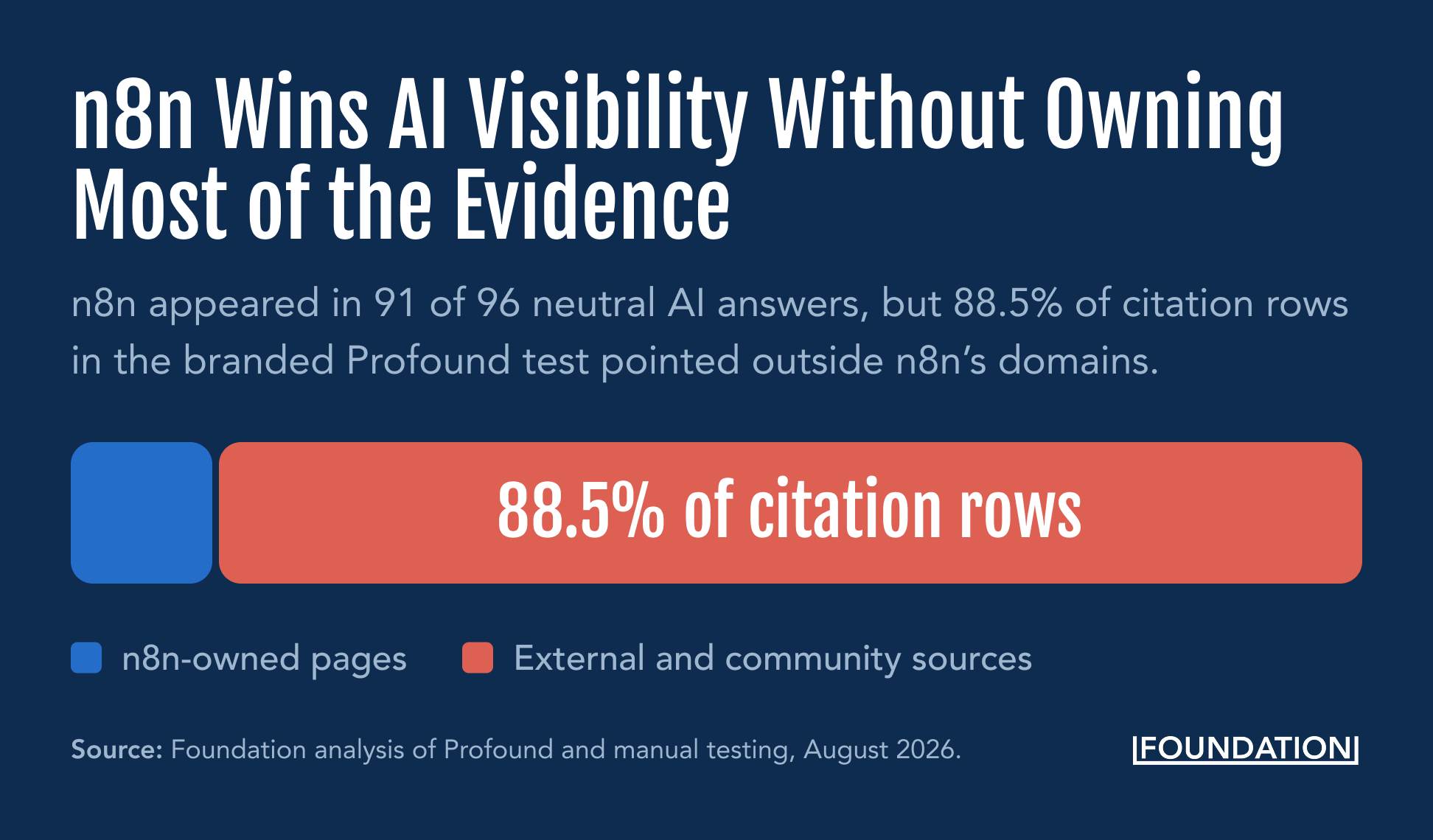
When we asked AI systems to recommend workflow automation tools without mentioning n8n by name (for example, “What is the best platform for self-hosted workflow automation?”), n8n appeared in 91 of 96 answers.
That level of visibility is unusually strong. A buyer asking AI about workflow automation was very likely to encounter n8n, even without searching for the brand directly.
But much of the evidence used to explain n8n came from somewhere else. n8n-owned properties accounted for just 15.7% of Citation Share in Profound’s branded dataset. Reddit threads were cited 95 times, compared with 33 for n8n’s blog.
The gap showed up in a buying query too. When we asked Google AI Mode for the best Zapier alternatives for complex workflow automation, a Reddit discussion appeared at source #4. n8n’s comparison page appeared at #7.
n8n is getting recommended, but it does not control much of the source set AI uses to justify that recommendation.

That Reddit thread is what we call a Ghost Citation: an outside source AI uses to explain or evaluate your brand, even though you neither created it nor control what it says.
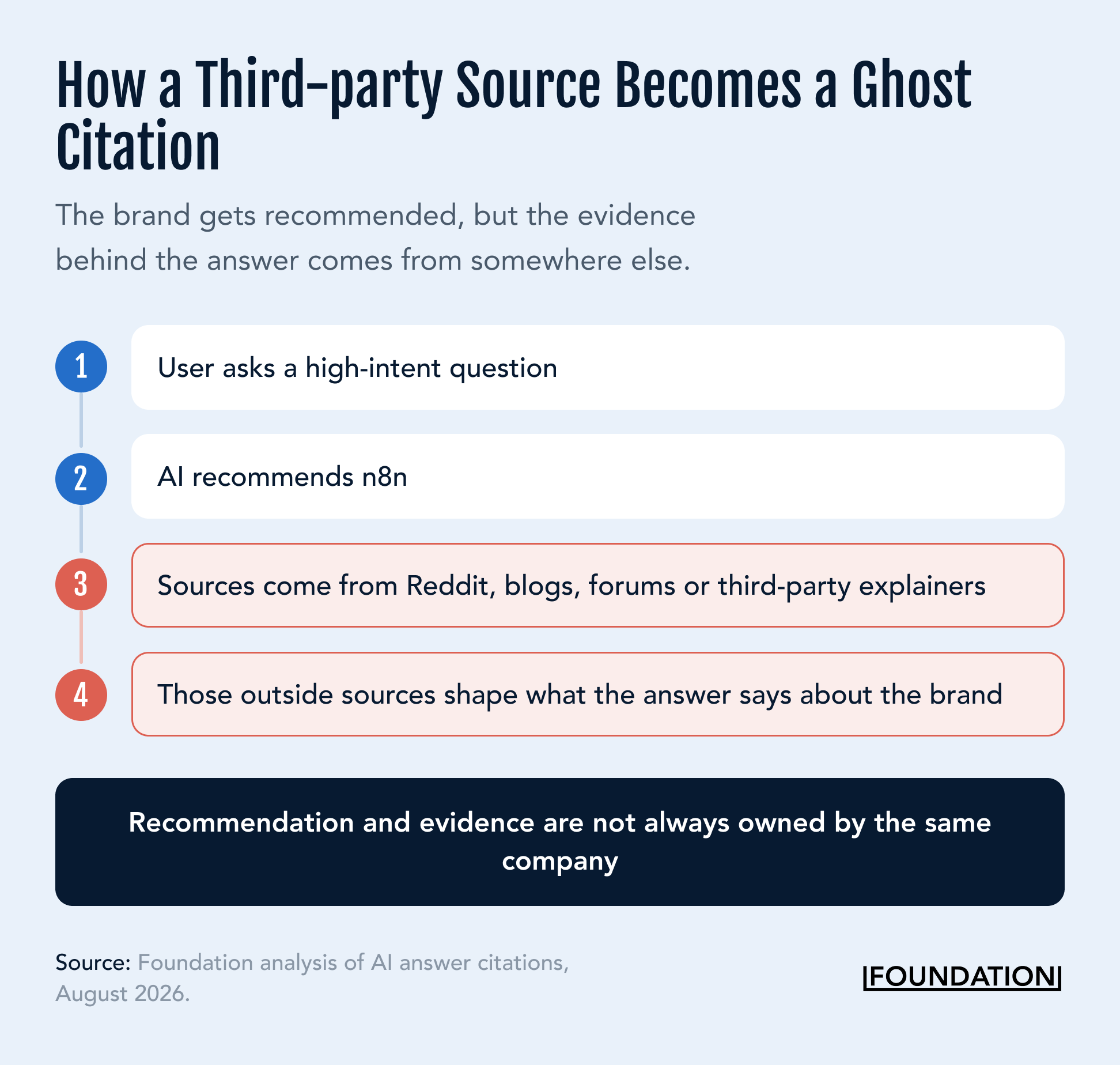
We traced the Ghost Citations shaping n8n’s answers to show you where they take hold, where first-party content still wins and how to regain influence over what AI tells buyers about your brand.
Let’s get into it!
Why n8n Is a Useful Ghost Citation Test
A Citation Audit of the Websites AI Uses to Answer n8n Queries
What Our Audit Found As Opportunities Worth Chasing
What You Can Steal: Run a Ghost Citation Audit
AI Visibility Is Only Half the Picture
Why n8n Is a Useful Ghost Citation Test
n8n is a useful test case: a strong first-party content operation sits side by side with an active user community documenting deployments, failures, workarounds and production trade-offs.
That gives us a clear question to investigate: when buyers ask AI about n8n, does the answer come from n8n itself or from the people using it?
To find out, we tested:
- 20 buyer questions
- Six AI surfaces: ChatGPT, Claude, Gemini, Google AI Overview, Google AI Mode and Perplexity
- Two separate rounds
The test produced 240 answer observations. We compared those results with Profound citation data and an Ahrefs audit of n8n’s publishing footprint to see which first-party pages carried answers, which outside sources kept resurfacing and where third-party evidence filled the gaps.
Foundation does not work with n8n. We selected the company independently because this mix of strong first-party content and active third-party discussion makes the Ghost Citation effect unusually visible.
A Citation Audit of the Websites AI Uses to Answer n8n Queries
Most of n8n’s Citation Footprint Sits Outside Its Domain Estate
In Profound’s branded n8n dataset, owned properties accounted for 15.7% of Citation Share.

The category view shows how fragmented the outside evidence is. Across the same Aug. 14–16 window, Automation Atlas led external domains at 5.74% Citation Share, followed by ayautomate.com at 3.71% and YouTube at 3.62%. No external domain came close to controlling the category narrative.

n8n is not trying to outrank a single alternative source of truth.
For this reason, AI systems can assemble an answer from publishers, creators, specialist sites, competitors and community discussions, each contributing a different part of the product narrative.
The earlier Reddit result from this article’s introduction shows what that dispersed source environment can look like around buyer prompts.
The Source Mix Changes by AI Surface
The aggregate ownership split shows where the evidence sits. A fixed prompt shows who each AI system chooses to rely on.
For “What are the biggest limitations or drawbacks of n8n?”, Google AI Mode placed two Reddit discussions ahead of n8n’s own documentation: “what are the limitations of n8n” at #1 and “Why I Left n8n for Python (and why it was the best decision)” at #4.

The first official n8n Docs result did not appear until #28.

Google AI Overview also leaned outward, drawing on Reddit alongside Emergent, AltexSoft, Cherry Servers and MentorCruise.

Gemini followed a similar pattern, surfacing DEV Community, G2, YouTube and AltexSoft without an official n8n property visible in the captured source panel.

ChatGPT went the other way. Its answer relied heavily on n8n Documentation to explain workflow maintainability, self-hosting and high-volume workloads.

Perplexity also led with first-party technical material, placing two n8n Docs pages before a Workato article.

Although we tested on Claude, its captured answers did not expose stable, exact source URLs, so we excluded it from source-level comparisons.
Our broader B2B citation research found Reddit to be the leading external citation domain. We’ve worked with Reddit in B2B since 2018 and published there since 2015. Here, the more important finding is how Reddit sits alongside reviews, publishers, video and first-party documentation in the evidence used to explain n8n.
n8n can therefore be the subject of the answer without consistently being the source that explains the product. One system may anchor its explanation in n8n’s documentation; another may rely on a Reddit user, reviewer, publisher, video creator or competitor.
Some Ghost Citations Keep Coming Back
Several Reddit threads resurfaced across prompts, platforms and both testing rounds. One appearance can be retrieval noise. A URL that returns across different prompts, platforms and testing rounds deserves more attention.
Several Reddit threads in our audit showed that recurrence. Many came from r/n8n, which had roughly 50,000 members when we audited it in August 2026. The community hosts discussions about deployments, bugs, workarounds, scaling, self-hosting and the compromises users encounter once workflows become business-critical.
One thread stood out: “The reality of n8n after 3 years automating for enterprise clients.”
The roughly year-old thread had 177 upvotes and 73 comments when we audited it.
In Profound’s August 14–16 dataset, it appeared nine times across eight answers:

Our controlled test then surfaced the same thread in both rounds when we asked whether n8n was reliable enough for production and business-critical workflows.


Other discussions showed the same persistence.
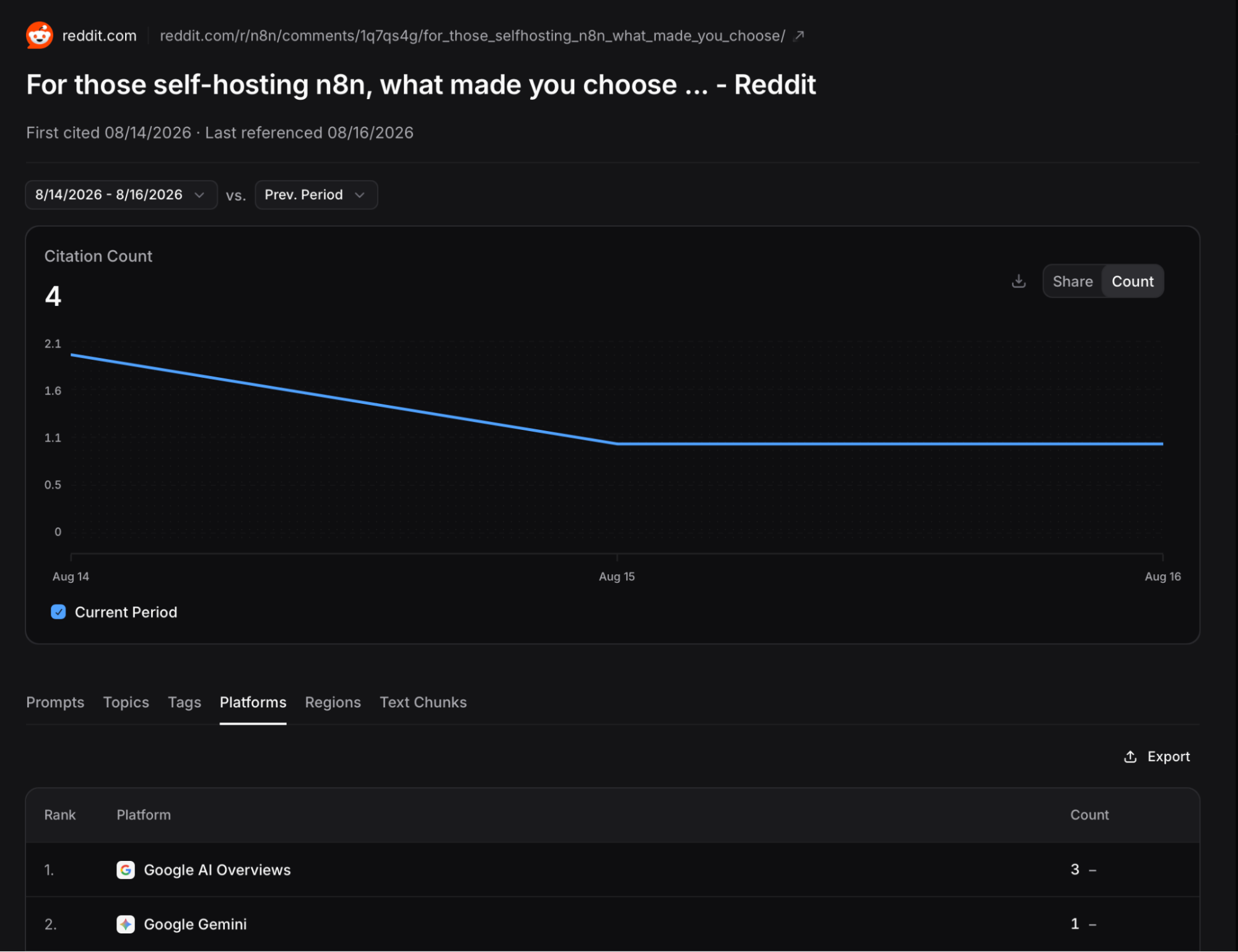
When we asked “What are the main tradeoffs of self-hosting n8n?”, the same 7-month Reddit thread resurfaced across both controlled rounds and two Google surfaces:
Google AI Mode in one round.

And Google AI Overview in the other. In the AI Overview result, the thread appeared at source #1 ahead of n8n Lab at #2. Despite the name, n8n Lab is an independent n8n-specialist agency rather than an n8n-owned property, making both of the top sources external to the brand.

Profound separately recorded four citation occurrences for the thread during the August 14–16 window.
The n8n limitations answer’s #4 Reddit source, ‘Why I Left n8n for Python (and why it was the best decision),’ was not confined to that one result. Profound recorded three additional citation occurrences for the thread during the August 14–16 window.

Three of these threads were roughly a year old when audited, yet they continued to surface around current questions about reliability, self-hosting and production use.
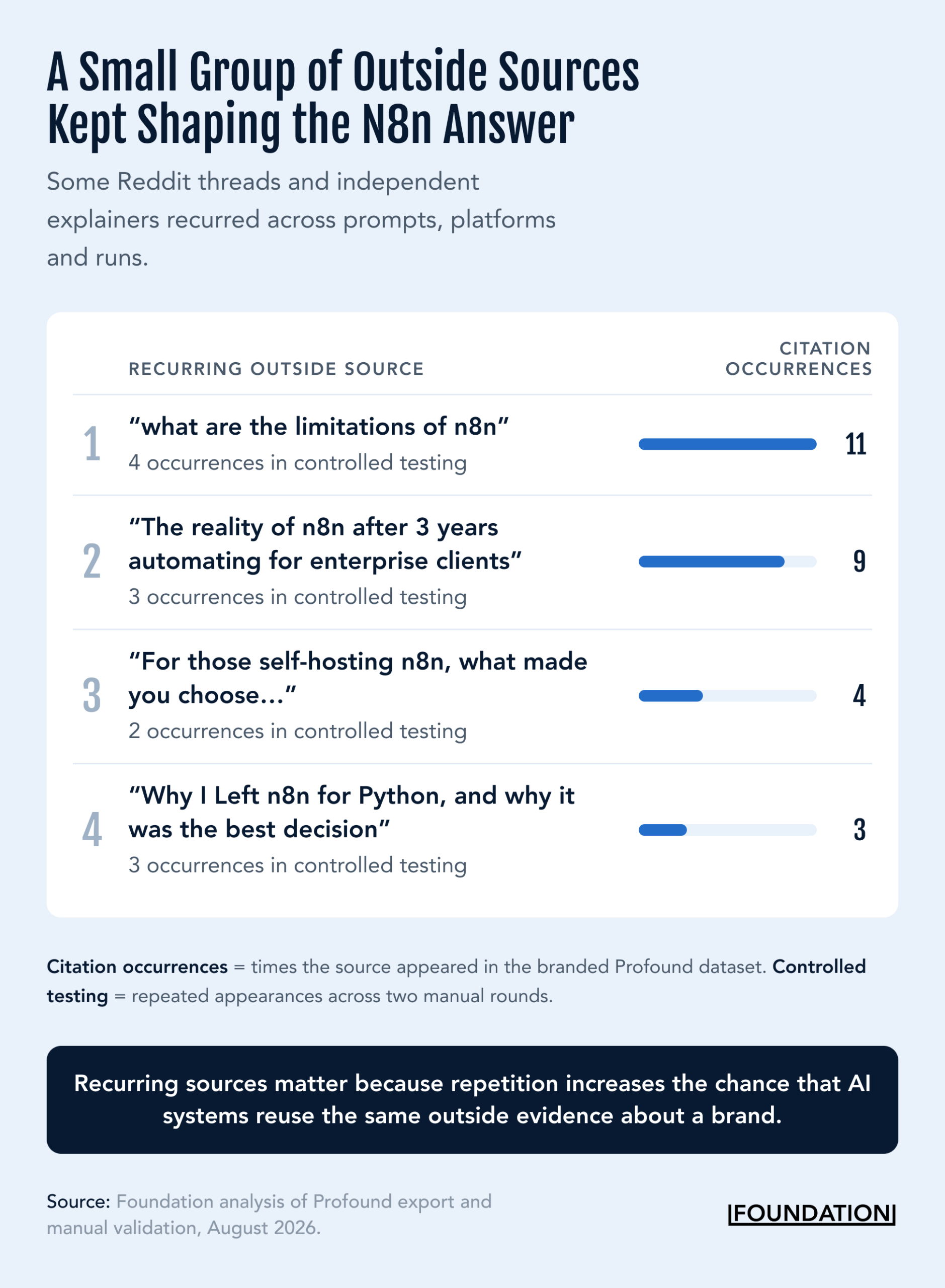
Once external evidence becomes retrievable across buyer concerns, newer first-party content does not automatically replace it.
The Content Calendar Only Captures Part of n8n’s AI Footprint
n8n has no shortage of content.
Ahrefs Content Explorer returned 94 blog.n8n.io pages dated between August 17, 2025 and August 16, 2026. Twelve were republished existing articles, leaving 82 net-new posts during the period.
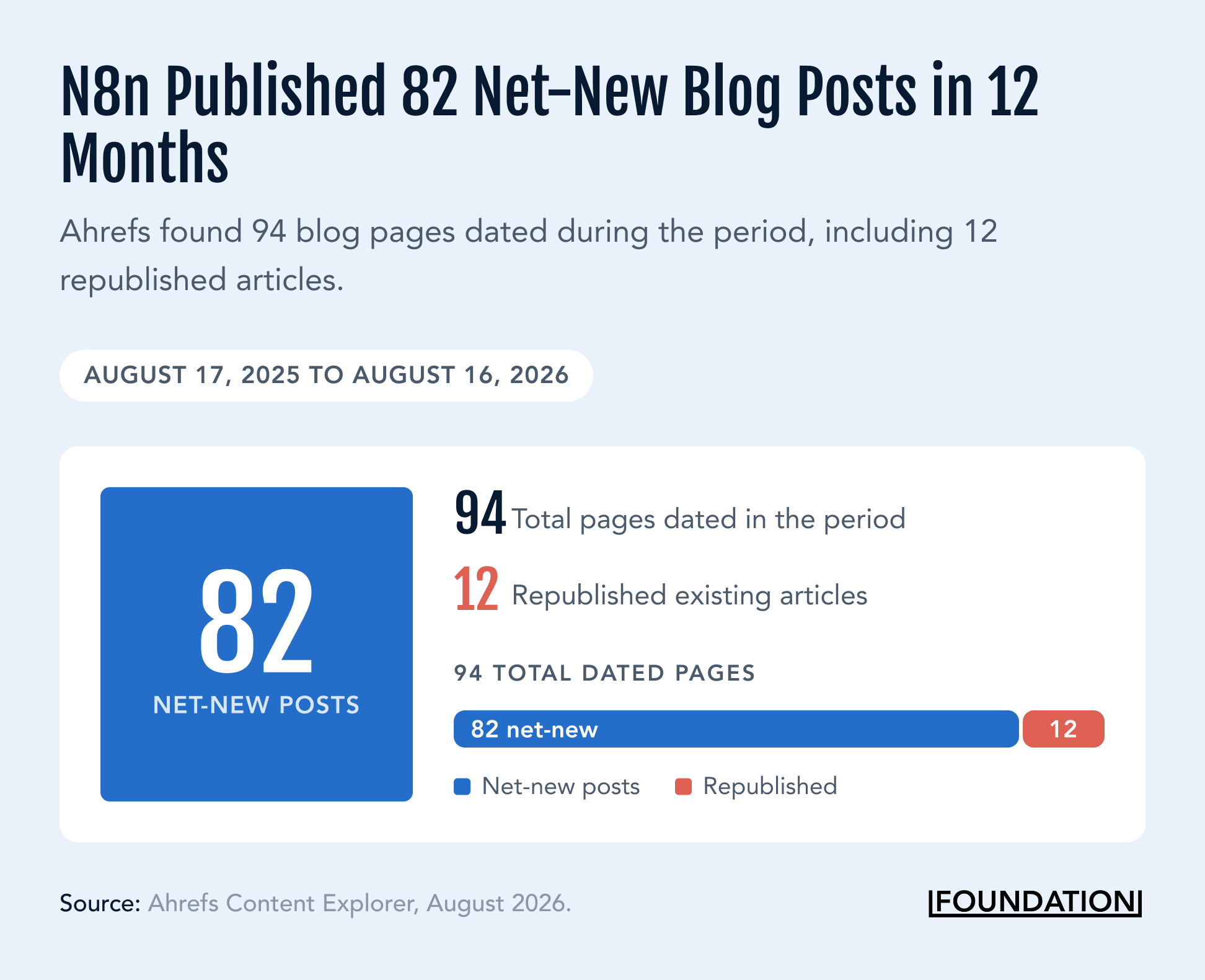
The blog generated 33 of the 2,423 citation occurrences in Profound’s branded dataset.

Those numbers describe different things and should not be read as a direct ROI comparison. Eighty-two measures publishing output over 12 months; 33 measures retrieval within a three-day prompt dataset. The contrast shows why publishing cadence alone cannot anchor the evidence environment around a brand.
Reddit produced 95 citation occurrences in the same branded dataset, while community.n8n.io produced another 59.

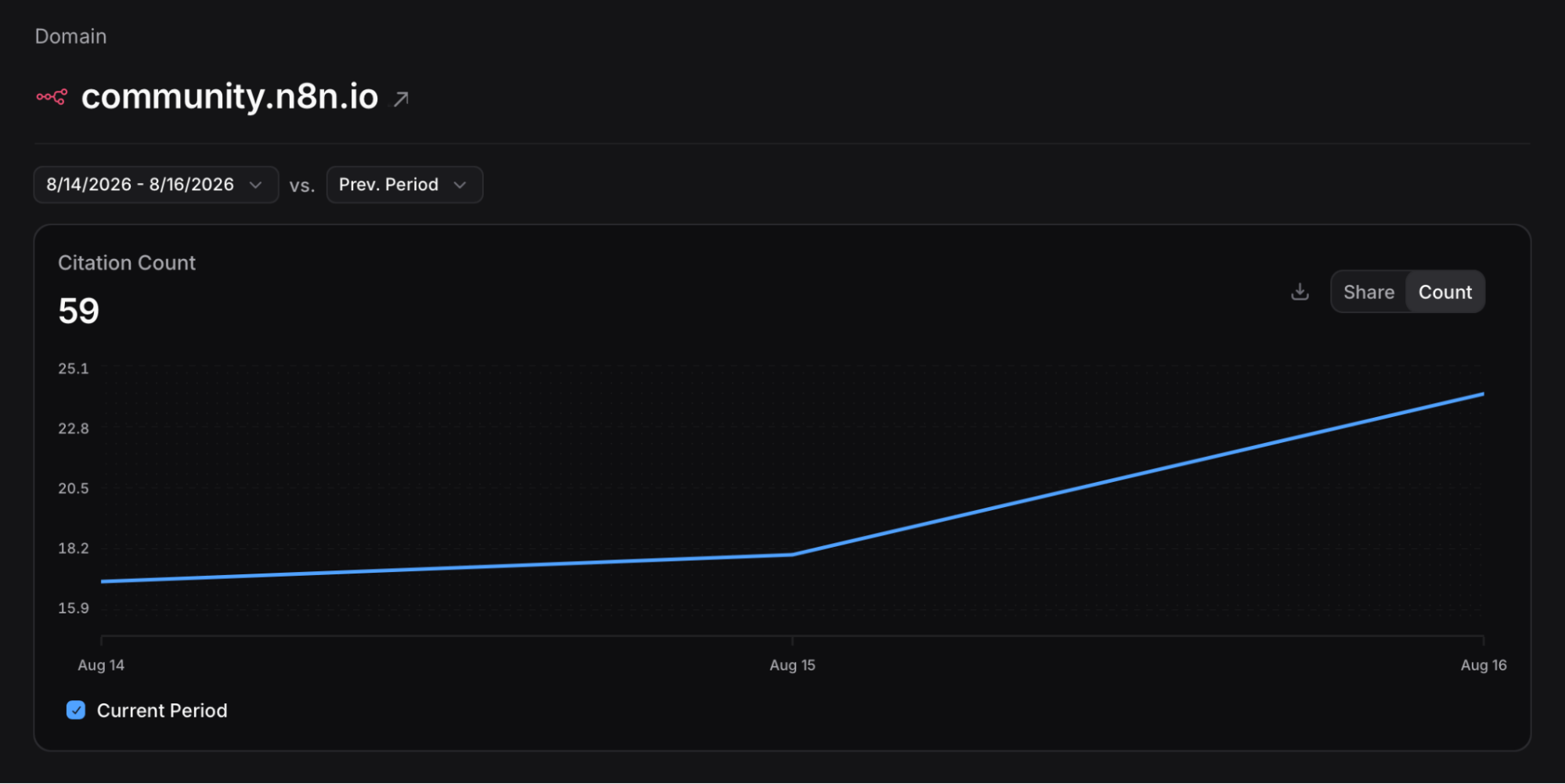
Combined, those community sources appeared 154 times, roughly 4.7 times the blog’s count.
The community.n8n.io figure also exposes a blind spot in ownership-only analysis. The domain belongs to n8n, but much of the material on it is written by users. A brand can therefore own the page without authoring the evidence being retrieved.
That leaves a citation audit with two separate questions: Who owns the page, and who authored the claim?
What’s Working
n8n Is Already in the Consideration Set
Profound ranked n8n #1 in the competitive set with a 91.9% Visibility Score during the August 14–16 window. Zapier followed at 68.1%, with Make at 54.2% and Workato at 51.4%.

That gives n8n a strong starting position because AI is increasingly part of the buying journey. In our analysis of G2’s 2026 buyer research, 51% of B2B software buyers said they start research with an AI chatbot more often than Google, while 69% said AI influenced the vendor they selected. n8n is present in that discovery process.
But the harder problem, as the citation trail shows, is what evidence buyers encounter once n8n enters the answer.
First-Party Documentation Still Carries Technical Authority
The prominence of external sources does not mean n8n has lost technical authority. On technical questions, n8n’s owned content often supplied the most precise evidence in AI answers.
In ChatGPT’s Run 2 limitations answer, n8n documentation supported points about memory management, queue mode, scaling, execution-data storage and community-node security. Its production answer likewise drew on first-party guidance around PostgreSQL, Redis, workers, monitoring and error handling.
Community content may shape how buyers interpret the operational experience, but n8n’s documentation still grounds the technical facts under it.
r/n8n’s 54,000 Weekly Visitors Are Shaping What AI Tells Buyers
r/n8n, a Reddit community for n8n users, showed 54K weekly visitors and 1.3K weekly contributions when captured. That activity gives AI a large pool of community evidence about the product.

Among n8n-specific answers where we preserved exact source URLs, community sources appeared in 38 of 60 trust, risk and adoption answers. In comparison-oriented answers, they appeared in 14 of 54.

The split shows where community evidence matters most. AI systems relied less on user experience for product comparisons, but cited users far more often when buyers asked whether n8n was reliable in production or worth adopting.
What Our Audit Found As Opportunities Worth Chasing
n8n’s Ghost Citation gaps show up later in the buying process, when outside sources help shape how buyers judge the product. Here’s how.
n8n’s Comparison Content is Not Yet Canonical
No n8n comparison page became a consistent first-party reference point across the AI systems we tested.
We held this buying question constant across every surface:
“n8n vs Zapier: which is better for complex business workflows?”
The answers broadly favored n8n, but the citation behind them varied. ChatGPT’s visible source panel was dominated by n8n documentation, including pages on sub-workflows, Code nodes, private nodes, queue mode and concurrency.

Gemini relied much more heavily on outside comparison content. Its visible sources included Zapier, HatchWorks AI, DataCamp and IntuitionLabs, which supplied evidence about complexity, pricing, integrations and data control.

Perplexity mixed first-party and external evidence. n8n’s pricing page and Zapier’s pricing page were the first two cited URLs, followed by Hackceleration, LowCode Agency, StartupOwl and other third-party sources.


The Google surfaces produced different mixes again. AI Overview surfaced publishers, YouTube comparisons, Parseur and Zapier among its visible sources.

Meanwhile, Google AI Mode built the same comparison from a largely external source set. Reddit appeared at #2, and n8n’s own comparison page did not show up until #8, behind sources such as Futurepedia, Parseur, HatchWorks AI, Zapier, YouTube and IntuitionLabs.

n8n has content for the comparison buying stage, but no first-party asset became the consistent reference point across the systems we tested.
That is the gap.
n8n Does Not Own the Scaling Narrative
The same problem appears deeper in evaluation. Once a buyer moves beyond which tool is better? and starts asking whether n8n can scale across a larger organization, the evidence gap becomes more consequential.
We asked every surface:
“What are the main challenges teams face when scaling n8n across a larger organization?”
ChatGPT leaned heavily on n8n’s own documentation and blog, using first-party material for RBAC, external secrets, SSO, environments, log streaming, queue mode and concurrency.

Gemini drew more heavily from outside sources. n8n Developers supplied infrastructure evidence, Alltomate covered credential and team-management issues, and Reddit surfaced operational problems that emerge after workflows reach production.

Perplexity blended both. It cited n8n’s Scalability Benchmark and community forum alongside Workato, Haktan Suren, Alltomate, Ucartz, Scalevise and n8nlab, combining first-party technical material with external evidence about governance, reliability and operational complexity.

If outside sources define the governance burden, reliability risks and operating costs of scaling n8n, they can influence whether a buyer adopts the platform, expands it across the business or chooses another tool.
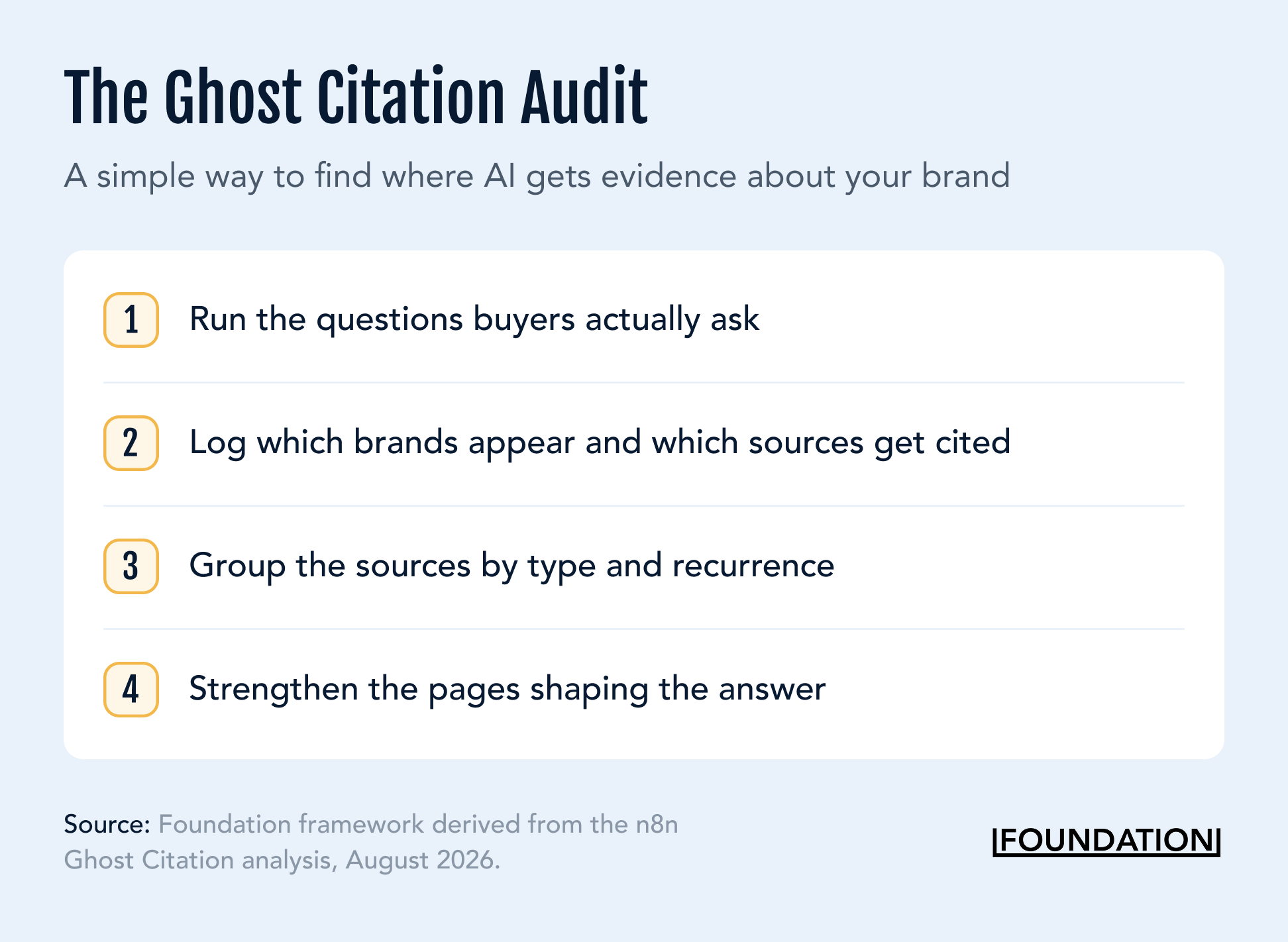
What You Can Steal: Run a Ghost Citation Audit
n8n’s citation trail suggests a more useful way to audit AI visibility. Don’t stop at whether your brand appears. Follow the sources behind the answer and identify the external pages that repeatedly supply evidence about your product.
1. Start with questions that can change a buying decision
Build a fixed set around the decisions a buyer makes as they move from discovery into evaluation:
- Discovery: Which products belong on the shortlist?
- Comparison: Why choose one vendor over another?
- Implementation: What does deployment or migration require?
- Risk: What breaks, becomes difficult or adds overhead?
- Trust: Is the product suitable for production or enterprise use?
Run the same questions across the AI surfaces that matter to your market. Save the answer, date and cited URLs so you can compare what changes.
2. Separate ownership from authorship
A source can belong to the brand without the brand having written the claim.
| Source | Ownership | Authorship |
| Documentation or product page | Brand | Brand |
| Company community forum | Brand | User or brand |
| Reddit thread | External | User |
| Review or comparison site | External | Publisher or user |
| Competitor comparison | External | Competitor |
That classification determines what to do next.
3. Follow recurring URLs down to the claim
Once a URL recurs, identify what the source is helping AI explain. “Reddit gets cited for self-hosting” is too broad. “Users describe self-hosting as trading subscription costs for additional infrastructure and maintenance” gives the content team something concrete to investigate.
The useful chain is:
source → claim → buyer question
That turns citation monitoring into an evidence audit.
4. Decide whether the evidence needs a response
Compare each recurring claim with what you can prove today.
If your existing content already answers the question with specific evidence, strengthen it rather than publishing another page.
If the claim matters but your evidence is weak or missing, build the strongest source for that question.
If the external source describes an older version of the product, publish current evidence with comparable specificity.
And sometimes, do nothing.
A credible user perspective can improve the answer. The goal is not to eliminate Ghost Citations, but to ensure buyers have enough current evidence to judge well. Our Generative Engine Optimization work follows the same principle.
Then rerun the same questions.
This time, track four things: your evidence entering the answer, recurring sources persisting, claims changing, and source position shifting.
The unit of measurement is the buyer’s answer, not the page you published.
AI Visibility Is Only Half the Picture
n8n was highly visible across our testing, but n8n-owned properties did not dominate the evidence behind that visibility. First-party documentation grounded the technical facts, while Reddit threads, reviews, publishers and community discussions filled in questions around reliability, limitations, self-hosting and scale.
For you, the useful next step is to identify where those outside sources have become the reference point for important buyer questions and whether first-party content can answer them with stronger, more current evidence.
Foundation’s GEO audits map that evidence across high-intent questions, showing where owned content already carries authority and where it is missing or being outranked. [See how this applies to your strategy.]