
Article's Content
Article's Content
Right now, an AI model is describing a software category to a buyer who will never tell you they asked. The shortlist it returns is assembled from sources that buyer trusts more than any vendor’s own page.
In a growing share of B2B categories, G2 reviews are one of those sources.
Over the last two years, G2 went from essentially no presence in AI answers to one of the most-cited sources on every major platform: roughly 23,700 citations in Perplexity, 12,000 in ChatGPT, 10,900 in Google’s AI Mode, 8,800 in AI Overviews, and 5,200 in Gemini.
Its pages now surface in Google’s AI Overviews tens of thousands of times a month, climbing from zero in mid-2024 to about 28,700 today.
That is the part most coverage misses. G2’s organic search traffic has come down from its 2023 peak, and it’s easy to read that one line as a story about decline. The fuller picture is a transfer. G2 stopped being only a review site that buyers clicked through from Google. It became infrastructure for the answer itself, the verified evidence layer AI models read before they recommend anything.
The traffic moved. The trust moved upstream, into the answer.
The Surface of Influence Changed, Not the Trust
For most of the last decade, G2’s authority converted directly into search visibility.
High-intent buyers searched for “best help desk software” or “[competitor] alternatives,” G2’s category pages ranked at the top, and a favorable listing captured a slice of that traffic. Get listed, collect reviews, climb the ranking, earn the clicks. That model worked.
What changed is where buyers go first. G2’s own survey of more than 1,000 B2B buyers found 71% now rely on AI chatbots for software research, up from roughly 60% seven months earlier, and more than half start with an AI chatbot more often than with Google. When a buyer’s first move is a prompt to ChatGPT, the page never earns the click no matter how well it ranks.
That severed the old link between ranking and traffic that the entire category was built on.
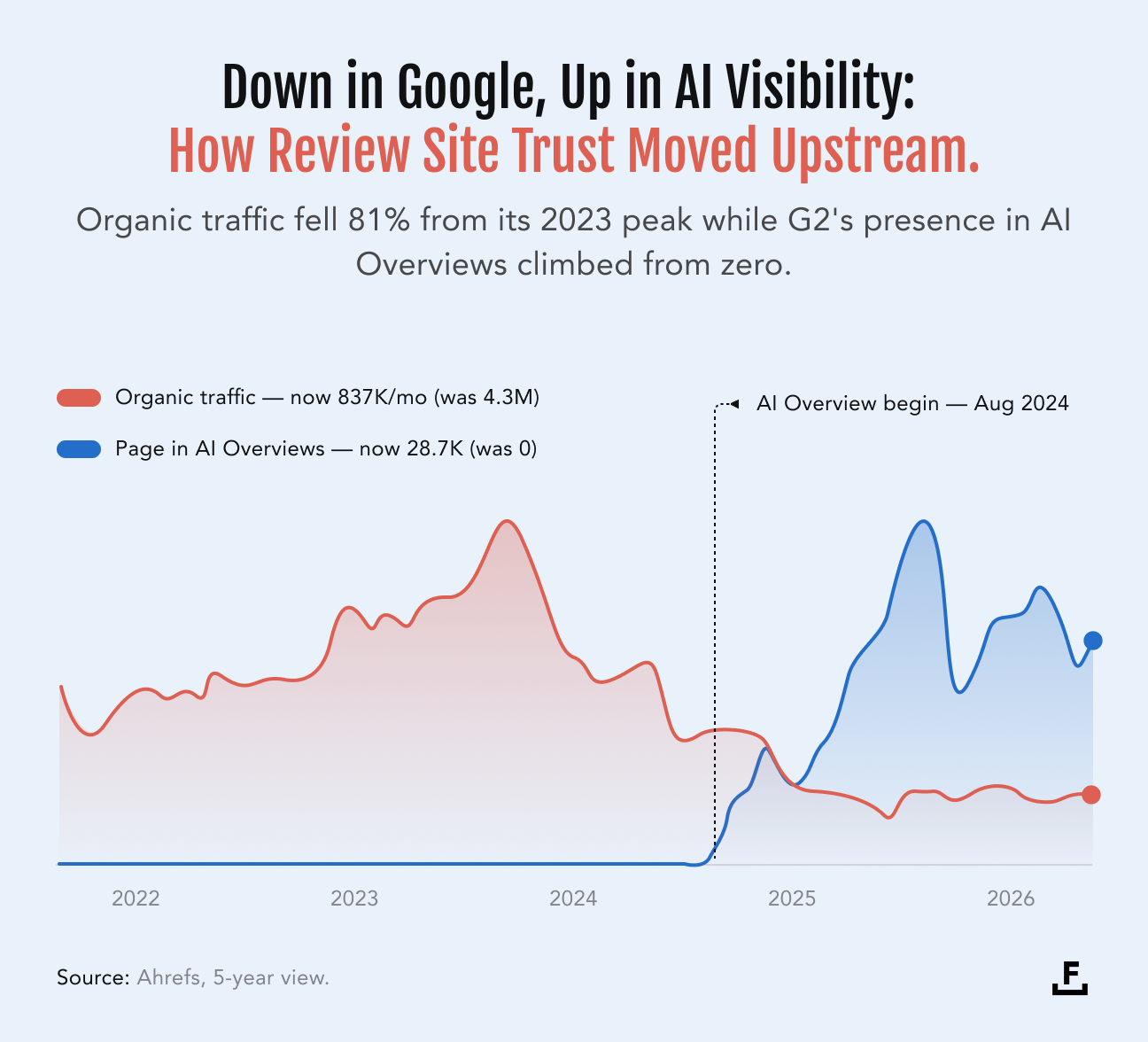
This wasn’t a G2 problem. The same shift hit Capterra, TrustRadius, and the major comparison publications at the same time, all of them showing the same pattern over the same window. Two forces pulled in the same direction: buyers went to Reddit for unfiltered peer feedback, and then AI search removed the click altogether. The category absorbed both at the same time.
So the trust buyers placed in verified G2 reviews didn’t disappear when the clicks did. It moved into the model.
G2 Is One of the Most-Cited Sources in AI Search
Over the same window that organic traffic came down, G2 built an AI citation footprint that didn’t exist before. The Ahrefs data, indexed across the major AI platforms, shows net-new gains accumulated from a standing start: roughly 23,700 citations in Perplexity, 12,000 in ChatGPT, 10,900 in Google’s AI Mode, 8,800 in AI Overviews, and 5,200 in Gemini.
Its presence inside Google’s AI Overviews tells the same story on its own. G2 pages first appeared there in August 2024, climbed to a peak of 43,400 in September 2025, and sit around 28,700 today.
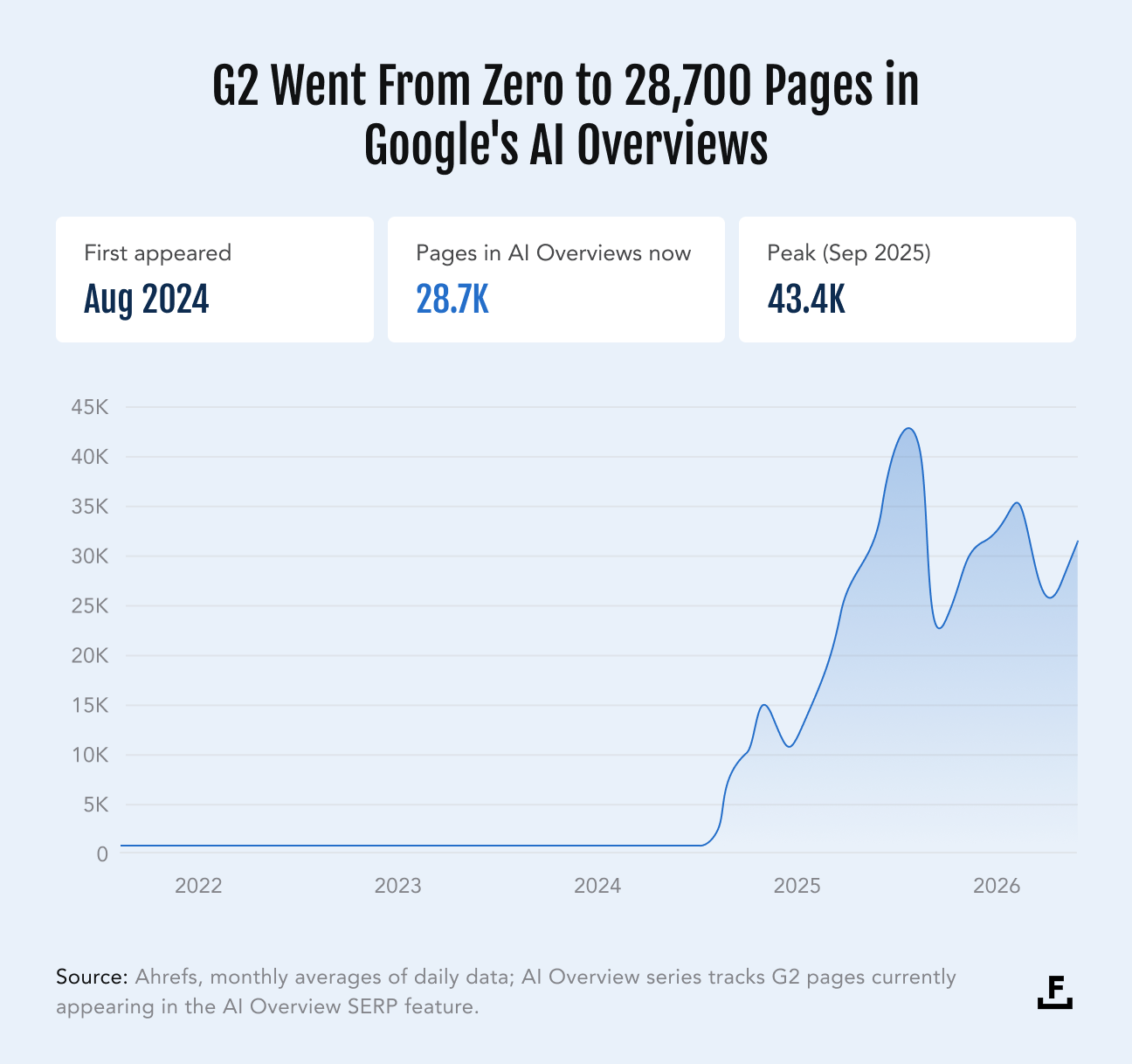
The pattern holds across the category, which is the point: the same review and comparison sites that buyers trusted on Google are now the sources AI models reach for. Where a buyer used to click a G2 review, an AI model now reads that same verified review content and folds it into the answer the buyer reads instead.
Why G2 Reviews Win the AI Answer
The reason is structural, and it explains why no amount of optimizing your own website fully covers it. Ross put it directly in his SEO Week presentation on AI memory inception:
“The traffic is declining like wildfire, but the citations are going up. When it comes to [review site] influence on your buyers, it has never been higher, because that influence is happening directly inside of the LLMs.”
— Ross Simmonds, SEO Week 2026
When a buyer enters a prompt, the model doesn’t run a single search. It performs a query fan-out, generating dozens of variations of the question: best, top-rated, most reviewed, highest-rated, alternatives to. Then it scrapes trusted sources for verifiable evidence it can use to justify the answer.
G2 pages are dense with exactly that kind of evidence:
- Verified ratings from named reviewers
- Structured comparison data
- Descriptions of real use cases
That’s the kind of source a model reaches for when it needs to back a recommendation with something more credible than a vendor’s own claim. G2 has joined Reddit and YouTube as part of the trust layer of AI search: the verified, third-party infrastructure models lean on to justify what they tell a buyer.
AI Visibility Doesn’t Always Track SERP Ranking
Here’s the single data point that captures the whole shift. G2 is earning AI citations on high-value commercial queries where its traditional organic ranking has already fallen off the first page.
- “zendesk alternative” gets 4,500 monthly searches at a $53.01 CPC. G2 ranks 48th organically.
- “freshdesk alternatives” gets 1,200 searches at $50.24. G2 ranks 31st.
- “seo software review” gets 1,000 searches at $75.83. G2 ranks 29th.
- “legalshield reviews” gets 2,100 searches at $37.59. G2 ranks 30th.
Nobody scrolls to the fifth page of Google. Under the old model, a position-48 ranking on “zendesk alternative” was worth almost nothing. G2 still gets cited in the AI Overview for that query.
The model assembling the answer isn’t ranking pages the way classic search did. It runs a fan-out, scrapes for verifiable evidence, and pulls G2’s verified reviews into the response regardless of where the page would have landed on a results list.
The citation has decoupled from the ranking, and it isn’t incidental: of the top thousand keywords where G2 surfaces in AI Overviews, nearly 80% carry commercial intent and more than a quarter command a CPC above $40. These are evaluation and comparison searches, the exact queries a model runs through its fan-out when a buyer asks it to recommend software.
For a vendor, the implication is direct. A strong G2 presence can put you in front of a buyer at the moment of decision, even on queries where ranking alone would have made you invisible.
What This Means for Your Review Strategy in 2026
The mechanics of investing in review sites haven’t changed much. Reviews still power everything. What changed is the payoff. In 2023 you collected reviews to climb the category ranking and win organic traffic. In 2026, reviews are the raw material AI models use to decide whether your brand gets named in an answer.
A steady flow beats any one-time push. Carlos Silva from Semrush recommends three ways to sustain a review strategy built for AI search visibility:
- Run an NPS survey and route promoters straight to your review platform. NPS surfaces your happiest customers at their happiest moment. Send the 9s and 10s directly to a review link while the goodwill is fresh, instead of hoping they find their way there later.
- Ask high-value customers for testimonials. Strategic accounts write the most detailed, credible reviews, the context-rich kind a model actually pulls into an answer. A personal ask to a key customer outperforms an automated nudge, and it’s worth the manual effort for the accounts that matter most.
- Prioritize recency over size. A consistent stream of new reviews signals a product that’s actively used and improving. A large but stale review bank reads as dated to buyers and counts for less in the answer. Recency is the lever most teams ignore, and the one that compounds.
Once your review engine is running, track how often that review content represents your brand inside AI answers (citation share, share of voice, and sentiment), not just the referral traffic it sends.
Make Off-Site Sources Part of Your AI Visibility Strategy
An AI is describing your category to a buyer who will never tell you they asked. The answer is assembled from sources you don’t own, in a mix specific to your category and how the buyer phrased the question, and review sites like G2 are a significant part of it.
G2 didn’t lose its influence when its traffic shifted. It moved that influence upstream, from rankings to citations, into a place you can’t see in your analytics dashboard and can’t win by optimizing your own website. The reviews are the receipts. The model is reading them whether you’ve invested in them or not.
If you want to see which review and comparison sources are shaping AI answers in your category, and where your presence is strong or missing, get in touch with the leading AI visibility agency for B2B brands.