Article's Content
Article's Content
“I think memory and the idea of personalization is going to be one of the most important concepts in our industry for the next forty eight months.”
— Ross Simmonds, SEO Week 2026
LLMs are learning from every user interaction. That memory increasingly shapes what gets prompted, what gets cited, and ultimately, what gets bought. The fight over terminology — SEO, GEO, AEO, etc. — is noise distracting marketers from the actual shift underway.
What matters is this: enterprise buyers are increasingly using AI systems to research and evaluate vendors, and influencing those systems is a layered process. Ross compares it to inception, a dream within a dream, where influence moves from owned content, through distribution channels, and eventually into the language buyers use to describe a category.
The brands that win the next 48 months won’t just rank well or earn citations. They’ll earn a place in the model’s memory.
Achieving this influence requires a layered inception strategy that works across three distinct areas.
The 3 Layers of Influence for AI Memory Inception
Before the framework makes sense, it helps to understand where AI systems pull from when generating answers.
When a buyer asks ChatGPT or Gemini a question, the model doesn’t retrieve information from one place. It pulls from three interconnected layers.
- Owned content. Blog posts, product pages, original research, named experts, schema markup. This is the bedrock —the layer fully under the brand’s control.
- Distribution depth. Reddit threads, YouTube videos, review sites, news coverage, LinkedIn posts, podcast mentions. These channels connect a brand’s content to the broader web and expand the paths through which a model can discover it.
- Category creation. The language, category terms, and associations that live inside both the LLM’s training and the buyer’s own memory. This is where brands stop competing for visibility and start shaping how buyers describe the category itself.

Two mechanics tie the layers together.
First is query fan-out. When a buyer enters a prompt, the model generates dozens of variations shaped by industry, role, geography, and prior context. Then it goes looking for evidence.
The model scans cited sources for verifiable claims it can use to justify its answer, which means generic marketing language rarely survives the cut. “Industry leading” gives the model nothing. A specific number, a named expert, a dated study, or a customer quote does.
The three layers below determine whether your brand appears when both processes happen.
Inception Layer 1: Your Owned Content
Owned content is the foundation — everything published on your own domain and fully under your editorial control. Blog posts, product pages, customer stories, original research, documentation. The other two layers depend on it.
But the rules have changed. Google has become a destination, not a referrer. SparkToro data still shows it as the front page of the internet for discovery, but optimizing for ranking alone is no longer enough. The job now is producing content the model will cite and remember.
The on-page fundamentals still matter: keyword targeting, heading structure, schema, internal linking, backlinks. They’re necessary, not sufficient. What’s changed is the need for justifiable claims. As Profound CEO James Cadwallader puts it, LLMs need to justify what they say, “so you need to give it justifiable claims that it can pull through the answer.”
That’s where E-E-A-T does the heavy lifting.
Create High-E-E-A-T Content for AI Visibility
The four pillars are the same ones Google has emphasized for years. What’s different is how directly they influence retrieval and citation:
- Experience. First-hand opinions, video reviews, case studies, and experiments built on proprietary data give LLMs verifiable claims to cite.
- Expertise. Named authors, linked credentials, original methodology, and demonstrated subject mastery create signal models can attribute and trust.
- Authority. Press mentions, peer citations, quality backlinks, and both linked and unlinked brand mentions show broader recognition across the web.
- Trust. Strong sourcing, honest framing, positive reviews, and credible UGC make your brand safer to recommend.

Even commodified formats like listicles can drive results when backed by strong E-E-A-T signals. Humans think in lists, and LLMs return lists. The difference between a generic listicle and one that gets cited lies in the quality of the evidence within it: named experts, original data, video walkthroughs, and customer-generated content.
Think Like an Investor, Not an Artist
Content teams should allocate budgets the way asset managers do. The mix depends on your market, audience, and resources, not aesthetic preference. Upload your industry’s high-value queries into an LLM tracking tool like Profound, export the URLs being cited, and study what’s actually winning.
If commodity lists are getting cited, build one that’s materially better. If you can’t outproduce the incumbent, collaborate with them instead. The goal is to make decisions based on the evidence LLMs already reward in your category, not the content you wish they rewarded.
Once the foundation is in place, distribution becomes the force multiplier.
Inception Layer 2: Distribution Depth
Distribution is the connective layer — the channels that carry out foundation content into the places where buyers form opinions. It’s where most of the leverage lives right now, and where most B2B brands still underinvest.
The data is unambiguous. According to our citation pattern report with AirOps, B2B brands own only about 10% of branded citations and a mere 2% of unbranded ones. Third-party domains dominate the narrative, with Reddit, YouTube, and LinkedIn together accounting for roughly 45% of all external citations.
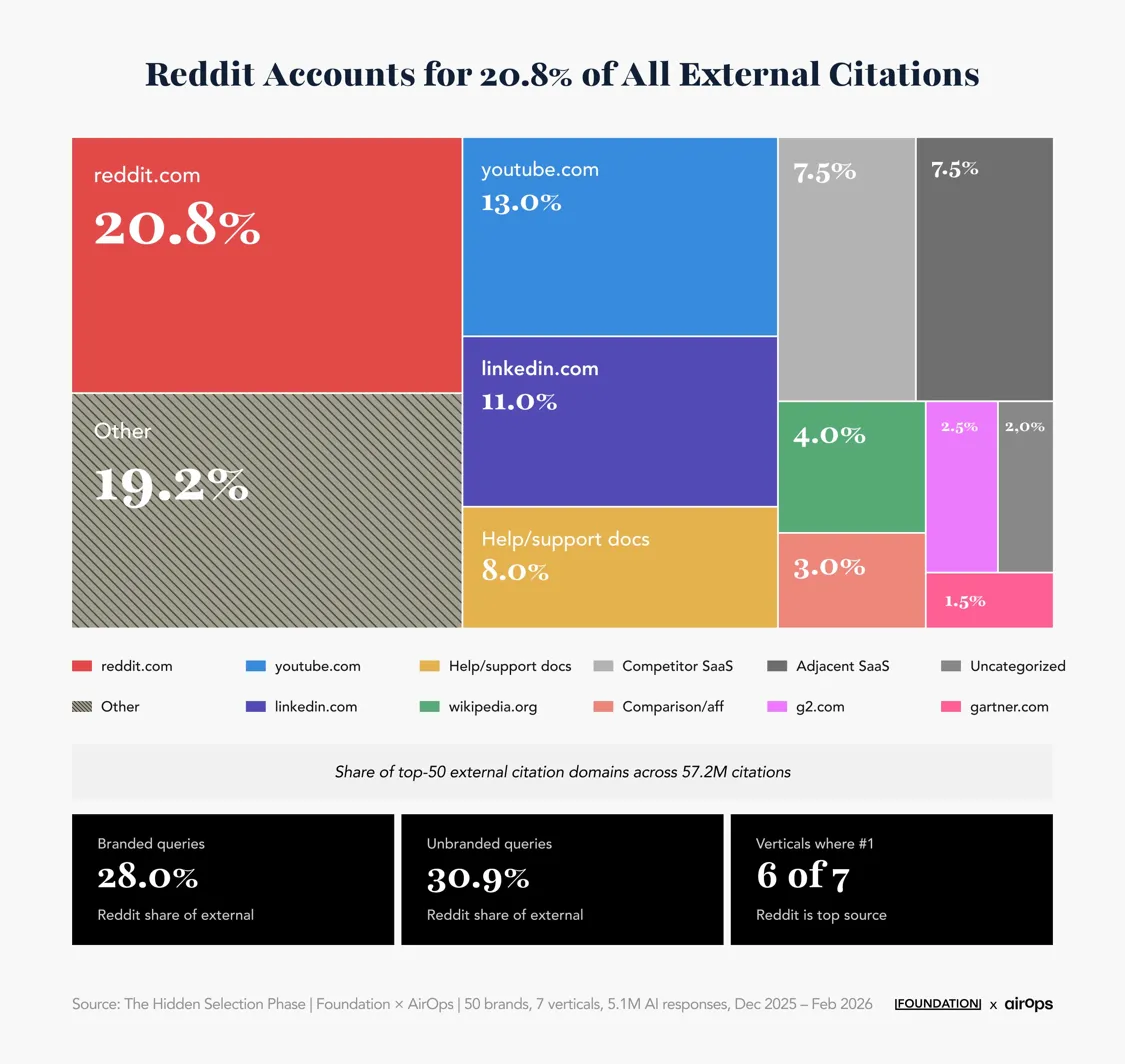
The visibility gap isn’t a content gap. Most brands already produce more content than they effectively distribute. The problem is that their messaging never reaches the channels shaping model retrieval and buyer perception.
These are the distribution channels driving both AI visibility and brand influence.
Reddit dominates long-tail citations
Reddit’s SERP dominance is well documented. Our analysis of 8,566 high-intent B2B keywords found Reddit ranks above competing vendors on 4,225 of them, representing 957,540 monthly searches. That visibility now extends directly into AI retrieval, with Ahrefs Brand Radar reporting:
- 12.3 million citations in the AI Overview
- 2.1 million citations in ChatGPT
- 2 million citations in Perplexity
Reddit is the single most cited third-party source in AI search — and the longer the buyer’s prompt, the more likely Reddit is to surface in the answer. It outperforms competitors on 63.8% of high-competition keywords, with win rates climbing to 73–100% on queries containing six or more words.
YouTube wins high-value attention
YouTube is the second most visited website in the world, and Google owns it. That alone should make it impossible to ignore. But the citation trends matter even more:
- 28.3 million citations in the AI Overview
- 6.4 million citations in Perplexity
- 391,000 citations in ChatGPT
YouTube is increasingly outranking SaaS companies on high-CPC commercial queries with modifiers like “best,” “vs,” and “review”. AI retrieval has only increased the strategic value of video.
LinkedIn compounds buyer trust
LinkedIn carries professional authority that translates directly into both organic and AI search visibility. It ranks for over 14.4 million organic keywords globally and appears consistently across major LLMs:
- 427,000 citations in the AI Overview
- 398,000 citations in Gemini
- 220,000 citations in ChatGPT
Long-form thought leadership published natively on LinkedIn gets pulled into AI answers at higher rates than the same content published elsewhere.
Don’t forget about review sites and industry publications
Two channels lost referral traffic and became more influential, not less.
Review sites — G2, Capterra, category-specific platforms— saw their organic traffic decline as Reddit threads and AI answers displaced them in search. But their citation visibility inside LLMs moved in the opposite direction. The buyer influence didn’t disappear, it moved from the SERP into the model.
Industry publications get even less attention in AI visibility conversations, but Ross believes the acquisition pattern tells the story.
- SEMRush bought Backlinko and Search Engine Land.
- HubSpot bought Starter Story.
- OpenAI bought TBPN.
- Spotify bought The Ringer.
Whoever controls the media controls the narrative, and whoever controls the narrative shapes what LLMs cite.
Your content distribution strategy determines whether your ideas stay isolated on your domain or compound across the systems shaping buyer perception. The final layer is making sure your category language gets remembered.
Inception Layer 3: Category Creation
This is the conceptual layer — the brand language, category terms, and associations that live inside both the LLM’s training data and the buyer’s mind. It has the least trackable surface area, the most competition, and also the highest leverage.
First, the bad news: every commodity term in B2B SaaS is already saturated. For example, new entrants into a saturated space like CRM have little hope of winning quick results for a “best CRM” prompt.
The opportunity runs the other direction: creating differentiated language that reframes the category around your strengths instead of competing on everyone else’s terms.
The deeper play is inventing the language. If you create and own the category term, you dramatically increase the odds that buyers — and the models serving them — associate that language with your brand.
Several successful SaaS companies created room for growth by abandoning crowded terminology in favor of language they could shape themselves:
- Drift: Best live chat software → Conversational marketing platform
- Gong: Best sales call recording tool → Revenue intelligence platform
- HubSpot: Best marketing software → Inbound marketing platform
- 6sense: Best B2B data provider → Predictive revenue platform
- Snowflake: Best cloud database → Data cloud platform
- Foundation: Best marketing agency → Content distribution agency

It’s the same mechanism marketers have used for decades, now amplified by AI retrieval. The language buyers adopt shapes the language models retrieve against, which shapes the language the next wave of buyers learns in return.
An idea, planted well, is the most resilient parasite a brand can own.
Be the Brand That Wins the Memory Layer
The three layers compound. Owned content gives the model something to cite. Distribution creates dense, interconnected evidence across the channels buyers trust. Category creation shapes the language models retrieve and buyers repeat.
Brands that build across all three don’t just earn citations — they shape how the market talks about the category itself. That’s the new moat.
The words buyers use to describe a problem influence how LLMs recommend solutions, and those recommendations reinforce the vocabulary of the market in return.
Foundation builds GEO strategies for B2B brands that want to influence how buyers and models discover their category. If you’re trying to identify where your visibility gaps are, what’s already shaping retrieval, and where the leverage exists in your market, we can help.