
Article's Content
Article's Content
Ask ChatGPT or Google AI Mode for the best compliance software, and Vanta is already in the room. That kind of presence would cost $517K a month to buy through paid search alone.
Vanta has built one of the strongest SEO moats in B2B SaaS by organizing their content around the compliance frameworks buyers research throughout the buying journey. Ahrefs tracks 1,661 keywords where Vanta ranks in the top three positions, and 2,603 of their 3,620 tracked keywords now trigger AI Overviews.
Those numbers don’t hand Vanta a perfect AI citation score. But they show a brand that’s built the kind of structure AI systems can retrieve from.
The brands winning AI visibility aren’t starting from scratch. They already have strong content systems, third-party validation, community mentions, and a clear relationship between their site architecture and the questions buyers ask.
Here’s how Vanta built that moat, and what’s worth stealing from it:
- The subfolder strategy behind their SEO architecture
- Why internal linking is doing more work than the content itself
- How offsite validation, from Reddit to third-party roundups, fills gaps their own site can’t
Let’s get stuck in.
The Subfolder Strategy Behind Vanta’s SEO Moat
Vanta is one of the best-known compliance automation platforms for startups and B2B software companies. They help teams prepare for frameworks like SOC 2 and ISO 27001, which means their buyers often spend weeks or months searching for compliance guidance before they’re ready to evaluate software.
The starting point for Vanta’s visibility isn’t one great blog post.
It’s the way the site is structured.
Vanta organizes much of their educational content into “Collections.” These collections are split within a clear site structure that segments compliance frameworks into topic-based subfolders that are closely aligned with their specific product offerings.
It’s an SEO topic cluster strategy, similar to the one used by NerdWallet. Each subfolder is dedicated to a topic category or compliance standard, such as SOC 2, GRC, or ISO 27001, and serves as a self-contained funnel that guides visitors from basic education to high-intent conversion points.
Here’s what it looks like from a high level:
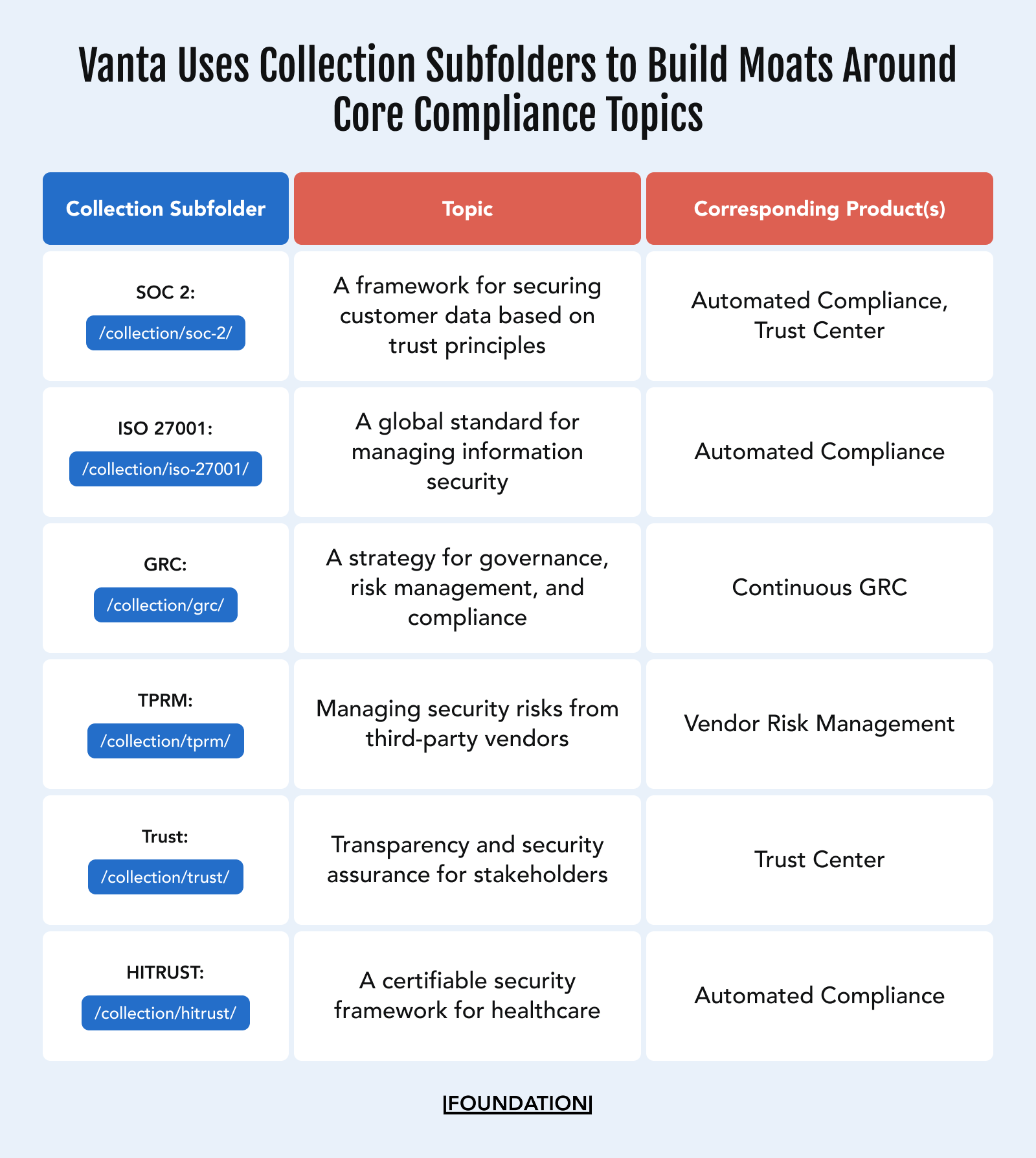
As of June 2026, these pages generate 22.8K monthly visits and have a traffic value of over $177K per month, according to Ahrefs data.
This approach helps Vanta boost topical authority across key compliance frameworks while guiding them through the initial stages of the B2B buyer journey.
That means a visitor searching for the difference between SOC 1 and SOC 2 can quickly find information on SOC 2 reports and then navigate to a demo of Vanta’s compliance automation.
The impact of the Collection subfolder strategy is evident. The SOC-2 Collection alone generates 10.6K organic visits per month. It has 475K backlinks, dwarfing other clusters like GRC and ISO 27001 (which still bring in thousands of additional high-value visitors each month).
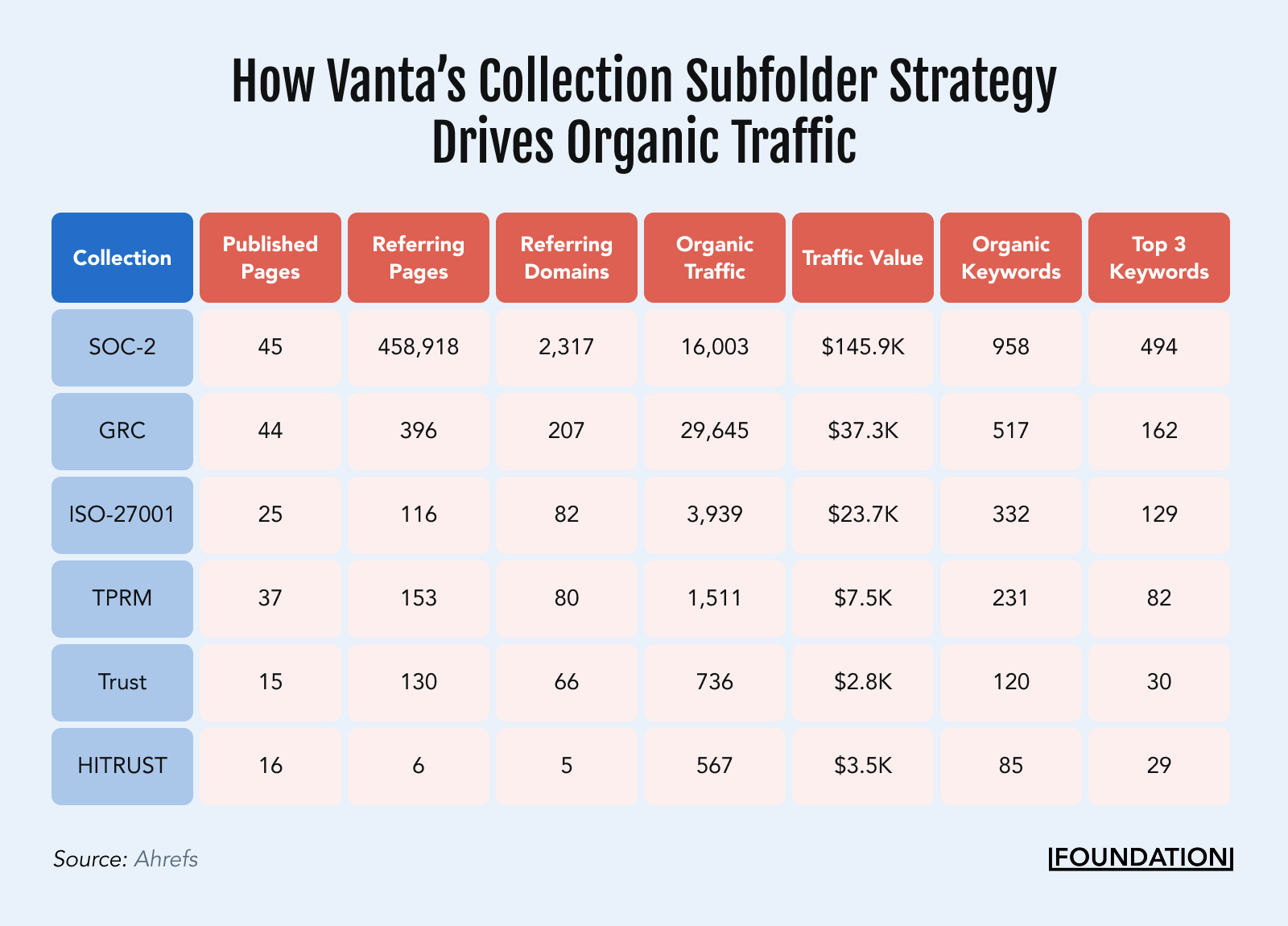
While the TPRM, Trust, and HITRUST Collections are further behind across almost all performance metrics, they’re content investments that can still pay major dividends down the road.
Over 64.7% of Vanta’s Top 3 keyword rankings originate from these subfolders. That’s 1.1K in total at the time of this writing. It’s a great example of how a well-structured, well-executed content strategy positions brands for massive traffic gains.
Why One Big Collection Beats a Dozen Blog Posts
AI systems need more than a keyword match. They need sufficient context to determine which source can answer the query, how the source relates to the broader topic, and whether the page links to other useful information.
A standalone “What is SOC 2?” article can answer one question.
Vanta’s SOC 2 Collection can answer dozens. It can explain what SOC 2 is, how it differs from SOC 1, why it matters, how to prepare for an audit, what goes into a SOC 2 report, and so on.
The depth of their collection is important because of how LLMs work.
When a security-conscious buyer asks an AI something like, “How do I prepare my startup for a SOC2 audit?”, the AI does more than search for that exact phrase. It “fans” the prompt out into multiple related sub-queries before providing an answer. This is known as the query fan-out process.

Unlike traditional search, which works roughly one-to-one, AI search works one-to-many. One prompt expands into dozens of sub-queries, and the final response is synthesized from everything the AI finds across all of them.
A standalone blog post is built for the first model. A collection is built for the second.
The same pattern applies to Vanta’s ISO 27001 and GRC content. Instead of publishing random posts into a generic blog folder, Vanta builds framework-specific environments that support searchers at different stages of the B2B buyer journey.
All of that structure gives Vanta a cleaner path to AI visibility.
To illustrate this, I asked ChatGPT, “What is the best tool for a SOC 2 audit?”
That’s one prompt. But the AI didn’t search for that phrase in isolation. It fanned out into sub-queries that I’d never typed.
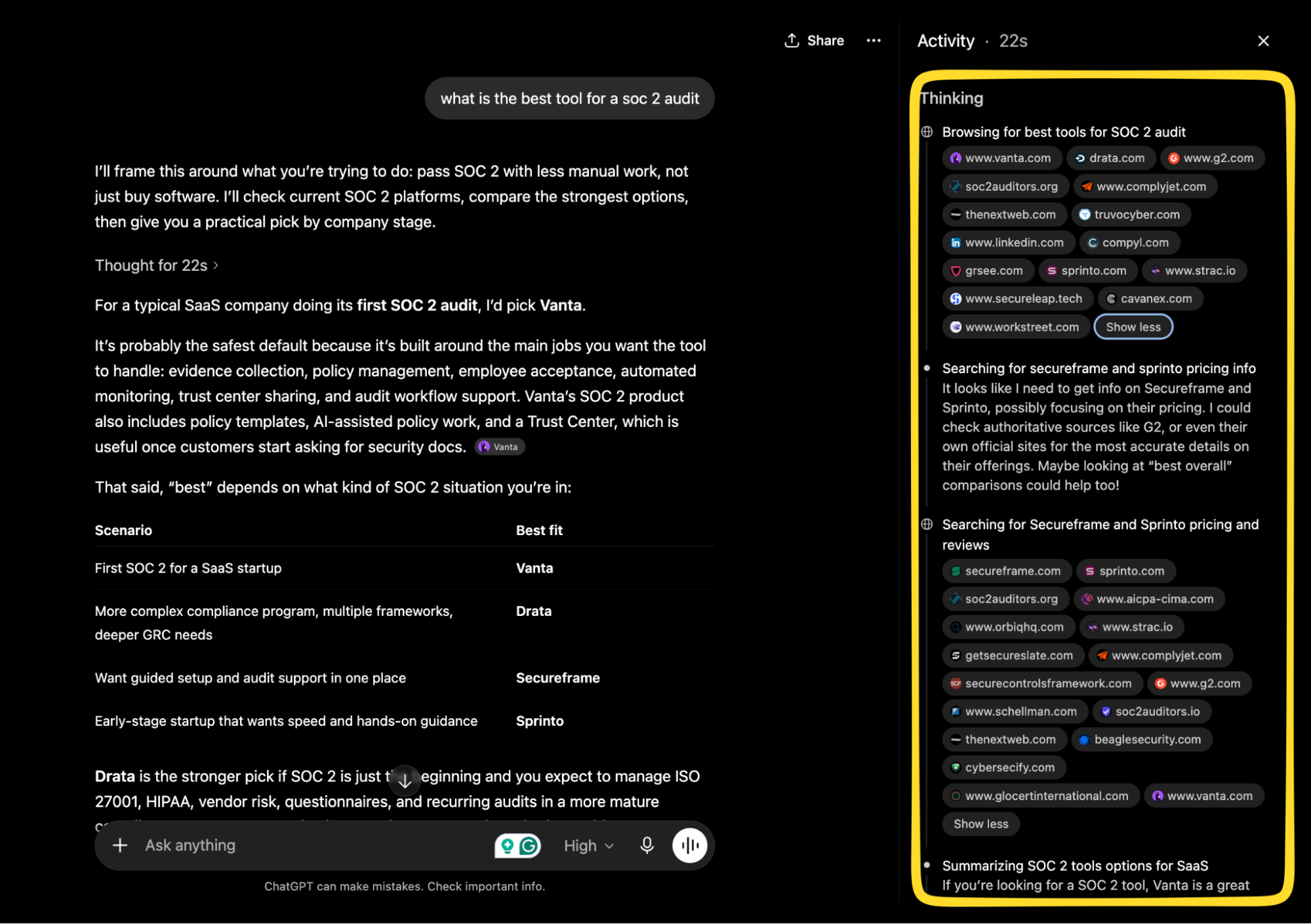
- What is SOC 2?
- Compliance automation software
- How to automate ISO 27001 & SOC 2 compliance
Vanta has content for each of them and is pulled directly as a source for the AI answers.

Vanta’s advantage comes from the way their pages connect: SOC 2 definitions, audit prep guides, comparison pages, internal links, Collection hubs, and product pathways all reinforce the same category story.
That’s where SEO and GEO overlap most significantly. Strong SEO still gives AI systems more to retrieve. But a single well-ranked page doesn’t confer the same advantage it once did.
The stronger play is building a web of pages that can be cited, summarized, compared, and recommended across many related prompts.
Vanta’s structure keeps them inside AI answers. But a ranking is worth something different now that Google often answers the query directly in the results page.
The Moat Nobody Notices: Vanta’s Internal Links
AI systems don’t just retrieve a single page and cite it. They need to understand how that page relates to everything else on the site: which topics it supports, and whether other pages back up the same claim. Internal linking is how Vanta gives them that map.
It’s not just an SEO best practice, Google’s own John Mueller has called internal linking “super critical for SEO” and one of the biggest levers a site owner has to guide Google toward the pages that matter most. (Google SEO Office Hours).
Instead of relying only on occasional in-text links, Vanta uses sidebars, Collection navigation, related article widgets, footer links, and contextual links to connect related pages across the site.
Every one of those links tells an AI system something about how two pages relate. That matters because of how citation actually works. When an AI system fans a prompt out into sub-queries, it needs signals for which pages answer which sub-queries, and which pages corroborate each other on the same topic. A page sitting inside a dense web of internal links carries more of that context than an identical page sitting alone.
In Vanta’s case, that web runs deep. Their top pages carry internal links in the thousands, as shown in the chart below, on a site with only around 725 distinct pages.

The footer alone links out to every Collection landing page, plus flagship articles like “What is SOC 2 compliance?” and “What is ISO 27001 certification?”
An AI system can trace SOC 2 content back to the Collection hub, forward to the audit prep guide, and sideways to the comparison pages, all through links that already exist on the page.

This is also why their moat is difficult to copy. A competitor can publish a SOC 2 guide, even a better one. But a single page carries no relationship signal around it. Catching up to a full Collection architecture, with hundreds of pages linked into a coherent structure, takes far longer than publishing better content.
That’s the same pattern we’ve seen in other breakdowns, including Clio’s AI visibility strategy and Tally’s GEO growth. Content alone doesn’t build the moat. The link strategy and architecture behind it does.
So far, that’s been built around education. Vanta’s newest move builds a second one around evaluation.
Vanta’s Move Into Comparison and Review Content
More recently, Vanta started publishing comparisons and reviews content, which sits as a category of its own on their website.
That matters because AI visibility isn’t only about answering educational questions. The money is in the evaluation prompts. A buyer may ask, “What is the best compliance software?”, “Best compliance automation tools for SaaS companies,” “Vanta vs Drata,” or something similar.
These prompts are closer to revenue. They’re also harder to win because AI systems pull from a messier set of sources: vendor pages, comparison pages, G2, Capterra, Reddit, YouTube, analyst-style roundups, and product review sites.
That is where Vanta’s comparison content becomes important.
Educational Collections help Vanta show up when buyers define the category, but Comparison pages help Vanta appear in buyers’ shortlists.
In one manual check for “what is the best compliance software?”, Vanta appeared as the recommended option for startups and SaaS companies.

In another check for “best compliance automation tools,” Vanta showed up alongside Drata, Secureframe, Hyperproof, Thoropass, and Sprinto.
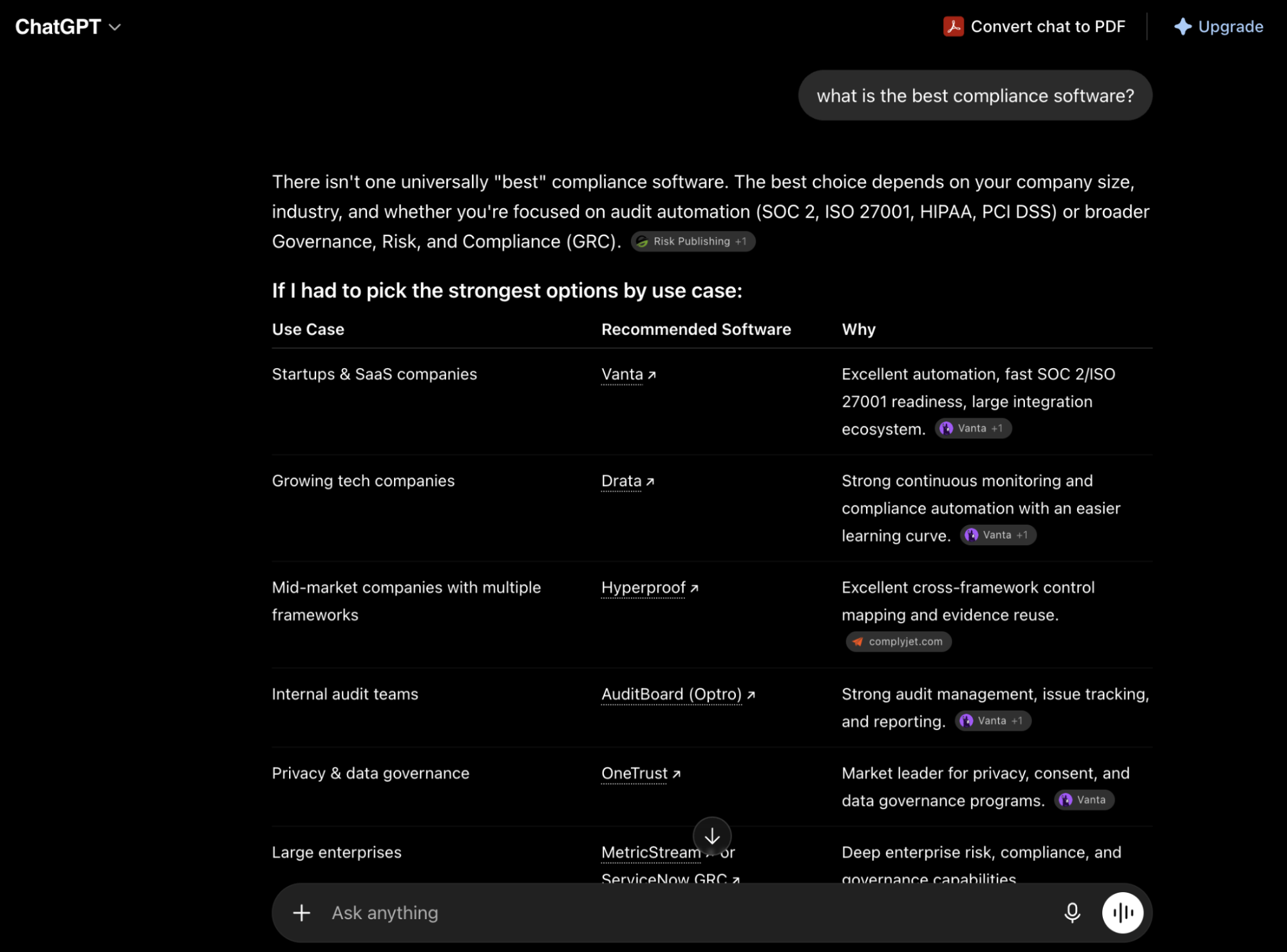
That’s the evaluation layer Foundation has been writing about in pieces like How AI Search Is Rewiring B2B Software Buying and Buyers Are Asking AI First.
Software buyers are no longer trawling through 10 vendor websites before forming an opinion. They’re asking AI tools to explain the category, summarize the tradeoffs, and narrow the list.
Vanta’s comparison and review section gives the company more control over that part of the journey.
Between the Collections and the comparison content, Vanta now shows up across most of a buyer’s research, from definition to shortlist. What that presence is actually worth is a different question once Google or ChatGPT answers most of it before a click happens at all.
AI Overviews Change What Vanta’s Rankings Are Worth
For a brand like Vanta, the value of ranking is no longer limited to the click.
When Vanta appears in an AI Overview, their content can help shape the answer, reinforce the brand’s association with SOC 2 and compliance automation, and keep the company visible while buyers are still learning the category.
If 2,603 of Vanta’s 3,620 tracked keywords trigger AI Overviews, then Vanta is playing in a search environment where the answer layer matters. The blue link is no longer the only prize. The cited source, brand mention, and recommendation carry more weight.
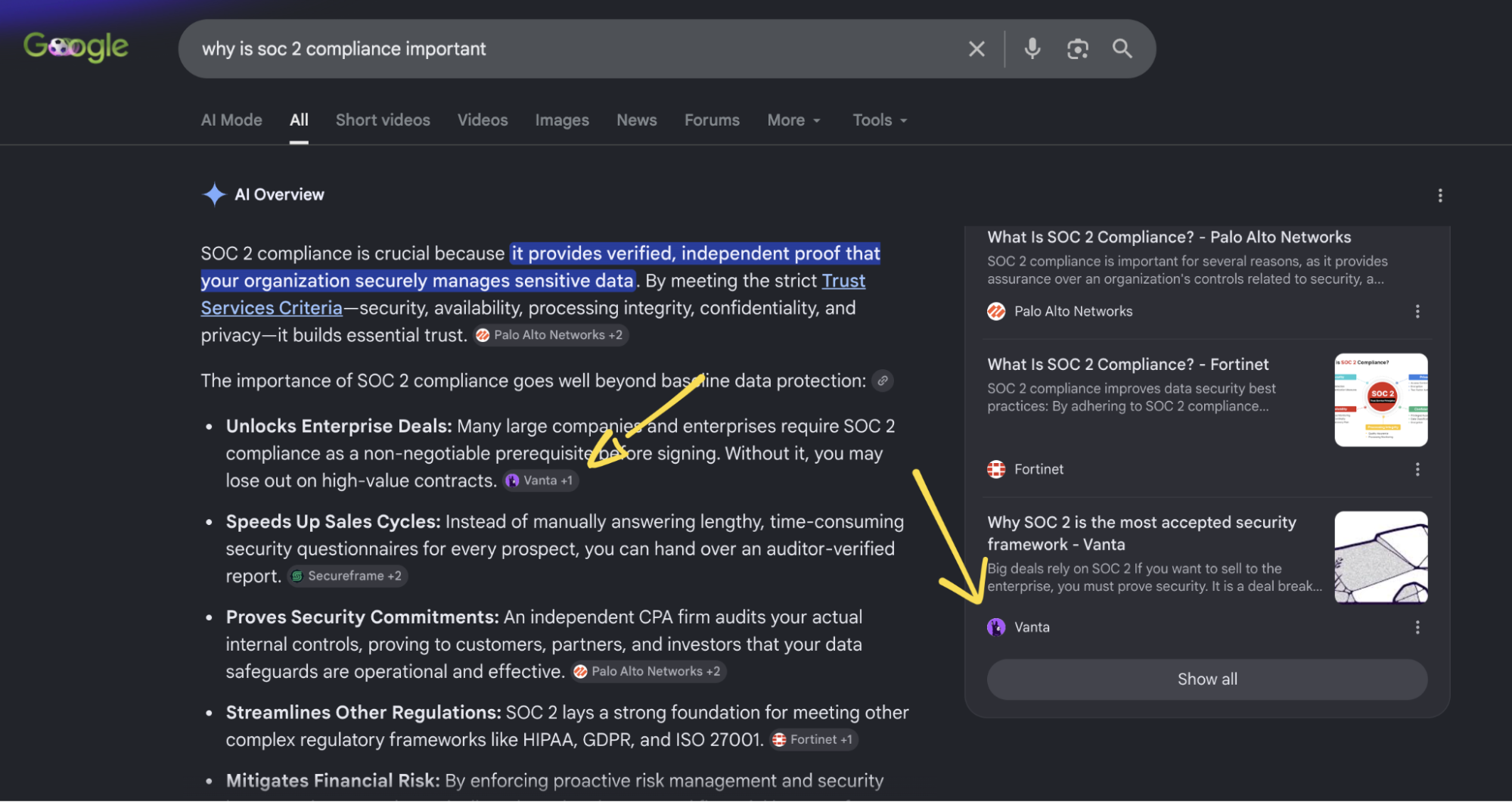
A keyword that triggers an AI Overview can still be valuable if the brand appears inside the answer.
That’s especially true for B2B SaaS companies.
In Vanta’s case, compliance buyers often search across a long sequence of questions before they talk to sales. A founder might start with “What is SOC 2?” then move to “SOC 2 compliance checklist,” then “SOC 2 automation software,” then “Vanta vs Drata.”
The value is in showing up repeatedly while the buyer is learning the category.
That repeated exposure builds familiarity. If Vanta appears in the early definitional answers, again in framework comparisons, and then in compliance software recommendations, the brand starts to feel like part of the category infrastructure.
Ross Simmonds, Foundation’s founder, has put it plainly: by the time a B2B buyer books a demo, “the decision is mostly made, and it wasn’t made on your website.” For a compliance buyer running that sequence of searches, Vanta’s site is often the last stop, not the first.
But not all of that repeated exposure comes from Vanta’s own site.
Offisite Sources Are the Trust Layer Vanta Doesn’t Own
Vanta’s owned content explains the category. Off-site sources help validate the brand inside it.
That includes Reddit threads, third-party roundups, review sites, and other pages where buyers compare compliance platforms in public.
Reddit Gives Vanta Peer-Led Validation
Reddit is worth paying attention to because it’s one of the most cited sources in AI answers, which isn’t all that surprising considering the million-dollar deals Reddit struck with Google and OpenAI.
As such, Reddit gives AI systems access to the kind of peer-led, unbiased commentary buyers often look for during evaluation.
When searching for an alternative to Vanta’s competitor, Sprinto, ChatGPT cited Reddit threads alongside vendor and third-party comparison pages:
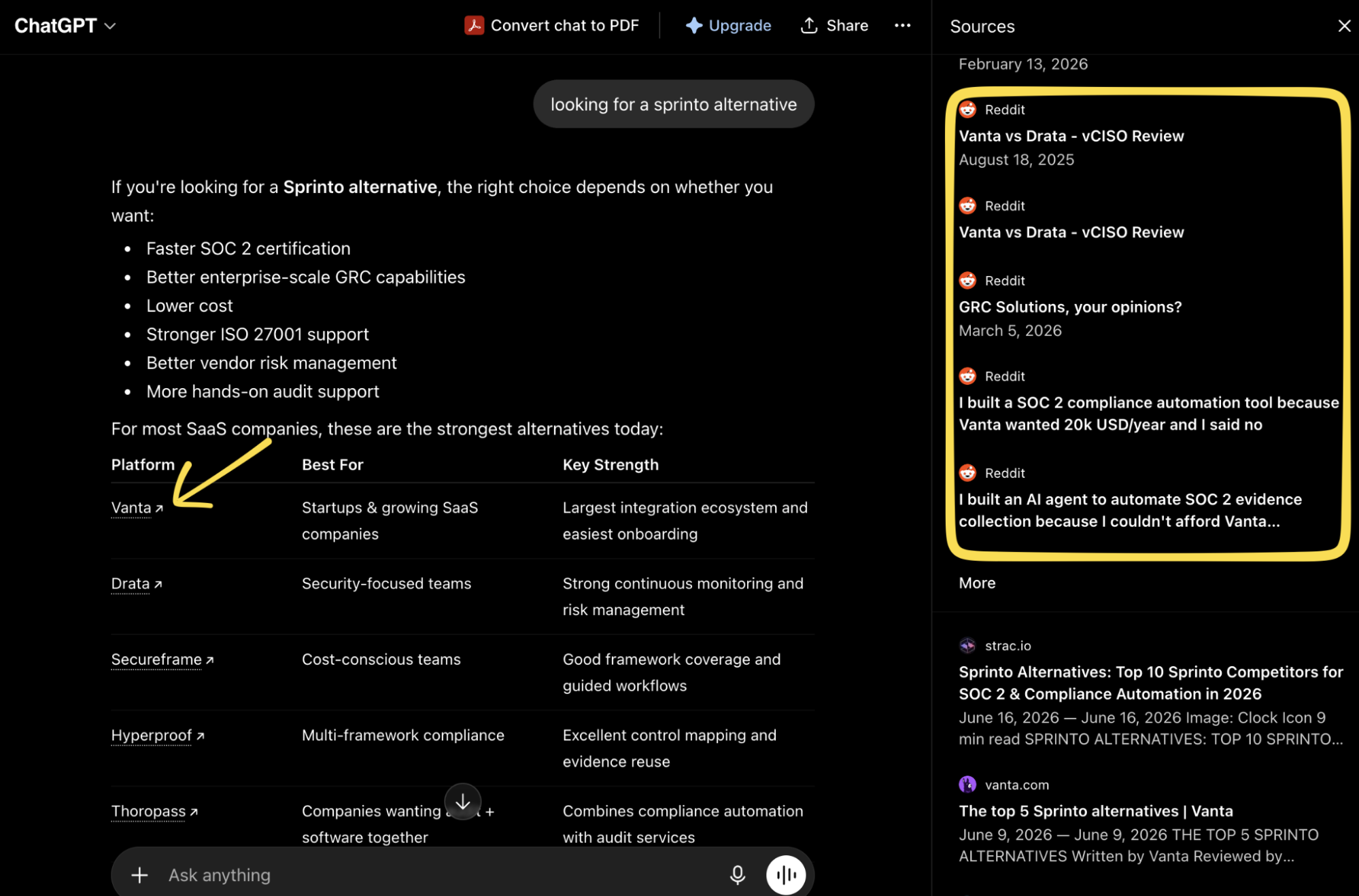
This is just an illustrative example, but it lines up with what Foundation found at scale. In a 60-day study with AirOps tracking 57.2 million citations across 50 B2B brands, Reddit accounted for 20.8% of all external citations, a share that climbs to 30.9% in unbranded discovery queries, the exact kind of “what’s the best compliance software” search a buyer runs before they’ve heard of Vanta.
B2B buyers ask those questions on Reddit, comparing platforms like Vanta, Drata, Sprinto, and Hyperproof in threads that AI tools increasingly cite when responding to comparison- and alternative-style prompts.

While it doesn’t look like Vanta has an official Reddit account, the brand appears consistently in conversations that provide exactly the user-generated, unfiltered opinions buyers are looking for.
As Foundation’s former B2B Reddit Strategist Enzo Carletti put it, “AI cites the posts with the most engagement in relevant communities.” A thread arguing about Vanta’s onboarding process carries more citation weight than a polished landing page ever will, precisely because it wasn’t written to be cited.
That’s a layer of visibility no owned content can replicate.
This doesn’t mean you should jump into every thread and start forcing mentions. But it does mean you should map the communities where your buyers talk, study the language they use, and understand which competitor narratives keep surfacing.
Our work on Reddit’s impact on B2B search points to the same reality: Reddit is no longer a simple community channel. It’s an integral part of the search and AI discovery layer.
Third-Party Roundups Reinforce Vanta’s Category Position
Vanta’s off-page appearance doesn’t end with Reddit. They also appear in many third-party software roundups.
They don’t always rank first, but they consistently appear on lists from sites like Cynomi, Optro, and ComplyJet. That gives AI systems more external validation to work with when tools like ChatGPT, Perplexity, and Google AI Mode generate vendor recommendations.
These pages aren’t owned by Vanta, which is exactly the point. AI systems don’t only look at what a company says about itself. They also look for repeated mentions across the wider web, especially from sources that compare, categorize, and recommend software.
YouTube: An Underused Surface for Vanta
YouTube can be a major AI visibility surface. Recent AI citation studies, from Ahrefs have found that YouTube appears in a meaningful share of AI-generated answers, which makes video content more than a brand or demand channel.
For Vanta, though, YouTube doesn’t appear to be a major citation driver — yet. That may be because their strongest YouTube assets are not structured around the same high-intent compliance questions that their website answers so well.
Vanta’s videos are mostly product demos, feature overviews, and webinar replays. That’s useful content for existing users, but it’s not directed at the discovery and evaluation stages that buyers are using AI tools for.
Building an AI Visibility Moat Takes Both Layers
Copying Vanta’s content won’t copy their result. A competitor can publish a better SOC 2 guide tomorrow. What they can’t publish overnight is a Collection architecture with hundreds of internal links, or years of Reddit threads and third-party roundups already reinforcing the brand.
That’s the actual moat: content built around how buyers search, plus validation the company doesn’t own but consistently earns.
Most teams are optimizing one side of that equation and calling it AI visibility. Foundation’s AI visibility work starts by showing you which side you’re missing.
See where your AI visibility gap actually is. Talk to our AI visibility experts to map it out and build the next layer of your moat.