



Article's Content
Article's Content
Imagine you run SEO or content for a B2B software company, and your CEO asks ChatGPT for the best tools in your category. Three competitors show up… and your brand isn’t one of them.
Now you need to know why those brands are being surfaced and what your team can do to change the answer. That’s the job of LLM SEO.
The old playbook only gets you so far: ranking well in Google can help, but AI systems can also pull from review sites, Reddit, YouTube, publishers, communities, comparison pages, and other sources.
At Foundation, we’ve studied how those LLMs find, evaluate, and surface brands. Most AI answers move through five stages: the LLM interprets the question, turns it into several searches, retrieves sources, decides which evidence is worth using, and synthesizes a response.
Your brand can drop out of the answer at any one of those stages. This guide walks you through all five stages, from how LLM SEO works to which strategies to prioritize and how to measure progress.
What is LLM SEO?
LLM SEO is the process of improving your brand’s visibility in answers generated by large language models and AI search tools such as ChatGPT, Gemini, Claude, Perplexity, Google AI Mode, and AI Overviews.
Most of your SEO foundation still applies.
Your website still needs to be easy for search engines to crawl and understand. You also still need useful content, credible authority, and strong links pointing to the right pages.
What’s changed is where discovery can happen and how information is assembled before it reaches the buyer.
A traditional search engine might give someone ten links to investigate. An LLM can investigate several sources on the user’s behalf and turn what it finds into one answer.
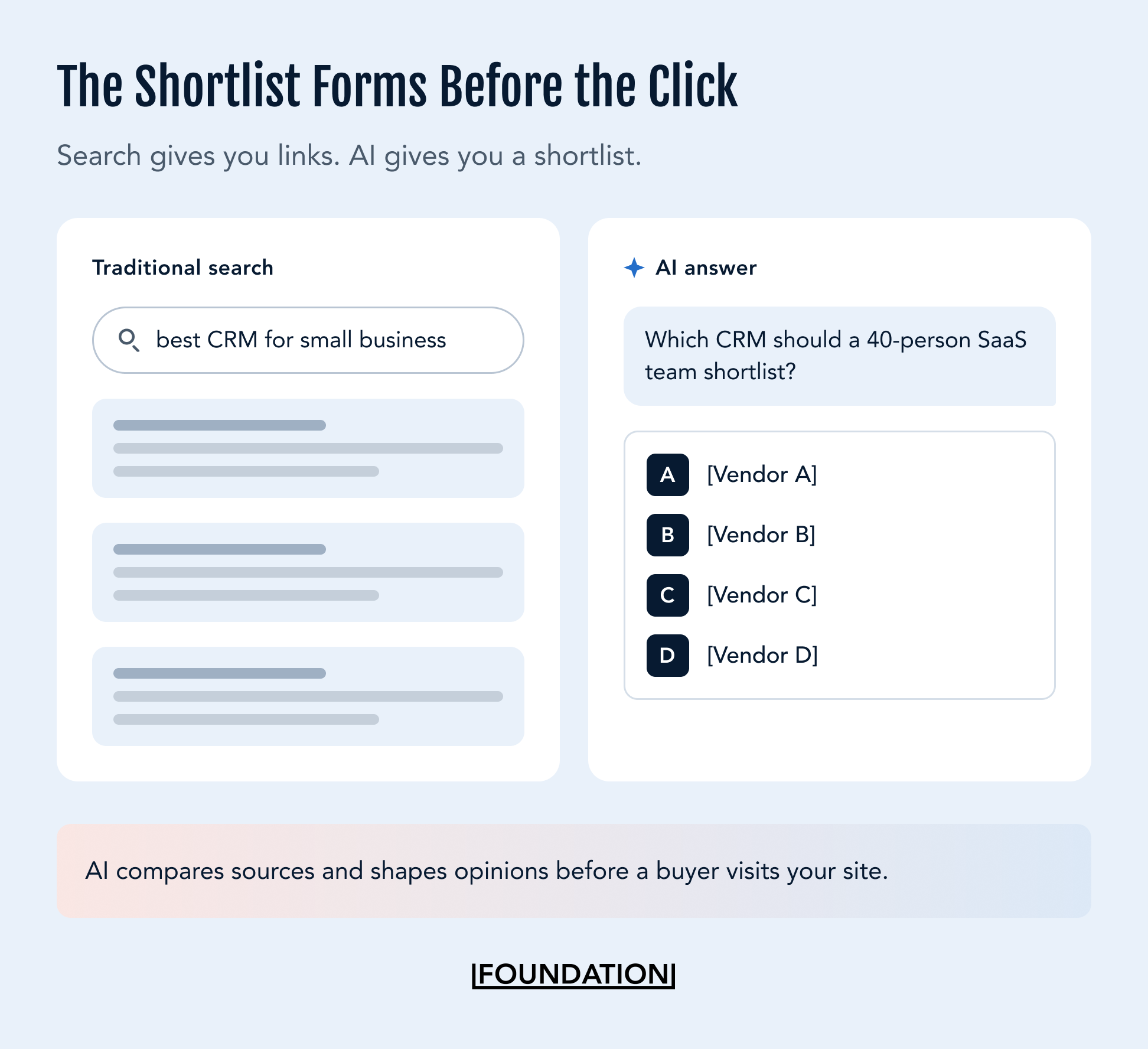
That changes what marketers are optimizing for.
Foundation uses generative engine optimization to describe the broader practice of improving visibility across generative search experiences. LLM SEO sits within that larger shift, with a particular focus on how brands and content surface inside large language model experiences.
Here’s what LLM SEO looks like for someone researching CRM software.
A traditional search might be:
“best CRM software”
The same person could ask ChatGPT:
“We’re a 40-person SaaS company using HubSpot Marketing Hub, but our sales team wants a more flexible CRM. Which alternatives give us strong automation without the complexity or cost of Salesforce?”
There’s far more information packed into that prompt.
The buyer cares about company size, automation, ease of use, pricing, HubSpot compatibility, Salesforce alternatives, and probably several criteria they haven’t explicitly mentioned.
Instead of giving the buyer a list of pages to investigate, the AI system can do part of that investigation itself.
It can gather information from different sources, compare products against the buyer’s requirements, and produce a shortlist.
That means a potential customer may form an opinion about your product before visiting your website.
LLM SEO is partly about improving your chances of being included in that research process.
You’ve probably heard this work referred to as GEO, AEO, or AI SEO. Before we get into how the five stages work, let’s sort out what each term covers.
LLM SEO vs. GEO vs. AEO vs. AI SEO
Marketers are using several terms for overlapping parts of the same shift:
| Term | What it usually refers to |
| LLM SEO / LLMO | Optimizing visibility in large language model experiences |
| GEO | Optimizing for generative engines |
| AEO | Structuring content so answer engines can surface it directly |
| AI SEO | Either optimizing for AI search or using AI to do SEO, depending on the context |
Search demand shows how unsettled the category still is: Ahrefs data from August 2026 puts “AI SEO” at 8,500 monthly US searches, “generative engine optimization” at 8,000, “answer engine optimization” at 5,000, and “LLM SEO” at 1,400. Some of the fastest-growing terms are newer ones, such as “AI visibility” and “LLM SEO optimization”.
Nobody’s won the naming battle yet.
Foundation’s position is simple: LLM SEO is the work, and AI visibility is the outcome. LLM SEO covers what your team does to shape AI answers, from the content you publish to the sources that mention you. AI visibility is how often, and how accurately, your brand shows up in those answers.
GEO and AEO already carry established search demand, but debating the acronym misses the point.
Your team needs to understand where your brand appears, why it appears there, and what you can do to improve that visibility.
How does LLM SEO work?
LLM SEO works by improving your odds at each of the five stages an LLM moves through before it answers: interpretation, query fan-out, retrieval, evidence selection, and synthesis. The details vary by platform. ChatGPT, Claude, Gemini, Perplexity, and Google AI Mode use different models, indexes, retrieval systems, and data sources.
Even so, the basic flow is similar enough to show where marketers can influence what gets surfaced.
1. The LLM Interprets What the Buyer Is Asking
People can give an AI assistant far more context than they would usually put into a Google search.
With details about company size, budget, existing tools, use case, and preferences in the same prompt, as in the CRM example above, the model first has to work out what the buyer is really trying to solve and which criteria should shape the answer.
2. The Original Question Turns Into Several Searches
Google has publicly documented a process called query fan-out, where their AI issues multiple related searches to answer different parts of a question.
For example, a buyer asking for software recommendations could trigger searches around pricing, integrations, alternatives, reviews, implementation, or specific features, even if none of those phrases appeared word-for-word in the original prompt.

In our research on query fan-out, we found that 95% of the ChatGPT fan-out queries in the dataset we analyzed showed zero traditional search volume.
Keyword tools can still tell you a lot about demand, but they won’t show every question an AI system may investigate on the way to an answer.
3. The LLM Retrieves Information From Across the Web
Once the fan-out queries are clear, the LLM can start looking for sources that can help answer them.
Your website might be one of those sources, but it could just as easily pull from Reddit, YouTube, review platforms, product documentation, industry publications, comparison pages, or another company’s site.
Foundation’s research with AirOps makes the scale of that source network clear. Across 57.2 million citations, only 10.15% pointed to brand-owned domains.

So improving a page on your own site only solves part of the problem. Roughly nine in ten citations point somewhere you don’t control: review sites, communities, publishers, and other vendors’ pages. If those sources don’t mention you, or describe you inaccurately, even your best-optimized page can’t fix the answer.
4. Retrieved Pages Earn Their Way Into the Answer
Being found doesn’t guarantee your content will be cited. The LLM still has to decide whether the information is useful enough to support the response, and a page that repeats what already ranks gives it little reason to choose yours.
That’s why we recommend non-commodity content. If your page says the same thing as twenty other pages, there’s nothing for the model to cite you for. The pages that earn citations add something the others don’t:
- Original research or proprietary data
- Expert commentary and firsthand experience
- A clear explanation of the core concept near the top of the page
- Evidence behind each claim
Traditional SEO decides which pages get that chance. Google says their generative AI features are built on their existing Search ranking and quality systems. Their guidance also notes that pages need to be indexed and eligible for Search before they can appear as supporting links in AI Overviews or AI Mode. Our analysis of Vanta shows what that looks like at scale: Vanta ranks in the top three for 1,661 keywords, and 2,603 of their 3,620 tracked keywords trigger AI Overviews.
Rankings get you considered, but evidence gets you cited. Our Atlan analysis found one page sitting around position 35 in organic search that still earned nine AI citations, and Atlan earned 328 third-party mentions alongside 237 citations to their own pages.
Keep your SEO foundation strong, then make sure every page you want cited carries evidence the model can’t find anywhere else.
5. The LLM Synthesizes What It Found
Stage five is where all of this reaches the buyer. The LLM turns all that retrieved information into an answer.
A product might be included because several sources support its fit for a specific use case. Another company could be left out because the model found too little relevant information about it across the sources.
By the time the buyer sees the response, the LLM may already have compared competitors, weighed different criteria, and decided which sources deserve to be cited.
LLM SEO is the work of improving your chances at each stage: being understood, being retrieved, providing useful evidence, and showing up in the final answer.
Why LLM SEO Is Becoming Part of the Buying Journey
Buyers now build their shortlist inside AI tools, often before they visit a single vendor site. G2 surveyed more than 1,000 software buyers and found that 51% now start their software research with an AI chatbot more often than with a Google search. Another 71% said they use AI chatbots at some point in the buying process.
For most of these buyers, AI isn’t a side channel. It’s where the research starts, and it changes the outcome: 69% said AI surfaced information that led them to choose a different vendor than the one they originally expected.
A buyer can now ask ChatGPT or Gemini to compare vendors and narrow a shortlist before visiting a company website.
By the time they reach your site, they may already have an opinion about your product, how you compare with competitors, and whether you belong on their shortlist.
We explored this shift in more detail in our research on how B2B buyers discover brands through AI. For marketing teams, the opportunity is bigger than generating another source of referral traffic. AI systems are increasingly influencing which brands buyers discover and investigate in the first place.
That also makes attribution less straightforward. Someone might learn about your company in ChatGPT, compare you against three competitors, and later find you through branded search or type your URL directly into their browser.
Search Console or GA4 may capture the final visit. Neither necessarily tells you where the buyer’s research started.
LLM SEO gives you a way to focus on that earlier part of the journey.
LLM SEO Strategies That Get Your Brand Into AI Answers
Every strategy below has the same goal: make your brand the easiest, best-supported answer to your buyers’ questions.
Build a Prompt Set Around Real Buying Decisions
You can’t see how LLMs interpret your buyers’ questions until you know how those buyers phrase them. Start with the questions buyers ask when they’re comparing options, narrowing a shortlist, or trying to solve a specific problem.
Pull those questions from sales calls, customer interviews, support tickets, Reddit threads, product reviews, Search Console, and competitor research.
Aim for 25–50 prompts you can keep coming back to.
Each prompt should represent a real decision your customer might make, such as choosing between vendors, finding an alternative, comparing pricing, evaluating a use case, or deciding whether a product fits their company.
That gives you a much better baseline than testing random questions in ChatGPT.
Run each prompt more than once. When ten people on our team ran the same revenue intelligence prompt across ChatGPT and Claude, the odds of getting the same list of recommended brands twice were under 1 in 100. One run is a snapshot, so treat your prompt set as something you sample repeatedly.
Cover the Questions Your Content Misses
Many brands drop out of AI answers because fan-out searches ask about details their websites don’t answer. Compare the answers from your prompt set with what already exists on your website.
Perhaps buyers keep asking about a use case you barely cover. Maybe competitors have detailed comparison pages, while yours only has a generic product page.
You may also find that AI systems repeatedly retrieve your documentation but have little to work with when someone asks about pricing, integrations, alternatives, or implementation.
Use those gaps to decide what to create, expand, or refresh.
Every new page should have a clear job inside the buyer’s research journey rather than existing because a keyword tool found another variation to target.
How you write those pages matters as much as which ones you publish. In our Docker analysis, all 10 of Docker’s most-cited documentation pages explain the core product concept near the top, before any instructions or configuration. That gives an AI system a clear, extractable answer to work with.
Map the Sources Shaping Those Answers
Run your prompts across the AI platforms your audience is likely to use and note where the answers come from:
- Which publications keep getting cited
- Where Reddit threads appear
- Whether review sites shape the recommendations
- Whether YouTube videos show up
- Which competitor pages get pulled into the answer
Now you have a source map for your category.
Our versus layer study shows how revealing this can be. Across 240 AI answers to applicant tracking system (ATS) buying questions, the four vendors being compared supplied only 27% of the evidence on direct comparisons. Independent publishers, other software vendors, review sites, and communities supplied the rest.
Earn Mentions From Credible Third-Party Sites
LLMs reward brands that show up beyond their own domain. Your website gives AI systems your version of the story. Mentions elsewhere give them independent evidence.
Look for places where your company should naturally be part of the conversation.
That could mean getting included in an industry comparison, contributing data to a journalist, supplying an expert quote, publishing research people want to reference, appearing on a podcast, working with creators, or giving partners something worth linking to.
A mention from another credible site can act like a vote of confidence because it shows that someone outside your company also associates your brand with that topic.
One isolated mention is unlikely to change much. A pattern of relevant mentions from trusted sources provides AI systems with more consistent evidence of where your company fits.
Our Brex analysis shows what happens when most of that evidence lives elsewhere. Brex ranks first on Google for “business credit cards for startups” and appeared in 51.7% of the AI answers we analyzed, yet only 6.5% of citations pointed to brex.com. Aggregators such as Nav and NerdWallet each supplied a larger share of the evidence than Brex’s own site.
Distribute the Same Expertise Across Multiple Surfaces
Distribution puts your expertise in more of the places LLMs retrieve from and gives the final answer more consistent evidence to draw on. Publishing should be the beginning of the distribution process.
A strong research report can become a YouTube breakdown, LinkedIn commentary, charts for industry publications, podcast talking points, Reddit discussions, newsletter pitches, and expert contributions.
Each format gives the idea another chance to reach buyers and appear in the sources AI systems use.
As Foundation’s CEO, Ross Simmonds, puts it: “Create once, distribute forever”. LLM SEO gives that approach another use case because distribution expands where your expertise can be discovered.
Publish Assets Other People Want to Reference
Generic blog posts are easy to reproduce.
Original information travels further.
Turn internal knowledge into assets that publishers, customers, creators, and AI systems can use. That could include benchmarks, surveys, proprietary data, expert interviews, templates, product experiments, teardown posts, or your customer base analysis.
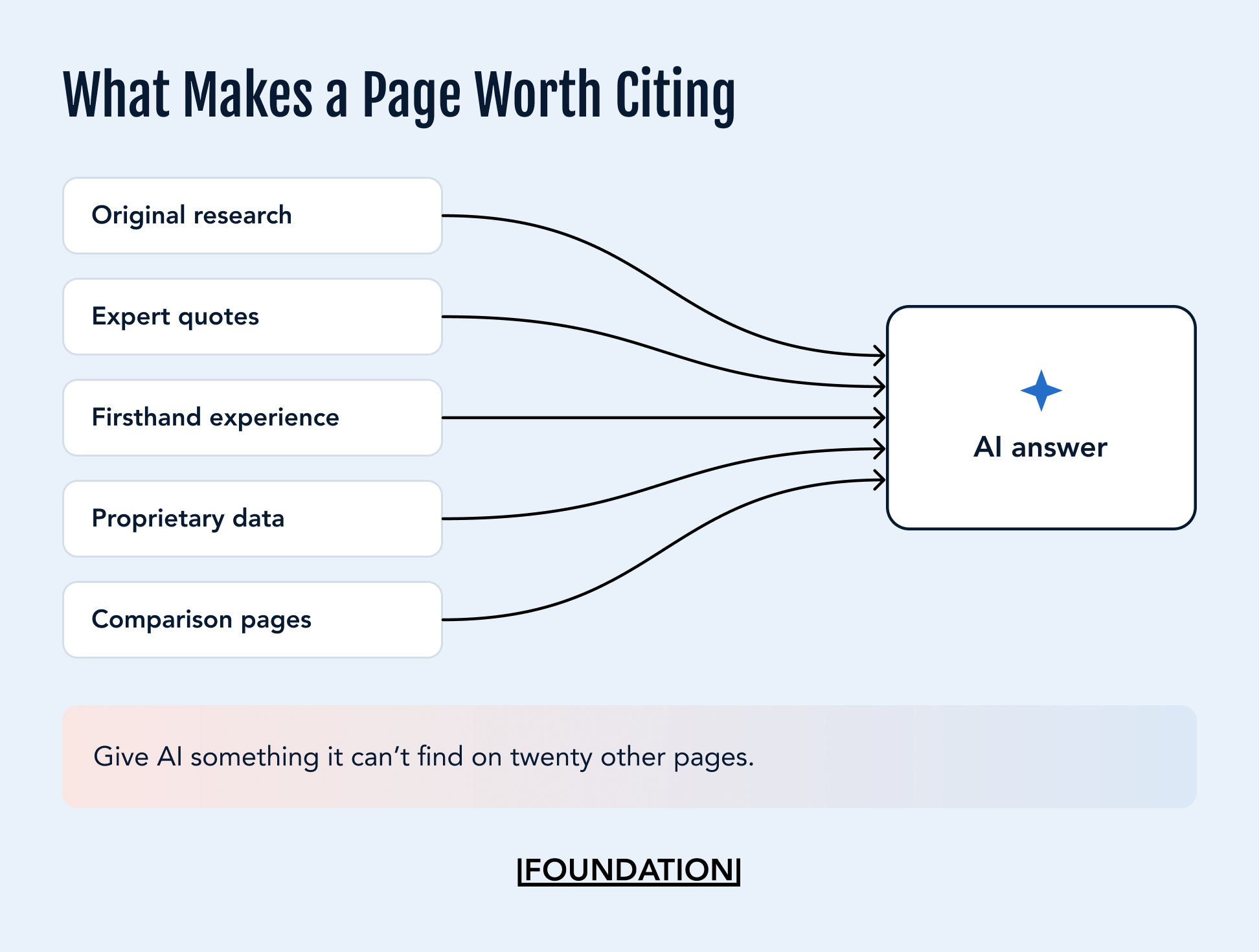
Instead of asking whether an article is “optimized for LLMs”, ask whether there is anything inside it that another writer would genuinely want to cite.
If the answer is no, adding another FAQ probably won’t fix the underlying problem.
How do you know if your LLM SEO strategy is working?
A buyer can come across your brand in an AI answer without ever clicking through, so rankings and traffic only tell part of the story. Use the prompt set you built earlier to track a few signals, then check whether that visibility is turning into site visits and sales conversations.
Prompt Coverage
This tracks how the LLM reads your buyers’ questions and the searches it runs. Check how many of your buyer prompts, and the fan-out questions behind them, your content can answer. If coverage rises over successive runs, the LLM has more of your material to interpret and search.
Citation Share
This tracks which sources the LLM retrieves. Look at which sources AI systems cite when your brand appears. Owned citations show your pages are being retrieved, while third-party citations show you’re part of the wider source network. The result may surprise you. Our n8n audit found n8n in 91 of 96 AI answers, yet n8n-owned domains earned only 15.7% of citation share.
Repeat Citations
This tracks whether your retrieved pages earn their way into the answer. Track which pages earn citations across multiple prompts and platforms. When your original research and comparison pages keep getting cited and generic posts don’t, that’s a sign AI systems find your evidence worth using.
Visibility, Recommendations, and Accuracy
This tracks the final answer itself. Measure how often you appear, how often you’re the recommended option, and how you compare with competitors on the same prompts. Then check whether AI systems describe your product, pricing, and use cases correctly, since an outdated claim can cost you as much as being absent.
Referral Traffic and Pipeline
This tracks what happens after the answer. Watch referrals from ChatGPT and Perplexity, add AI discovery to your “How did you hear about us?” options, and ask sales to note when prospects mention AI tools. None of these signals proves impact on its own, but together they show whether AI is part of the path to purchase. We cover the attribution challenge in our breakdown of GEO and AEO ROI.
What tools can you use for LLM SEO?
No single tool gives you a complete picture of LLM visibility.
Ahrefs or Semrush show the rankings and search demand behind the pages AI systems retrieve, and Google Search Console shows which pages already earn visibility in Google. Bing Webmaster Tools now reports when your site is cited in Microsoft Copilot and AI-generated summaries in Bing.
AI visibility platforms such as Profound track prompts, competitors, citations, and source domains across engines. As a verified Profound partner, Foundation uses that data for citation tracking.
LLM SEO Starts With Knowing What Your Buyers Ask
The models keep changing, and so do their answers. What holds steady is the groundwork: know what your buyers ask, and make sure the sources AI systems trust have evidence about you worth citing. Start with one prompt set this week. The next time a buyer asks ChatGPT for the best tools in your category, make sure your brand is part of the answer.
If your brand is barely showing up in ChatGPT, Gemini, Claude, Perplexity, or AI Overviews, Foundation can help you figure out why.
Our team researches the prompts your buyers use, maps the sources shaping AI answers in your category, creates the content those systems can retrieve, and distributes your brand across channels such as search, Reddit, YouTube, and earned media.
We also track citation rate, share of model, and AI-driven pipeline, so you can see whether the work is changing your visibility.
See how our AI visibility services help B2B brands get found, cited, and recommended across AI platforms.
Frequently Asked Questions About LLM SEO
What is LLM SEO?
LLM SEO is the process of improving your brand’s visibility in answers generated by large language models and AI search tools such as ChatGPT, Gemini, Claude, Perplexity, Google AI Mode, and AI Overviews.
How is LLM SEO different from traditional SEO?
Traditional SEO focuses on helping pages get discovered and ranked in search engines. LLM SEO extends that work into AI-generated answers, where your brand can be retrieved, cited, compared, or recommended alongside information from third-party sources.
Is LLM SEO the same as GEO?
GEO is the broader practice of optimizing for generative engines, while LLM SEO refers more specifically to visibility within large language model experiences. At Foundation, we call the broader discipline GEO and the outcome AI visibility.
How do you rank in LLMs?
There usually isn’t a fixed ranking like there is on a Google results page. Your chances of appearing improve when AI systems can find useful information about your brand, retrieve relevant pages, and see consistent evidence about your company across credible sources.
Does traditional SEO help with LLM visibility?
Yes. Strong technical SEO, useful content, internal links, backlinks, and organic visibility all give search and retrieval systems more opportunities to find your content. LLM SEO builds on that foundation by also looking at citations, third-party mentions, source coverage, and how your brand appears in AI answers.
What is LLM seeding?
LLM seeding is the deliberate effort to increase accurate references to your brand across places AI systems may retrieve from, including industry publications, review sites, communities, YouTube, podcasts, comparison pages, and your own content.
The goal is a credible information footprint around your company, so AI systems have more reliable context when they encounter your brand.
Can you guarantee that ChatGPT will recommend your company?
No. AI responses can change based on the prompt, model, retrieval system, location, and timing. You can improve the information environment around your brand and increase your chances of appearing, but no marketer can guarantee a specific recommendation every time.

