
Article's Content
Article's Content
You’ve probably rewritten the comparison page, added an FAQ block to the product page, and refreshed last year’s blog posts, all to get cited in AI answers.
But Docker’s citation data points somewhere else: technical documentation.
Across two Profound runs on August 23 and 24, 2026, Docker Docs produced more first-party citations than every other Docker-owned surface combined, accounting for 54% and 53% of the company’s first-party citations. When we adjusted for the size of Docker’s content library, the page-level advantage almost disappeared.
We call this the Docs Dividend: the return from building and maintaining a technical knowledge base that becomes a brand’s largest source of first-party evidence in AI answers.
This teardown tests four explanations for the pattern: content scale, authority, maintenance, and page structure, and shows which lessons transfer to B2B teams who don’t have a decade-old docs library.
How We Tested the Docs Dividend
Docs Are Docker’s Largest First-Party Citation Source
The Docs Dividend Holds on Commercial Evaluation Prompts
Docker Docs’ Citation Lead Shrinks After Adjusting for Content Volume
Docker Docs Have a Much Larger Content and Authority Footprint
Backlinks Matter, but They Don’t Explain Every Citation
What Docker’s Most-Cited Docs Have in Common
Docker’s Technical Blog Posts Break the Pattern
Three Places the Docs Dividend Stops Paying
How to Find Your Docs Dividend
How We Tested the Docs Dividend
We used four checks to test whether Docker Docs were overrepresented in AI citations and to identify potential explanations for the pattern.
- We ran a set of 40 prompts through Profound on Aug. 23 and 24, 2026, producing 480 answers and 3,300+ citations. Each citation was classified as Docker Docs, Docker blog, another Docker-owned source, or external.
- We manually ran 16 prompts twice across ChatGPT, Gemini, Perplexity, Claude, Google AI Overview, and Google AI Mode, producing 192 answers. We recorded only the citations exposed by each interface.
- We audited the 10 most-cited Docs pages across 17 structural dimensions, comparing five with relevant Docker marketing pages and five with technical blog posts. We used Ahrefs to compare indexed page volume, organic traffic, keyword visibility, and referring domains.
- We reviewed the public update history of five Docs pages that recurred across the Profound and manual tests to see how often they were updated.
This is a single-company study. Ahrefs page counts reflect its index, not Docker’s definitive CMS inventory. The analysis shows associations, not causal ranking factors, and measures citation behaviour rather than pipeline or revenue.
Terminology: First-party means Docker-authored content. External and community sources include third-party publications, vendor content, tutorials, Reddit, and community-authored Docker Forum discussions. A citation occurrence is one instance of a source appearing in an AI answer.
Docs Are Docker’s Largest First-Party Citation Source
We started with the full citation mix from the August 23 Profound run.
Third-party tutorials, vendor content, editorial sites, Reddit, and community-authored Docker Forum discussions accounted for 1,306 of 1,706 citation occurrences, or 76.6%. Docker-authored content produced the remaining 400.
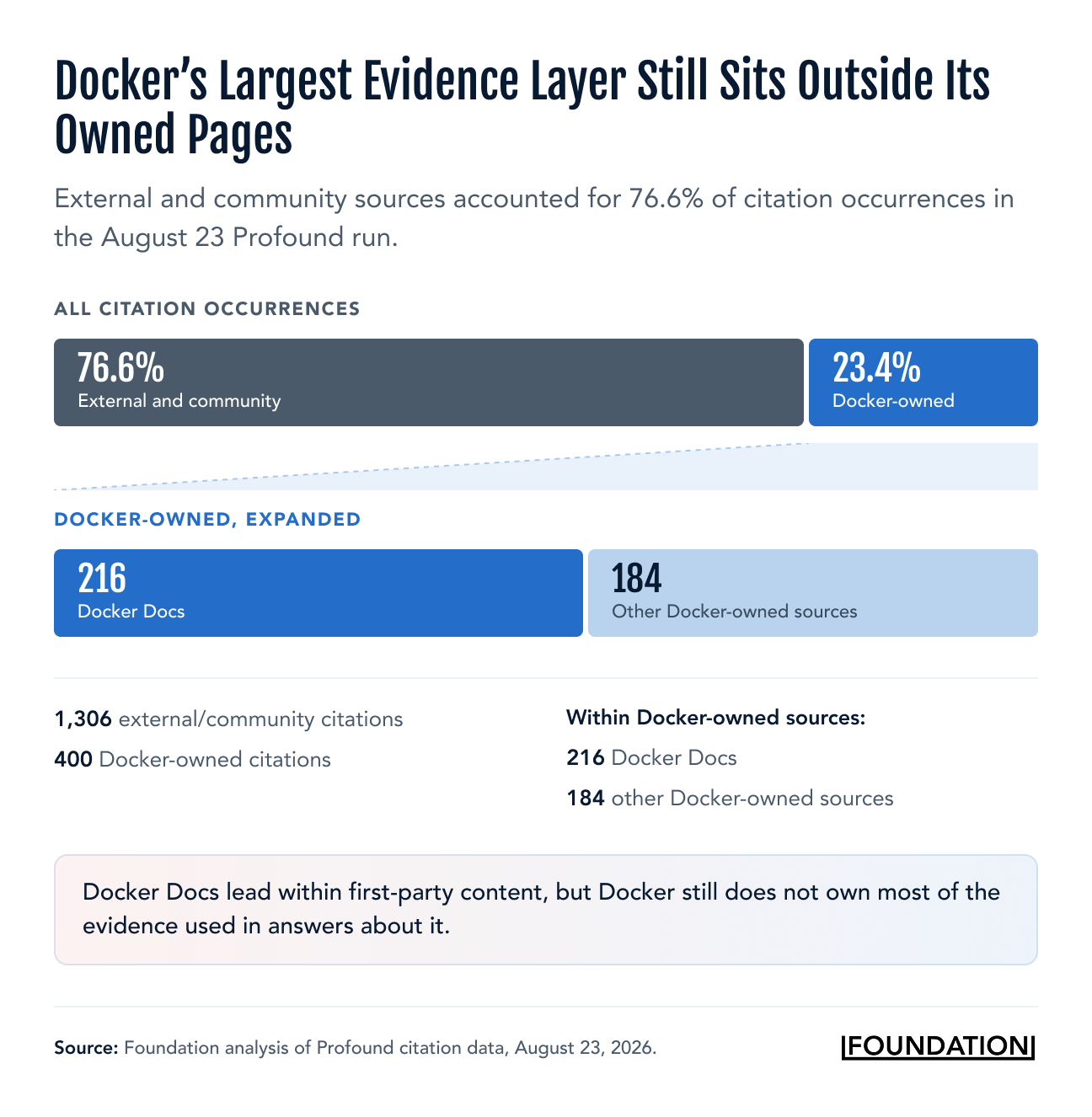
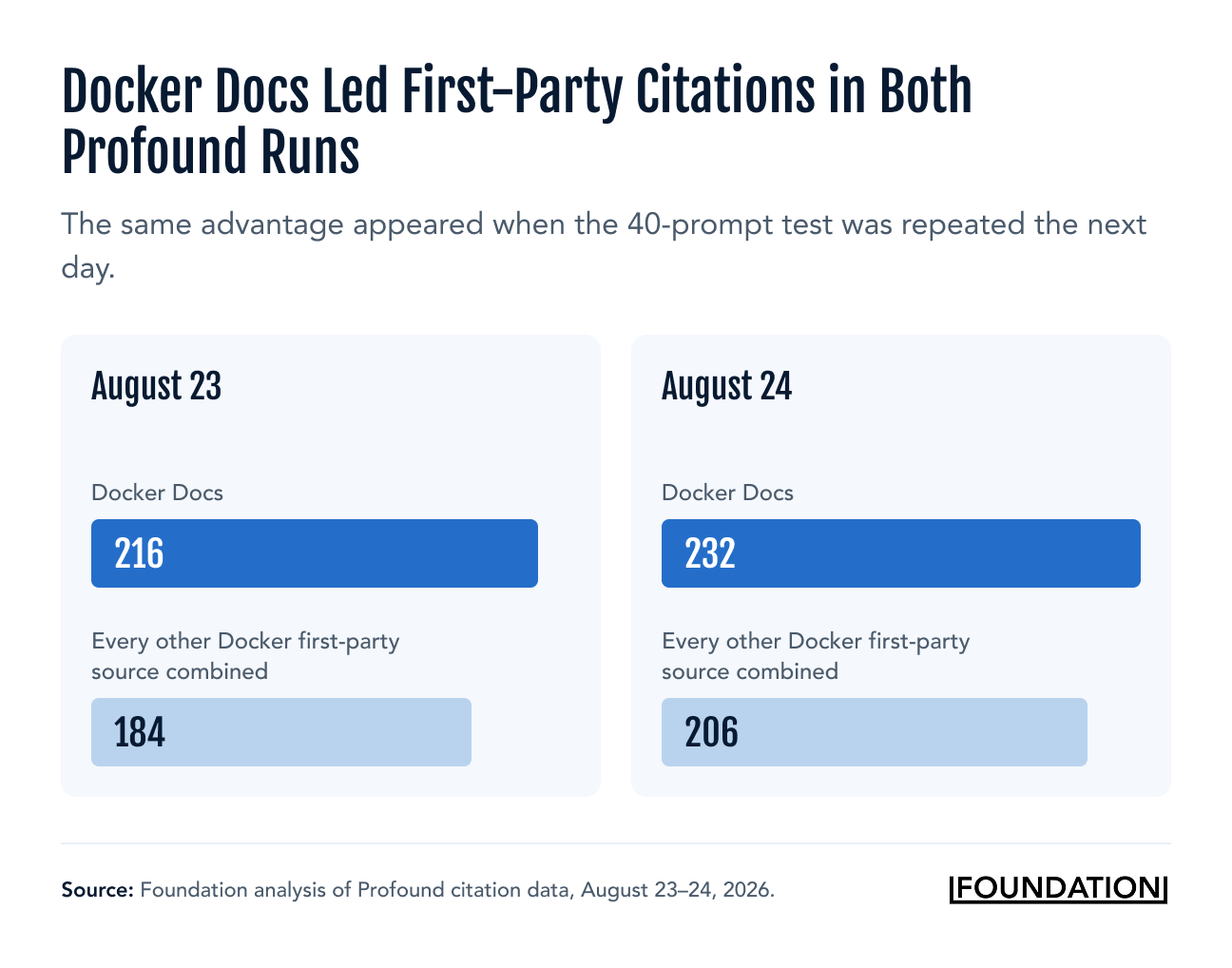
Within those 400, documentation produced 216 citation occurrences against 184 for every other Docker-owned source combined. When we reran the same 40 prompts across the same six surfaces on August 24, the result held: 232 for Docs, 206 for everything else.
The Docs Dividend Holds on Commercial Evaluation Prompts
The more useful test was whether the docs lead held on questions closer to product evaluation.
We isolated 16 Docker-evaluation prompts, including:
- “Is Docker suitable for regulated or security-sensitive organizations?”
- “How does Docker support security and governance across large engineering teams?”
- “How well does Docker scale across a large engineering organization?”
In the August 23 run, the 16 Docker-evaluation prompts produced 608 citation occurrences. Docker-authored first-party sources accounted for 33.6% of them, and documentation led the owned subset with 89 citation occurrences, or 43.6%. Documentation remained the largest first-party source when the same 16 prompts ran again on August 24, accounting for 40.5% of Docker-authored first-party citations.
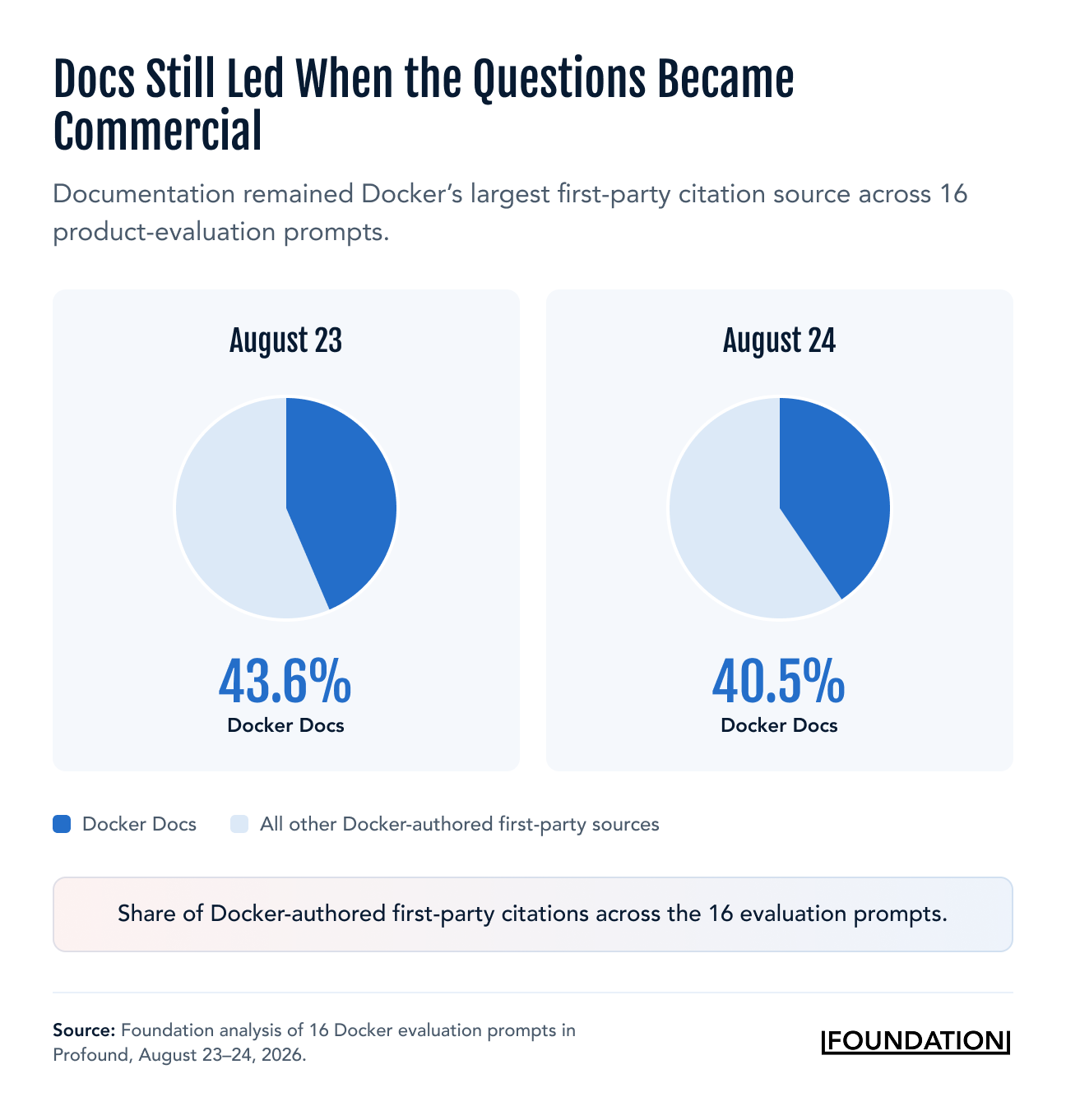
Individual prompts were less stable. For the Docker Desktop trade-offs prompt, docs accounted for 74% of first-party citations on August 23 (14 of 19) and 38% on August 24 (3 of 8).
Across the full 16-prompt commercial subset, however, documentation remained Docker’s largest first-party source on both days.
Docker Docs’ Citation Lead Shrinks After Adjusting for Content Volume
Across both runs, Docker Docs received 447 citations, compared with 196 for the blog. At first glance, that looks like a large advantage.
But Docs also had a much larger content footprint. In our August 30 Ahrefs inventory, we counted 2,303 qualifying Docs URLs and 1,110 qualifying blog URLs. Docs therefore made up 67.5% of the combined inventory.
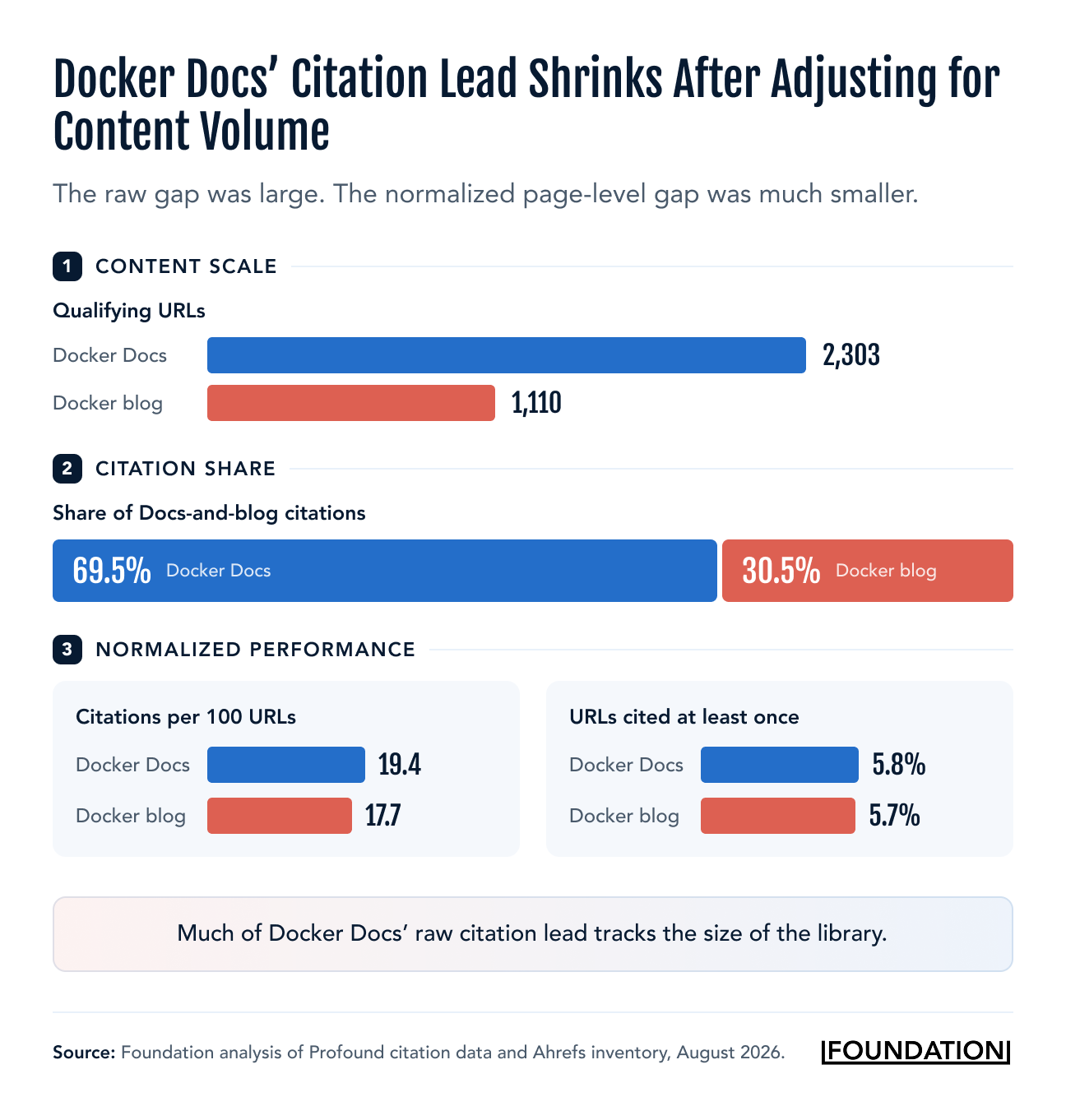
Once we adjusted for the size difference, the gap became much smaller. Docs accounted for 69.5% of Docs-and-blog citations and generated 19.4 citations per 100 indexed URLs, compared with 17.7 for the blog. The share of the inventory cited at least once was closer still: 5.8% for Docs and 5.7% for the blog.
The raw citation lead is much larger than the normalized page-level gap.
Next, we looked at another difference between the two libraries: their backlink and search footprints.
Docker Docs Have a Much Larger Content and Authority Footprint
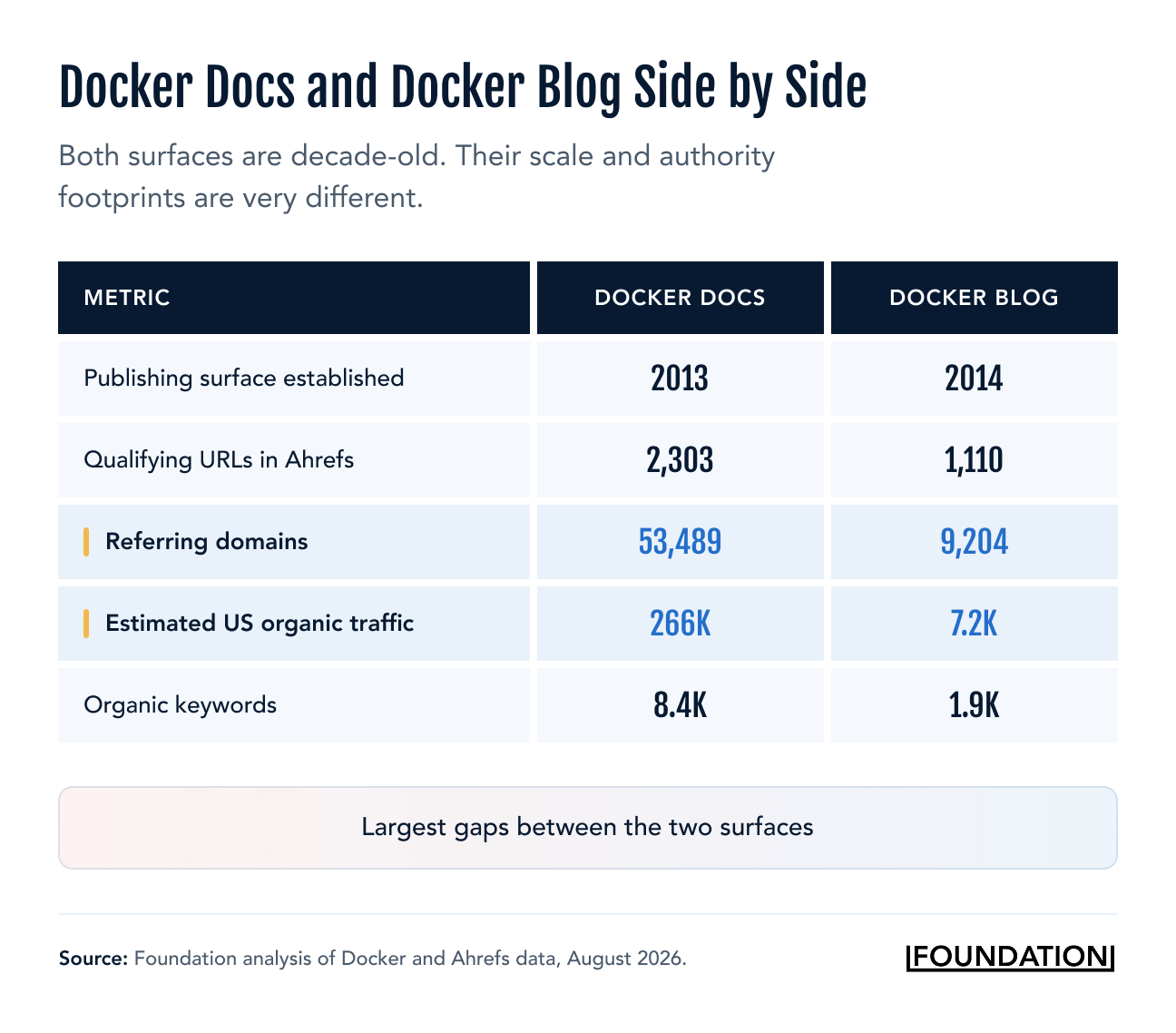
Both surfaces are over a decade-old: Docs launched in 2013, the blog in 2014. But they differ in scale and authority.
Ahrefs indexes 2,303 Docs pages and 1,110 blog posts in our cleaned set. Docs also have links from 53,489 referring domains, compared with 9,204 for the blog, a 5.8x gap.
Search visibility diverges even further: an estimated 266,000 monthly US organic visits for Docs versus 7,200 for the blog. Yet in the August 23 run, Docs generated only about 2.2x as many citations. The blog punches well above its search footprint.
Backlinks Matter, but They Don’t Explain Every Citation
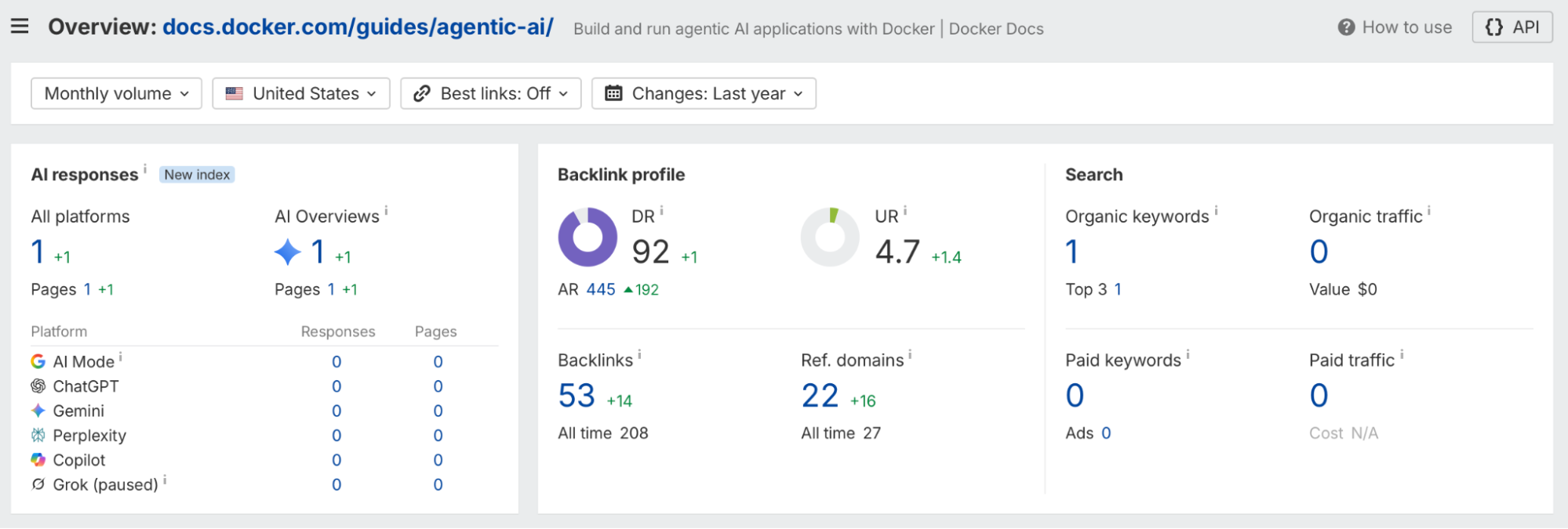
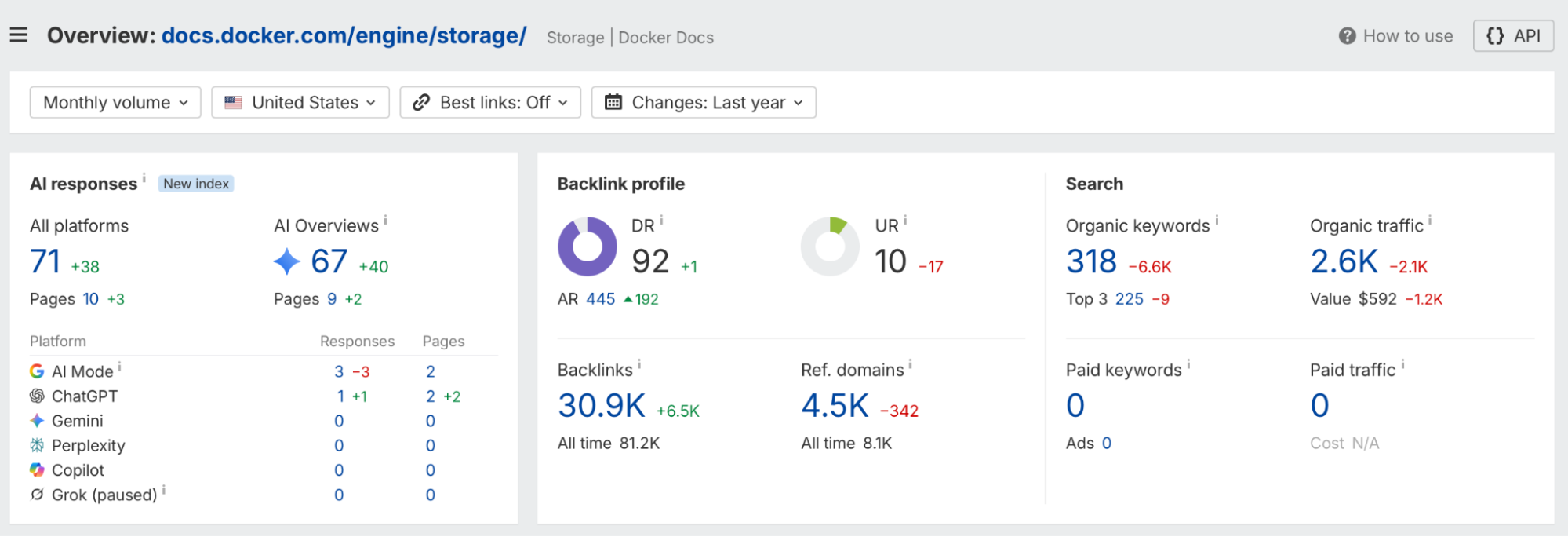
Among the cited pages we reviewed, the median Docker Docs page had roughly 785 referring domains, compared with 21 for the median cited blog post. But within the Docs sample, higher referring-domain counts did not consistently correspond with higher citation counts.
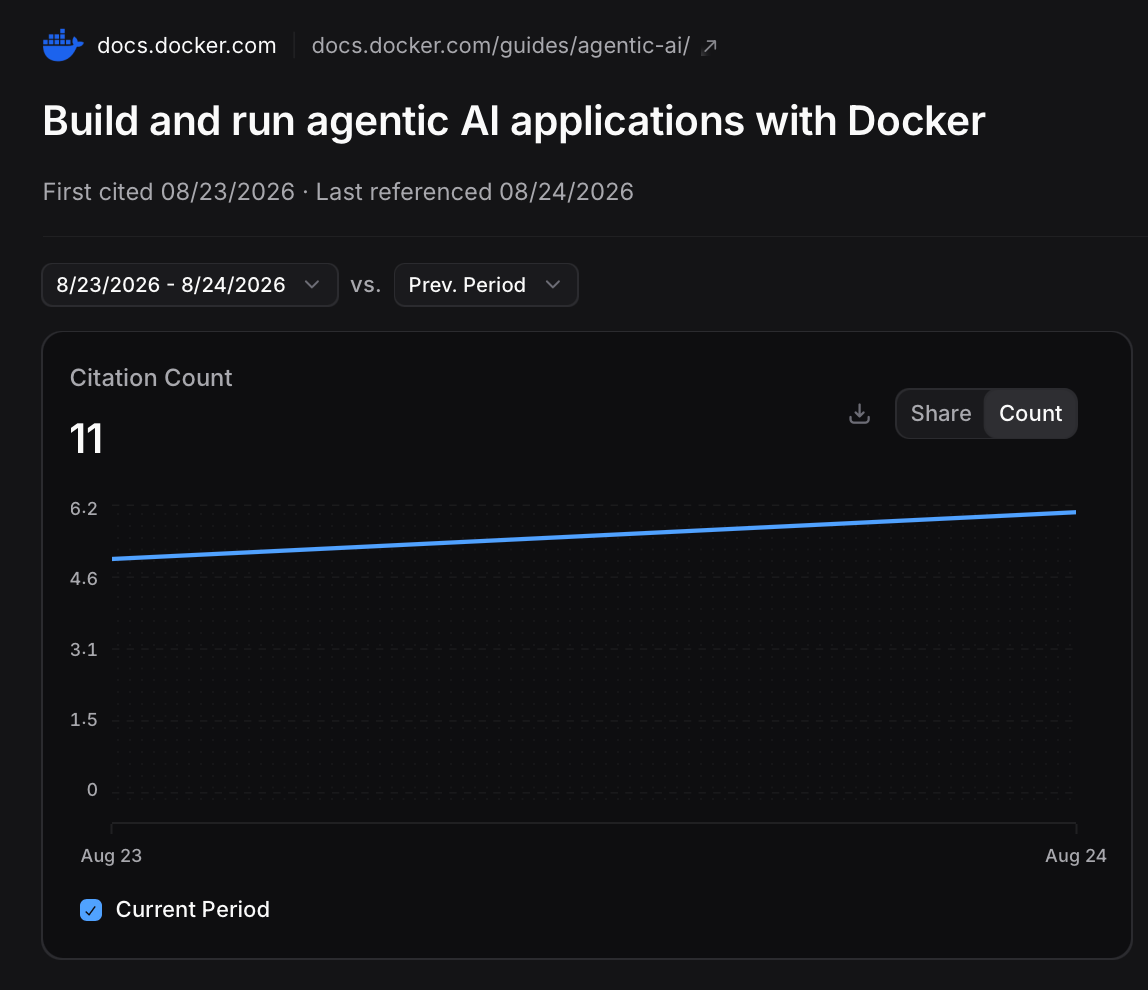
The Agentic AI guide received 11 Profound citations with only 22 referring domains, a URL Rating of 4.7, and effectively no estimated US organic traffic.
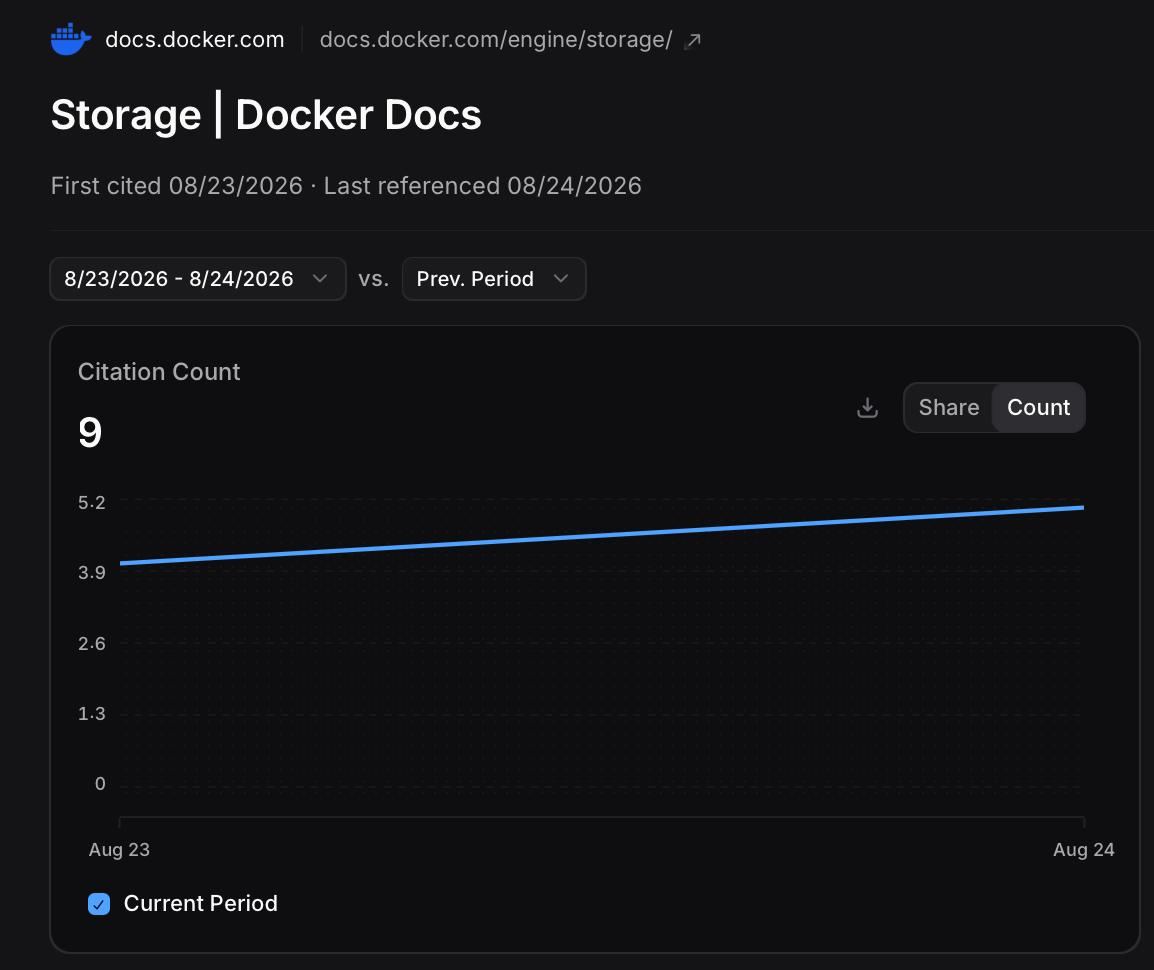
The Storage docs had roughly 4,500 referring domains and received 9 citations.
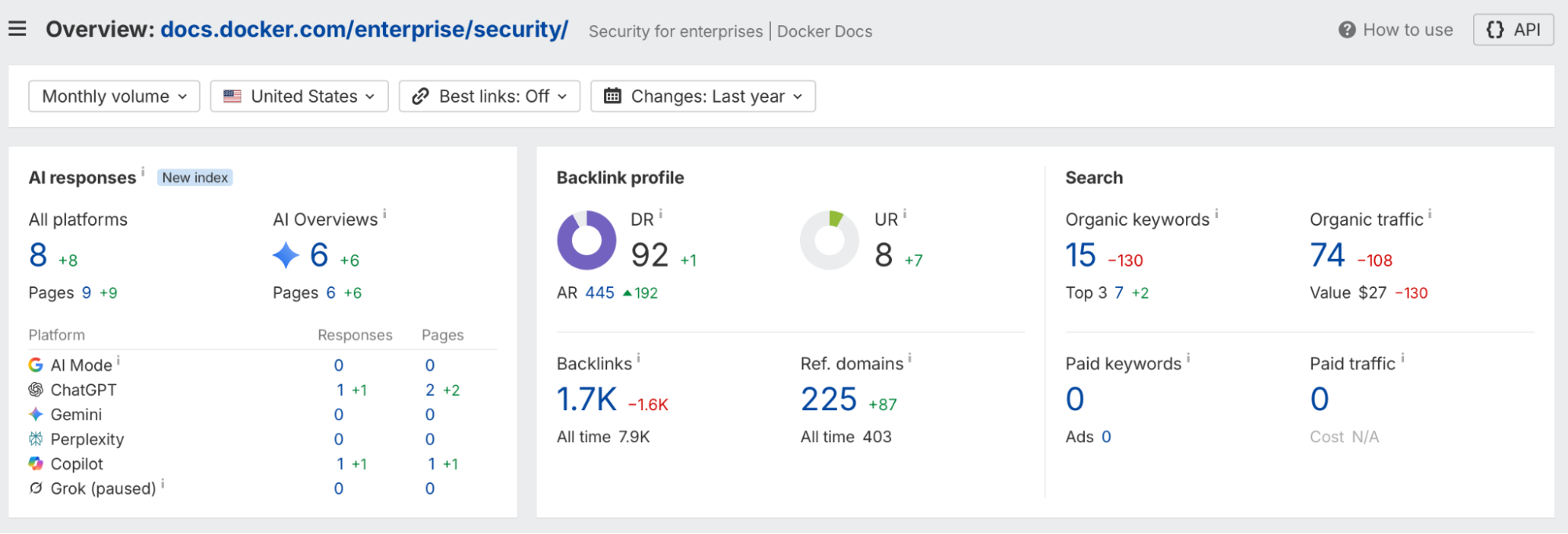
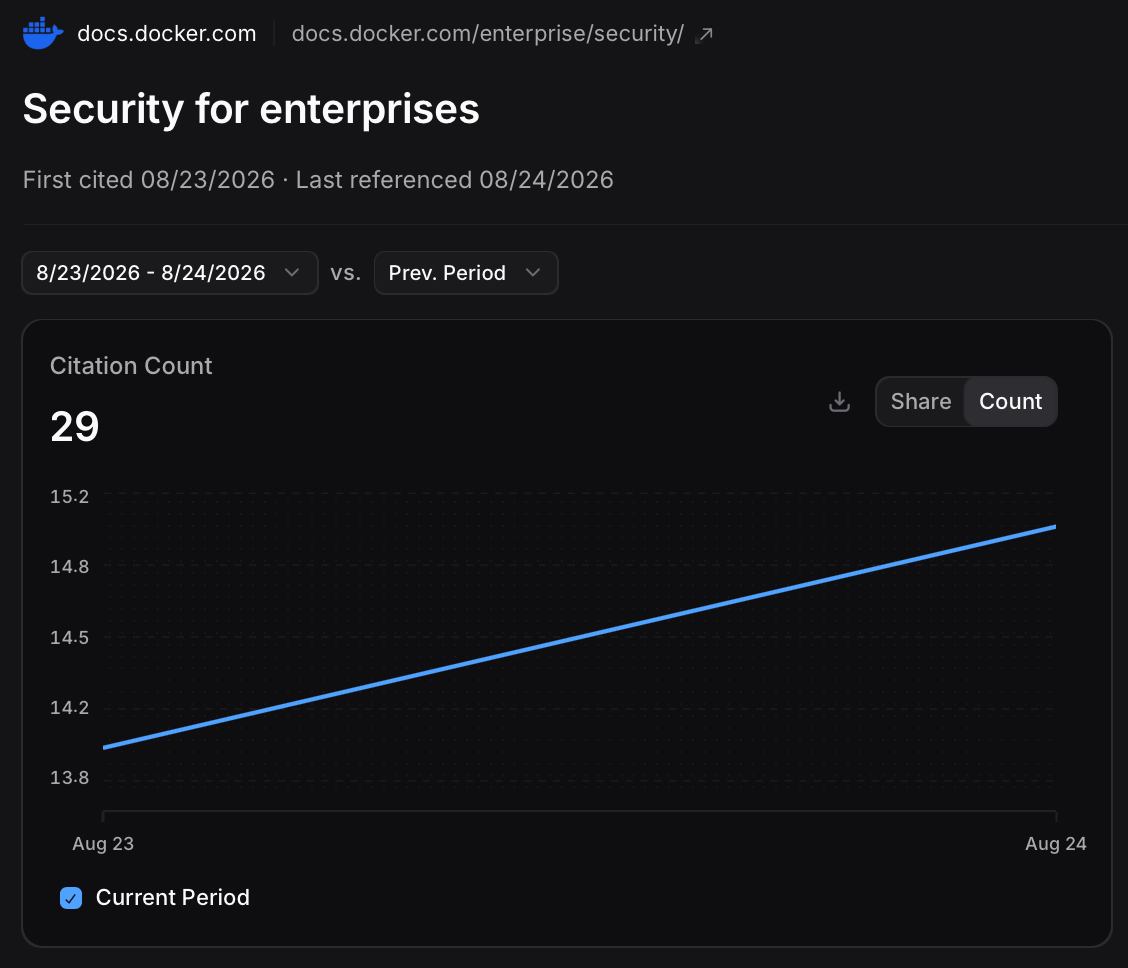
The Security for Enterprises docs page received 29 citations with 225 referring domains, making it the most-cited docs page in our sample despite having far fewer referring domains than several other pages.
What Docker’s Most-Cited Docs Have in Common
We audited the 10 Docker Docs URLs with the most citations across both runs, looking at how each page introduced its subject, organized headings, explained features, handled examples and operating conditions, and placed promotional material around the answer.
One trait appeared across all 10 of the most-cited Docs pages.
The Most-Cited Docs Explain the Product Before the Details
All 10 establish the core concept near the top, before instructions or configuration.
The Docker Scout page explains the image → SBOM → vulnerability workflow before routing readers into Quickstart, integrations, policy, and dashboard docs.
The Administration page establishes the company → organization → team → member hierarchy before defining each layer.
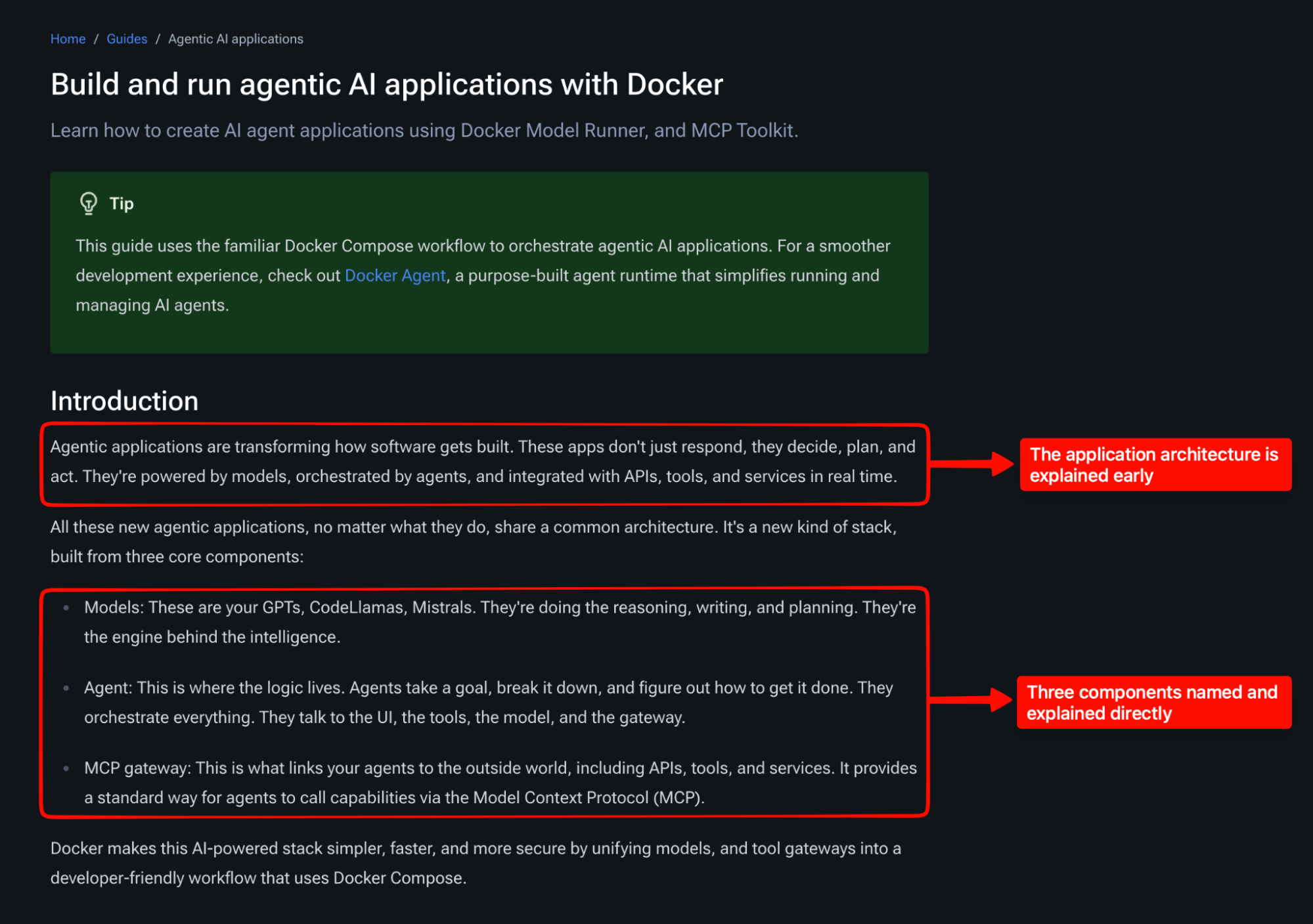
The Agentic AI guide introduces models, the agent, and the MCP gateway before setup.

The Biggest Structural Gap Appears Against Docker’s Marketing Pages
We matched five cited Docs pages with the closest Docker marketing page covering the same subject. The Docs pages were Security for Enterprises, Docker Engine Security, Agentic AI, Docker Scout, and Administration. Their marketing counterparts covered enterprise security, the Docker container runtime, Docker for AI, Docker Scout, and Docker Desktop Business respectively.
The comparison lets us hold the subject roughly constant and look at how the two first-party content types do their jobs.
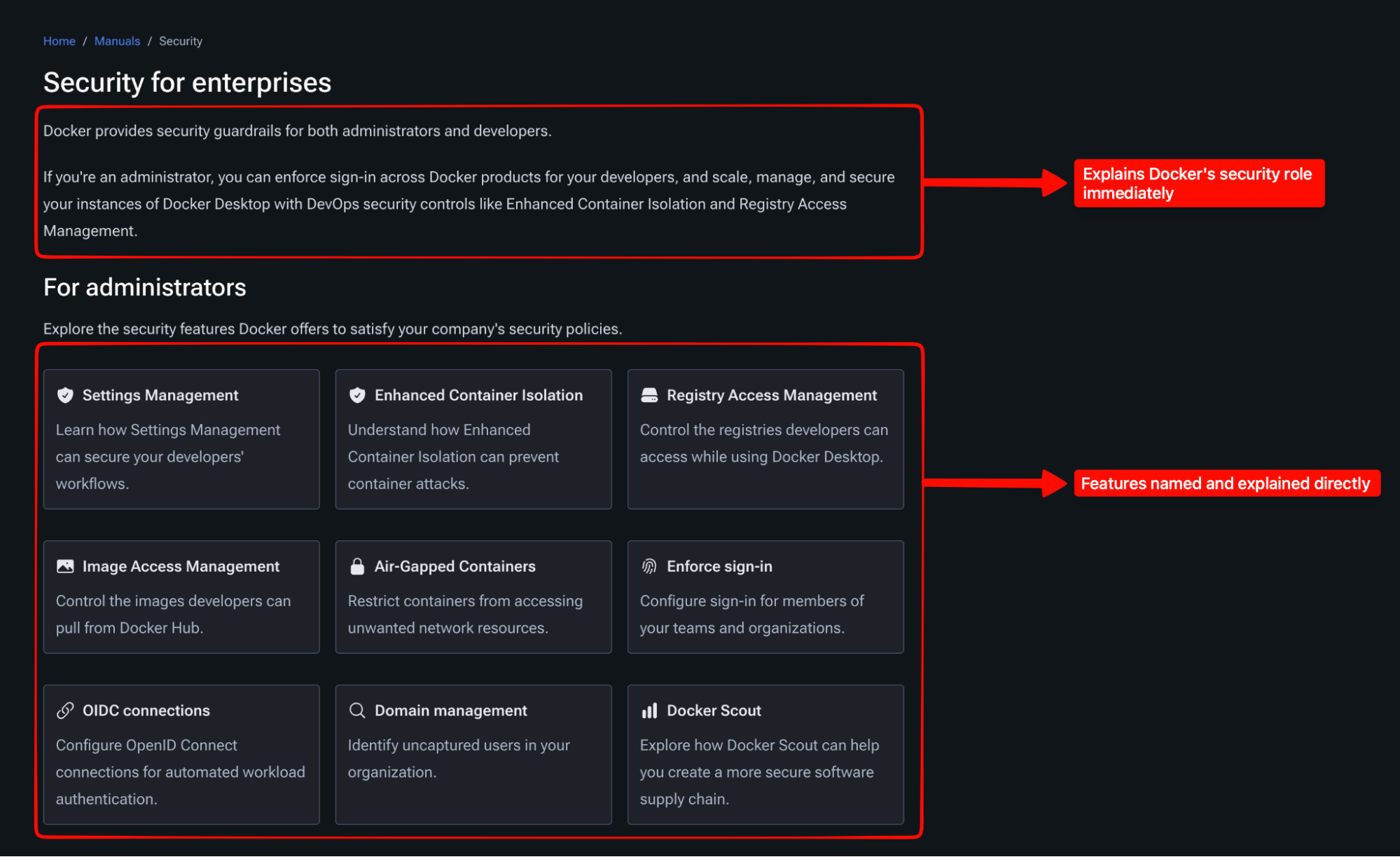
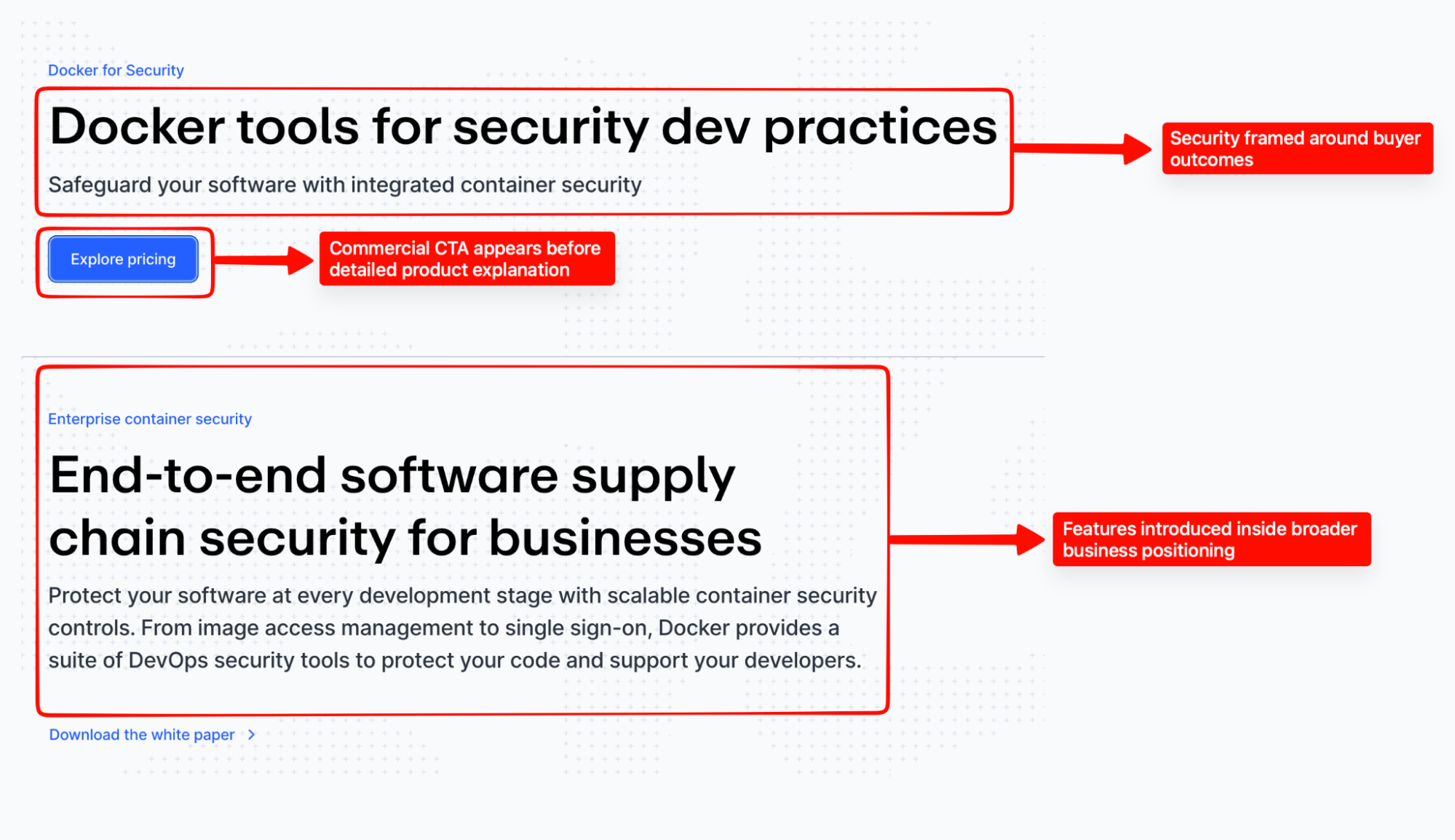
The Security for Enterprises Docs page, the most-cited page in our Docs sample with 29 citations, moves quickly from a short explanation of Docker’s security role into named controls such as Enhanced Container Isolation, Registry Access Management, SSO, and SCIM.
Its closest marketing counterpart, Docker for Security, covers the same broad security territory but gives buyer outcomes and commercial positioning more prominence before moving deeper into the product.
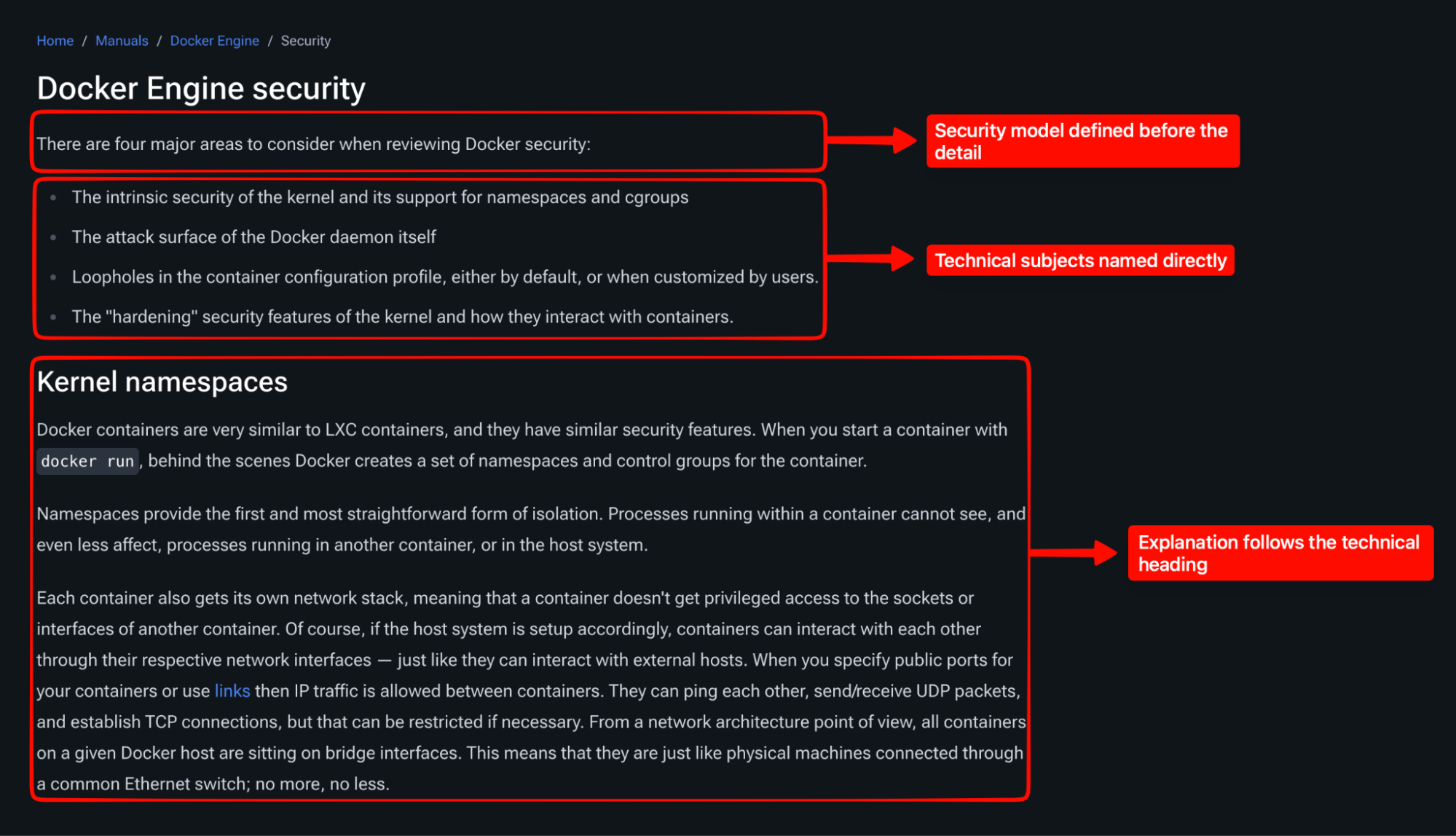
The distinction also appeared in the Docker Engine Security pair. The Docs page received 16 citations across the two Profound runs and explains kernel namespaces, control groups, daemon attack surfaces, Linux capabilities, Content Trust, and hardening options.
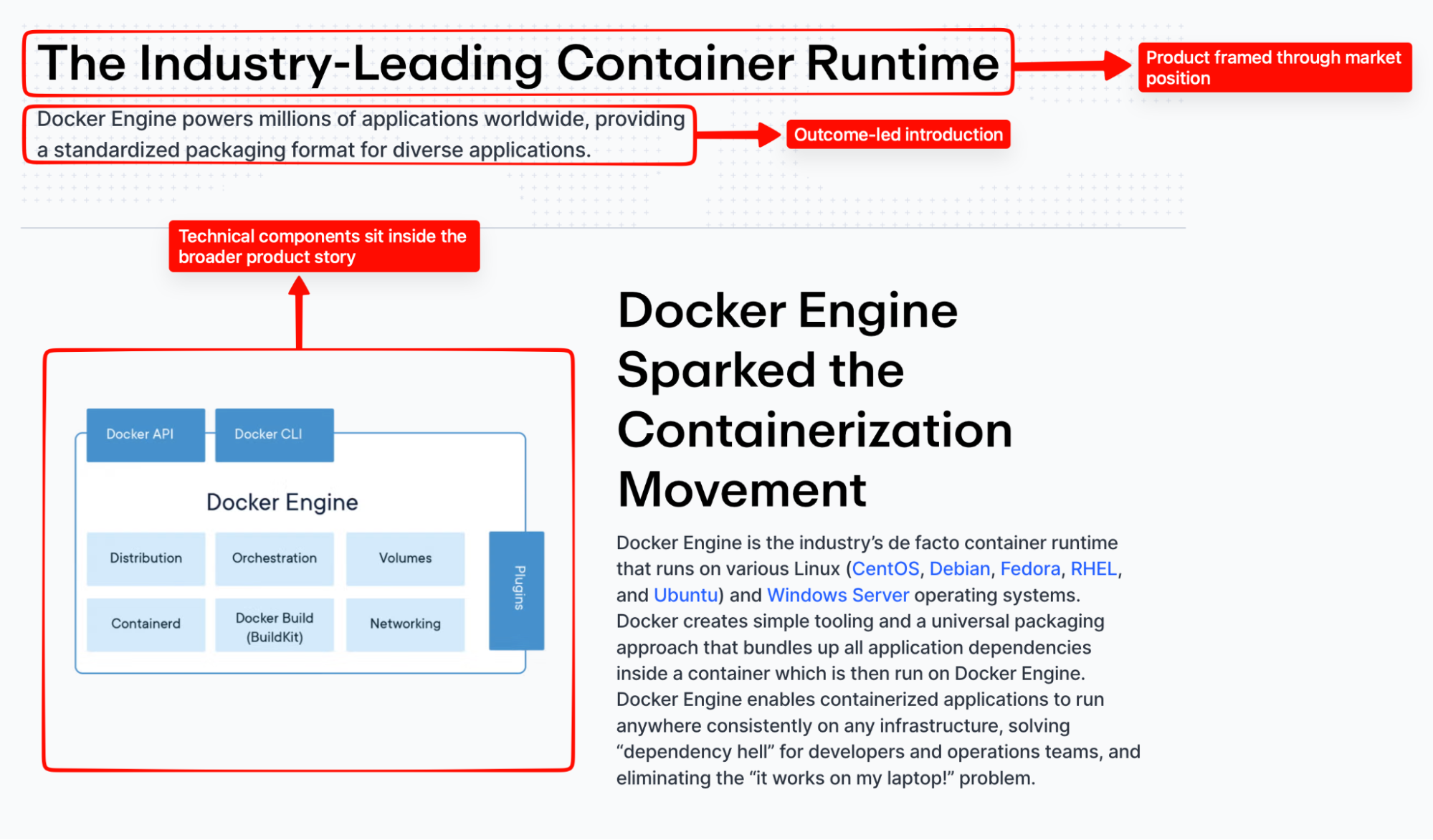
The Container Runtime marketing page covers Docker Engine too, but frames it first through standardization, portability, and Docker Engine’s position as an industry-leading runtime before introducing components such as containerd, BuildKit, and the Docker CLI.
The Agentic AI Docs guide received 11 citations. It establishes the application architecture and then gives the reader prerequisites, hardware requirements, a sample application, a Compose file, environment variables, and the role of each part of the stack.
The Docker for AI marketing page discusses many of the same products, including Compose, Model Runner, and MCP Gateway, but introduces them through outcomes such as easier agent development, local-to-cloud deployment, and developer productivity.
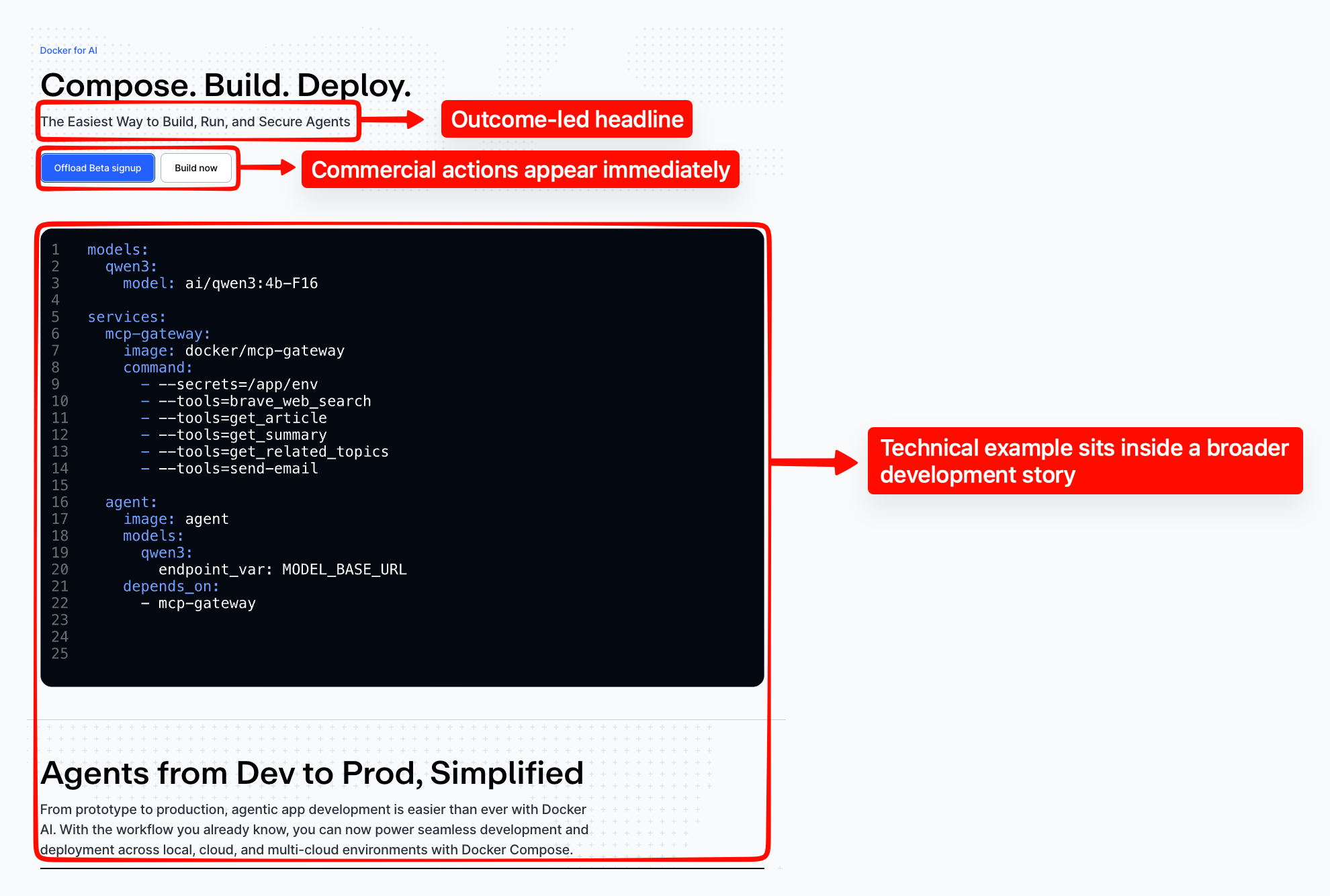
Docker Scout was a useful counterexample. Its Docs page received nine citations, but the marketing page is hardly structurally weak. It has clear feature headings, an FAQ section, customer proof, and dedicated explanations for vulnerability analysis, remediation, integrations, and policy evaluation. Those are all structures marketers are often told to add for generative engine optimization (GEO).
Yet the cited Docker Scout Docs page is much simpler. Its opening explains what Docker Scout is and how the SBOM-to-vulnerability process works, then directs readers into the rest of the documentation.
That comparison is why we would not reduce the finding to headings, FAQs, or answer distance. The marketing page already had those features.
Across the five pairs, the more consistent difference was the informational job of the page: Docs were primarily organized to explain the product or system, while marketing pages had to explain it alongside positioning, proof, benefits, and conversion.
Docker’s Technical Blog Posts Break the Pattern
The marketing comparisons raised another question: Was the smaller positioning buffer actually a property of documentation, or were we simply seeing the difference between technical explanation and marketing?
To test that, we took the other five pages from our top-10 Docs sample and matched each with a Docker technical blog post covering the closest subject. These were Resource Constraints (14 citations), Networking Overview (14), Understanding Image Layers (10), Storage (9), and Storage Drivers (8).
If the structural traits we had found were genuinely distinctive to Docs, they should still separate the two groups.
They largely didn’t.
The Resource Constraints docs page starts by explaining that containers have no resource limits by default, then identifies the runtime controls for memory and CPU and the kernel requirements that affect them.

Docker’s Java 10 resource limits blog post takes a similarly direct approach. It explains how Java 10 handles container memory and CPU limits, then demonstrates the behaviour with commands, resource values, and actual output.
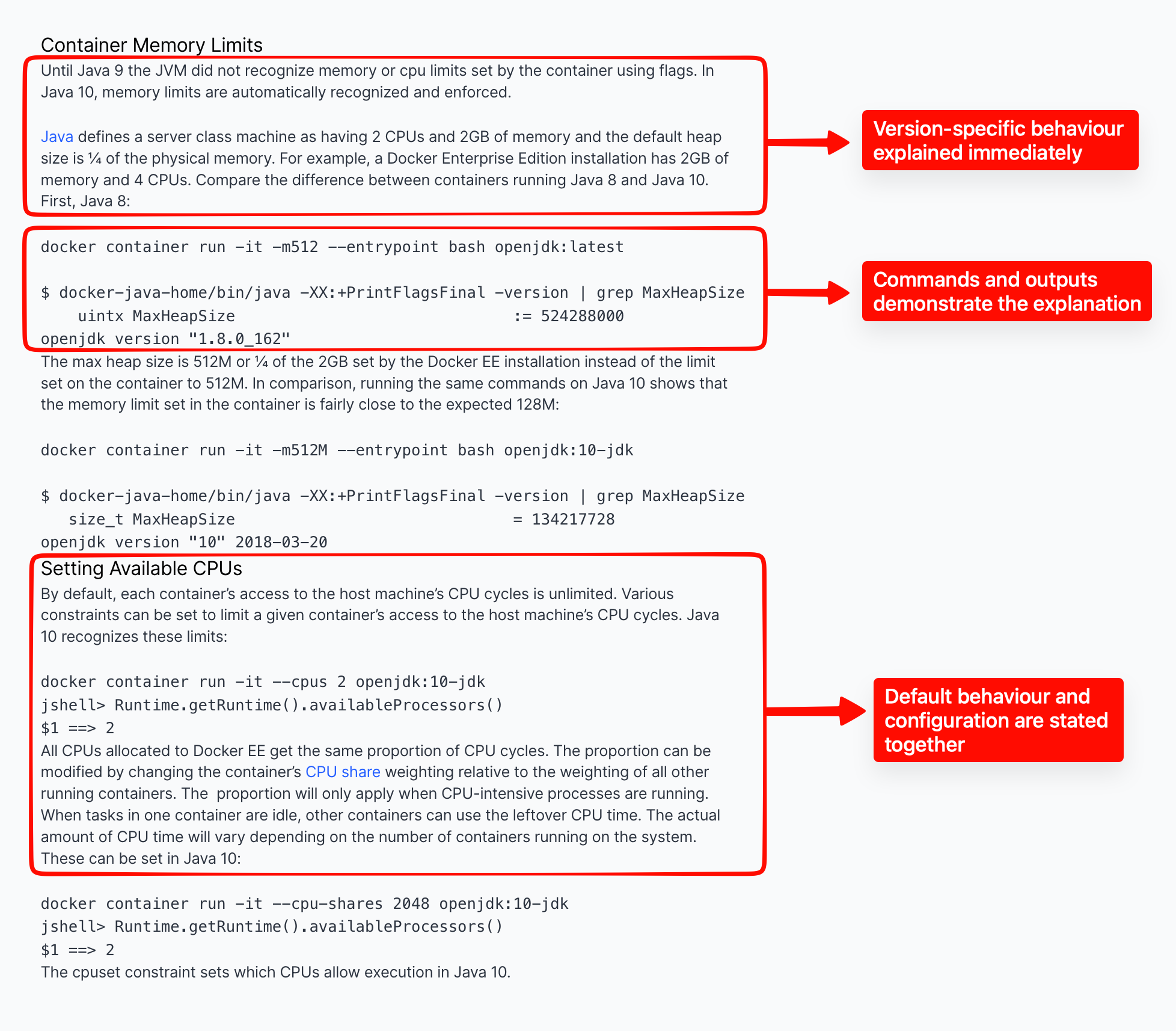
For the narrower Java use case, the blog post goes further into implementation than the broader Docs page. The same overlap appeared in our networking comparison.
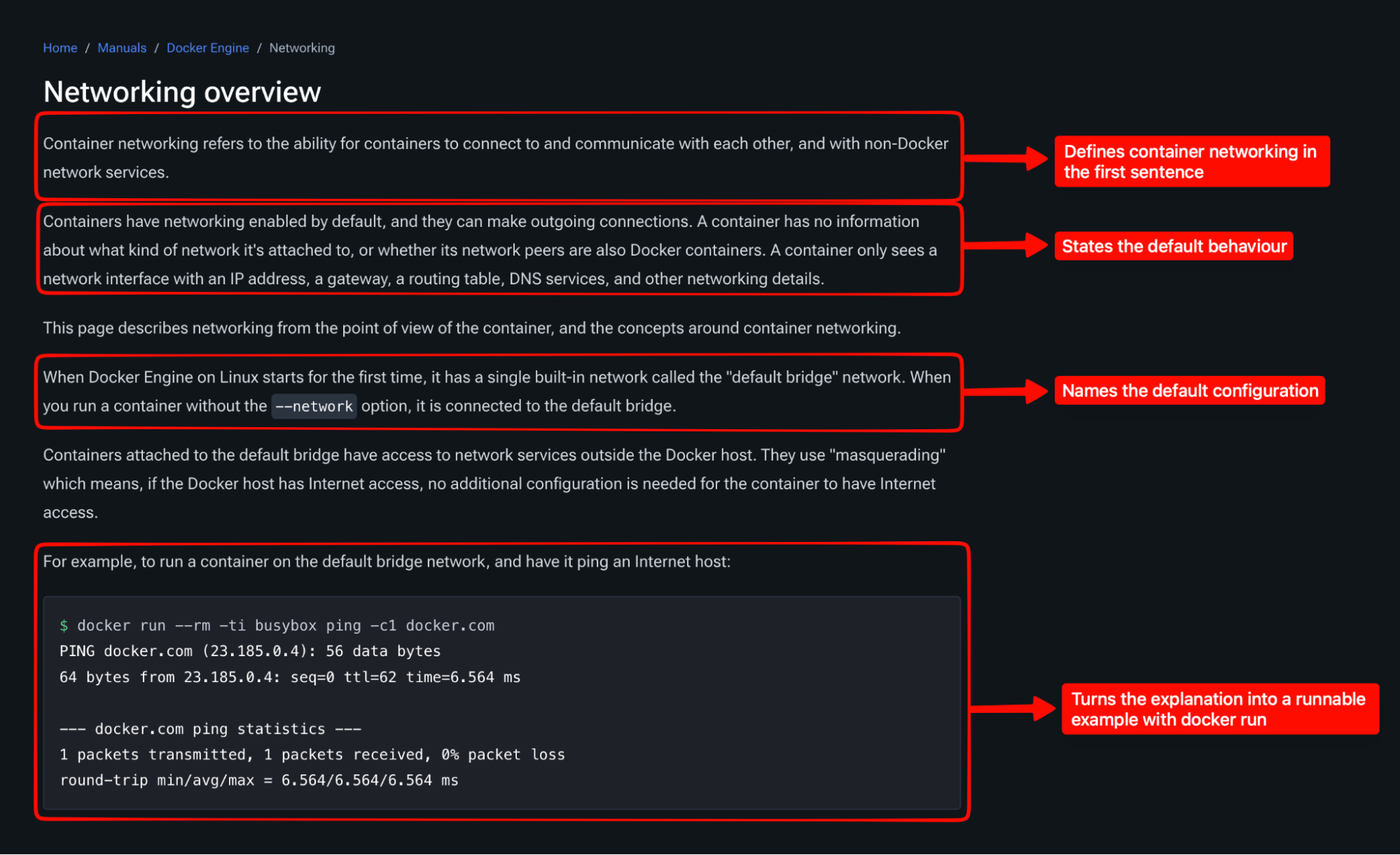
The Networking Overview docs page defines container networking near the top, explains the default bridge model, and gives readers a runnable example.
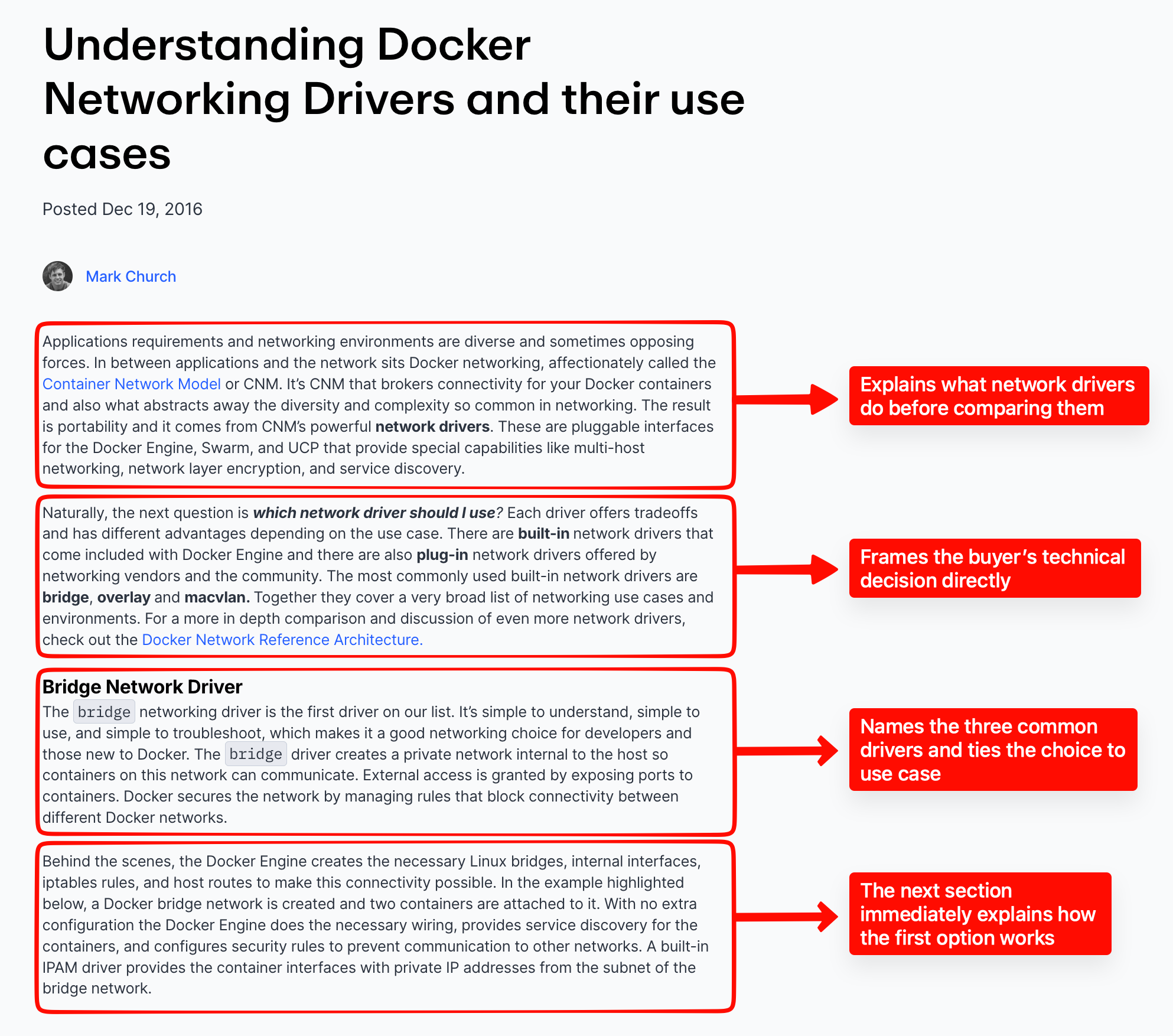
Docker’s Networking Drivers blog post also explains the technical model directly, but moves into a different question: which network driver should you use? It names bridge, overlay, and macvlan and explains how their use cases differ.
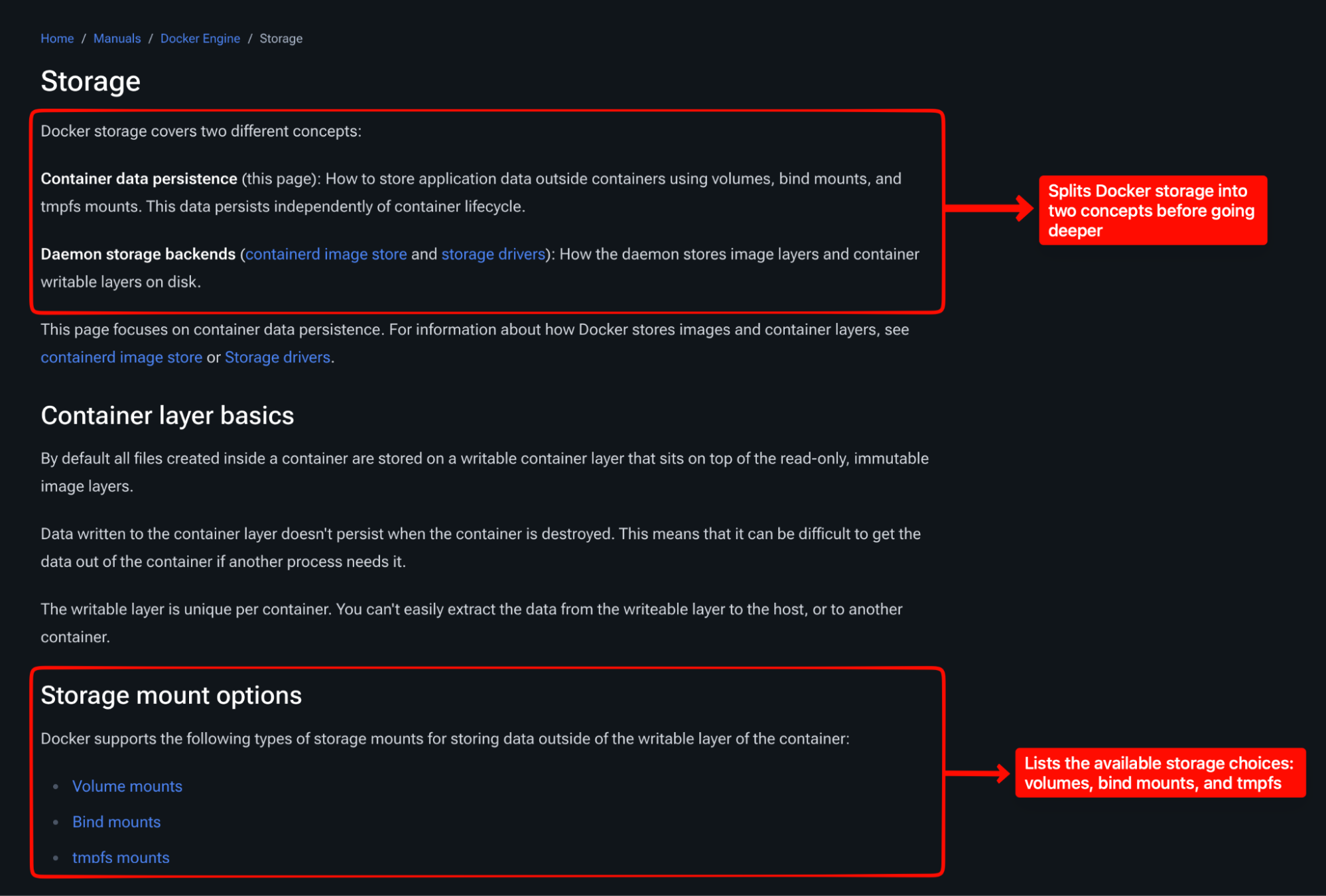
The Storage docs page separates container data persistence from daemon storage before mapping the available mount options.
The Docker blog post on managing volumes defines what a volume is, explains when persistent storage is useful, and then gives readers the commands needed to create, list, remove, inspect, and use volumes. In some places, the blog post gives the reader more step-by-step implementation detail than the broader docs page.
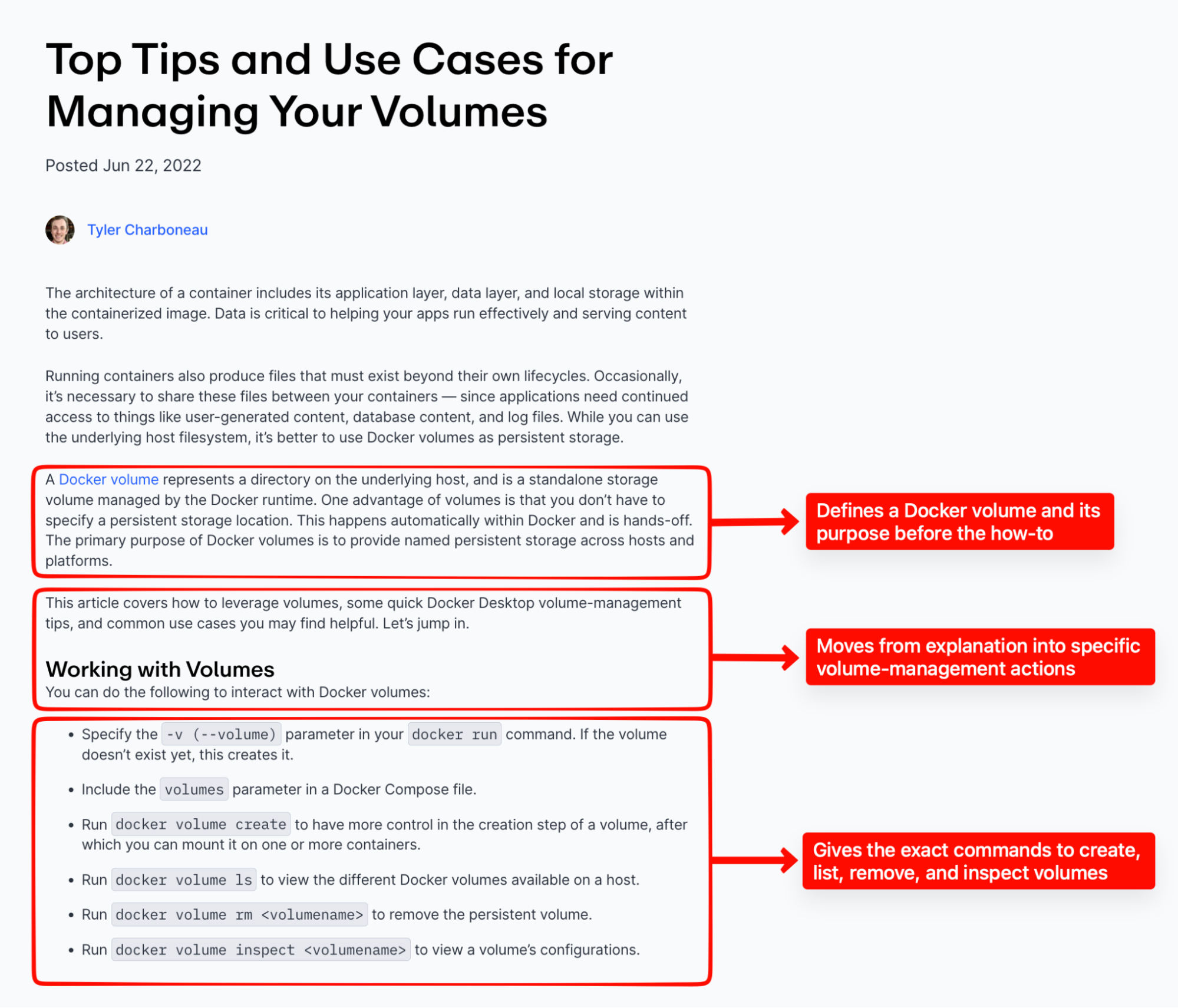
Direct headings, early explanations, commands, operating conditions, and specific product terminology appeared on both sides, and neither carried a positioning buffer.
Our matched-page analysis gave us no evidence that conventional on-page GEO structures by themselves explained Docker Docs’ citation lead. At the passage level, technically rigorous blog posts often looked remarkably similar.
The larger differences were at the program level: Docker had roughly twice as many indexed Docs pages as blog posts, 5.8x the referring domains, and a maintained technical library capable of answering a much wider range of product questions.
Four of Five Recurring Docs Pages Were Updated Within Six Months
For the maintenance check we narrowed to five pages that appeared repeatedly in the Profound data and resurfaced in the manual tests: Security for Enterprises, Administration, Set Up Your Company for Success With Docker, Docker Scout, and Hardened Docker Desktop.
Four of the five had received substantive updates in the previous six months — changes to instructions, product details, configuration guidance, or page structure.

For Hardened Docker Desktop, later May commits covered redirects and icon migration. We counted the February 13 namespace-access-control change as the latest substantive update.
Three Places the Docs Dividend Stops Paying
A maintained first-party evidence layer still has limits. Docker’s data shows three.
Docker Still Does Not Own Most of the Evidence
Documentation was Docker’s strongest first-party source, but third-party tutorials, community threads, reviews, comparisons and support content still shaped most answers. We saw the other side of this problem in our Ghost Citation teardown of n8n,where a highly visible brand still relied heavily on third-party sources to explain it in AI answers.
Strong Evidence Does Not Guarantee Discovery
On neutral discovery prompts, Docker sometimes disappeared entirely. In the August 23 run, Docker appeared in zero of six Profound executions for developer-environment governance, 0 of 6 for software supply-chain security and one of six for local AI development.
In one ChatGPT execution on developer-environment governance, the answer recommended Humanitec, Harness, Backstage, Port and other platforms without mentioning Docker.
Strong documentation can support Docker after retrieval. It cannot guarantee Docker enters the answer in the first place.
The Docs Dividend Weakens on Docker’s New AI Story
Across the 8 prompts about Docker’s newer AI products and agent-development story, the source mix looked different. In the August 23 run, the blog accounted for 46.7% of Docker’s first-party citations, compared with 28.3% for docs. On August 24, the gap nearly disappeared: 35.7% for the blog and 34.7% for documentation.
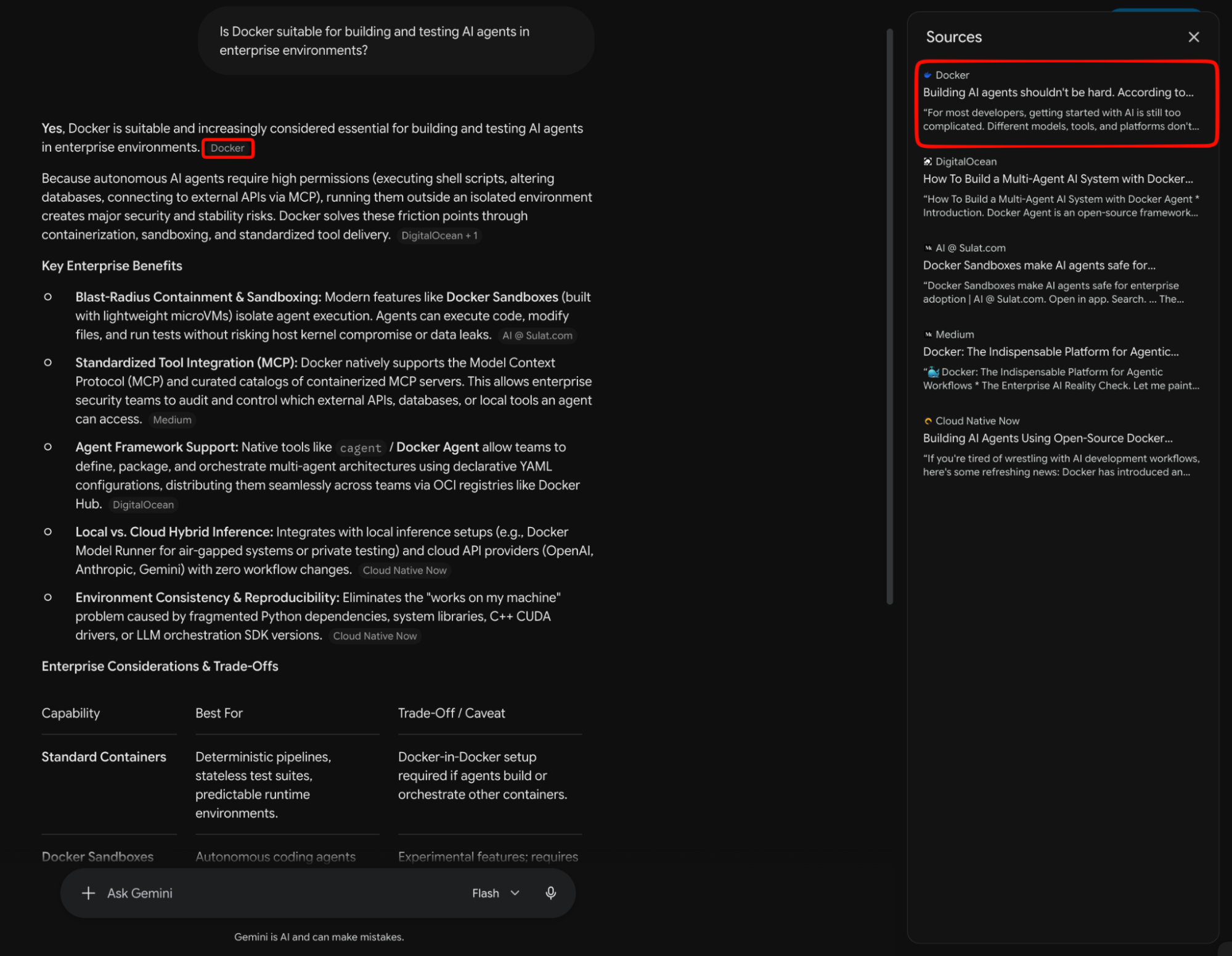
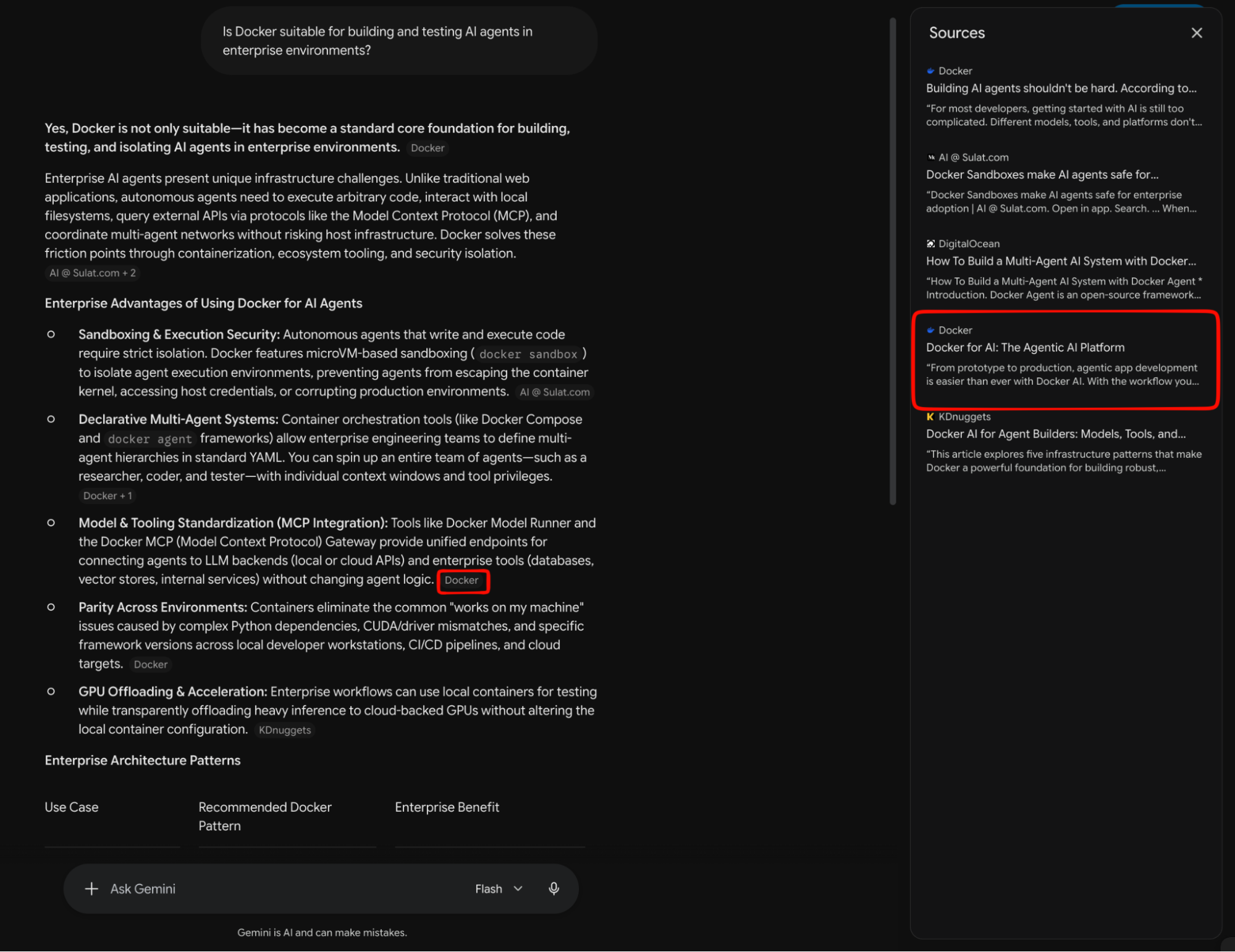
For the prompt “Is Docker suitable for building and testing AI agents in enterprise environments?”, Gemini cited Docker’s blog post “Building AI agents shouldn’t be hard” in both manual rounds on August 23 and 24, 2026.
In the August 24 run, it also cited the Docker for AI product page, “Docker for AI: The Agentic AI Platform.”
One hypothesis worth watching is whether this reflects the maturity of Docker’s AI content. As the surrounding documentation expands, the blog’s citation share may fall. Two days of data across eight prompts can’t tell us whether that will happen.
How to Find Your Docs Dividend
Before you change a page, find out which part of your site AI systems already cite.
1. Map Where Your First-Party Citations Come From
Classify your first-party citations by content type, then compare each layer’s share of citations with its share of the content inventory.
| Example | Citation share | Content inventory share | What it shows |
| Docs A | 50% | 10% | Strong over-index |
| Docs B | 50% | 50% | Citation share tracks scale |
| Docs C | 50% | 70% | Under-index relative to volume |
Raw citation share can hide the difference. Docs A are contributing far more evidence than their size would suggest, while Docs C are under-indexing despite having the largest content footprint.
If you need to establish this citation baseline across the AI platforms your buyers use, our Generative Engine Optimization services cover the broader visibility and citation analysis.
2. Find the Pages That Keep Supplying Evidence
Inside your strongest layer, rank URLs by citation frequency and by recurrence across prompts, runs, and AI surfaces. Record the buyer questions and each recurring page answers.
That shows both the pages supplying the most first-party evidence and the questions where your own content is missing.
If implementation questions repeatedly cite third parties, for example, you may need stronger first-party implementation content rather than another formatting change to an existing page.
3. Compare Those Pages With the Content You Expected to Win
Match each recurring technical page with the closest marketing or editorial page covering the same subject, then compare:
- Subject clarity: Does the page name the feature, task, or concept directly?
- Answer distance: How quickly does it reach the first substantive answer?
- Feature → explanation: Does it explain what the named feature does?
- Operating conditions: Does it include relevant requirements, permissions, versions, dependencies, prerequisites, or exceptions?
- Extractability: Does the factual passage still make sense without the surrounding positioning, proof, or calls-to-action?
Use our downloadable Docs Structural Checklist to run the comparison page by page. [DOWNLOAD THE DOCS STRUCTURAL CHECKLIST]
Use this checklist to compare how two pages answer the same buyer question. These checks are diagnostic, not proven AI ranking factors.
Build the Evidence Layer
Start with the questions your buyers ask before they buy — the ones Docker’s 16 evaluation prompts stand in for — and find out who answers them today.
Where third-party sources dominate, check whether your first-party coverage is missing, too shallow, or simply not being retrieved.
Where an owned page exists but rarely appears, compare it with the pages that do surface: the depth of the answer, surrounding authority, maintenance history, and how much positioning sits between the reader and the factual explanation.
Then watch two things over the next few quarters. Whether your newest products keep pulling blog citations while the docs catch up, as Docker’s AI story did. And whether the pages you’re maintaining are the same pages AI systems keep returning to.
If you need help mapping where your brand is cited, missed, or replaced by third-party sources, our GEO team can help you audit and strengthen your AI visibility. Contact us today.