
Article's Content
Article's Content
Welcome to Volume 278 👋
Happy Thursday!
In this week’s newsletter, we cover:
- 🚀 The Founder-led social strategy driving 33% of Beehiiv’s Traffic (And AI Visibility)
- 📊 The Rules Are Changing — Ahrefs Analysis of 1 Billion AI Search Datapoints
- 👀 The Latest in B2B SaaS This Week
- 🧠 This Week’s Brain Food
- ➕ The Best Content Across the Web
- 📣 We’re Hiring: Check Out Our Open Positions!
Let’s get into it.
🚀 The Secret to Beehiiv’s Explosive traffic growth
When someone asks ChatGPT “What’s the best platform for newsletter monetization?”, Beehiiv dominates the response with an 80.8% visibility score — higher than Substack, Kit, and Ghost combined.
But here’s the fascinating part: this AI dominance didn’t come from traditional SEO. It came from a social-first strategy that’s now paying dividends in ways most brands haven’t even considered yet.
Beehiiv generates 1.43 million monthly referrals from social platforms — 15% of their total traffic. YouTube drives 33% of those referrals. X contributes 24%. LinkedIn adds another 22%. But the real story isn’t the traffic. It’s that every thread, every tutorial video, and every employee advocacy post is training the AI models that answer your customers’ questions.
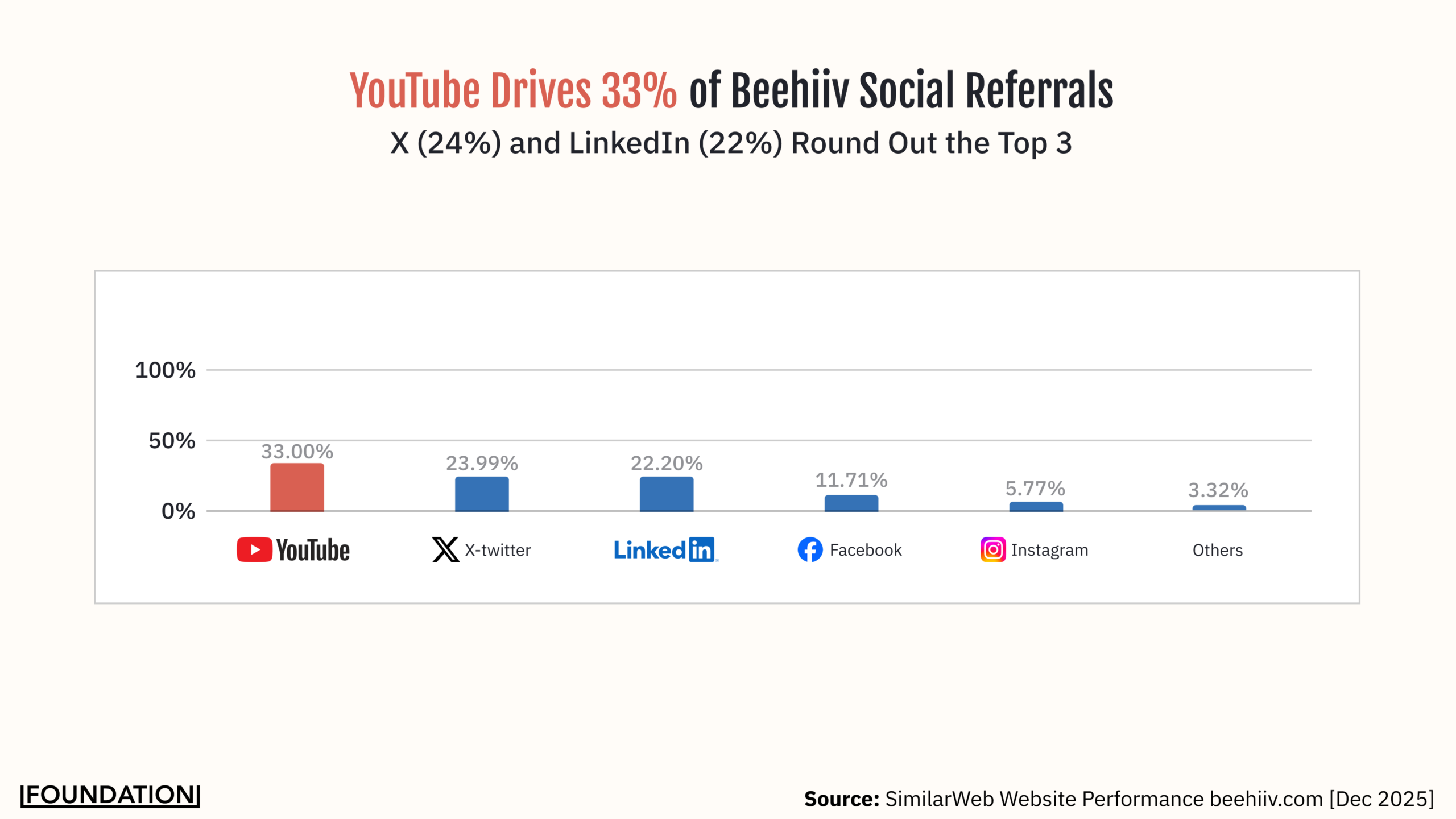
Tyler Denk built Beehiiv by leveraging his Twitter network from Morning Brew. Those first 400 waitlist signups all came from one announcement tweet. Today, that founder-led approach has scaled into a multi-platform machine that dominates both human and AI-driven discovery.
Our complete breakdown reveals what’s actually working:
- The founder-led flywheel: How Denk’s personal X account (41K followers) outperforms the brand account by sharing transparent growth tactics, product feedback screenshots, and well-timed offers that resonate with specific audience segments.
- YouTube as a conversion engine: Why 661 videos and 19K subscribers generate more referral traffic than platforms with 3x the following — and how educational content transforms free users into paying customers while simultaneously feeding AI training data.
- The social proof multiplier: How user-generated content creates a self-reinforcing cycle where current users become evangelists, exposing new creators who become evangelists themselves — all indexed and ranked for branded searches.
Social platforms aren’t just distribution channels anymore. They’re the training data for AI models that increasingly mediate customer research and decision-making.
Read the full breakdown and see exactly how Beehiiv turned social media into their primary growth engine.
📊 Traditional SEO Rules Don’t Apply — Takeaways from Ahrefs Analysis of 1 Billion Data Points on AI Search
Ryan Law and the team at Ahrefs just gave every marketing department an early (or late) Christmas present: sharing the cliff notes from 11 studies analyzing over 1 billion data points across AI search platforms.
It provides a high-level view of what’s happening with AI visibility. Here are some of the most important takeaways:
- YouTube mentions are the single strongest predictor of AI visibility, with a correlation of 0.737 — stronger than Domain Rating, backlinks, or any traditional SEO factor combined. Both Google and OpenAI train on YouTube content, and it’s heavily cited in AI responses. If your content strategy doesn’t include video, you’re invisible where AI models are actually looking.
- The content length myth is dead. Ahrefs found essentially zero correlation (0.04) between content length and AI citations. 53% of all AI Overview citations go to pages under 1,000 words. The 3,000-word comprehensive guide optimized for search crawlers? Not necessary for AI visibility.
- Fresher content gets cited more, with 79% of blog lists cited by ChatGPT updated in 2025, and 76% of top-cited pages refreshed within the last 30 days. AI Overviews themselves are volatile — changing 70% of the time, with individual citations lasting just 2.15 days on average.
- “Best X” blog lists dominate ChatGPT responses, making up 43.8% of all page types cited — and 35% of those come from low-authority domains. The implication: AI platforms prioritize format and freshness over traditional authority signals.
But Law reminds us to keep things in perspective. Google still sends 345x more traffic than ChatGPT, Gemini, and Perplexity combined. ChatGPT accounts for 80%+ of all AI-driven website traffic, but we’re still talking about a fraction of what organic search delivers.
For marketers, this research supports the main takeaway from SEO vs GEO debates. Optimize for traditional search with proven tactics, but start building your AI visibility playbook now: invest in YouTube content, refresh existing assets aggressively, format content as scannable lists, and stop chasing word count or domain authority as primary KPIs.
🗽 We’re Headed to SEO Week NYC
Ross Simmonds is taking the stage at SEO Week in NYC this April to break down exactly how modern brands earn real attention and lasting visibility across search, social, and AI systems in 2026.
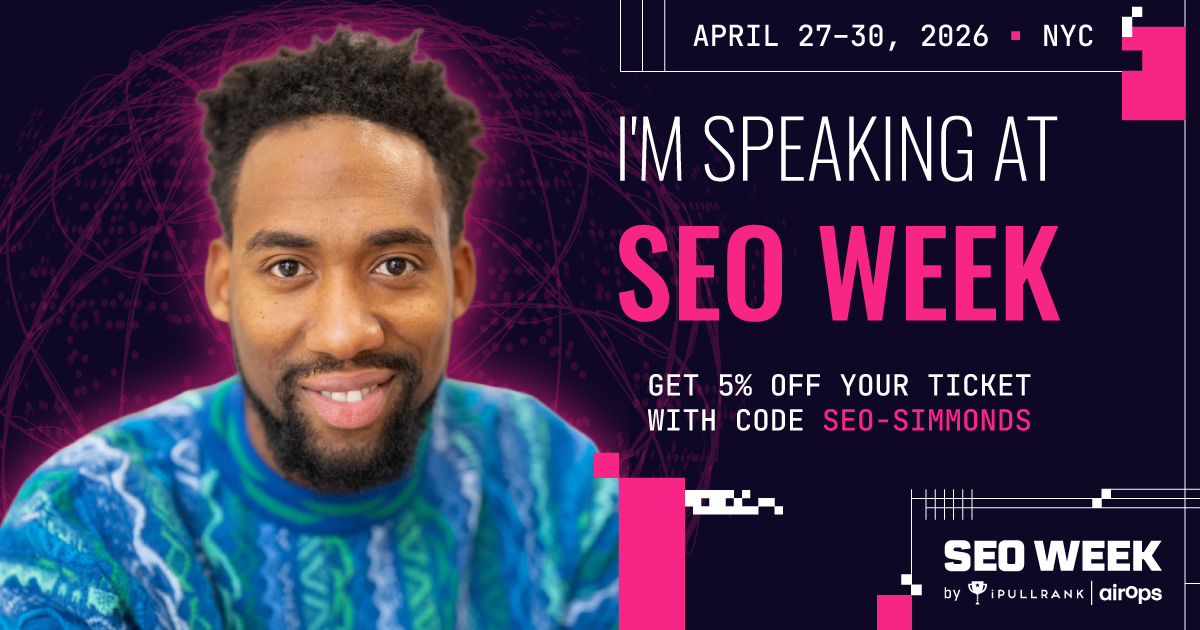
If SEO, GEO, AI optimization, and smart content distribution are on your roadmap, this is the must-attend event.
Get 5% off your ticket with code SEO-SIMMONDS at seoweek.org
👀 What’s the Latest in B2B SaaS This Week?
📈 Fundamental raises $255 million Series A with a new take on big data analysis | TechCrunch
📢 Gemini Set to Bring Significant Improvements to Google’s Ad Business |AdWeek
📉 Update: AI Overviews Reduce Clicks by 58% | Ahrefs
🤝 OpenAI Is Hiring Hundreds of AI Consultants to Boost Enterprise Sales | The Information
💻 Google parent Alphabet shares fall 5% after earnings beat. Here’s what’s happening | CNBC
🚨 New Podcast Alert: The Stockdale Paradox — Why Blind Optimism Kills Startups
In the latest episode of The Ross Simmonds Show, Ross breaks down one of the most dangerous myths in startup culture: that relentless positivity is the key to success.
Drawing from the story of Admiral James Stockdale and his survival as a POW, Ross introduces the Stockdale Paradox — the counterintuitive idea that winning leaders hold two truths at once: unwavering belief they will succeed, and brutal honesty about the reality in front of them.
Here’s what Ross covers:
- Blind optimism is quietly killing more startups than bad markets. “Stay positive” sounds good, but when it becomes denial, founders miss the warning signs that could save their companies.
- Toxic optimism destroys trust faster than bad news. When leaders spin every metric and ignore churn, teams stop believing. False confidence shortens your runway. Honesty builds resilience.
- Fear-driven leadership kills growth. Pessimism and doomsday thinking stall innovation, disengage teams, and create self-fulfilling prophecies. Conviction matters as much as realism.
- Great leaders hold two truths at the same time. Ross shares how to confront hard metrics, communicate bad news transparently, and still rally the team around long-term belief.
- Things can be hard and you can still win. The best founders don’t pretend challenges don’t exist. They acknowledge them, adapt, and stay locked in on the outcome.
Listen to the full episode on Apple Podcast or Spotify to learn how to balance brutal honesty with unshakable belief — and lead like you actually plan to win.
🧠 This Week’s Brain Food
The marketing discourse would have you believe TikTok is eating the world and Facebook is dead. New data from Pew Research tells a different story.
Despite years of “Facebook is over” takes and TikTok growth narratives, 84% of U.S. adults use YouTube and 71% use Facebook. Instagram is the only other platform breaking 50%. Meanwhile, after a few years of explosive growth TikTok, sits at just 37% of adults, while Reddit (26%), Snapchat (23%), and X (21%) trail even further behind.
The daily usage patterns are even more revealing.
About half of U.S. adults visit Facebook or YouTube every single day, including 37% who check Facebook several times daily. Just 24% of adults are daily TikTok users. For all the attention it commands, TikTok hasn’t yet become a daily habit the way Facebook and YouTube have.
The gap widens further when you look beyond the under-30 demographic. While 80% of 18–29 year-olds use Instagram and roughly half use TikTok daily, YouTube and Facebook are the only platforms a majority uses across all age groups. Facebook usage actually peaks among 30–49 year-olds (80%).
So, what does this all mean?
Newer platforms dominate the conversation, but older platforms still dominate reach and frequency. If you’re chasing TikTok virality while ignoring YouTube’s 84% penetration and daily usage, you’re optimizing for narrative over numbers. The platforms everyone thinks are dying still deliver the scale and habit formation that newer ones are years away from matching.
Want to sponsor our next issue? Reply to this email, and we’ll share how you can reach more SaaS founders and marketers today.
🏅 Reddit Post of the Week
100 Proven Instagram Hooks That Went Viral {Steal Them for Your Content} In r/SocialMediaMarketing
🎖️ LinkedIn Post of the Week
Must-read for SEOs. This has likely been the most popular tactic for AI Search visibility. By Brodie Clark
🤳🏽 Nice Finds You Should Binge
- Google Bets on ‘Helpful AI’ to Push Gemini Into the Zeitgeist in Super Bowl Ad | AdWeek
- Hollywood Is Losing Audiences to AI Fatigue | WIRED
- Exposed Moltbook Database Let Anyone Take Control of Any AI Agent on the Site | 404Media
- Increase of AI bots on the Internet sparks arms race | Ars Technica
💻 Job Postings Worth Checking Out
Looking for a new opportunity? Here’s a round-up of some exciting job openings in the B2B SaaS space.
- Foundation Marketing | GEO Partnerships Coordinator (PT)
- Foundation Marketing | Senior Account Manager
- Foundation Marketing | Reddit Specialist
- Foundation Marketing | Content Creator
- Foundation Marketing | Senior Account Coordinator
- Foundation Marketing | Senior Content Strategist
- Foundation Marketing | Executive Marketing & Outreach Assistant
Want us to include your job postings in our next issue? Reply to this email, and we’ll share how you can reach more SaaS professionals today.
🎧 What We’re Wired Into This Week
Olivia Dean – Live At The Jazz Cafe
This SaaS news smattering is brought to you by Ethan Crump!
If you have any feedback, suggestions, or ideas you want to see in this newsletter, feel free to email me at ethan@foundationinc.co. We’re always looking for ways to improve and provide the best B2B SaaS marketing resources.
Have a great weekend!