
Article's Content
Article's Content
Welcome to Volume 280 👋
Happy Thursday!
In this week’s newsletter, we cover:
- 💸 Google Ads CPL Is Up 69%. Most Teams Fix the Wrong Thing.
- 🔬 Which is Better for AI Crawlers? Markdown vs. HTML
- 👀 The Latest in B2B SaaS This Week
- 🧠 This Week’s Brain Food
- ➕ The Best Content Across the Web
- 📣 We’re Hiring: Check Out Our Open Positions!
Let’s get into it.
💸 Google Ads CPL Is Up 69%. Most Teams Fix the Wrong Thing.
Google Ads cost per lead is up 69% in four years. CPC is climbing across 87% of industries. And when the numbers dip, most teams do the same thing — swap headlines, adjust audiences, raise bids.
Everybody’s busy. Nobody knows the root cause.
Foundation’s Strategy Director Ben Dankiw has spent 15 years watching teams burn budget fixing the wrong thing. This week he walked us through his solution: a three-pillared diagnostic framework that separates paid media performance into creative, landing page, and post-click — each with its own signal metric and set of fixes.
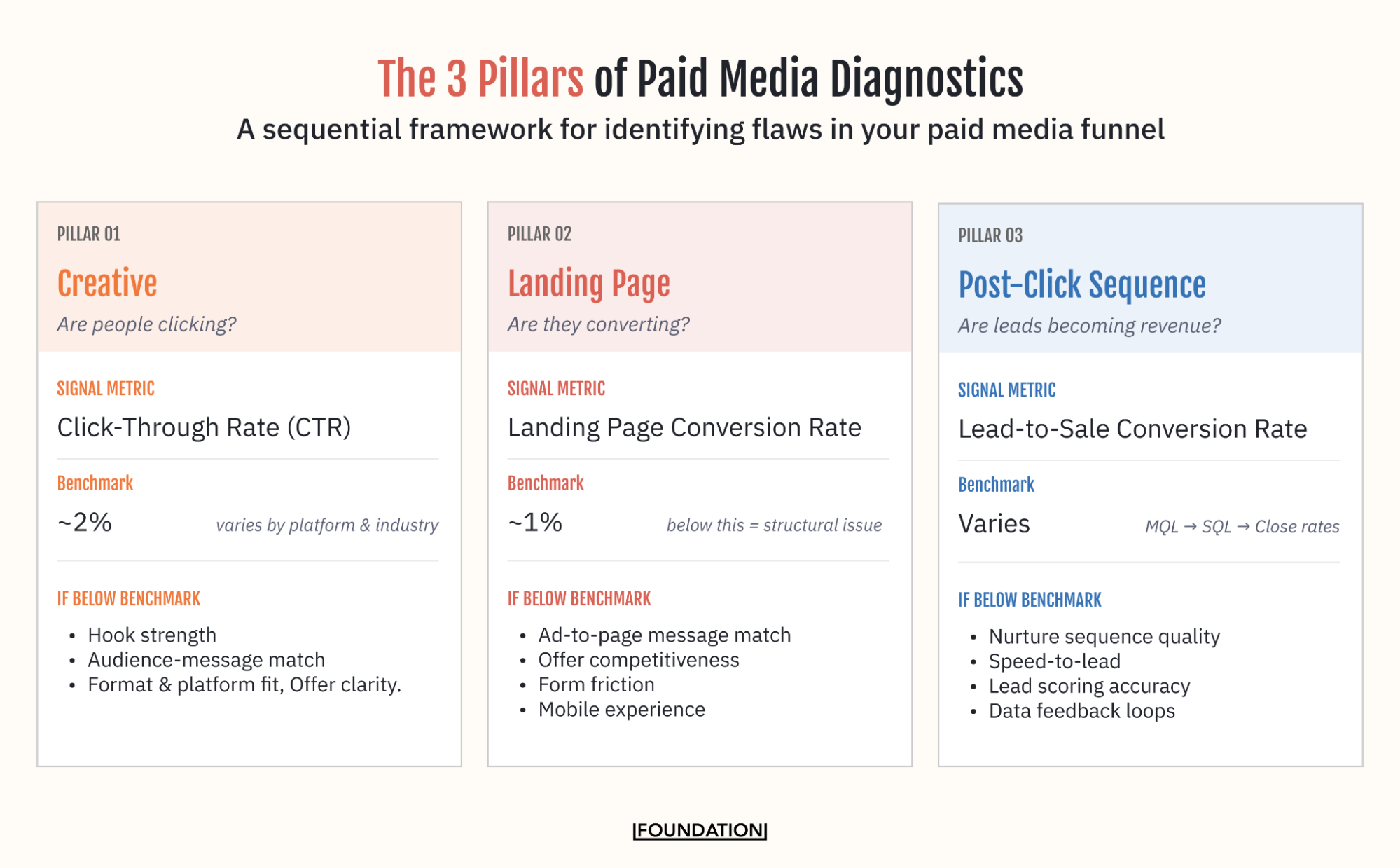
These insights come at the perfect time: too many teams still conflate cheap clicks with mean efficient spend.
For instance, while Meta’s average CPC is far lower than Linkedin’s, Dreamdata found that LinkedIn delivers 113% ROAS compared to Meta’s 29% — but only for teams that measure through to closed revenue. Most teams aren’t.
Before you rewrite another ad or rebuild another page, run the diagnostic first.
🔬 Markdown vs. HTML for AI Visibility: Profound Weighs in with Data
One of the more persistent theories in the GEO community has been that serving Markdown to AI crawlers — instead of standard HTML — boosts your visibility in tools like ChatGPT and Perplexity. The logic made sense on the surface: markdown is cleaner, more structured, and easier for LLMs to parse. A few high-profile sites even reported gains after making the switch.
But the evidence was mostly anecdotal. Until now.
New research from Profound ran a proper A/B test across 381 pages on six real websites, randomly splitting pages into two groups: one serving standard HTML to AI bots, the other serving clean Markdown versions of the same content. They tracked bot visits over three weeks from crawlers tied to OpenAI, Anthropic, Perplexity, Meta, and DuckAssistBot.
Markdown pages saw roughly one additional median bot visit over the entire three-week window — about a 16% higher mean. But that difference was driven almost entirely by pages that were already getting heavy bot traffic. The typical page saw almost nothing.
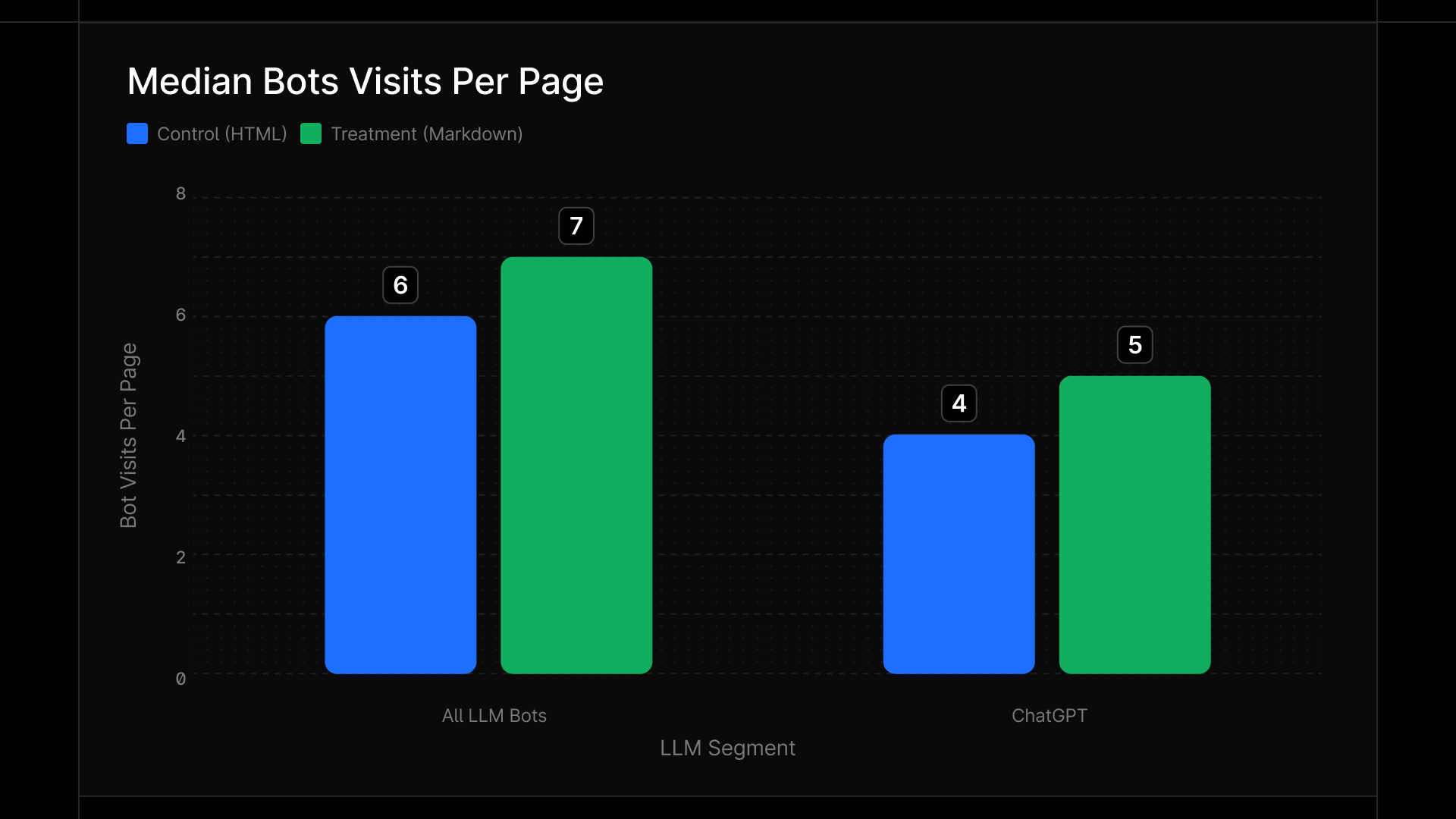
The one signal worth watching: ChatGPT-User — the bot triggered when someone uses ChatGPT’s web search — made up 74% of all bot traffic in the experiment and showed a consistent directional lean toward Markdown (~+20%). But even that wasn’t statistically significant.
The likely reason for these undramatic results is straightforward. LLMs have been trained on billions of pages and have spent years optimizing their crawlers to handle HTML at scale. Markdown may be cleaner in theory, but cleanliness doesn’t appear to translate into a meaningful crawl advantage, at least not yet.
The bottom line for anyone chasing AI visibility: format optimization is probably not the lever you’re looking for. Fast load times, crawlable structure, and genuinely useful content still matter far more than what markup language your bot sees.
🗽 We’re Headed to SEO Week NYC
Ross Simmonds is taking the stage at SEO Week in NYC this April to break down exactly how modern brands earn real attention and lasting visibility across search, social, and AI systems in 2026.
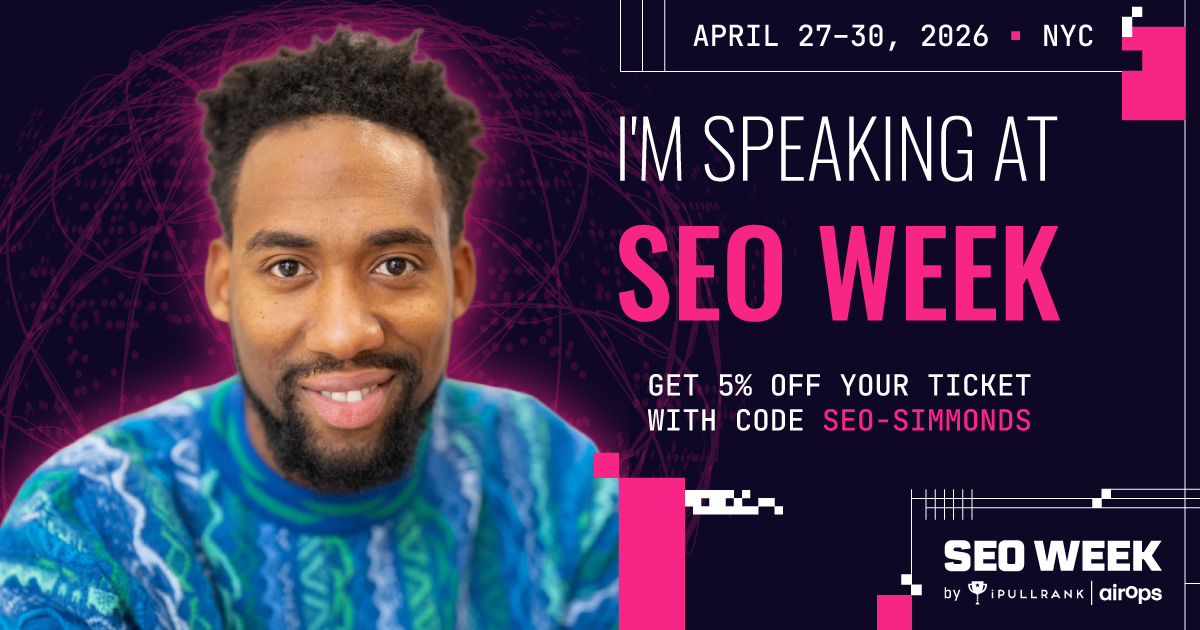
If SEO, GEO, AI optimization, and smart content distribution are on your roadmap, this is the must-attend event.
Get 5% off your ticket with code SEO-SIMMONDS at seoweek.org
👀 What’s the Latest in B2B SaaS This Week?
💰 OpenAI Is Finalizing First Commitments for $100 Billion Mega Round | The Information
💬 How answering People Also Ask questions correlates with organic rankings (Study) | Also Asked
⛔ Perplexity Abandons AI Advertising Strategy Over Trust Worries | MacRumors
🤝 OpenClaw creator Peter Steinberger joins OpenAI | TechCrunch
📺 YouTube outage cause revealed: Here’s what we know | Mashable
🚨 New Podcast Alert: The Enterprise AI Stack Blueprint — How to Build It Right (Without Wasting Millions)
In the latest episode of The Ross Simmonds Show, Ross gets tactical about something most enterprises are getting completely wrong: building an AI stack based on hype instead of strategy.
He breaks down a use-case-driven framework for building an AI stack that actually works — one that scales, stays secure, and doesn’t lock you into costly mistakes. Here’s what Ross covers:
- Most companies are choosing AI tools for the wrong reasons. Vendor pitches and social buzz are driving long-term contracts that create scaling and security nightmares.
- There is no “best” AI tool — only the right tool for the right use case. Marketing, engineering, and finance all have different needs. Stop hunting for a silver bullet and start building a stack shaped by your constraints, industry, and goals.
- The 5-Layer AI Stack Framework is your blueprint. Writing & Communication, Research & Analysis, Code & Technical Execution, Automations & Workflow Integration, and Security & Compliance.
- AI adoption fails without ownership and training. Appoint an AI stack owner, build internal systems for sharing prompts and workflows, and capture institutional knowledge before it walks out the door with one employee.
- Start small, but start strategic. Don’t wait for the perfect moment — AI is already reshaping competition. Build security and compliance in from day one and budget realistically for tools, training, and ongoing maintenance.
Listen to the full episode on Apple Podcast or Spotify to get the framework you need to build an enterprise AI stack that actually delivers — without blowing your budget or betting on the wrong platform.
🧠 This Week’s Brain Food
A new commentary published in Cognitive Science argues that perfectly sustained attention is theoretically impossible. And the implications extend well beyond the lab.
Drawing on decades of research across neuroscience, cognitive psychology, and real-world safety systems, researchers Sharpe and Tyndall argue that attention lapses, instead of being a personal failure or a training problem, are actually hardwired into the architecture of the human brain. The default mode network (in charge of mind-wandering and memory consolidation) is always competing for bandwidth with task-focused systems.
The real-world data reinforces the point. Highly trained lifeguards show significant vigilance drops within just 10 minutes of continuous monitoring. Vigilance failures contribute to roughly 20% of aviation incidents — even with multiple crew members present. CCTV operators, nuclear plant supervisors, and surgical teams all show the same pattern: motivation and expertise slow the decline, but they don’t stop it.
Even elite performers don’t escape this. Studies of U.S. Army Rangers and experienced Buddhist monks show measurable attention fluctuations when examined closely. Flow states and pharmaceutical enhancers can optimize attention management — but they don’t eliminate the underlying constraints.
The takeaway for anyone building teams or workflows around sustained human monitoring is blunt: stop trying to train your way out of a biological reality. Design systems that work within human attention limits.
Want to sponsor our next issue? Reply to this email, and we’ll share how you can reach more SaaS founders and marketers today.
🏅 Reddit Post of the Week
Marketing teams aren’t slow, they’re just stuck waiting on permission In r/marketing
🎖️ LinkedIn Post of the Week
My shpiel on LinkedIn post hooks (I find most advice here over-indexes on them) By Josh Cons
🤳🏽 Nice Finds You Should Binge
- Mark Zuckerberg and his Ray-Ban entourage have their day in court | The Verge
- Nvidia’s Deal With Meta Signals a New Era in Computing Power | WIRED
- OpenClaw security fears lead Meta, other AI firms to restrict its use | Ars Technica
💻 Job Postings Worth Checking Out
Looking for a new opportunity? Here’s a round-up of some exciting job openings in the B2B SaaS space.
- Foundation Marketing | GEO Partnerships Coordinator (PT)
- Foundation Marketing | Senior Account Manager
- Foundation Marketing | Reddit Specialist
- Foundation Marketing | Content Creator
- Foundation Marketing | Senior Account Coordinator
- Foundation Marketing | Senior Content Strategist
- Foundation Marketing | Executive Marketing & Outreach Assistant
Want us to include your job postings in our next issue? Reply to this email, and we’ll share how you can reach more SaaS professionals today.
🎧 What We’re Wired Into This Week
This SaaS news smattering is brought to you by Ethan Crump!
If you have any feedback, suggestions, or ideas you want to see in this newsletter, feel free to email me at ethan@foundationinc.co. We’re always looking for ways to improve and provide the best B2B SaaS marketing resources.
Have a great weekend!