Article's Content
Article's Content
Welcome back to What Matters This Week.
Last week, we covered Condé Nast planning for zero search traffic and what B2B teams can learn from a publisher’s worst-case scenario. This week, we’re looking at the other side of the same coin: Google finally telling marketers how to show up in AI Overviews and AI Mode.
Google Published Its First GEO Guide. But it’s Only Half the Picture.
Here’s the TL;DR
- Google published the first official guide on optimizing for generative AI features. The headline message: SEO fundamentals still apply, and they debunked several GEO myths.
- Google explicitly calls out five GEO myths: llms.txt files, content chunking, AI-specific rewriting, chasing inauthentic mentions, and overfocusing on structured data.
- Don’t forget that 1) Google has a history of saying one thing and doing another and 2) there are plenty of other AI surfaces that B2B buyers use. This advice is specific to Google’s AI SERP features.
What’s happening
Google published their developer guide on GEO this week: Optimizing your website for generative AI features on Google Search. It’s the latest information from Google on how to show up in the AI Overviews and AI Mode chats that are replacing the old blue link experience.
The core message is simple: the SEO fundamentals haven’t changed. If Google can index your content and surface it in the SERPs, it can also use it for generative AI features.
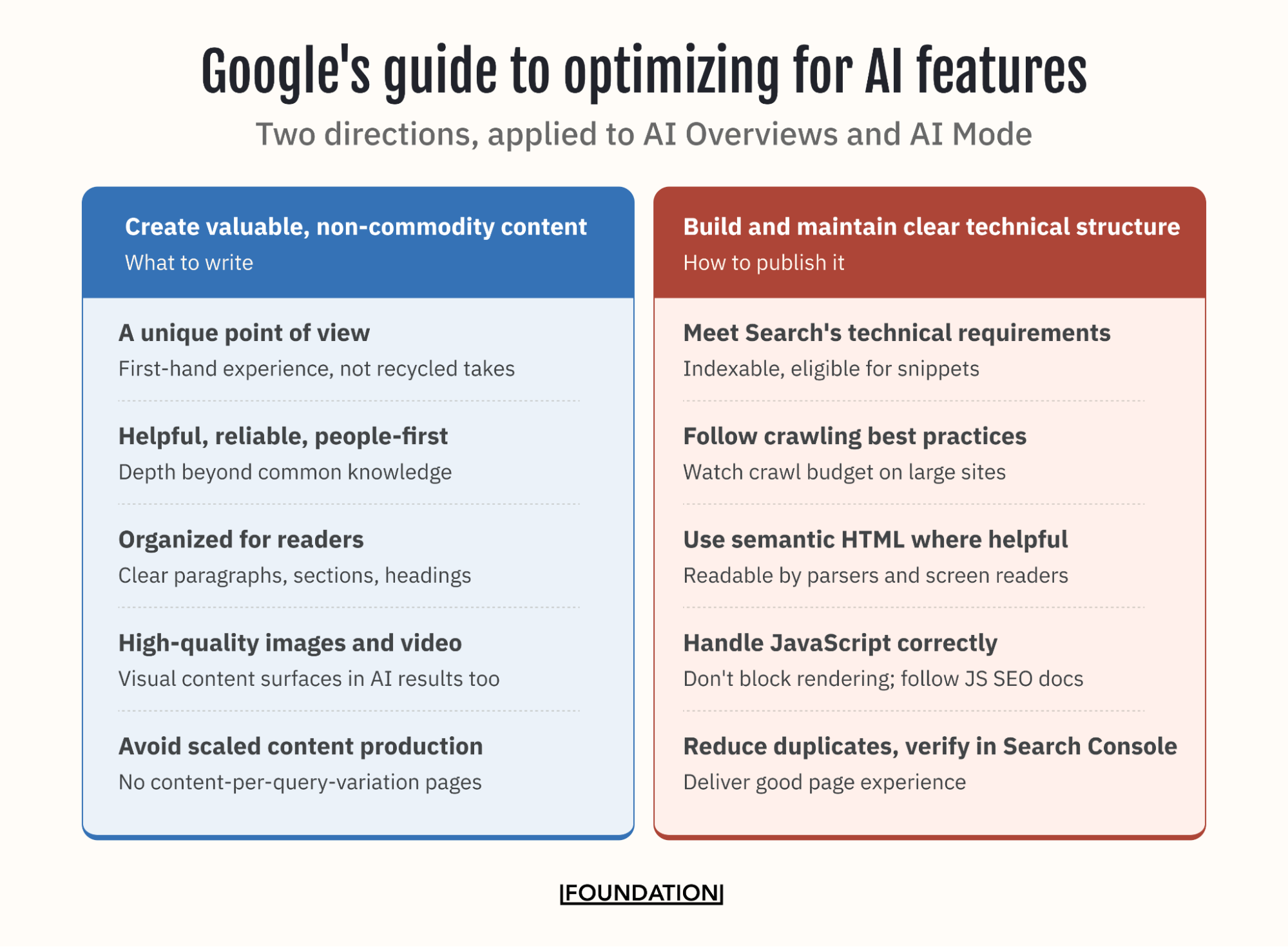
As for how to increase the likelihood of getting in those features, the guide organizes the work into two buckets:
- Create valuable, non-commodity content. Google leans hard on first-hand experience, unique perspective, and depth beyond common knowledge. Their example: a generic 7 Tips for First-Time Homebuyers loses to Why We Waived the Inspection & Saved Money: A Look Inside the Sewer Line. First-hand experience and insights beat recycled or AI-generated.
- Build clear technical structure. Continue to meet Search’s technical requirements. Follow crawling best practices. Use semantic HTML where it helps readability. Handle JavaScript correctly. Reduce duplicates. None of this is new, they’re just reiterating that it matters in the context of their AI features.
The most pointed section includes a list of GEO myths that Google says are either unnecessary or actively harmful to AI visibility:
- LLMs.txt files and special markup. No machine-readable files required.
- Content chunking. Google can parse pages covering multiple topics and surface the relevant section.
- Rewriting content for AI. Models understand synonyms. You don’t need separate pages for every query variation.
- Seeking inauthentic mentions. Spam systems block manufactured mentions. Core ranking systems prioritize quality.
- Overfocusing on structured data. Not required for AI search, though still useful for rich results.
Don’t Forget Google’s Track RecordIn the past, Google’s public guidance has described their search systems in ways that were demonstrably false. The 2024 API leak confirmed Google used several click signals that they had denied on record for years: Chrome clickstream data and site-level authority scoring. That doesn’t mean this guide is dishonest, but take it with a grain of salt. Prime example: not even a week after the GEO search guide came out, new documentation for Google’s Lighthouse tool describes llms.txt as an “emerging convention.” The context is within Agentic AI, not search, but it’s something to note. |
Why it matters
This is a warning shot against AI-slop content strategies.
This isn’t the first time Google has mentioned content quality. A few weeks ago, the company explicitly called out the saturated, commodity content brands are chasing with scaled AI content. And recent reporting on the negative search impact of AI-heavy content strategies shows that Google is serious about this shift.
For marketing leaders, this means investing in a strategy that produces original, experience-based content benefits you in two ways:
- Reduces the risk of a search penalty that costs 30–50% of your organic traffic
- Increases the chance that your content surfaces in the SERPs and AI features
To earn that visibility with non-commodity content, you’re going to need first-hand data, named expert perspectives, and, ideally, some credentials. And no, I don’t mean the kind that you get from asking Claude to “act like a cybersecurity expert with 200 years of experience.”
A lot of marketing strategies are full of GEO myths
GEO, AEO, and all the other “EOs” have gotten a lot of airtime over the last few years. Vendors, service providers, and agencies (us included) have discussed the topic. And, while they may not say it publicly, every company has (or should have) a strategy for how they will win AI visibility.
Well, Google just weighed in on all of these strategies and, trust issues aside, it’s worth taking a closer look at which of these myths are in your strategy. Some pose more risk than others.
Adding an llms.txt file to your root directory? Low risk.
Using AI to create 1,000 new blog posts in a quarter? High risk.
Chunking content? Low risk.
Spamming Reddit and review sites with AI-generated testimonials? High Risk.
You get the picture. It’s time for a sober, honest assessment on whether the GEO strategy you’re following is sound, a waste of resources, or, at worst, actually working against you in the SERPs and AI features.
What to do about it
Between Google’s latest stance on GEO and content, and their dishonest track record on how their tools operate, it’s hard to know what to do. Based on AI visibility data from our Hidden Selection Phase report with AirOps, we’ve seen that brands need to focus more on how they distribute their high-quality content.
Build a content distribution strategy that influences every AI platform.
Google’s guide is about Google Search’s AI features. It says nothing about the way popular tools like ChatGPT, Claude, or Perplexity form their answers. Those systems operate on different retrieval and training data, and have different systems for browsing the web. How much the web browsing overlaps with Google is constantly changing, but it’s not a complete overlap.
The Hidden Selection Phase data shows that roughly 90% of brand mentions in AI search come from third-party content, while just 10% point to brand-owned domains.
The remaining citations originate from “non-owned” channels like Reddit, YouTube, LinkedIn, review sites, and community forums. A GEO program built only on brand-owned domains (even if its high-quality non-commodity content) leaves the channels generating the vast majority of citations untouched.
Build a system to create high-EEAT content at scale.
Generic SEO content isn’t going to win you visibility in the SERPs, and it isn’t working in Google’s AI SERP features either. To stand out across organic and AI search, you need to produce non-commodity content that’s based on genuine experience, expertise, authority, and trustworthiness.
Every B2B SaaS or services company has internal experts with product-, customer-, and industry-level insights that people want to read and algorithms want to cite. Building a content supply chain that captures this information and turns it into content is how you build a moat of non-commodity content.
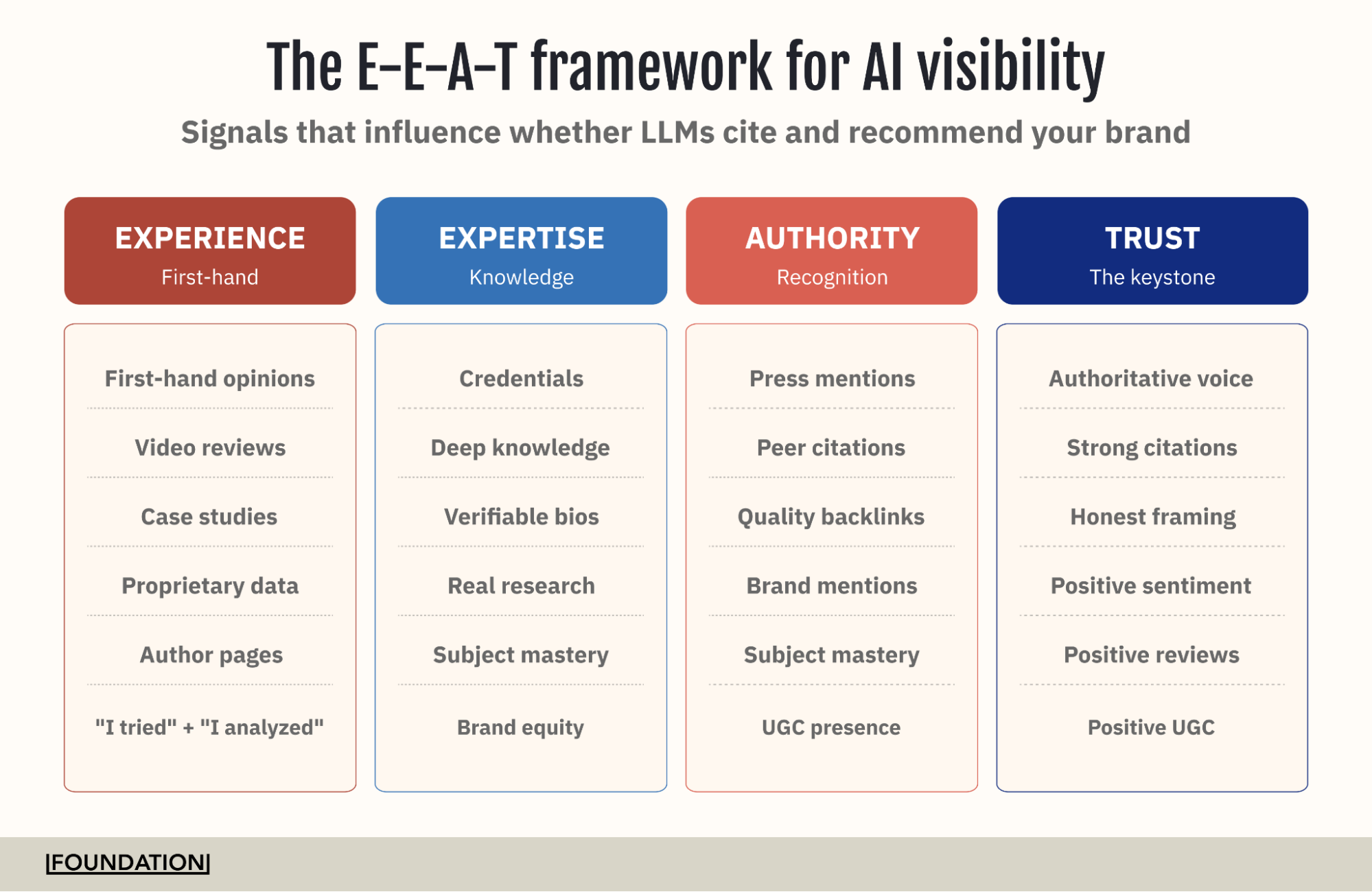
When Google first made the non-commodity announcement about a month ago, I highlighted how brands like Beehiiv, 6Sense, and Clarity are ahead of the curve on this type of content. These brands have content engines that turn insights from co-founders, C-Suite executives, and subject matter experts into high-EEAT content. But even more importantly, they embrace content distribution to expand the influence of that content.
What 57.2 Million Citations Reveal About the AI Visibility Gap in B2B
We partnered with AirOps to track how 50 B2B brands appear in AI-generated responses across five major platforms over 60 days. When buyers search for your category without your brand name, only 2% of citations in AI responses point to content you own. In 90% of those responses, no brand-owned source appears at all.

The full report maps where those citations come from, how the fingerprint shifts by vertical, and what the brands earning more citations are doing differently.
Read The Hidden Selection Phase Report: The 14x Gap Between Branded and Unbranded AI Citations.
Go Deeper on Google’s AI Search Guide
→ Google Released an AI Optimization Guide: Here’s What It Means for Your GEO Strategy — Our full breakdown of the guide, the five tactics Google explicitly debunks, and how to integrate it into a broader GEO program. Covers the EEAT-first content approach Ross laid out at SEO Week, the AirOps data showing 90% of brand mentions in AI search come from third-party sources, and the earn-vs-game framework for evaluating which tactics survive the next round of trust and safety policy. The execution context for everything in this issue. [Foundation Labs]
→ Google’s llms.txt Guidance Depends on Which Product You Ask — Matt G. Southern at Search Engine Journal documents the contradiction we flagged earlier in this issue. Google Search lists llms.txt among tactics you don’t need. Days earlier, Lighthouse 13.3 shipped an Agentic Browsing audit that checks for the file and calls it an “emerging convention.” A useful read for anyone making 2026 budget decisions based on Google’s guidance. [Search Engine Journal]
→ An Anonymous Source Shared Thousands of Leaked Google Search API Documents with Me — Rand Fishkin’s original write-up of the 2024 API leak. 2,500+ pages of internal documentation confirmed Google’s use of click signals, Chrome clickstream data, and site-level quality scoring after years of public denials from Google representatives. The single best piece of context for why “Google said it” and “Google does it” aren’t always the same thing. [SparkToro]
That’s it for this week.
If something landed, tell us. If something felt off, tell us that too. Reply to this email or DM me on LinkedIn.
Have a great weekend,
Ethan Crump