
Article's Content
Article's Content
Hey folks, Enzo here. I’m the AI Service Delivery Lead at Foundation. It’s a long title that boils down to my unofficial titles of “robot guy” or “Claude whisperer”.
I speak with you today because Ross asked me to “write a piece about AI and how you’re seeing it impact the productivity and efficiencies of marketers”
The overthinker that I am, Ross’s question made me ask myself: are we more productive, or is AI upskilling the labour most of us are stuck with?
Turns out my initial gut feeling, fuelled by internal observations, news headlines, and too many carbs, was spot on.
According to McKinsey research, 64 percent of respondents say AI is enabling their innovation. Yet only 39 percent report an earnings before interest and taxes (EBIT) impact at the enterprise level. More than half of organizations are using AI. Less than half translate that adoption into cold, hard cash.
From the research and our own work at Foundation, I’ve found that the gap comes down to what I call the learning tax: the time it takes to learn the tools, test them, and fit them into how your team actually works. Pay it with a plan, and it compounds. Pay it without one, and you just burn through your budget.
Three steps have helped me give that learning a direction. Here’s the evidence that convinced me they matter, and then the framework itself.
Adoption Is Up. Impact Isn’t.
This chart from McKinsey’s research shows more than half of folks are using AI.
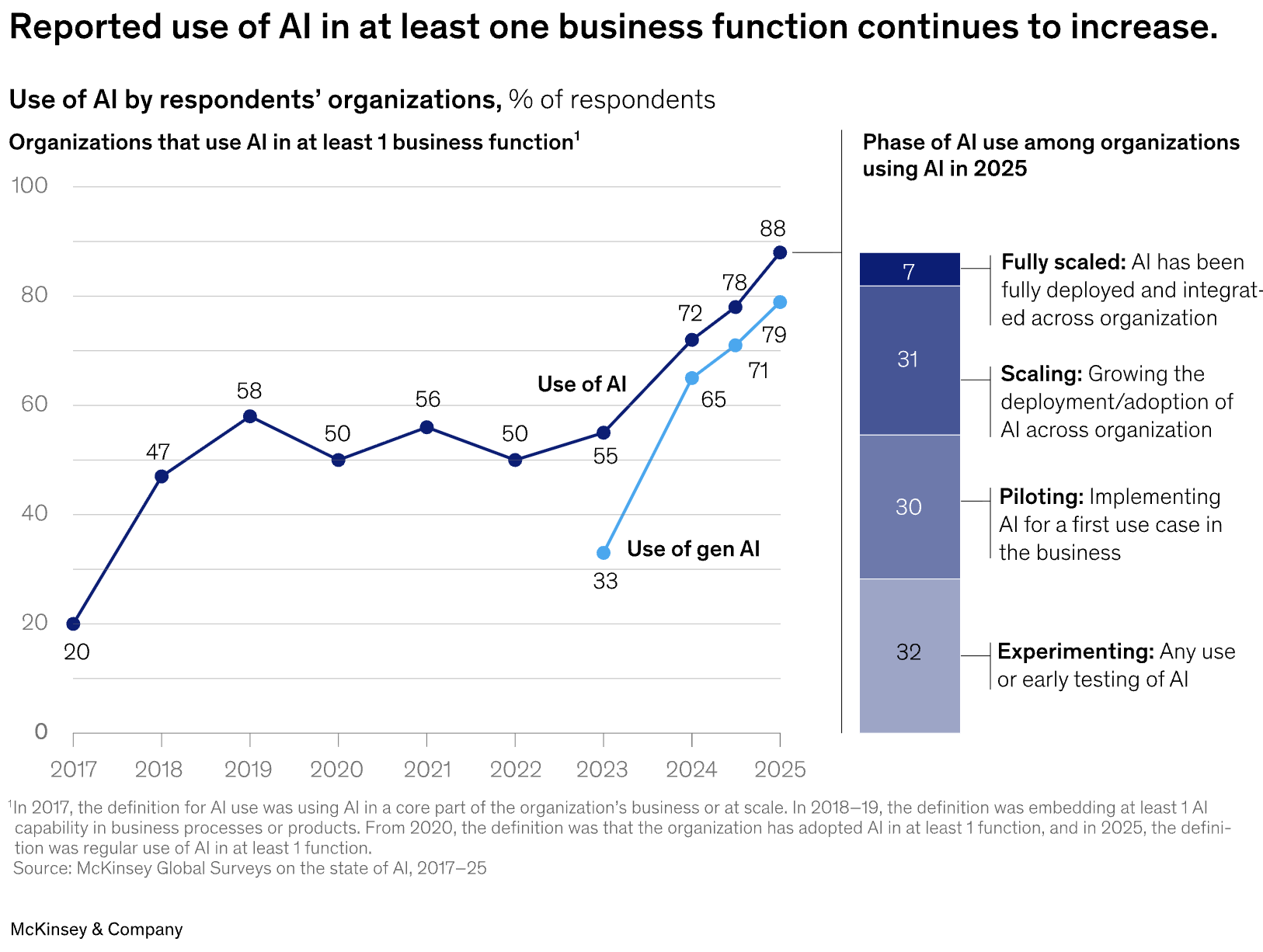
Adoption keeps climbing. Business impact doesn’t.
The situation looks even worse when you zoom out of North America. According to The National Bureau of Economic Research, 6000 executives report little own-firm impact of AI over the last three years, with nine-in-ten reporting no impact on employment or productivity.
ActiveCampaign surveyed 1000 marketers to understand this curve. They claim daily AI users win back about 13 hours of their week.

Good stuff. Grab the full report here.
The commonality I noticed from ActiveCampaign’s study vs our own work at Foundation is thus:

Their data shows most people lean on AI as a creative partner. Then there’s a steep drop-off in implementing those ideas.
My favourite recent example from this year is Uber, where Fortune reported they burned through an entire 2026 AI budget in four months. Big yikes to Uber’s team. Realistically though, it’s a scenario none of us are safe from.
Paying the AI Learning Tax
That whiplash points to the same curve every AI rollout follows, and it helps to put a name to it.

My personal workflow feels like it’s right at the inflection point on this graph. Too much time than I’d care to admit went into that. For the broader team, I’d say collectively we’re smack in the messy middle, paying the learning tax.
The people seeing outsized AI gains aren’t ahead because AI is easy. They’re ahead because they paid the learning tax with a plan.
That gap between generating ideas and implementing them is where the framework comes in. To give that learning a direction, I use three steps:
- Start with a business problem. Identify what you sell or want to offer, and where your team lacks the time to deliver it well.
- Benchmark the work before automating it. Understand the current process so you can test whether AI improves it.
- Understand the workflow you build. Commit to your tools, but know what each piece does so you can adapt without starting over.
Step 1) Build Backwards From an Organizational Issue
A stellar report from Data Ethics claims FOMO is a core marketing tactic in the AI era. The speed at which new tools roll out and old traffic sources have declined creates a lot of tension.
Within this tension, I see teams chase many shiny objects. Somehow every tool has started to look like this generic dashboard I created using AI:

The risk we face as scrappy marketing teams is this: when you spend three months training your team with one tool, only to shift to another months later, you dig a money pit.
To move away from the pit and lack of strategy as a strategy, define:
- One core thing you sell
- One thing you’d like to sell but lack the time to do well.
If you start there, you spend less time researching software stacks and more time with grounded work pointed at your business’s pain points.
Here at Foundation we’re solving for AI visibility and selling work around it. Our research shows that YouTube shorts are a fast-growing citation source for B2B brands. So the core thing we sell is AI visibility strategy, and the thing we’re going to sell but need more time for is the research and production for this content type.
With this in mind, I’ve crafted an automated AI research workflow. Next month, I’ll work closely with our creative team to shape tools and test new efficiencies.
One problem needs one solution.
Your choices on what to learn and implement become easier when you’re crystal clear on what you do. With that in mind, let’s move on.
Step 2) Benchmark the Time It Takes to Produce the Thing You Sell
No one really talks about how expensive true automation is. An end-to-end, fully autonomous workflow costs serious tokens and still needs a human in the loop somewhere.
Build the business case first:
- Look at what you sell and how long each thing takes to create
- Architect those things into repeated actions with time estimates
- Document the actions you take as a standard operating practice (SOP)
- Turn that SOP into an AI-driven workflow, then benchmark the new time
If you don’t have that context yet, get it. You’re missing what you need to stay profitable.
AI can help here, too. Here’s a prompt to run in the tool of your choice:
I'm looking to automate part of my workflow for producing
[THE DELIVERABLE, e.g. "client onboarding decks"]. Here's the
current process:
SOP: [PASTE YOUR STEP-BY-STEP SOP HERE]

Current time per unit: [X HOURS/MINUTES]
Current tools already in use: [LIST YOUR EXISTING STACK]
Budget ceiling, monthly, including token/API costs should be: [$X]
Steps that must stay human-reviewed no matter what:
[LIST NON-NEGOTIABLES]

Research software, github repos, and AI-driven workflows shared on
social media that could reduce time on the steps above without
touching the non-negotiables. Name specific, currently available
tools, not categories. For each one, tell me:
-
What it actually automates vs. what still needs a human -
Realistic monthly cost at my volume, including token/API usage, not just the subscription price -
Setup time and learning curve estimate -
The most likely way it breaks or underdelivers
Rank the top 3 by new estimated time-per-unit vs. my current
benchmark, and flag which one requires the least change to my SOP.
I’d like the report in [Format]
Tweak it as needed. A strong scaffold on what you do, how, and why gives your AI everything it needs to guide the build.
This brings us to our last step in this framework.
Step 3) Commit to Your Tech Stack, but Understand It Well Enough to Port the Core Features
A dangerous thing you can do is give all your thinking over to AI. Even with a strong workflow, you need to understand what each piece does and where the AI logic works.
Some questions I usually ask are:
- Does this action need expensive LLM reasoning (tokens) or can the action be hard-coded?
- Do I understand and agree with how the steps an LLM proposed shapes the final workflow?
- Does this workflow improve on or match the quality of what we currently do manually?
- Can I explain how this workflow works to my colleagues?
I ask these questions because we’re in a volatile period for new tech. Costs can fluctuate and model benchmarks are in a constant race.
If you don’t understand what you’ve built, replacing it will be very expensive and stressful. Conversely, knowing what each piece of your automation does will be the biggest time saver in the long run.
This is the operational challenge people face.
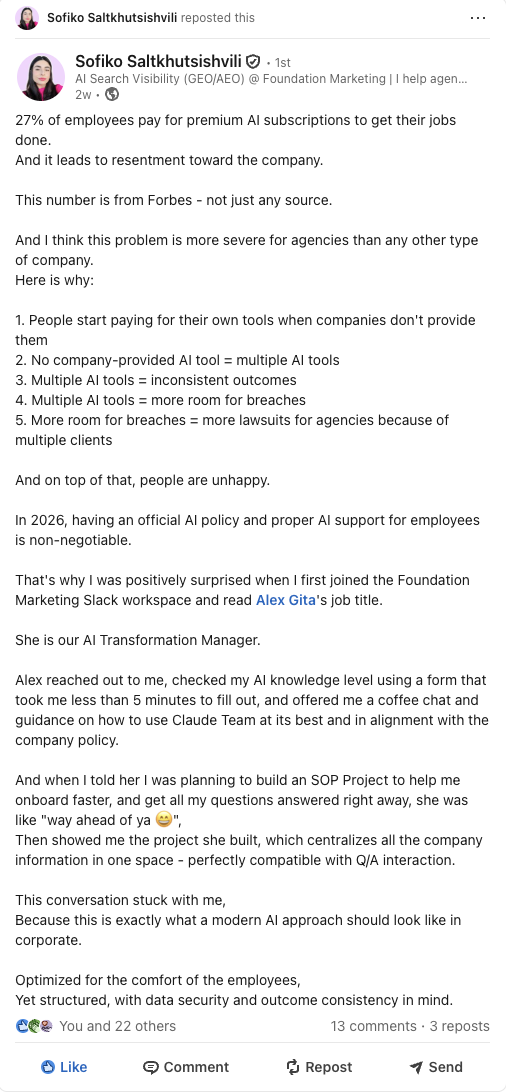
A growing share of employees are paying for their own AI tools out of pocket because their companies don’t provide them.
Sofi Saltkhutsishvili, who recently joined Foundation, flagged the downstream risk: no company-provided tool means multiple tools, inconsistent outcomes, the list goes on.
That’s the cost of skipping the “understand what you’ve built” step.
When nobody owns the standard, every person on your team builds their own stack, and you lose visibility into what’s running, what it costs, and what it touches.
At Foundation, our Transformation Manager, Alex Gita owns that standard. The workflows we build get shared across teams and held to a consistent bar. That’s what keeps us from becoming another cautionary tale about AI spend with nothing to show for it.
Make AI Earn Its Place in Your Workflow
If you know what each piece of an automation does, you can swap models in and out like Lego. You build less dependence on one provider and productize your unique workflow in a way that’s defensible.
Don’t find yourself in a mad scramble to replace an AI tool because the price has 10x’d, or the model output has changed so much that your previous outputs aren’t replicable anymore.
The learning tax is worth paying when it leaves your team with a better way to deliver the work. Start with a business problem, benchmark the time and effort it takes to solve it, and understand the workflow you build well enough to maintain and adapt it.
Those three steps roll back to one test: whether the tool or workflow reduces the time you spend and improves the quality of the work, so your clients see results faster.
That test takes proper time estimates, tracking, and intention. I invite you to run it at your organization. If you need help shaping the answer, get in touch with us today.