
Article's Content
Article's Content
Last week I set off a lively discussion on Slack.
It started with some thoughts I shared about AI visibility audits based on a report from the web accessibility experts at Common Crawl. My first big takeaway from that stellar report is this:
Ranking well in Google does not automatically mean a brand is visible inside ChatGPT, Gemini, Claude, Perplexity, or other AI answer systems.
That’s a crucial recognition because more and more of our enterprise clients approach GEO and AI Visibility with a checklist of SEO tactics. They assume executing this list of tactics will move the needle on AI visibility.
I get it. It’s a safe assumption that makes the scope and speed of frontier model changes feel more manageable.
But amid all the focus on strategy, direction, and execution, it’s easy to completely miss one of the biggest pieces of the puzzle for AI visibility: timeliness.
Today I’ll talk about some of the technical aspects left out of the AI conversation and introduce you to an idea around how model releases introduce a countdown clock all brands should be aware of.
Let’s get into it starting with:
The AI Visibility Gap Most CMOs Miss
Common Crawl is a nonprofit that has crawled the open web every month since 2007 and publishes the results as a free, open archive. They use a bot called CCBot that fetches publicly accessible pages and writes them into monthly snapshots, each one roughly 350 to 400 TiB of uncompressed data drawn from the open internet.
The Common Crawl archive became one of the primary training sources behind modern LLMs, meaning whether a crawler can reach your site is, indirectly, a decision about whether your content enters the data these models learn from.

This is why access sits upstream of everything else. Before teams talk about content quality, links, rankings, or on-page improvements, they need to know whether training crawlers can reach and read the site in the first place. A page can rank well in Google and still be invisible to the model.
This line from Common Crawls AI Visibility Audit field guide hit me the hardest: “The old world was index and rank. The new world is train and retrieve.”
That shift changes everything about how brands should think about timing, which is what I want to get into next.
The AI Model Training Countdown Clock
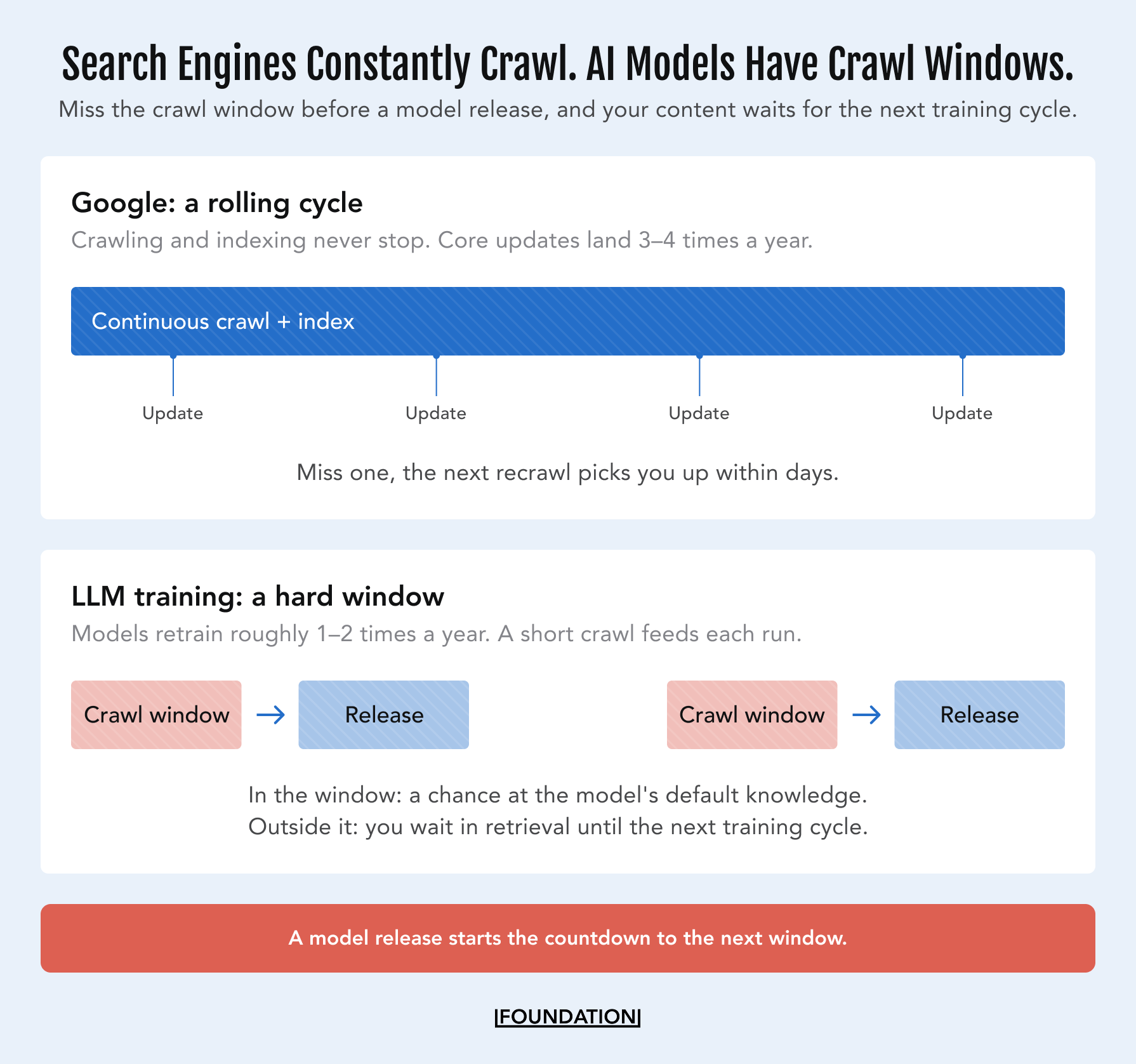
Google SERP optimization runs on a rolling cycle. Crawling and indexing is continuous and core updates happen about 3 to 4 times a year.
LLM training doesn’t work that way. Major models are expensive to train and release roughly 1 to 2 times a year. That means there’s a hard window before each training run where the crawl that feeds the model happens.
Our AI Service Delivery Lead, Enzo Carletti, usually shows up in these chats and had a great analogy for this ticking clock all teams are up against:
“To launch a rocket into space you need escape velocity, but you also need the launch window. Miss it, and the trajectory to your destination is gone. It’s the same for LLM training. Miss the window and the whole launch gets delayed. Better luck next time!”
Content that gets crawled and indexed in that window has a chance to become part of the model’s default knowledge. Content that misses it does not.
Your team needs to feel a sense of urgency around these windows.
Right after a model release, it’s a countdown to get your best data into the LLM by default.
These days, LLMs can surface your brand’s information in two primary paths:
- As part of its core knowledge base (information stored from training)
- As part of an agent’s search (Fan-out queries, Retrieval-Augmented Generation aka RAG)
Route number one is completely missed if your team does not have a gameplan and awareness of the last model’s release data.
A few weeks ago, Anthropic released Fable 5. The game clock to get the information you want surfaced by default into Claude is now ticking down!
Recently, one of our clients voiced concerns about old developer doc information surfacing in LLM responses.
Their challenge is unique in that they serve an active developer community and as such, the information they had up when the model was first released becomes the default.
In a situation like this, a client can use tools like LLMs.txt to help support path two, RAG.
But time is a limited resource and the countdown clock is already ticking away.
Now let’s get into what your team can do today to set your brand up for success as AI giants start to train new models.
Foundation’s Framework To Beat The LLM Training Countdown Clock
Treat a model release like a sports team would treat the post-season after a tough play-off run.
The new model is already out, so your work starts with reviews and audits.
Step 1) Audit Your Tracked Prompts The Week After A New Model Release
This is your baseline. As a partner agency to Profound, our first step after a model release is to ensure we gather fresh data on prompt sets tied to brand, service lines, and priority keywords.
Having a tool like Profound is helpful, but another way to check this manually would be to go to ChatGPT, Claude, or Gemini and ask questions about your brand to see what’s there or what’s changed.
If what you’re seeing isn’t up to par, catalogue the gaps. The clock is running to have your chance to shift that knowledge.
Step 2) Study What’s Changed
Each model release also changes what the AI tool trusts. Sources like Reddit, YouTube, LinkedIn and 3rd party sites will all shift in rank for citation authority.
After step one, you should have a sense of what’s misaligned. Step 2 carves you the path to understand what works for others and where your brand needs to be.
If a competitor’s site is cited, that’s signal website optimization is still on the table.
Has Reddit taken over your category? That’s signal to form your Reddit strategy or reach out to an AI visibility agency like Foundation that gets you started on Reddit the right way.
Step 3) Form Your Gameplan And Execute It In Order Of Priority
Steps one and two will give you the clearest picture of what’s missing.
Your job from there is to shape your content plan in order of priority.
What information made it into the training data as default knowledge that needs to change? What pages need to be updated to ensure those are fixed in time for the next release? What new citation sources fit within your team’s capacity?
The faster you triage your opportunities and execute, the greater your odds to get your best info baked into LLMs knowledge base.
Don’t Wait For The Next Model Release
For Foundation, this reshapes what an AEO/GEO audit even asks.
Not just “are you ranking?” but “are you accessible, understood, retrievable, and eligible to be cited by AI systems?” That’s the gap most audits miss, and it’s the one that decides whether a brand shows up when a buyer asks ChatGPT, Claude, or Gemini for a recommendation.
The window is open right now. Every new frontier model release restarts the clock, and the brands that get their best information early are the ones that become the default answer.
The ones that wait get retrieval at best and silence at worst.
This is the work we do: finding where you’re invisible to AI systems, fixing the access and signals that keep you out, and building the citations that make you the brand models surface by default. If you’re not sure whether you’re in the crawl that trains the next model, that’s exactly where to start.
Get in touch and we’ll run the audit before the window closes.
The clock is already ticking…