Article's Content
Article's Content
Ask ChatGPT and Google’s AI Overview the same question about enterprise software, and the sources behind the two answers only partly overlap. Both lean on vendor pages. Past that, they pull from different corners of the internet. We set out to learn how AI platforms choose the sources they cite, and what B2B marketers can do to earn those citations.
For almost five weeks, Foundation and AirOps ran commercial-intent buyer prompts for 81 B2B software categories, from applicant tracking systems to managed databases, across six AI surfaces. We then classified roughly three million citation events by domain, page type, and sentiment. A citation event is one domain appearing as a source in one AI answer, so it measures visibility, not traffic.
The headline finding of The State of B2B AI Discovery 2026, a new joint report from Foundation and AirOps, is that AI answers draw on two different systems, and a single blended visibility score can’t tell them apart.
- 380K AI answers logged
- 3M citation events classified
- 81 B2B software categories
- 6 AI surfaces monitored
Vendor pages anchor both systems. The difference is in everything else a buyer sees cited: reviews, communities, social video, and media. Here’s where the split shows up, and what to do about it.
AI answers run on two different systems
Google AI Overview and Google AI Mode build their answers from Google’s live search index. ChatGPT, Claude, Gemini, and Perplexity are standalone assistants with their own retrieval systems and training data. That difference shapes what each one cites.
To compare them, the report sorts every cited domain into six source types: products (vendor sites, tool directories, and comparison pages), reviews (sites like G2 and Capterra), communities (Reddit and forums), social (YouTube and LinkedIn), educational (Gartner), and media (Medium, Slashdot), plus an uncategorized bucket for the rest.
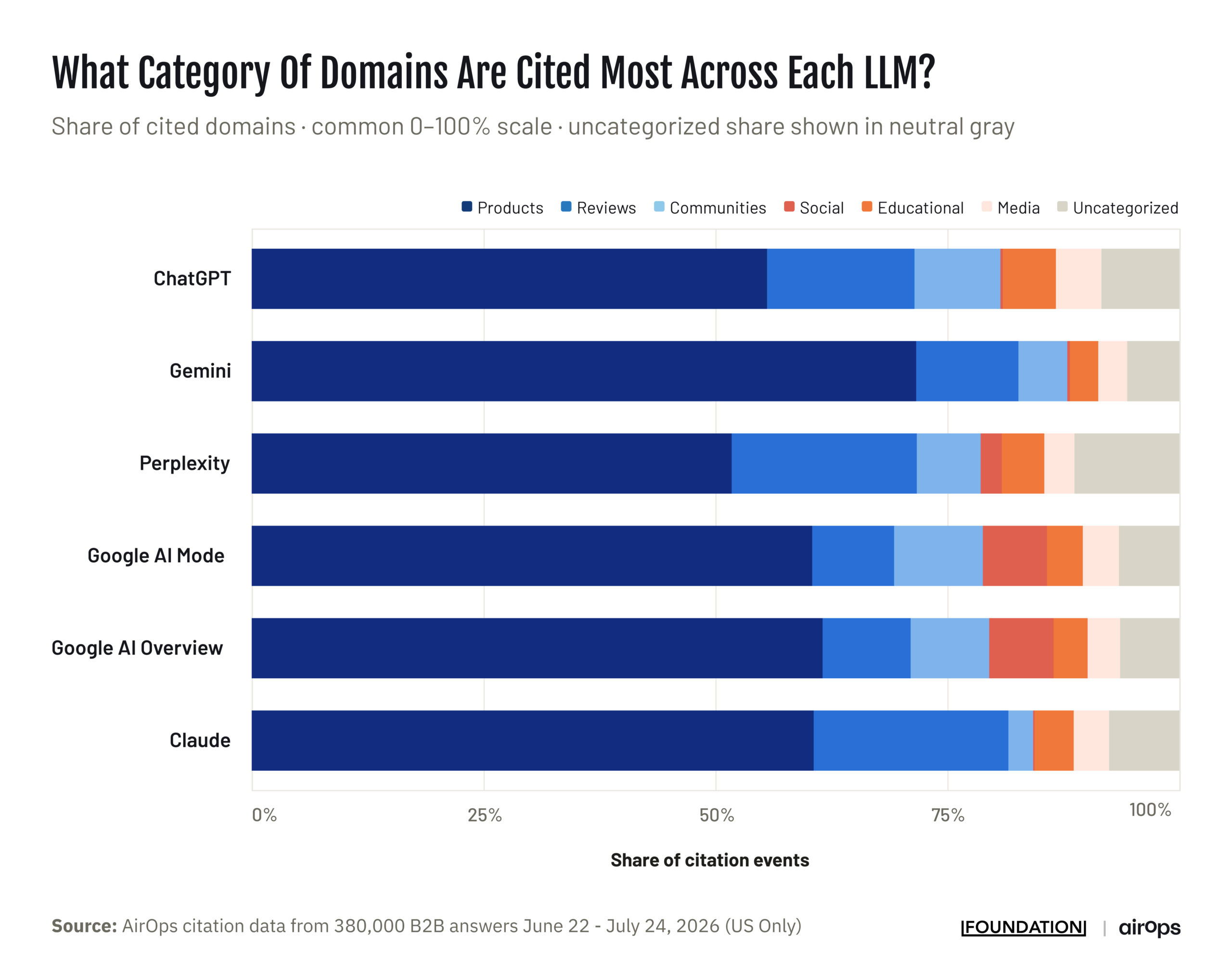
Product domains take the largest share of citations on all six surfaces. The split shows up in the smaller source types.
Source: The State of B2B AI Discovery 2026, Foundation × AirOps.
Social is the sharpest example. About 7% of the citations on Google’s two AI surfaces go to social domains like YouTube and LinkedIn. On ChatGPT, Gemini, and Claude, social’s share is 0.3% or lower, roughly a 27x gap between AI Overview and ChatGPT.
Community content splits along a different line. ChatGPT’s citation share for community domains (9.26%) rivals Google’s surfaces, driven almost entirely by Reddit. Claude sits at 2.67%.
Gemini is the outlier in the other direction. It sends 71.63% of its citations to product domains, the most vendor-heavy share in the dataset, and third-party sources barely register: no single third-party domain appears in even 14% of Gemini’s answers. Compare that with G2, which appears in a quarter to a third of citing answers on the other five surfaces.
A brand can be everywhere in Google’s AI answers and invisible in ChatGPT, or the reverse. A visibility strategy that treats AI answers as one channel can look healthy on one surface while the brand is missing from another.
Your website is the biggest lever. The next 30% is contested.
Here’s the reassuring part. Across every platform tracked, brand and product pages are the single biggest source of citations in AI answers. That holds whether the buyer is on ChatGPT or on Google’s AI Overview.
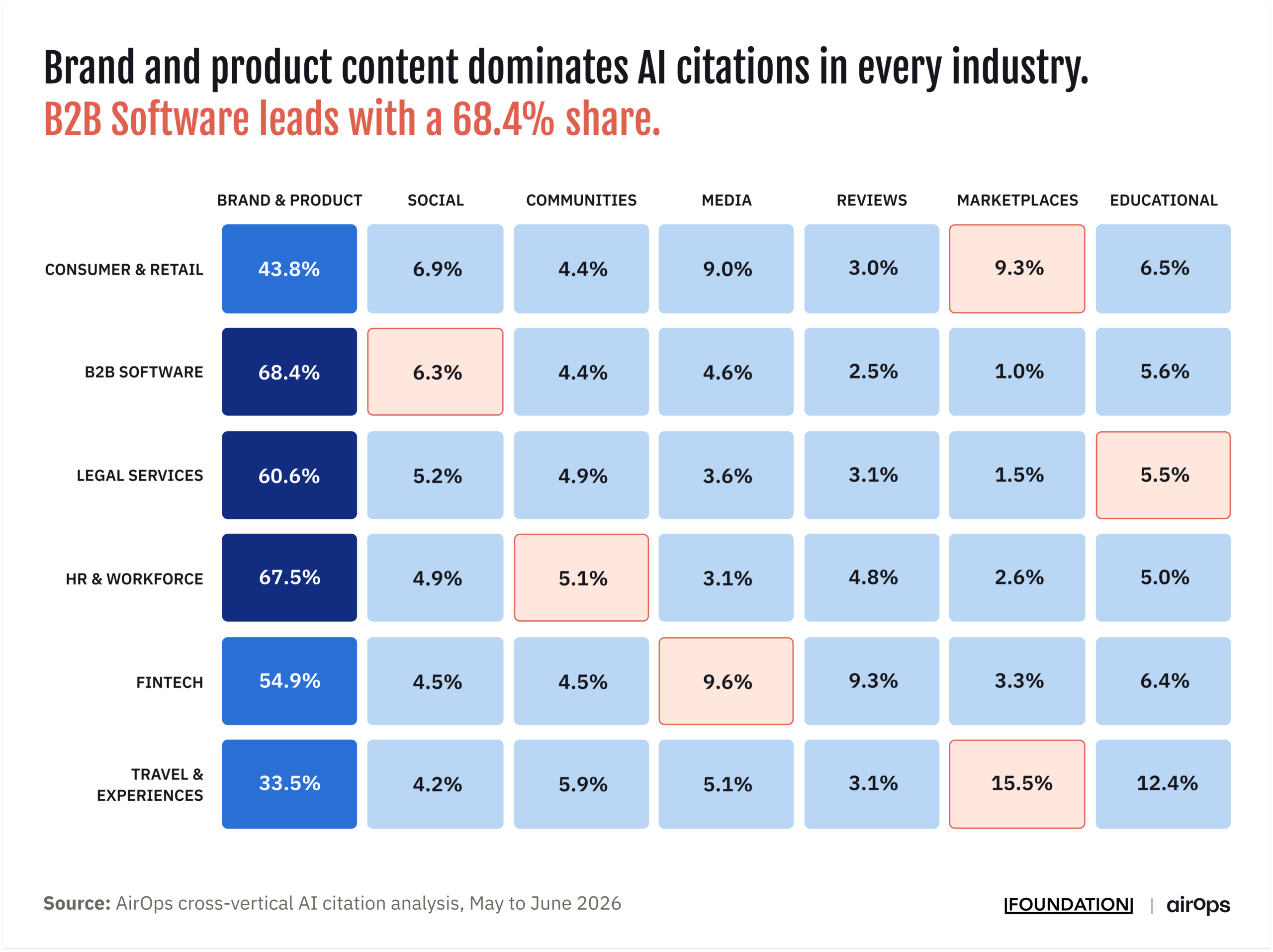
AirOps’ own cross-vertical citation analysis (May – June 2026) backs this up at the industry level. B2B software leads every vertical, at 68.4% brand-and-product citation share, ahead of HR & workforce (67.5%) and legal services (60.6%), and roughly double travel (33.5%).
Source: AirOps proprietary AI citation analysis. This analysis uses its own source taxonomy, so shares aren’t directly comparable with the six-surface study.
Product pages, comparison pages, and use-case content still do most of the work, in AI answers as much as in classic search. As James Scherer, VP of Strategy at Foundation, puts it: “Editorial gets the budget; product pages get the citations”.
But 68.4% isn’t 100%. The remaining share, split across social, communities, media, and reviews, is where the six-surface data shows AI platforms diverge, and where third parties shape how your brand shows up in AI answers without anyone on your marketing team controlling it.
Your software category shifts the mix as much as the platform does
The mix also changes with the market you sell into. Across the six categories below, reviews’ share of citations swings 3.3x, from 7.64% for managed databases to 25.07% for recruiting and applicant tracking software. Community share swings 2.5x, from 5.5% for SEO platforms to 13.89% for security tooling (EDR/XDR).
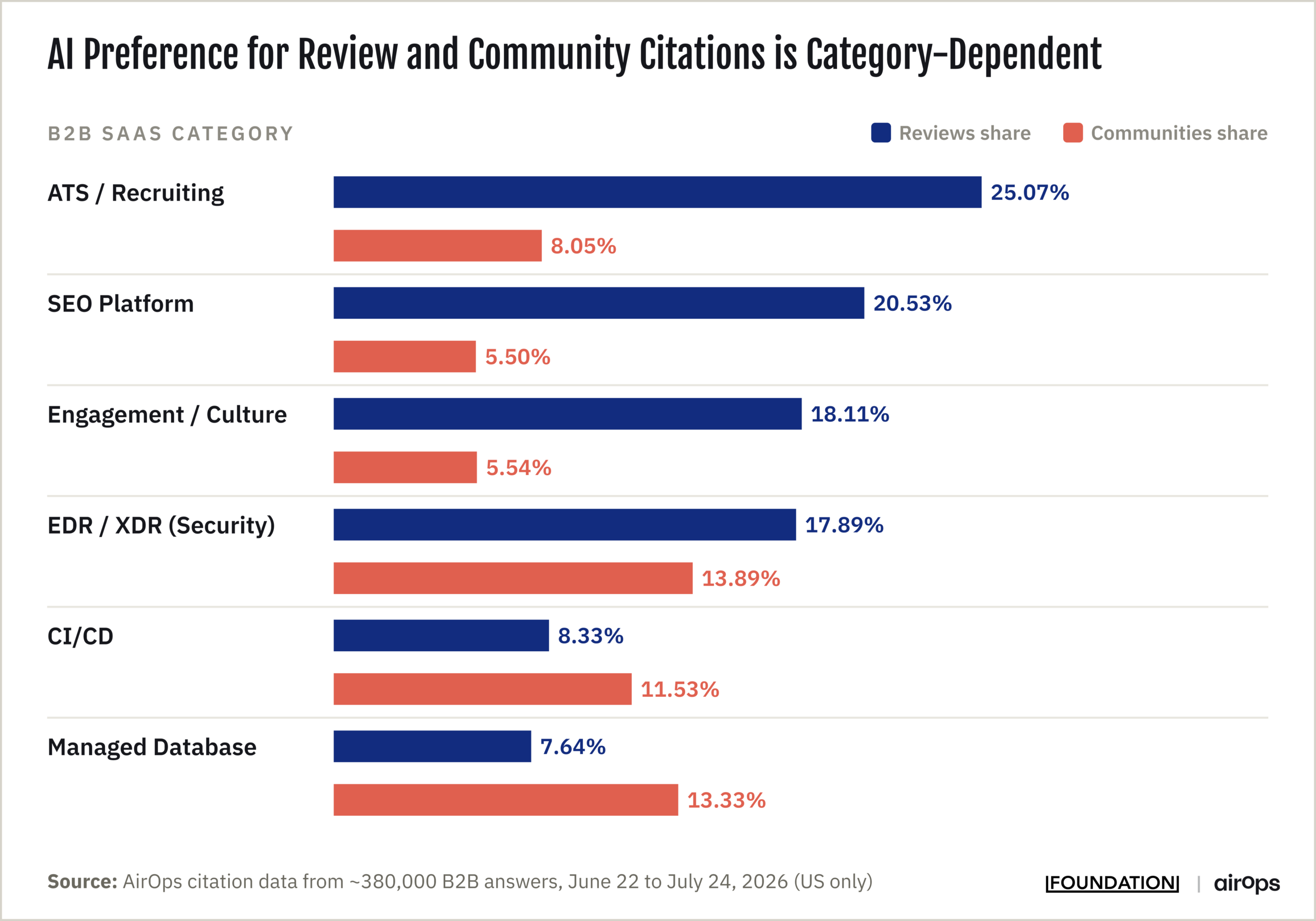
Reviews vs. community citation share across six representative B2B categories. The spread between the top and bottom bars in each color shows how far off a one-size-fits-all playbook can be for any single category.
Source: The State of B2B AI Discovery 2026, Foundation × AirOps.
Copy a playbook built for another category, or a blended industry benchmark, and you risk funding the wrong channel. If your buyers check G2 and Capterra, your review profiles deserve the same care as your product pages. If they read Reddit threads and community forums, you need a different content strategy and budget.
The full report breaks down the source mix for all six categories above, from ATS and recruiting to managed databases, and shows how G2, Reddit, and YouTube behave on each AI surface. Know where your category sits: get your copy.
What to do this week to improve AI visibility
- Stop reading one blended AI visibility metric. Track citation rate and citation share separately for each of the six surfaces. A healthy Google AI Overview score can hide a ChatGPT problem, or the reverse. We used the AirOps platform to track citations for this report, and it’s designed for this: continuous prompt tracking instead of a one-time snapshot.
- Treat your G2 profile as owned media. It’s the one third-party domain nearly every AI surface cites heavily.
- Build a prompt set that mirrors how buyers ask, not how a brand would like them to ask, and run it on a recurring schedule rather than as a one-time audit.
- Audit your comparison and use-case pages before you commission the next blog post. They carry more citation weight than most editorial calendars assume.
The takeaway
AI hasn’t replaced Google search. Instead, AI discovery now runs on at least two systems that draw on different parts of the internet, weigh different source types, and reward different work. Brands that treat AI visibility as a single channel risk missing many of the conversations that decide who makes the shortlist.
Methodology Note
Foundation and AirOps tracked commercial-intent B2B software prompts across six AI surfaces (ChatGPT, Claude, Gemini, Perplexity, Google AI Overview, and Google AI Mode) from June 22 to July 24, 2026.
AirOps ran the tracking behind roughly 380,000 logged AI answers; Foundation built the prompt library, classified about three million citation events across 81 software categories, and wrote the analysis.
- A citation means an AI surface included a domain as a source in one answer. It measures AI-answer visibility, not traffic or conversion.
- Google AI Overview doesn’t trigger for every query, so its answer volume differs structurally from that of the four standalone assistants.
- This report was produced in collaboration with Foundation Marketing Services, which has a commercial relationship with AirOps.
Full methodology, including the six-surface reach matrix, is in the complete report.