


Article's Content
Article's Content
You’ve written the comparison pages, documented every feature, and answered every objection your buyers raise. Then they ask AI about your product, and it quotes a stranger on Reddit instead.
Showing up in AI answers doesn’t mean you control what those answers say about you.
So we picked a real brand to test it: n8n. They’re a workflow automation platform with strong owned content and an active user community. If a brand’s owned content was going to win the citation fight, it should have been theirs.
We ran their category’s buyer questions through the major AI models and traced every citation back to its source.
Here’s what we found.
n8n wins AI answers. Its owned content doesn’t
We asked six AI systems, ChatGPT, Claude, Gemini, Google AI Overview, Google AI Mode, and Perplexity, 20 buyer questions about workflow automation, without naming n8n directly. Questions like “What’s the best platform for self-hosted workflow automation?”
n8n demonstrated strong visibility, showing up in 91 of 96 answers. But when we traced the sources behind the recommendations, it turned out n8n-owned content accounted for just 15.7% of citation share. Reddit threads were cited 95 times, while n8n’s own blog was cited 33.
We saw the same trend in buying queries, too. Ask Google AI Mode for the best Zapier alternatives, and a Reddit discussion lands at source #4. n8n’s own comparison page doesn’t show up until #7.
We call this a Ghost Citation — when AI cites an external source to describe your brand, even though you didn’t create it and don’t control what it says.

A single Reddit thread keeps getting cited as a source
A single thread, “The reality of n8n after 3 years automating for enterprise clients”, showed up nine times across eight separate AI answers in our data window. It resurfaced in several rounds of testing whenever we asked whether n8n was reliable enough for production use.
It’s not alone. Combined, Reddit and n8n’s own community forum generated 154 citation occurrences, which is 4.7 times the blog’s count, even though the blog published 82 net-new posts in the same 12 months.
Publishing more content doesn’t make you the source AI selects to explain a claim.
Run the same Ghost Citation audit on your brand
Here’s the four-step version of our framework:
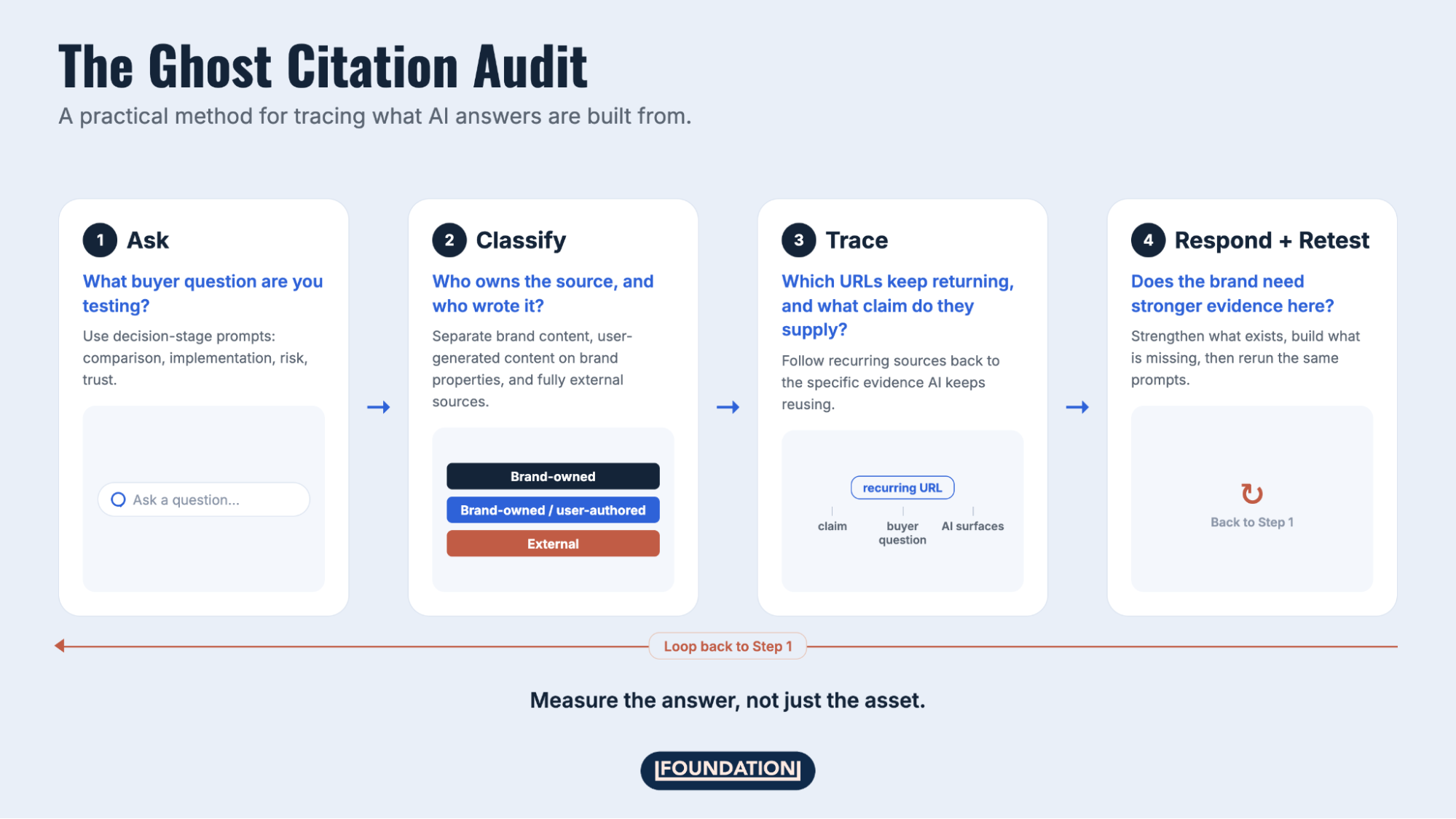
- Build a fixed set of buyer questions: Write one for each stage: discovery (“which products belong on the shortlist”), comparison (“what vendor is better”), risk (“what breaks or adds overhead”), and trust (“is this ready for production”). Run the same questions across the AI platforms your buyers use.
- Separate ownership from authorship: A page can discuss your brand without your brand having written it; community forums are the clearest example. Check which of your citations are in your own voice.
- Trace recurring URLs to the specific claim: ”Reddit gets cited for self-hosting” is too vague to act on. “Users describe self-hosting as trading subscription costs for infrastructure overhead” gives your content team a concrete claim to respond to, or reinforce.
- Respond to claims: If your own content already proves the point with equal specificity, leave it. If the evidence is outdated or missing, build a stronger source. Sometimes, a credible outside voice is fine. The goal is to make sure buyers have enough current, accurate evidence to make an informed judgment.
Then rerun the same questions later, and track what changed: which of your sources entered the answer, which outside sources kept recurring, and whether the citation’s actual position moved.
→ Read the full audit for the breakdown across six AI platforms and the opportunities we found.
Being the answer and owning the evidence are two different jobs. Find out what others say about your brand and make sure your content is strong enough to stand next to it.
📊 The Data Point
We asked six AI systems the same question: “What are the biggest limitations or drawbacks of n8n?” ChatGPT built the answer entirely from n8n’s own documentation. Google AI Mode listed a Reddit thread as source #1 and didn’t cite n8n’s documentation until position #28. The same brand and question, but AI relied on different evidence. Don’t audit your AI visibility in general. Check it platform by platform, starting with the ones where your buyers use.
⚡ Quick Hits
- AI doesn’t always back up its own claims. Washington University in St. Louis researchers analyzed 98,020 claims across 55,393 Google queries. Only 11% weren’t actually supported by the source cited next to them. Check your own cited pages against the claims attached to them; a citation isn’t proof that the fact is right.
- Google bans manipulating AI citations. Google’s spam policy has covered generative AI responses since May, and its August spam update dropped 16.7% of top-10 URLs past position 100. Skip fast-paid citations, put that budget into the true evidence instead.
- Third-party mentions beat owned content 3-to-1. Ahrefs studied 75,000 brands and found that web mentions correlate with AI Overview visibility at 0.664, compared to 0.218 for backlinks. 26% of brands had zero AI Overview mentions at all. If your AI visibility plan relies on your own site, it’s missing the stronger lever. Earn mentions on other people’s pages.
🔗 From Our Lab
- 3 Steps That Turn AI Into Leverage, Not Extra Labour
- Brex Ranks #1 on Google and Appears in Half of AI Answers. The Recommendation Still Goes to a Competitor.
- The Reddit Cloud 100: Ranking B2B SaaS Subreddits by AI Visibility
- Reddit AI Citations: How Reddit Shows Up In The LLMs
Run the same audit on your own brand and see what Ghost Citation turns up. Reply and we’ll help.

