


Article's Content
Article's Content
Welcome back to What Matters This Week.
This week, we dug into 83,835 YouTube citations to find out which videos AI answers actually pull from. A lot of the top-cited ones come from channels you’ve never heard of.
Google’s AI Cites YouTube 17x More Than ChatGPT. Channel Size Doesn’t Decide Who Gets Cited.
Here’s the TL;DR
- We tracked 83,835 YouTube citations across ChatGPT, Google AI Mode, and Google AI Overviews. Google’s two AI features cited YouTube in 36% of answers. ChatGPT did it in 2.1%.
- Audience size barely mattered. The most-cited video in our study had 3,671 views, came from a channel with 3,560 subscribers, and appeared in 291 AI answers.
- If your category’s rate is high, turn your strongest comparison page into a five- to 15-minute video titled like the buying question. Put the verdict in the first five minutes.
What’s Happening
Foundation’s B2B Citation Index, powered by Writesonic, ran the same 5,000 bottom-of-funnel software prompts across 80 categories every week for 13 weeks, from June 29 to September 21. That produced 182,631 AI answers. Of the 2.2 million citations in those answers, 83,835 pointed to YouTube.
The engine split is the headline. Google AI Mode and AI Overviews produced 98.2% of all YouTube citations. A Google AI answer was about 17 times more likely to cite YouTube than a ChatGPT answer. Even ChatGPT’s best query type for video, Reviews & Validation, only reached 4.1%.

The buyer’s question changes the odds. On Google, 46.5% of “best of” answers cited YouTube. Pricing answers cited it 19.1% of the time.
Category matters even more. Project management hit 63.2%. ABM platforms sat at 13.2%. In nine of the 80 categories, more than half of Google’s AI answers cited YouTube.
Why It Matters
Keep in mind that the patterns below are among cited videos, not proof of what causes a citation. Treat them as a checklist to test on your own uploads. Throughout, “top-cited” means the 100 to 150 most-cited videos in the study.
- Views and subscribers don’t predict citations.
Among the 150 most-cited videos, the rank correlation between citations and views was −0.08. For subscribers it was −0.07. The top group’s median view count was 1,207, lower than the 1,719 for videos cited only once. 42% of the top-cited videos came from channels under 10,000 subscribers.
You don’t need an audience before you can show up in AI answers. That changes the business case for B2B video.
- The winning videos are titled like the prompt.
“Best” or “top” appeared in 59% of the top-cited titles, compared with 10% of videos cited once. A year in the title showed up in 57% of the top-cited and 20% of the cited-once group.
Demo and how-to titles went the other way. They made up 18.8% of cited-once titles and 7.3% of the top-cited. Our earlier research found YouTube in Google’s top 10 for 80.2% of demo searches. Ranking in search and earning an AI citation are separate outcomes.
- Google cites the moment.
48.4% of Google’s YouTube video citations included a timestamp. The median moment was 2:28, and about 71% pointed within the first five minutes. We saw zero timestamped citations from ChatGPT.
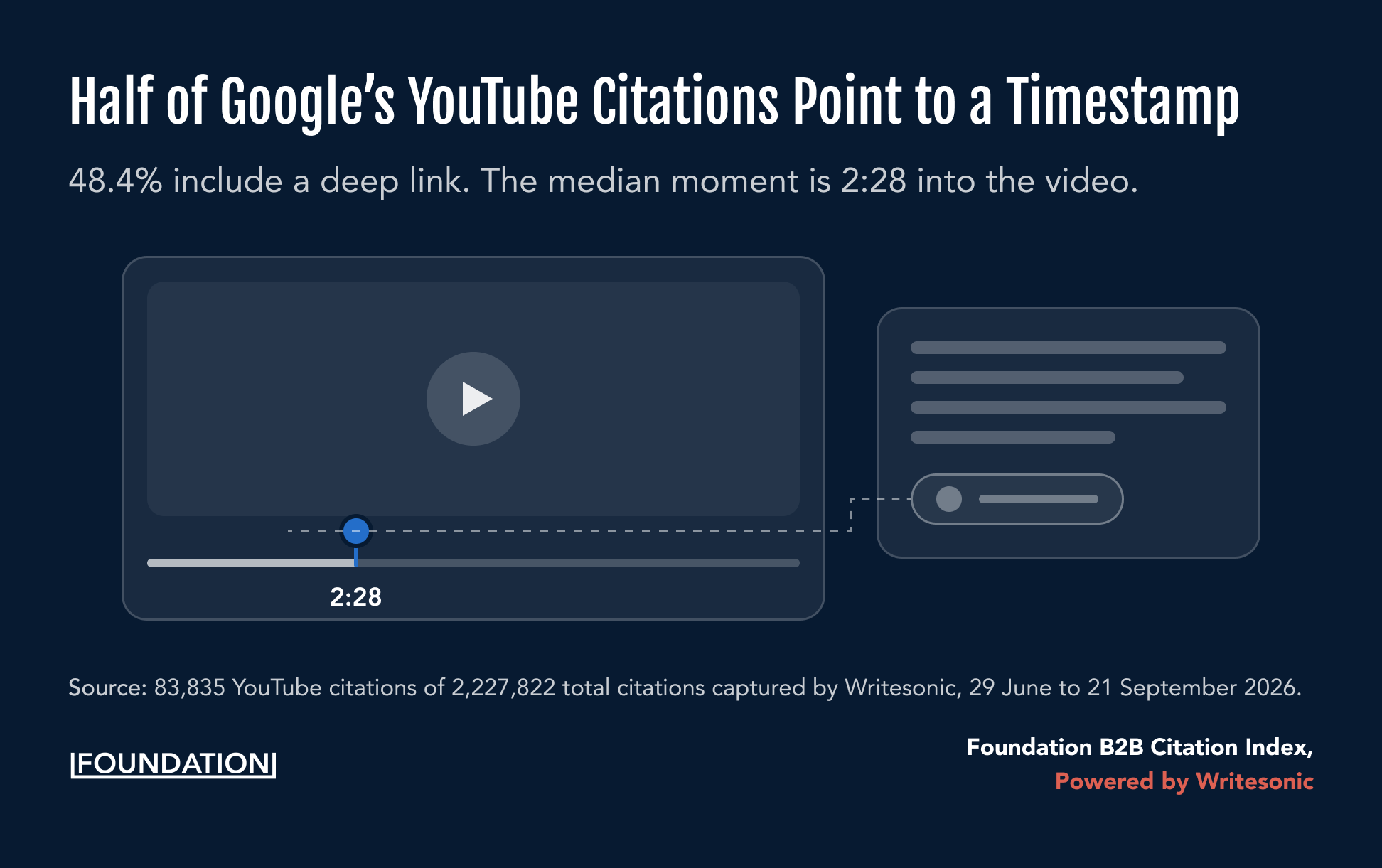
Each section of your video has to answer a question on its own, and the answer has to come early.
- Nobody owns this yet, and the videos that break through stay.
Citations spread across 17,780 videos. The top 100 accounted for just 12.6% of video appearances, and 52.7% of cited videos appeared in a single answer.
The ones that land keep landing. In total, 3,016 videos appeared in at least five of the 13 weekly runs and made up 66.4% of all video appearances. Of those, 176 appeared every single week.
Vendors can win this too. Seven of the 30 most-cited videos came from vendor channels, and nearly all of them compared the whole category, competitors included. Teamflect’s “Lattice vs 15Five vs Teamflect” video had 133 views and appeared in 158 AI answers.
What to Do About It
- Check your category’s rate before you commit budget. The full 80-category table is in the study. If your category sits near the bottom, video makes a weaker case as an AI citation play on its own.
- Start with a page you already have. Turn your strongest comparison or “best of” page into a 5- to 15-minute video. 72% of the top-cited videos fell in that range, compared with 43% of cited-once videos.
- Title it like the buying question and answer it early. State the verdict and your criteria in the first five minutes. Add chapters named after the questions they answer. 56% of top-cited videos had chapters, against 33% of the cited-once group.
- Vendors: publish the category comparison yourself. Include competitors. That’s what the vendor videos in the top 30 did.
- Refresh every year. 69% of top-cited videos were under 12 months old. When the year rolls over, republish with current pricing and the new year in the title.
- Measure over weeks, not one run. AI Mode’s weekly YouTube rate swung between 17% and 56% across runs. Track the share of relevant Google AI answers that cite your videos with a consistent prompt set.
🚨Seat Requests for the Inaugural Citation Conference Open Today🚨
If you’re in charge of AI visibility outcomes for your company, this one’s for you.
The Foundation team is hosting Citation Conference: a new event for the enterprise marketing leaders responsible for how AI describes their brands. The inaugural event runs May 11 to 13, 2027, at the Design Exchange in Toronto.
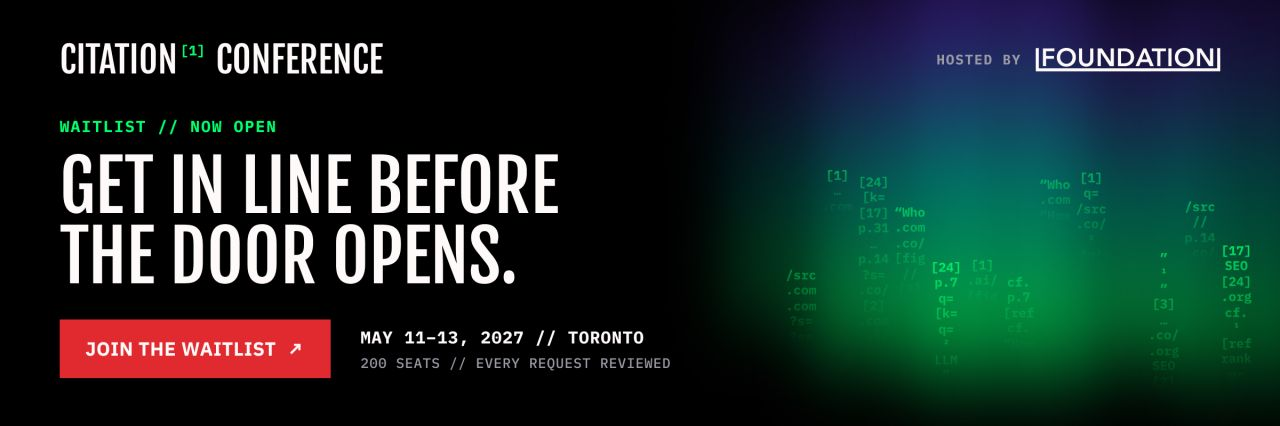
There’s one track and no expo hall. Seats are capped at 200, most of them for in-house marketers, and every request is reviewed individually. The format is built around small Table Talks of 10 people, so you leave with answers to the problems you actually brought.
Seat requests open today. With 200 seats and a review on each one, the earlier you’re in line, the better.
📊 The Data Point
Peec AI’s David Konitzny recently looked at how ChatGPT actually splits and scores page content to put theories about “chunking for AI visibility” to the test. His finding: blocks covering more than half of a query’s terms were almost 3x as likely to score above 0.99 in ChatGPT as blocks covering less than a quarter.
On his example page from Disneyland Paris, ChatGPT’s block boundaries ignored the page’s paragraphs and sections. One block bundled the title, intro, heading, and first attraction card. Another started halfway through an FAQ answer. Large, information-dense blocks scored highly too.
Position looked like it mattered at first, since blocks near the top scored higher. When two blocks covered the same share of query terms, the top one did no better. Titles and intros win because they summarize the page and naturally cover more of the query.
For your team: it might be time to write and format content for readers again, instead of chopping pages up for the bots.
⚡ Quick Hits
- ChatGPT Ads is now live in 89 countries. OpenAI opened ChatGPT Ads to 26 markets, 14 of them in Latin America, and says more than 100,000 advertisers have run campaigns since ads launched just over eight months ago. Ads only appear on the Free and Go plans. OpenAI says they’re labeled, kept separate from answers, and have no influence on what ChatGPT says.
- Profound puts Google rankings and AI citations on the same screen. Profound’s Pages feature now pulls in Moz-powered Search Visibility data next to AI Visibility. Each page shows Page Authority, linking root domains, and its top 50 Google keywords, plus a list of sites that link to competitors but not to you.
🔗 From Our Lab
- Short-form Video is Showing Up in B2B Search Results and AI Answers (But Nobody’s Talking About It) | YouTube Shorts ranks in Google’s top 10 for 475 US “best + software” searches and sits at number one for three of every four. 92% of those result pages carry an AI Overview. Read it next to this week’s study, where Shorts made up just 3.7% of video citations. Ranking and getting cited are separate jobs.
- The Creator Driving Nearly 200M YouTube Views for vidIQ | How vidIQ hired creator Rob Wilson as its YouTuber-in-Residence and built a channel with 2.1M subscribers. His thumbnail redesign took click-through rate from 2.5% to 5% to 6%, and over 70% of views now come from non-subscribers. Useful proof that a SaaS brand can run a channel people actually watch.
- How to Start a YouTube Channel for B2B: Dominate Visibility and Influence Buyer Decisions | The setup guide for teams starting from zero. Covers how to pick a channel archetype with strategist Enzo Carletti’s framework, plus the caption and schema work that helps AI engines parse your videos. Start here if this week’s data made the case for video in your category.
Foundation Is Hiring (Like, a Lot)
This has been a big growth year for Foundation, and we’re not slowing down. We’re hiring across the board, and every role is remote:
- B2B Strategy Manager (AEO / GEO)
- Marketing Strategist (GEO / AEO)
- Marketing Strategist (YouTube)
- Marketing Specialist (GEO / AEO)
- Senior Account Manager
- Group AEO Marketing Director (Group Account Director)
- Senior AEO Marketing Director (Senior Account Director)
- AEO Marketing Director (Account Director)
- Associate AEO Marketing Director (Associate Account Director)
- Senior AEO Program Director (Senior Delivery Director)
- AEO Program Director (Delivery Director)
- Associate AEO Program Director (Associate Delivery Director)
- Reddit Specialist
- Fractional Video Director
- Reddit Content Manager
If you know someone who’d be a fit, send this their way.
That’s it for this week.
If something landed, tell us. If something felt off, tell us that too. DM me on LinkedIn.
Have a good week,
Ethan Crump

