


Article's Content
Article's Content
Welcome back to What Matters This Week.
This week, Semrush joins the growing list of rank tracking tools that have caught Google serving fake search results. It’s time to take a closer look at that SEO data you’ve been reporting for the last month.
Is Google Lying to Your Rank Tracker? Semrush Joins List of Impacted Platforms.
Here’s the TL;DR
- Semrush confirmed it has been seeing “poisoned” Google results since late summer. Ahrefs said the same five days earlier. The two leading SEO tools used by marketing departments are seeing altered SERPs.
- The poisoned SERPs display results that don’t match the search term. The rate peaked near 25% of results and now runs 5% to 11% a day, with Ahrefs putting the industry range at 5% to 20%.
- The disruption appears to be contained to tools that scrape Google’s results page. It doesn’t touch Search Console, GA4, or AEO tools directly.
What’s Happening
On October 27, Semrush confirmed that Google has been returning inaccurate results to their collection systems since late summer. This comes five days after Ahrefs called it an industry-wide issue affecting between 5% and 20% of results depending on the provider.
The pattern was first documented by enterprise rank-tracker Nozzle. In a sample of 27.5 million results pages across 49 countries, 8% came back poisoned after September 13, against 0.17% before. The peak hit 25%, and daily rates now sit between 5% and 11%. Search Engine Land reports that other trackers, including DemandSphere, SE Ranking, SISTRIX, DataForSEO, and AccuRanker, have all flagged the same thing.
One caveat: Google has not confirmed any of this. It hasn’t commented publicly, and the “poisoning” label is the vendors’ framing, not Google’s. What’s no longer in question, now that Ahrefs and Semrush both see it in their own pipelines, is that the data is being altered and it’s in the numbers you report on.
Here’s how the alleged SERP poisoning works:
Google answers queries with a complete, normal-looking SERP whose results are wrong, and nothing on the page says so. Unlike a refused request, which tells a scraper to try again, a poisoned one gets stored as real. Nozzle’s read is that this is aimed at AI companies scraping Google to ground their answers, with rank trackers caught in the same net.
Semrush describes two different types of poisoned SERPs:
- Sometimes the whole page is clearly off, with results that don’t match the query even on page one.
- Other times the page looks normal up top and only degrades further down, with loosely related pages mixed in.
Their example: a Brazilian search for a baby stroller model returned a dental supply store’s page, because both share the Portuguese word “carrinho.”
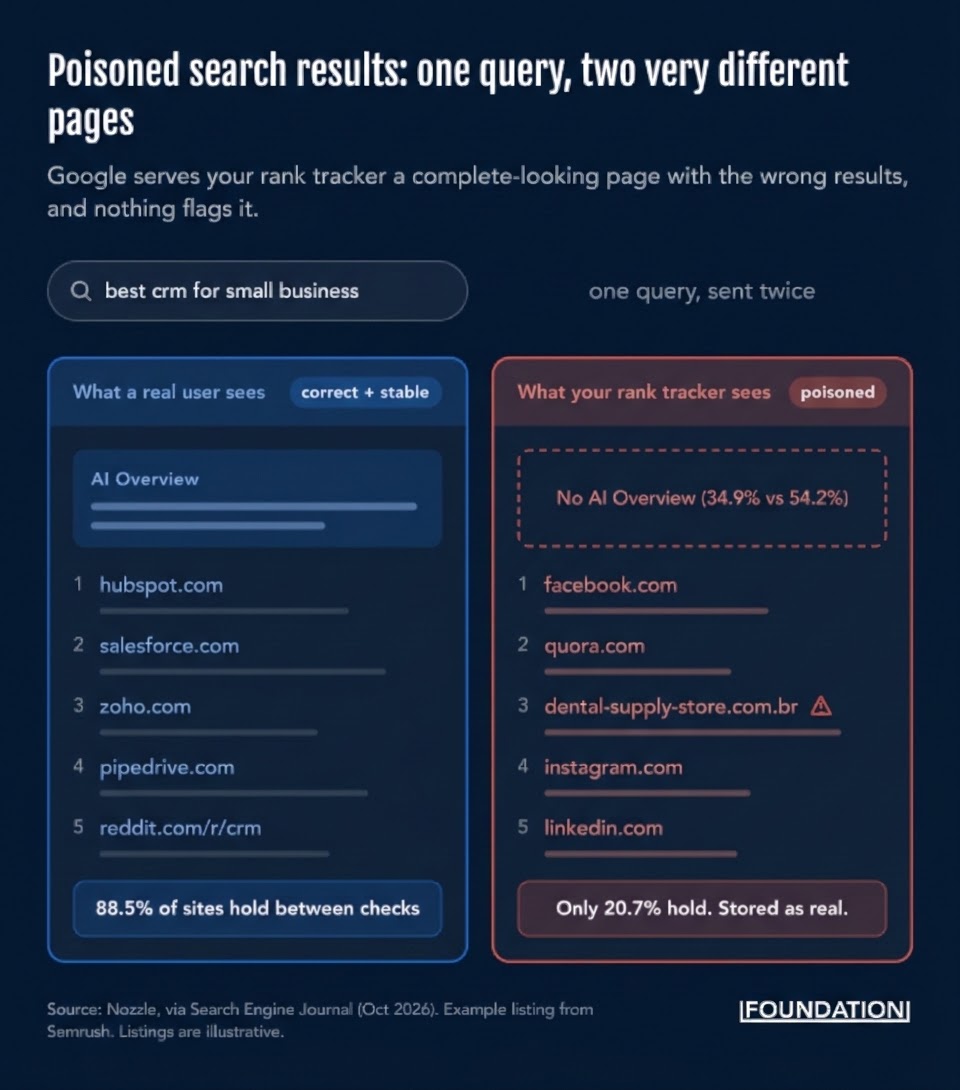
The volatility is the tell. Normal results keep 88.5% of the same sites between repeated checks for the same keyword. Poisoned results keep only 20.7%. That gap is what lands in your dashboard as a drop that never happened. And it clears fast: 80% of poisoned results last a single check, and most pages recover within three days. So the damage concentrates in daily and weekly views and smooths out over a month. The fake pages also have a pattern worth knowing. More UGC from Reddit, Quora, LinkedIn, Facebook and Instagram, and fewer AI Overviews, which show on 34.9% of poisoned pages versus 54.2% normally. Ads and shopping stay stable.
Why It matters
- The dashboard is the one surface you can’t trust right now, and that’s not one firm’s opinion anymore.
If you report week-over-week ranking movement, some of what you’re reporting is noise. A keyword that “dropped” this week probably didn’t. When the two platforms most agencies run on both tell their customers the data is being altered, this stops being a debate. Before anyone flags a drop to a stakeholder, the move has to be checked against a source Google can’t poison. We’ve been seeing exactly this kind of October volatility across Ahrefs and Semrush, enough that it first read like a core update.
- First-party data was always the point. Now it’s the proof.
This issue doesn’t touch Search Console, because that’s Google’s own data rather than a scrape. It doesn’t touch GA4, conversions, or site search. Those have always driven strategy, with third-party rank data as one directional input. Nothing about the strategy changes. What changes is how much weight the scraped number can carry on any single reading, which is now less than it used to be. Both Ahrefs and Semrush point customers to the same check: if rankings move for keywords unrelated to your pages, compare against Search Console before believing it.
- AI-answer visibility appears to sit outside the blast radius.
Thus far, the poisoning looks like it hits tools that scrape Google’s results page. It doesn’t appear to touch the tools that query models directly. Here’s how our Head of Growth, Ren Costantini, put it after doing some digging with our AEO tool of choice:
“The disruption hits tools that scrape classic Google rankings off the results page. Profound’s Answer Engine Insights works differently. It sends prompts to AI answer engines and records each response, so every metric comes from those responses, not from organic ranking positions. Ranking data is compromised. Response-level AI visibility and first-party attribution are not.”
The one open question is Google’s own surfaces. AI Overviews and AI Mode get captured directly from Google (albeit poorly, via Google Search Console), so whether those collection routes see the same interference is still being confirmed. Everything measured off the model’s actual answer holds.
The data that depends on scraping Google broke. The data you own and the data that measures whether you’re in the answer did not.
What to Do about it
- Switch ranking reports to month-over-month. A monthly view should smooth out poisoning spells that wreck a daily or weekly view. Use head terms to show direction on a topic, not exact positions.
- Check Search Console before flagging any drop. If impressions and clicks held steady, the drop is a data artifact, not a lost ranking. This is the exact check both Ahrefs and Semrush now recommend. Make it the gate before anything reaches a stakeholder.
- If you need to rely on SEO tools, triangulate. Keep Ahrefs and Semrush as proxies, not primary measures. Both say they’ve added filters to detect and re-collect poisoned results, but neither catches everything, and both are cleaning up historical data that already landed. Averaging across sources waters down a bad reading from any one of them.
- Make sure your C-suite is aware of the issue. Send a quick update: third-party rank data is being disrupted across the industry, confirmed by the vendors themselves, which is exactly why we anchor on first-party data and AI-answer visibility. Don’t wait for someone to open a dashboard and see a cliff that isn’t there.
🚨Request Your Seat for the Inaugural Citation Conference🚨
If you’re in charge of AI visibility outcomes for your company, this one’s for you.
The Foundation team is hosting Citation Conference: a new event for the enterprise marketing leaders responsible for how AI describes their brands. The inaugural event runs May 11 to 13, 2027, at the Design Exchange in Toronto.
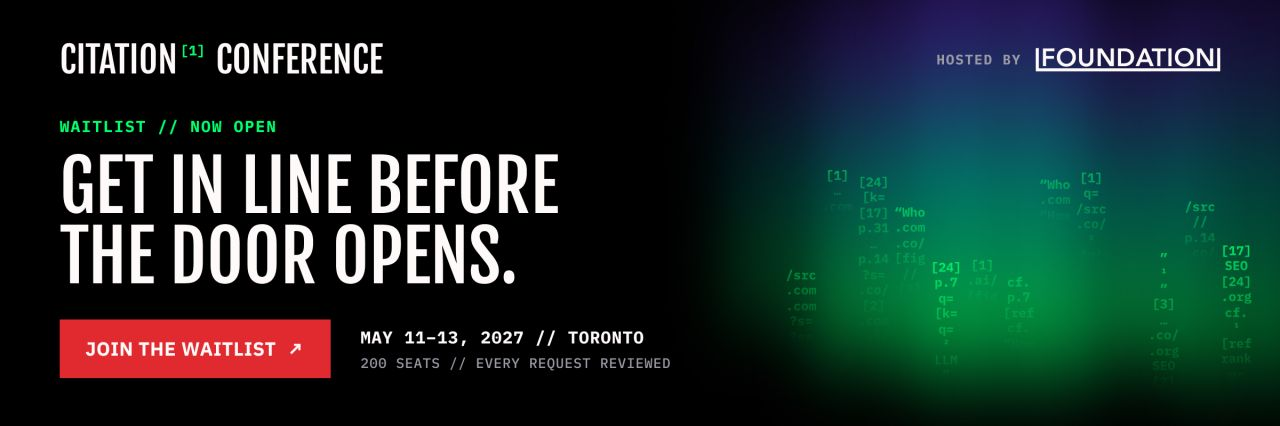
There’s one track and no expo hall. Seats are capped at 200, most of them for in-house marketers, and every request is reviewed individually. The format is built around small Table Talks of 10 people, so you leave with answers to the problems you actually brought.
With 200 seats and a review on each one, the earlier you’re in line, the better.
📊 The Data Point
AirOps’ Jason Saltzman shared new research on how often AI answers cite LinkedIn, split by sector and page type. B2B wins by a wide margin. Marketing and agency services top out at 7.1% of answers citing LinkedIn, followed by professional services at 6.0% and software & SaaS at 4.6%. On the consumer side, only education clears 3%, and most B2C sectors sit below 1%.
The content format also has an impact. B2B citations lean on articles and posts, which make up two-thirds or more of what gets cited. Consumer answers cite people instead. In consumer finance, 39% of LinkedIn citations are personal profiles.
Two caveats worth keeping:
- ChatGPT pulled back hard on LinkedIn. Its share of answers citing LinkedIn fell from roughly 1-in-22 to 1-in-175. The citation weight is concentrating in other engines, so don’t read “LinkedIn gets cited” as “LinkedIn gets cited everywhere.”
- Cited posts are old. Most LinkedIn content AI cites is more than six months old, and fewer than 1% is from the past week. This rewards evergreen posts on category questions, not reaction posts. A take you publish today is unlikely to surface in answers soon, if at all.
The through-line for anyone running executive posting: it’s a citation asset, and it compounds slowly. Post on the durable category questions your buyers ask, not the daily feed cycle.
⚡ Quick Hits
- Mark Williams-Cook broke down how AIO links get assigned based on the mechanism in patent US11769017B1. According to the patent, Google splits each summary into pieces, then attaches the first page that clears a similarity threshold, not the best match. The takeaway: pages that closely mirror the specific claims in an answer win the citation, not just the ones that rank.
- Effective October 16, Google’s privacy policy now lets Gmail, Photos and Drive data personalize ads for users who opt into Personal Intelligence in AI Mode. Google is testing AI Mode ads in that experience. No new advertiser controls, targeting, or reporting come with it. The signals sit entirely on the searcher’s side.
- Discord is making public communities searchable, with selected messages from 63,000+ public servers set to appear in search results starting mid-December. The same concerns that trailed Reddit’s data deals are back: that a public post was never consent to be indexed everywhere, and that the conversations could feed AI training. One to watch as another community platform that could become a citable source, though whether LLMs pull from it is still unconfirmed.
🔗 From Our Lab
→ Who Owns AEO? An Ownership Model for Enterprise Teams — AEO keeps landing on the SEO team, but across Foundation’s study of 50 B2B brands, only about 10% of AI citations point to brand-owned domains. A remit built around the website misses the other 90%. Shadrack lays out an ownership model for enterprise teams: one in-house lead with budget authority across channels, delivery assigned by deliverable (technical GEO to SEO, source packs to Content, platform assets to Community, earned media to PR), and measurement run independently of the teams doing the work. Includes a full RACI and a rule for when to bring in a partner.
→ The State of B2B AI Discovery 2026 — Foundation and AirOps logged 380,000 AI answers across six surfaces and classified 3M citation events across 81 software categories. The headline: AI discovery runs on two different systems, and a blended visibility score can’t tell them apart. Google’s AI surfaces send about 7% of citations to social (YouTube, LinkedIn); on ChatGPT, Gemini and Claude it’s 0.3% or lower, a 27x gap. Community citations split the other way, with Reddit driving ChatGPT’s 9.26% community share. Vendor pages anchor every surface, but the contested 30% behind them is where brands win or lose the shortlist.
→ Brex Ranks #1 on Google. AI Recommends Someone Else. — Brex built a $536K content engine and holds the #1 organic spot for “business credit cards for startups.” Across 348 AI responses on eight engines, Brex appeared in 51.7% of answers, but only 6.5% of citations pointed to brex.com. The AI Overview above their #1 page leads with Reddit and cites Nav, naming Brex as one option, not the pick. Competitors and earned media supply 46% of the sources. The lesson: ranking, getting cited, and being recommended are three different outcomes built by three different source ecosystems.
Foundation Is Hiring (Like, a Lot)
This has been a big growth year for Foundation, and we’re not slowing down. We’re hiring across the board, and every role is remote:
- Marketing Manager
- B2B Strategy Manager (AEO / GEO)
- Marketing Strategist (GEO / AEO)
- Marketing Strategist (YouTube)
- Marketing Specialist (GEO / AEO)
- Senior Account Manager
- Group AEO Marketing Director (Group Account Director)
- Senior AEO Marketing Director (Senior Account Director)
- AEO Marketing Director (Account Director)
- Associate AEO Marketing Director (Associate Account Director)
- Senior AEO Program Director (Senior Delivery Director)
- AEO Program Director (Delivery Director)
- Associate AEO Program Director (Associate Delivery Director)
- Reddit Specialist
- Fractional Video Director
- Reddit Content Manager
If you know someone who’d be a fit, send this their way.
That’s it for this week.
If something landed, tell us. If something felt off, tell us that too. DM me on LinkedIn.
Have a good week,
Ethan Crump

