


Article's Content
Article's Content
Welcome back to What Matters This Week.
This week we’re looking at citation data from Writesonic to test a warning that’s been making the rounds: that competitors can now shape your brand’s answer in Google.
Competitors Can Shape Your Brand’s AI Overview. It Happens One Word Later.
Here’s the TL;DR
- 21.7% of Google AI Overviews on B2B branded buying searches cite a direct competitor. In 11.9%, the competitor is cited and the brand the buyer named isn’t.
- “Alternatives” searches carry the most risk, with a competitor cited 35.8% of the time. But pricing (13.4%) and reviews (7.8%) are also susceptible to competitor influence.
- The pages earning those citations are the SaaS landing pages brands have invested in for years, led by alternatives and comparison pages. If you don’t publish yours, a competitor answers for you.
What’s Happening
The number of brand name searches that trigger an AI Overview in the Google SERP jumped from 26% to 80% in September. Usually that information is sourced from that brand’s own site or a neutral third-party like Wikipedia.
But high-intent searches rarely start with a brand name alone. What happens when you add commercial intent to the brand name?
To find out, we compiled 1,235 queries that named one B2B SaaS brand plus modifiers like “alternatives”, “pricing”, or “reviews”. Our friends at Writesonic then ran each one weekly from June 29 to September 21, for 15,716 Google AI Overviews in total.
A direct competitor was cited in 21.7% of them.
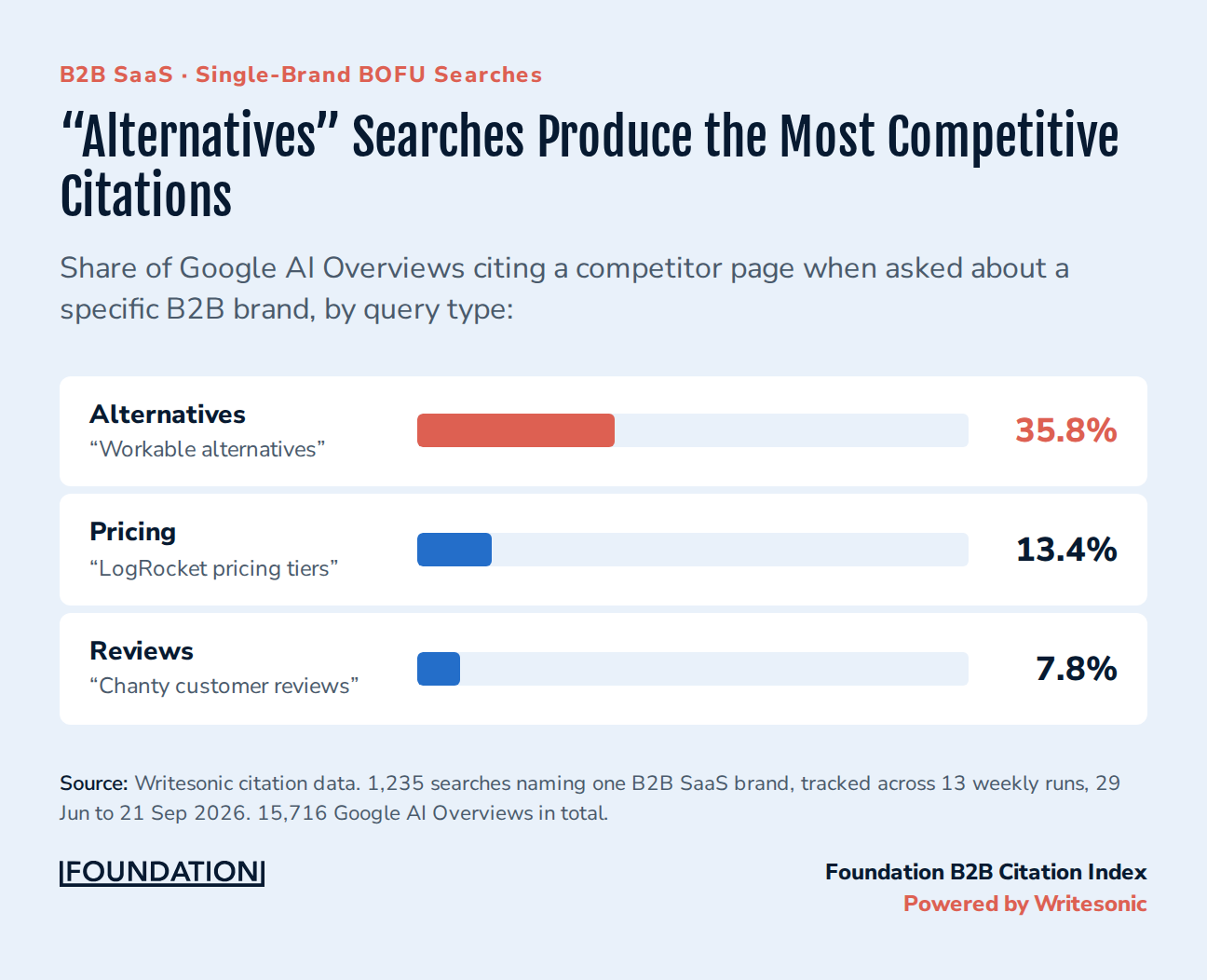
The Writesonic data suggests that the modifier a buyer uses in their branded search is the best predictor of a competitor showing up in the AIO:
- 35.8% of alternative searches cite a direct competitor
- 13.4% of pricing searches cite a direct competitor
- 7.8% of review searches cite a direct competitor
Alternative searches are also where brands go missing. The brand’s own site appears in only 32.9% of those AI Overviews. In 22.0%, a competitor is cited and the brand isn’t, even though the buyer typed the brand’s name.
Why It Matters
- This isn’t just an AI Overviews problem.
Writesonic ran the same single-brand prompts through Google AI Mode and ChatGPT. AI Overviews cited a direct competitor in 21.7% of answers, AI Mode in 19.4%, and ChatGPT in 16.2%. Google’s AI Overview is the most likely to bring a rival into a search about you, but it’s a regular occurrence across answer engines. It’s not just a Google quirk.
If you only track AI Overviews, you’re only watching one of the places where buyers find your competitors’ pages after typing your name.
- Your competitors are already publishing for your searches.
On “Mixpanel alternatives for startups”, AI Overviews cited Amplitude’s Mixpanel alternatives page in all 13 weekly runs. Half of the competitor pages we saw cited were “alternatives” pages, and the five money page types Ross has been telling SaaS brands to build for years account for 78.8% of the competitive citations. Those pages were built to rank in search, and they now earn the citation in AI answers too. They also stick. About one prompt in five had a competitor cited in at least half of its weekly runs.
What to Do About It
- Audit your branded buying searches, not just your name. Add “alternatives”, “pricing”, “reviews”, “migration”, and your ICP qualifiers to your tracked prompts, and record every site each AI Overview cites. Rerun it regularly. The weekly competitor rate in our data moved between 12.7% and 30.2% over the quarter.
- Own your alternatives answer. This is where brands are weakest. An honest page on who you’re a good fit for, and who should pick someone else, gives Google a first-party source to cite.
- Protect the answers you already win. Brands’ own sites appear in 75.7% of pricing AI Overviews. Keep your pricing page current and specific so a competitor’s pricing guide has no gap to fill.
- Show up where the decision gets described. Your G2 profile and the Reddit threads where buyers compare tools are part of your brand answer now. Treat them that way.
If you want the rest of the data, including what happens when buyers name two brands and a closer look at three SaaS brands showing up in their competitors’ AIOs, the full breakdown is up on Foundation Labs.
Get in Line for a Seat at the Inaugural Citation Conference
If you’re in charge of AI visibility outcomes for your company, this one’s for you.
The Foundation team is hosting Citation Conference: a new event for the enterprise marketing leaders responsible for how AI describes their brands. The inaugural event runs May 11 to 13, 2027, at the Design Exchange in Toronto.
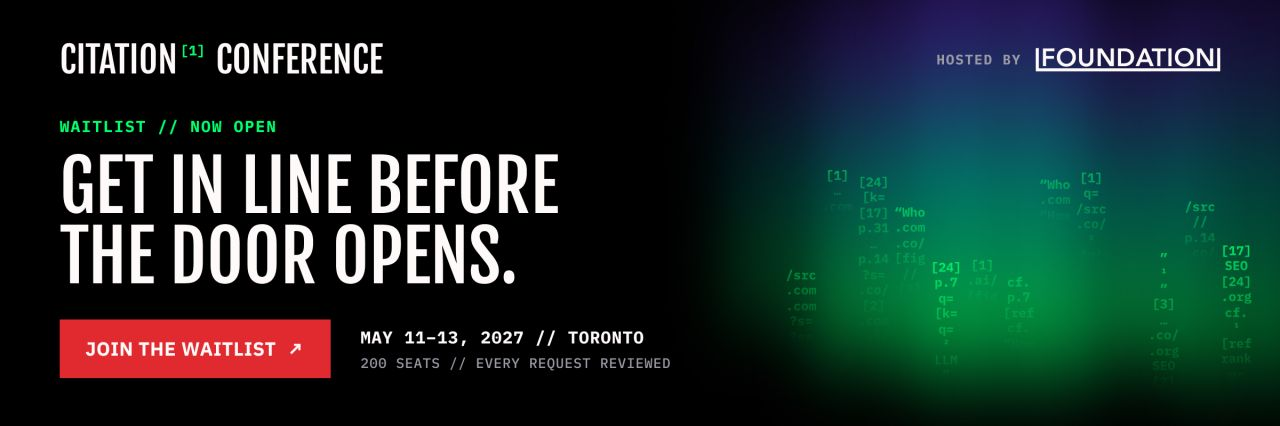
There’s one track and no expo hall. Seats are capped at 200, most of them for in-house marketers, and every request is reviewed individually. The format is built around small Table Talks of 10 people, so you leave with answers to the problems you actually brought.
Tickets go live October 26, so get in early while you still can.
📊 The Data Point
For about a week this month, ChatGPT clicks went missing from analytics. Cedric Huesler tracked roughly 500 pages where ChatGPT drives 5% or more of visits and found ChatGPT referrals down 31,000 visits a day from October 9 to 13 compared with the week before. Direct traffic on the same pages rose 26,000 a day.
ChatGPT links had stopped carrying utm_source=chatgpt.com, so those visits showed up as direct. On October 15 the tags came back after OpenAI confirmed to Huesler that it was a bug, though the fix was rolling out gradually (Search Engine Roundtable has the timeline). If your ChatGPT referrals dipped mid-October, annotate the week instead of reporting it as lost AI visibility.
⚡ Quick Hits
- Gemini 4 Argon is now in AI Mode. Google extended access to their new frontier model, Gemini 4 Argon, on October 13. Argon is now rolling out in AI Mode for Google AI Pro and Ultra subscribers (the announcement doesn’t mention AI Overviews). Note the date in your AI Mode tracking, so any shift in answers after this week has a likely cause attached.
- Your rank tracker may be seeing fake Google results. Nozzle’s research, covered by Search Engine Journal, found Google serving altered results pages to rank trackers on 5% to 11% of SERPs per day since October 1. Those pages showed AI Overviews 34.9% of the time, against 54.2% on normal results. It’s one vendor’s analysis, but it’s reason enough to confirm any sudden drop in AI Overview presence.
- Ahrefs automated its data refreshes and kept publishing at the same pace. In a follow-along guide, Si Quan Ong walks through a workflow that pulls fresh data for 12 datasets every month, rebuilds the tables and charts, updates the WordPress drafts, and waits for a human to review everything before it goes live. Their publishing cadence didn’t change. The point was keeping pages fresh: Ahrefs’ 2025 research found AI assistants cite pages last updated an average of 909 days ago, against 1,047 days for organic results.
🔗 From Our Lab
- AI Citation Tracking: What It Is, Why It Matters, and Which Tools to Use
- SaaS Landing Pages: Must-Have Pages For Every SaaS Company
- The Versus Layer: Who Owns the Pages AI Uses to Compare Your Product?
Foundation Is Hiring (Like, a Lot)
This has been a big growth year for Foundation, and we’re not slowing down. We’re hiring across the board, and every role is remote:
- B2B Strategy Manager (AEO / GEO)
- Marketing Strategist (GEO / AEO)
- Marketing Strategist (YouTube)
- Marketing Specialist (GEO / AEO)
- Senior Account Manager
- Group AEO Marketing Director (Group Account Director)
- Senior AEO Marketing Director (Senior Account Director)
- AEO Marketing Director (Account Director)
- Associate AEO Marketing Director (Associate Account Director)
- Senior AEO Program Director (Senior Delivery Director)
- AEO Program Director (Delivery Director)
- Associate AEO Program Director (Associate Delivery Director)
- Reddit Specialist
- Fractional Video Director
- Reddit Content Manager
If you know someone who’d be a fit, send this their way.
That’s it for this week.
If something landed, tell us. If something felt off, tell us that too. Reply to this email or DM me on LinkedIn.
Have a good week,
Ethan Crump

