Article's Content
Article's Content
Welcome back to What Matters This Week.
Most AI visibility reports present a single number: how often the brand appears. ClickUp’s visibility number would make any team happy, but it hides something that decides the deals.
In September 2026, the Foundation Labs team ran 21 prompts twice across ChatGPT, Claude, Gemini, Perplexity, Google AI Overview, and Google AI Mode. Across 120 discovery answers where we didn’t name the brand, ClickUp appeared 117 times, a 97.5% presence rate.
Then we asked each platform which of ClickUp, Asana, and monday.com a 100-person company should choose, and ClickUp received zero of 12 default recommendations.
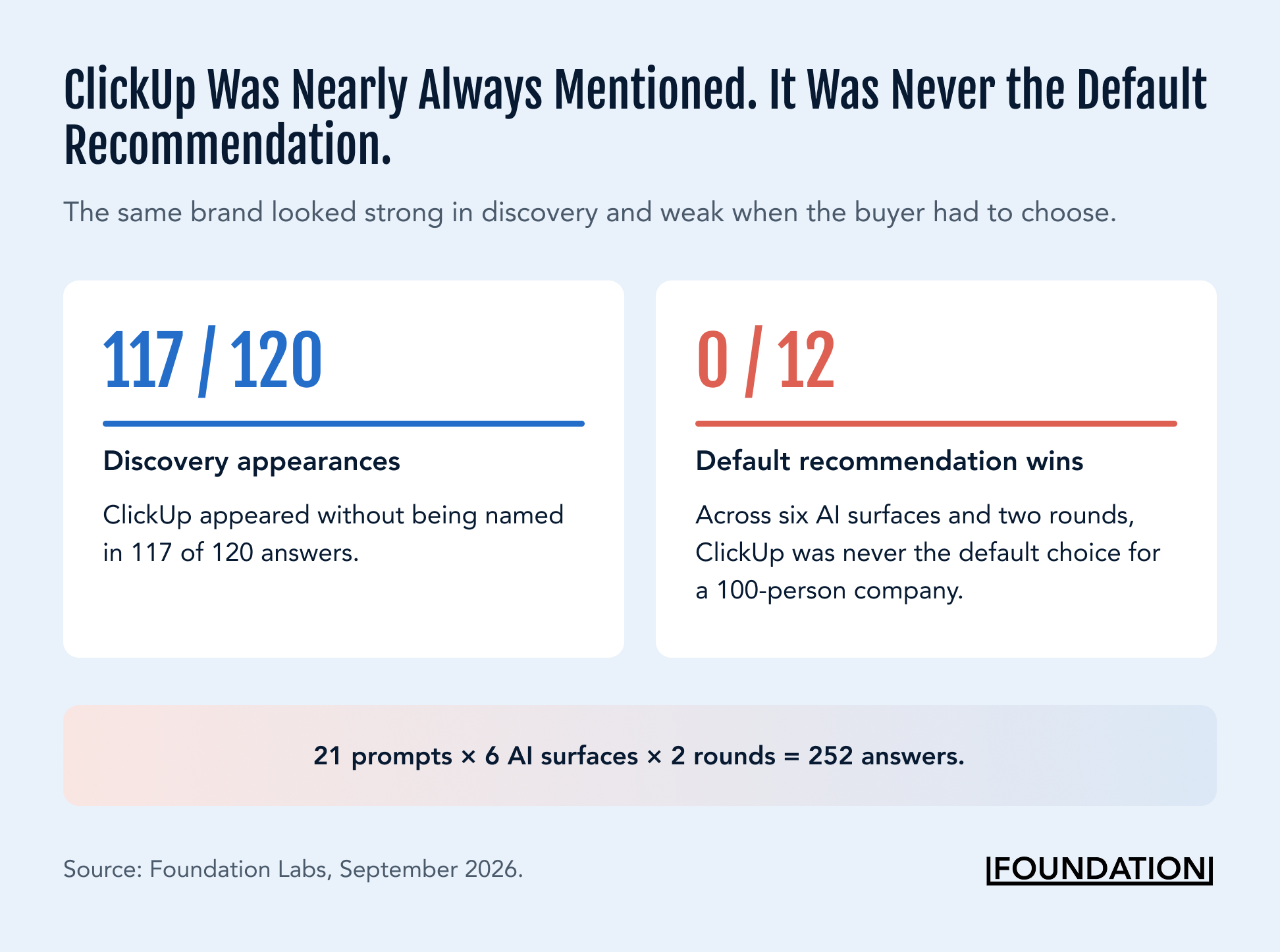
A presence score tells you you’re in the conversation, and nothing about who wins the recommendation. It also hides Model Drift: the same brand, the same buyer question, a different answer depending on which AI surface you ask.
Below is what that high mention score hid, plus a four-step audit to look past yours.
Why AI Praised ClickUp and Recommended Someone Else
ClickUp’s average sentiment sat above neutral on five of the six surfaces, and the answers regularly credited it for feature breadth, customization, and automation. Even so, ClickUp received zero default recommendations across 12 answers. In one ChatGPT run, Asana came out ahead on adoption, portfolio visibility, governance, and lower administrative burden.
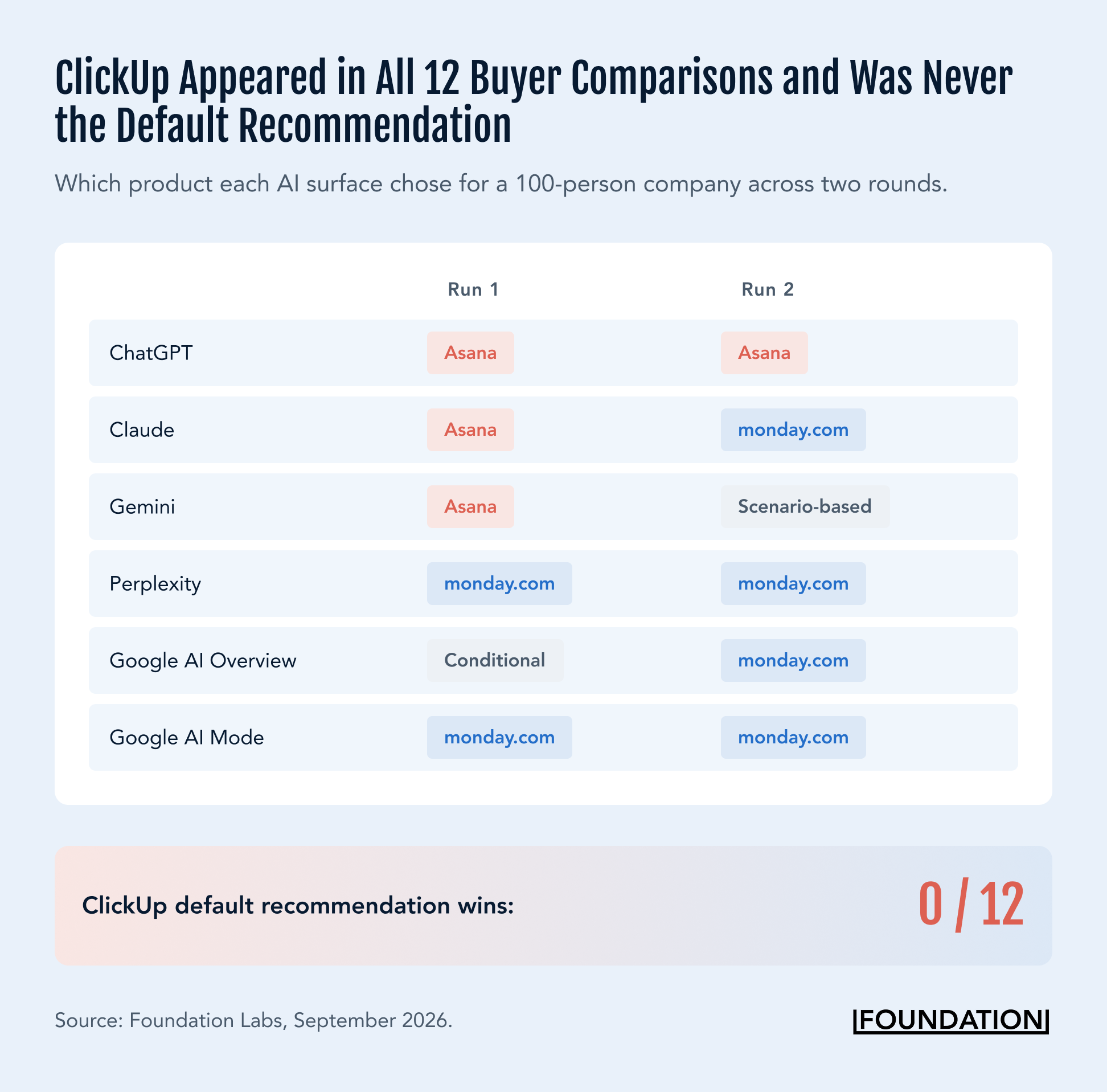
ClickUp received 0 of 12 default recommendations against Asana and monday.com for a 100-person company. Source: Foundation Labs.
When we asked which of the three tools offers the best user experience for a 100-person company, ClickUp won zero of 12 answers, and the same criticisms kept coming back: a steeper learning curve, denser configuration, more onboarding effort, and heavier administration.
One ChatGPT answer called ClickUp the most capable of the three and still ranked it third for user experience. For a buyer weighing how quickly 100 people can get productive, the models put adoption risk ahead of feature depth, and the evidence they found on adoption favored ClickUp’s competitors.
So, despite its 97.5% AI presence, ClickUp lost the competition when buyers asked AI to make the choice. If your reporting stops at presence, you can’t see this loss at all.
ClickUp Wins When the Question Changes
When buyers asked about consolidating tools or reducing software sprawl, ClickUp moved from never chosen to first place in most answers.
On the best tools to consolidate project management, docs, chat, and time tracking, ClickUp placed first in 11 of 12 answers and made the top three in all 12. On reducing software sprawl, it placed first in seven and made the top three in 10. And when the question narrowed to AI embedded in project execution, ClickUp was named in all 12 answers, up from 10 of 12 on broader AI-productivity prompts.
On the AI execution prompt, Claude called ClickUp “the most aggressive on agents”, and the narrower question removed general-purpose competitors from the field. The question a buyer asks determines which evidence gets weighed, so the move is to identify the decision questions you’re losing and build proof for them, rather than chase a higher overall presence score.
Each AI Tells Buyers a Different Story About ClickUp
A single score doesn’t show how each platform treats you.
On discovery prompts, ClickUp ranked in the top three in 19 of 20 Google AI Mode runs, compared with 11 of 20 on Claude.
The category language drifted too. ClickUp calls itself a “Converged AI Workspace”, but only ChatGPT and Claude used that label consistently in both runs, while the other four defaulted to project management, work management, or work OS.
AI surfaces category language from the sources it retrieves. If the only place “Converged AI Workspace” appears is ClickUp’s own site, most surfaces will default to the label the rest of the web uses.
The sources behind each answer explain much of the spread. Product-owned pages dominated on ChatGPT, editorial sources made up the majority everywhere else, and Google’s two surfaces carried the highest share of community content.
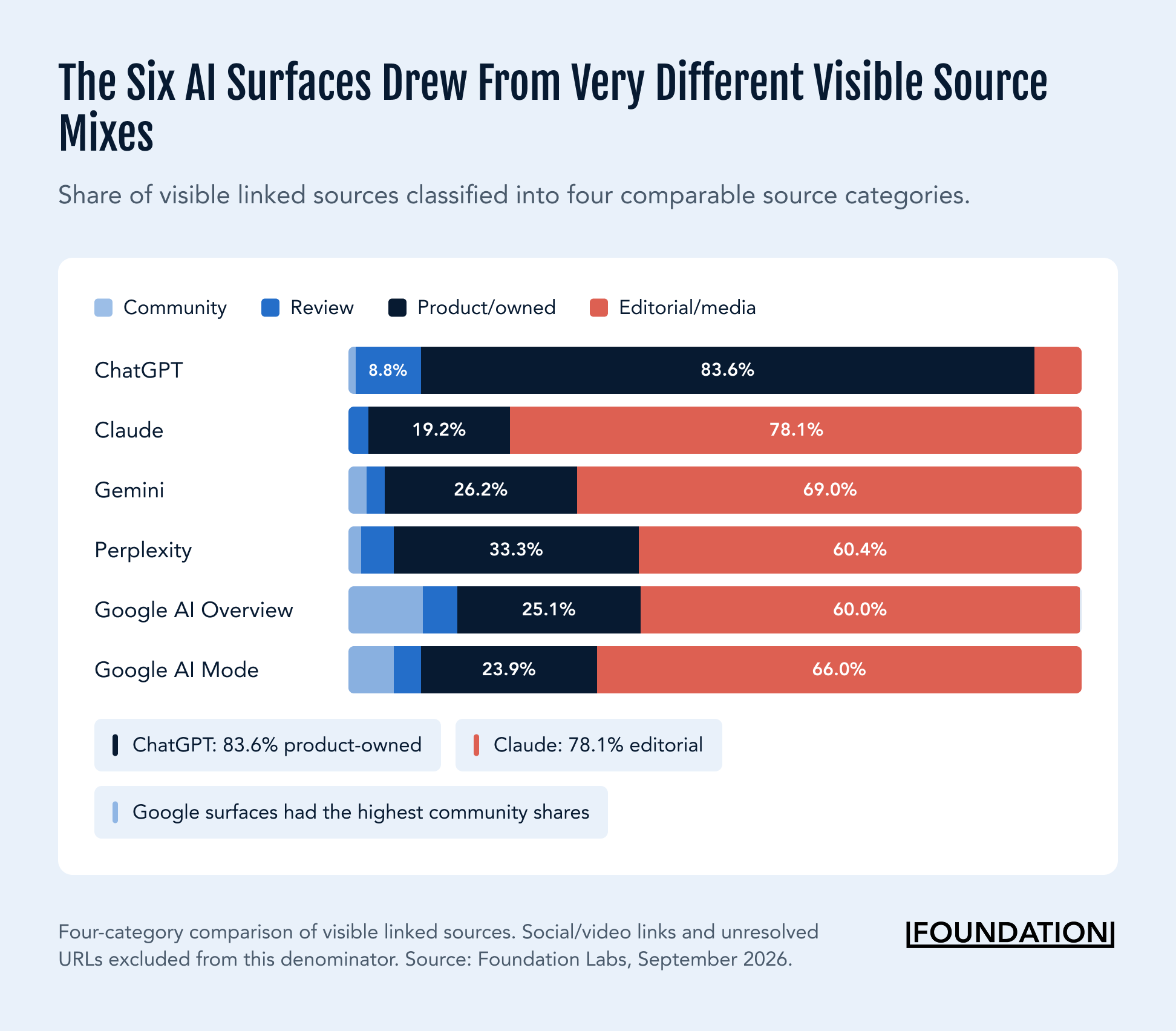
Visible source mix across ChatGPT, Claude, Gemini, Perplexity, Google AI Overview, and Google AI Mode in answers about ClickUp and its competitors. Source: Foundation Labs.
Reddit and YouTube show the sharpest split between surfaces. Google AI Overview cited 24 Reddit links and 23 YouTube links, and AI Mode cited 24 and 36. ChatGPT cited 20 Reddit links and no YouTube. Perplexity and Gemini cited four and two Reddit links and no YouTube, and Claude cited neither.
Results also fluctuated within a single surface. Google AI Overview left ClickUp out of its “best AI productivity platforms for teams” answer on September 12, then included ClickUp Brain in the same answer on September 13, so a single run on a single day isn’t enough to judge.
Run a Model Drift Audit on Your Brand
Here’s the method we used to look past ClickUp’s presence score. Apply it to your own brand:
- Ask a question that forces a choice. Discovery prompts tell you whether you’re on the list, and decision prompts tell you whether you win. Write three prompts in your buyer’s words that name you and your two closest competitors, such as “Which should a 100-person company choose?”, “Which is easiest to adopt?”, and “Which scales best for a growing team?” Run each one twice on all six surfaces and log the recommended product, the reasons it won, and every concern raised about you. If you place in the top three on discovery prompts but don’t win the choice prompt, you have the same problem as ClickUp, and the concerns you logged are your work list.
- Trace the evidence behind each concern. For every concern in your log (onboarding, governance, price, admin load), note which sources appear next to it on each surface, using Profound or Ahrefs Brand Radar to pull the cited URLs. Expect the mix to differ, the way ChatGPT leaned on product pages while Google’s surfaces pulled in Reddit and YouTube. A displayed source doesn’t prove it supports every claim in the answer, so tag each concern with the source types that recur around it and use that as your placement map for step three.
- Build proof for the concern where AI looks for it. Turn each concern into something you can measure. In ClickUp’s case, AI kept citing a steep learning curve, so the counterevidence would be launch time, onboarding completion, administrator workload, and adoption across larger accounts, published as customer stories, review-site profiles, YouTube walkthroughs, and community answers, the same source types from your map. If your data contradicts what AI says, you have your asset. If it confirms it, take it to the product team before taking it to marketing. Apply the same logic to category language: if AI won’t use your term, get it into analyst briefings, partner pages, and review profiles.
- Rerun with the same setup and compare. Keep the prompt, surface, and test setup identical, record the date and visible model, and compare the new run with the last one across the six dimensions the full teardown tracks: presence, position, description, preference, sentiment, and visible sources. Note which results hold and which change, and run each prompt at least twice, given how much a single surface can move overnight.
The upside is already visible in ClickUp’s own data: when the question matched its strengths, it took first place in most answers. Go beyond AI visibility. Give AI a reason to pick you.
→Read the full Model Drift teardown
Go beyond AI visibility. Give AI a reason to pick you.
📊 The Data Point
Only 16% of Fortune 500 brands systematically track their performance in AI search, according to McKinsey, even though half of consumers already use it and McKinsey expects $750 billion in US revenue to flow through it by 2028. If you aren’t tracking yet, start with decision prompts rather than mentions.
⚡ Quick Hits
- Google AI Mode and AI Overviews will show different answers by design. Google’s documentation states that the two “may use different models and techniques, so the set of responses and links they show will vary”. Report them as two separate surfaces rather than one “Google AI” line in your dashboard.
- A 0.1-star rating edge erased big brands’ advantage in AI recommendations. In an arXiv study testing skincare brands on GPT-4o-mini, Claude Sonnet, and Gemini 3 Flash, well-known brands were recommended 100% of the time when specs were identical, but that dominance disappeared once a competitor had a rating just 0.1 stars higher. Compare your average G2 and Capterra ratings with your two closest competitors, because a small difference may carry significant weight in AI answers.
- ChatGPT agents now sit inside Slack and Teams. At DevDay on September 29, 2026, OpenAI launched Dots, always-on agents that paid ChatGPT Pro and Business subscribers can message directly in Slack and Teams, so some vendor research now happens in chats you’ll never see. Ask clients and prospects on discovery calls, “Did you use an AI agent to research vendors, and what did you ask it?”, and run the exact prompts they share in your next audit.
🔗 From Our Lab
- The Versus Layer: Who Owns the Comparison Pages AI Uses?
- The Two Internets Behind AI Answers, and What They Mean for B2B Marketing
- How Query Fan-Out Works, Why It Matters, and What It Means for Brand Visibility in AI Search
- The Docs Dividend: How Docker Built Its Largest First-Party AI Evidence Layer
That’s it for this week.
If something landed, tell us. If something felt off, tell us that too. DM me on LinkedIn.
Have a good week,
Ethan Crump