Article's Content
Article's Content
“Content is becoming a commodity. It’s easier to create than ever before. The sea of mediocre content marketing has never been more full than it is today.”
Ross said this on X back in 2023 and the issue has only gotten worse. That’s why Google announced their new recipe for AI visibility:
Create non-commodity content.
The timing isn’t a mystery. Generative tools have made it trivially easy to produce competent-looking content about anything, and the web is filling up fast. When anyone can generate a passable “how to” guide or “best tool” listicle in minutes, that content stops being valuable to the audience.
Google’s answer was to draw a line between content anyone could produce and content only you could.
Here’s what you need to know about Google’s preferred content type.
What is Non-Commodity Content?
According to Google’s guidance on AI visibility, non-commodity content provides “unique expert or experienced takes that go beyond common knowledge or the ordinary.”
The emphasis on expertise and experience are key: Google differentiates between high-value and low-value content by identifying signals of genuine human experience. The examples Google’s Danny Sullivan provided during his Search Central Live presentation exhibit this dynamic perfectly.

| Pro Tip: Video content creation is mentioned in two out of the three examples of non-commodity content. That’s a big hint from Google about their content preferences going forward. |
Commodity content vs non-commodity content
A product or service becomes commoditized when it becomes so indistinguishable that competition runs through price instead of quality. The process holds for the marketing materials we see online.
Commodity content is content that you can produce with no input from anyone at your company through simple research or, increasingly, the use of AI. The information is recycled from top-ranking pages or LLM outputs and becomes indistinguishable from existing articles on the same topic.
Non-commodity content is both helpful and reliable because it centers on real first-hand experience and subject expertise. A real decision, a test that surprised you, a client situation you navigated. During the Google Search Central presentation, Sullivan named the three attributes that define non-commodity content:
- Unique: it provides a viewpoint others can’t easily replicate
- Specific: it focuses on a particular instance rather than a general rule
- Authentic: it’s based on first-hand knowledge from someone who did the work
As the Google examples show, this happens frequently with content formats that show up at the top of the SERPs. Generic listicles, well-trodden how-tos, and surface-level thought leadership recycled from social media.
Here’s how that played out across the three scenarios Sullivan used:
| Running store. | Commodity: “Top 10 Things to Consider When Buying Running Shoes”
Non-commodity: “Why This Customer’s Shoes Collapsed After 400 Miles” |
| Real estate agent. | Commodity: “7 Tips for First-Time Homebuyers.”
Non-commodity: “Why We Waived the Inspection (And Saved $15k” |
| Interior designer. | Commodity: “2024 Kitchen Trends You Need to See”
Non-commodity: “Marble vs. Grape Juice: Why I Refused to Install Stone for a Family of Five” |
While the commodity focus is new, this announcement is just the latest step in Google’s journey to surface content that actually users.
Non-commodity content didn’t come out of nowhere
Ever since the Helpful Content Update in 2022, Google has had a consistent message for site owners: Create for people, not search engines.
The underlying test still applies — would this content have value if no algorithm ever saw it? If the answer is yes, you’re creating the helpful content Google wants to surface. If the answer is “we published it to rank or win AI visibility,” it isn’t. That principle carried through every major update since: the March 2024 core update that wiped out enormous volumes of low-quality AI content, the continued refinement of E-E-A-T signals, and Google’s increasing emphasis on named authors, first-hand experience, and original reporting.
Non-commodity content is that same test, updated for the AI era. Generative AI has made the commodity side of that line dramatically easier to populate. Anyone can produce competent-looking content about any topic in minutes, which means competent-looking content is now the floor, not the standard.
Non-commodity is Google raising the bar to a place AI can’t follow, now let’s look at some examples of brands that pass that bar.
Key Characteristics of Good Non-Commodity Content (With B2B Examples)
Good non-commodity content starts from an advantage that most companies already have access to: proprietary data, subject-matter experts, and thought leaders who have made decisions worth hearing about.
The raw material is never the constraint. The constraint is having a content supply chain that helps get it out of your data bases or SMEs and onto the page. It’s true whether you’re a B2C shoe company or an enterprise B2B SaaS.
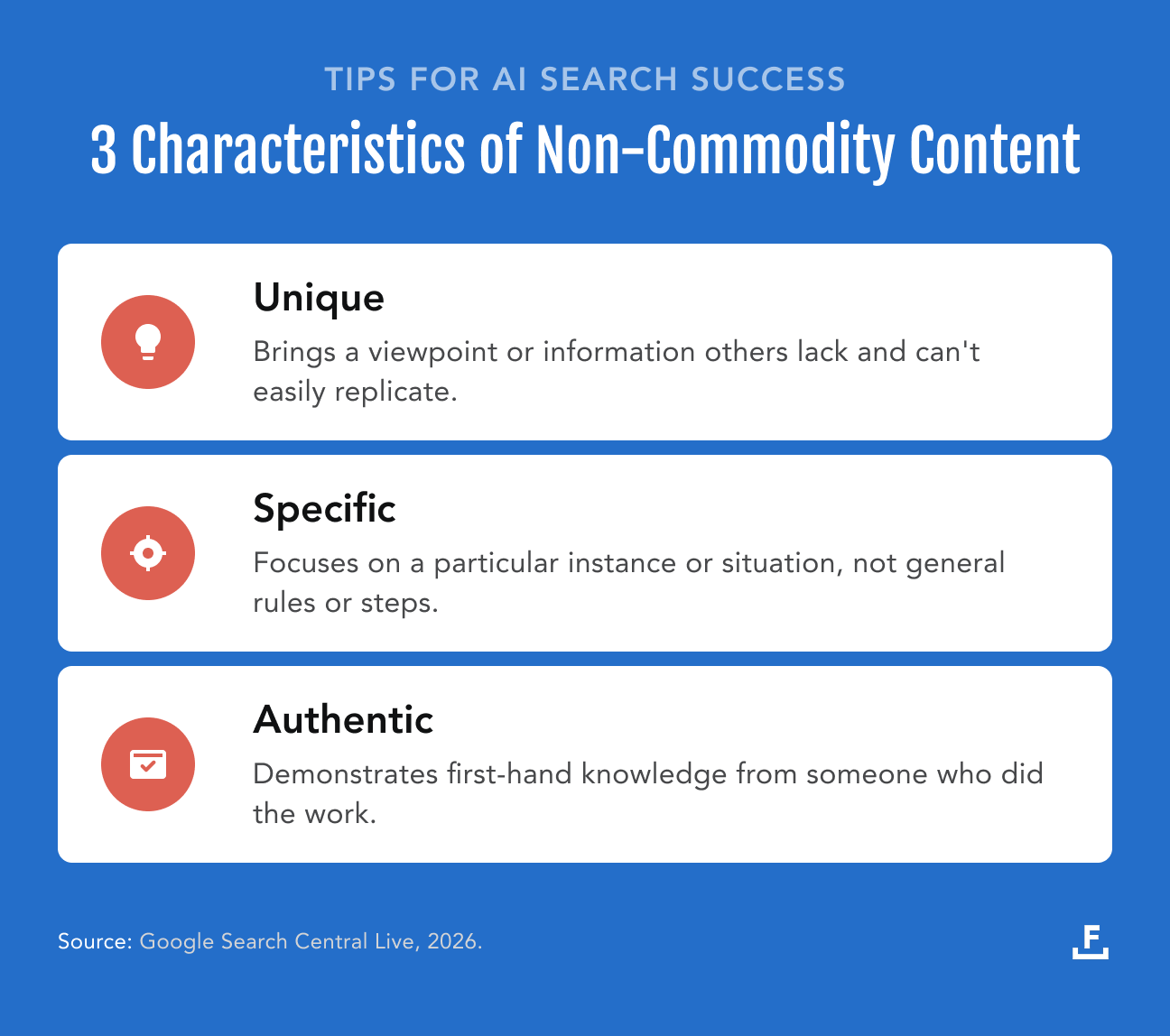
Each of the three attributes Google named maps to an asset you already own. Here’s what that looks like in practice.
Unique: Bring a view that others can’t replicate
Unique content brings information or a viewpoint others can’t easily replicate. Google’s running-store contrast captures it: the generic “Top 10 Things to Consider When Buying Running Shoes” versus a teardown of one customer’s gait that explains why their foam collapsed after 400 miles.
In B2B SaaS, uniqueness usually comes from proprietary data and a vantage point no one else has. 6Sense’s ebook, A Deep Dive Into the Dark Funnel, is a great example. The company built it around a concept it defined and trademarked: the Dark Funnel, the anonymized buyer-intent data scattered across third-party sites like G2 and TrustRadius and buried inside a company’s own systems.
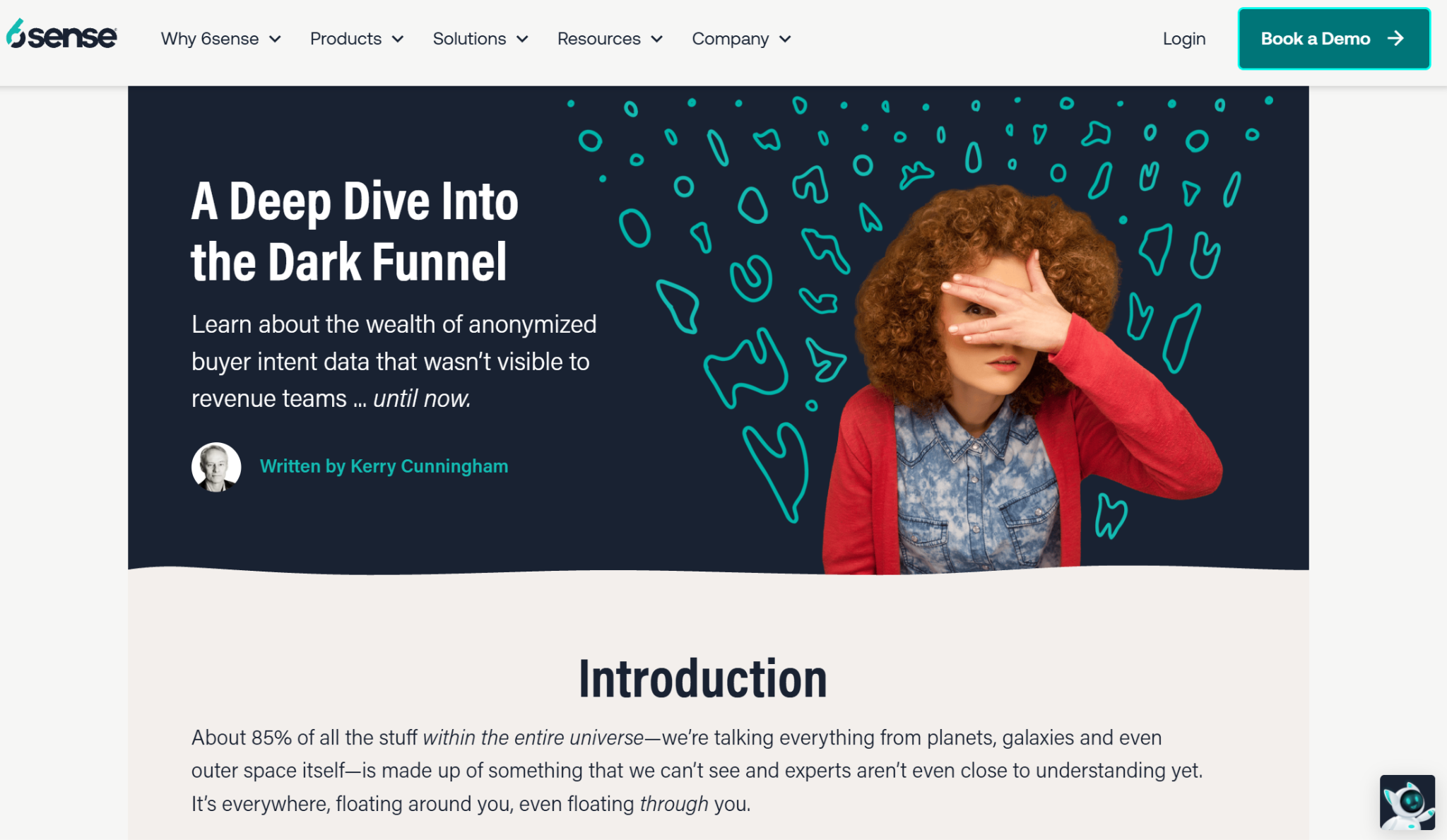
The insight draws on nearly a decade of pulling that data into the light for more than 600 companies, a vantage no competitor shares. 6Sense even frames it with an analogy only it would reach for, likening the unseen data to dark matter, the invisible mass that makes up most of the universe.
Proprietary data plus the lived expertise of a named author, demand-gen veteran Kerry Cunningham, is the moat.
Specific: focus on the particulars that matter most
Specific content covers a particular instance, not a general rule. Google’s real-estate example: the “7 Tips for First-Time Homebuyers” listicle versus “Why We Waived the Inspection (And Saved $15k),” built around one bidding war and a decision to crawl the sewer line and confirm it was PVC.
Clarify, an AI-native CRM startup, does this from the founder point of view.
Co-founder Patrick Thompson’s post on finding your first customers reads nothing like another “how to use LinkedIn” guide. He builds it around his own path: at his previous startup, Iteratively, he won nearly half his early customers by hanging out in the Slack communities where his buyers already were and writing posts that answered the problems they raised.
He turns that lived experience into a framework he calls the Founder-Channel Matrix, backed by specific plays from named founders at companies like Tofu and Pylon.

It works because every claim traces to a real instance someone lived, not a survey anyone could assemble. Specificity is what makes content relevant, because buyers are looking for their exact situation rather than the category overview they’ve read ten times.
Authentic: demonstrates your first-hand experience.
Authentic content demonstrates first-hand knowledge. Google’s interior-design example: the Pinterest trend gallery versus the designer explaining why she refused to install marble for a family with three toddlers, with the grape-juice-and-turmeric stain tests to prove it.
Beehiiv runs this at the brand level. Its annual report, The State of Newsletters 2026, demonstrates experience the way Google means it.
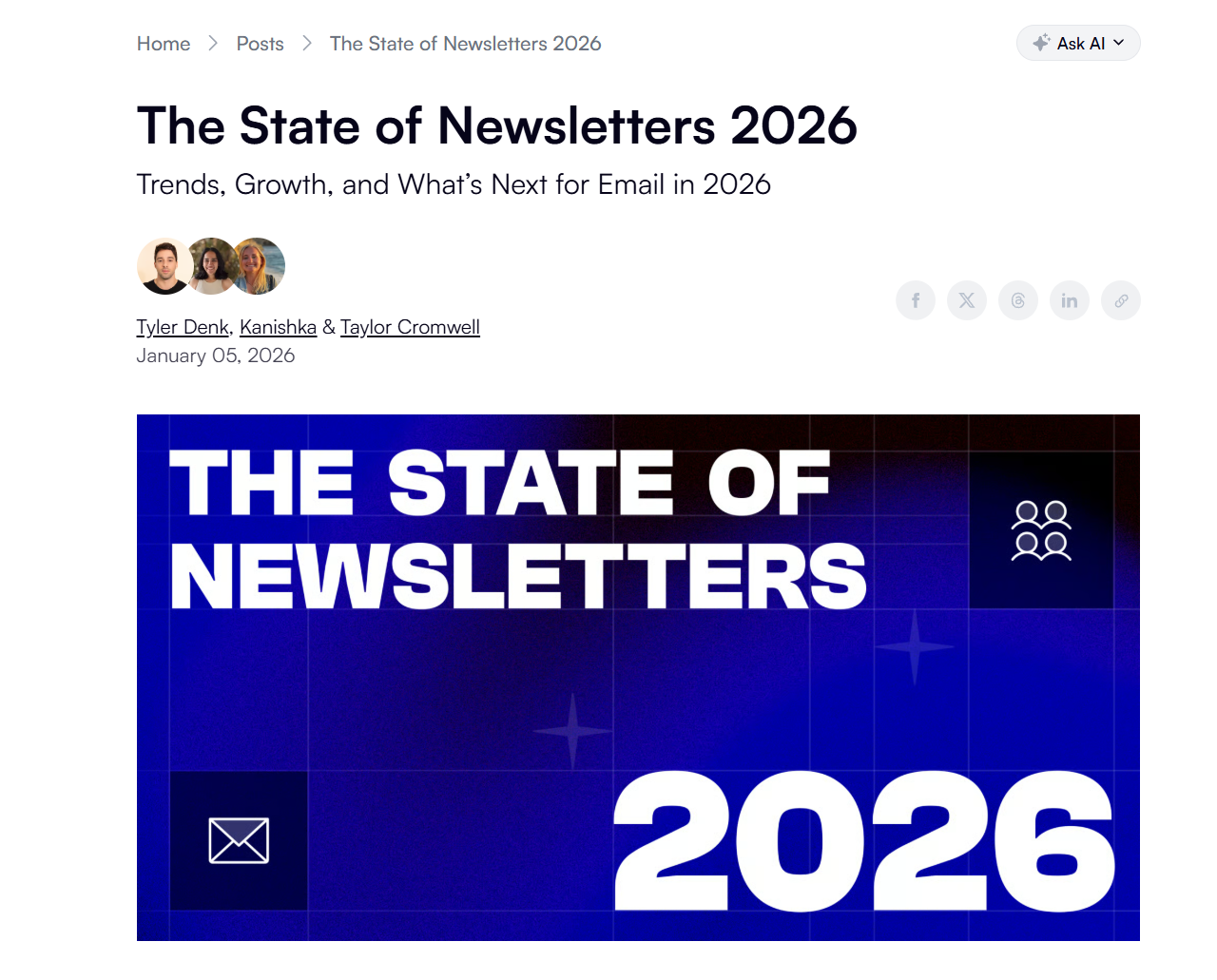
Every benchmark comes from inside the platform Beehiiv operates, so the numbers are first-hand rather than borrowed: 28 billion emails sent and 255 million readers reached last year, with paid subscriptions jumping 138% to $19M in 2025.
Beehiiv pairs that owned data with interviews of the founders and operators who actually did the work, and publishes it under real bylines from CEO Tyler Denk and his team. That is EEAT (Experience, Expertise, Authority, and Trust) working as intended: experience demonstrated through the data and the people who lived it, not merely claimed.
Across all three examples, the format changes but the source doesn’t. 6Sense leaned on data only it could gather, Clarify on a founder’s real path to his first customers, and Beehiiv on numbers pulled straight from its own platform. None of it could have come from a competitor or a generic prompt, which is exactly what makes it non-commodity content.
What Does this Mean for Your Commodity Content?
Despite Google’s intentions, commodity content isn’t disappearing from SERPs overnight. Some of what AI cites today is weak: pages with little traffic, almost no engagement, and few links.
In his SEO Week presentation on AI memory marketing, Ross put it like this, “If the garbage is being cited, but you’re adding value, get your brand in there so you can add value to the customers who are looking for that.” When commodity content is what gets pulled into answers in your niche, your brand still needs to compete.
Start by checking what’s being cited. Pull your highest-value queries into an LLM tracking tool and study the URLs that show up. Across most industries, you’ll find commodity content doing the work. What you do next depends on your market.
- In a mature industry, more commodity content won’t move you. You should already have a moat built on harder-to-replicate work, and AI can now produce the generic version in seconds.
- In a newer market where that commodity content doesn’t exist yet, filling the gap is a real opening.
When commodity content is winning and you decide to compete, the bar is to make it meaningfully better than what ranks. Add proprietary data, or embed the firsthand detail a competitor can’t fake.
Turn Your Expertise into a Winning Content Strategy
The line Google drew isn’t complicated. Commodity content is anything a competent writer could produce with no input from your team. Non-commodity content carries proof of work that only you could supply, and it’s what earns visibility now that AI search is sorting the two.
The encouraging part is that you already own the raw material. Every company has proprietary data, subject-matter experts, and leaders who’ve made decisions worth hearing about. What most teams lack isn’t insight. It’s a reliable way to pull that insight out of people’s heads and turn it into content, week after week, across the channels their buyers use.
That’s a content strategy problem, and it’s the one worth solving.
If you want help building a content marketing strategy that consistently turns your team’s expertise into content readers and AI both reward, get in touch with Foundation.