
Article's Content
Article's Content
Welcome back to What Matters This Week.
Last week, we covered Profound’s data on ChatGPT writing “reddit” into its query fanouts 24x more often than in January. This week, we’ve Foundation’s latest research on a channel most B2B teams are still treating as optional.
YouTube Is Where Your Buyers Decide. Most B2B Brands Still Don’t Have a Strategy.
Here’s the TL;DR
- New Foundation analysis of 8,566 keywords across 130+ B2B SaaS categories found YouTube ranking in Google’s top 10 for 80.2% of “demo” queries, 22.5% of “best” queries, and 20% of “vs” queries. The average CPC on demo keywords is $49.
- YouTube outranks three or more SaaS vendors simultaneously on 1,723 keywords representing 513,000 monthly searches. On 166 keywords, it beats five or more vendors at once.
- The biggest pool of search volume where YouTube ranks (1.35M monthly searches) falls in the lowest-paid-competition zone. Almost nobody is advertising there. YouTube is winning anyway.
What We Found
We ran the analysis to answer a question our sales team keeps hearing on strategy calls: Is YouTube actually important for organic search and AI visibility?
The team pulled 8,566 keywords across 130+ SaaS categories and 14 SaaS domains, then broke every keyword down by search intent, query modifier, keyword length, paid competition density, and cross-competitor overlap. We measured how often YouTube cracked Google’s top 10 for each, and how often it outranked the actual SaaS vendors competing for the same terms.
Across all 8,566 keywords, the intent breakdown looks normal: 58.1% commercial, 23.3% informational, 11.5% transactional, 7.1% navigational.
But when you filter to only the keywords where YouTube ranks in the top 10, the mix changes. Transactional keywords jump from 11.5% to 18.7% and navigational nearly triples to 17.5% to 17.5%. YouTube isn’t over-indexing on awareness queries. It’s over-indexing on the moment buyers are ready to act.
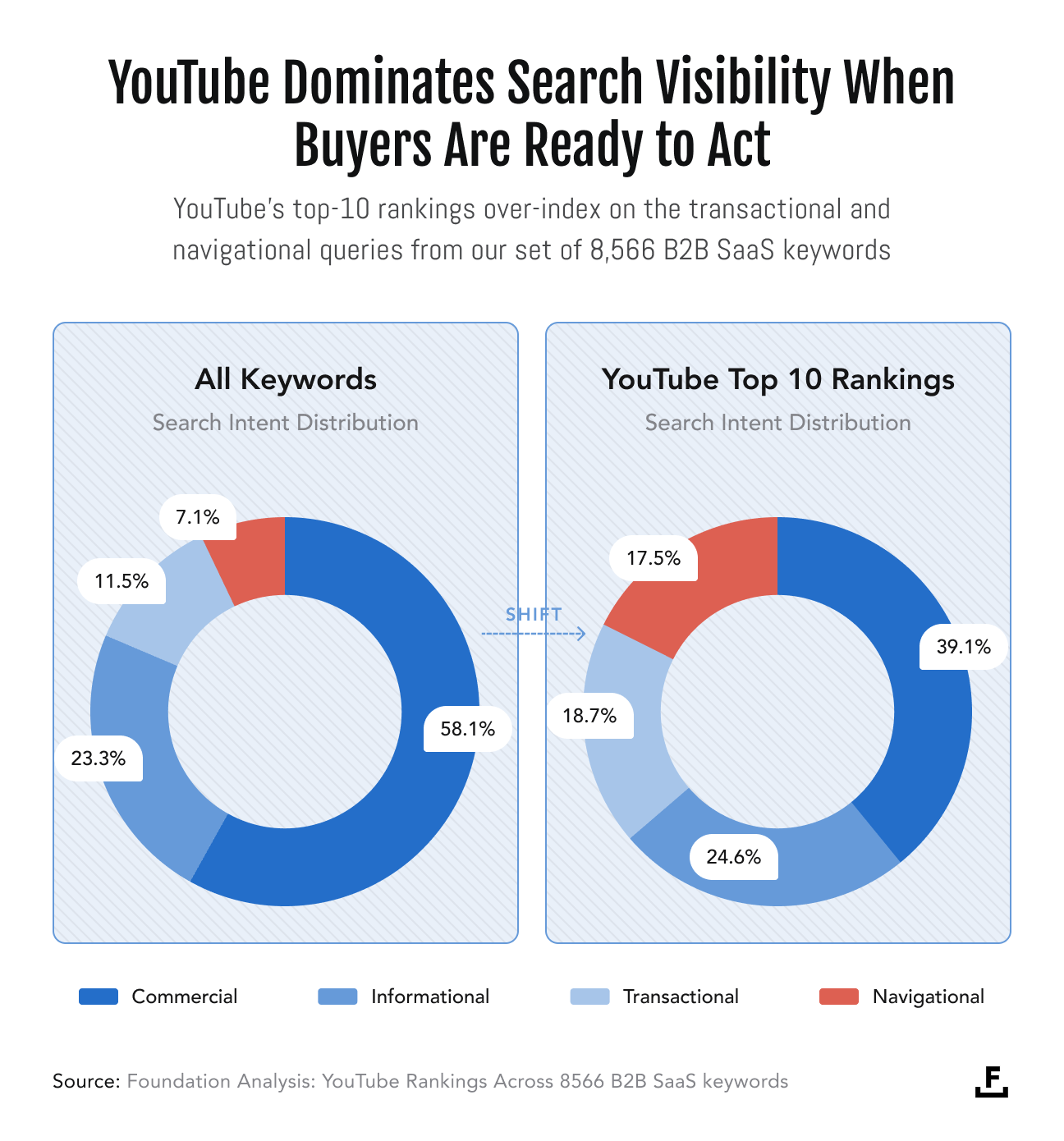
The query-modifier data shows the extent of YouTube’s dominance in top-10 SERP spots for high-value B2B SaaS queries:
- Demo: 80.2% ($49 average CPC)
- Login/sign in: 39.7% ($45 CPC)
- For beginners: 36.4% ($7 CPC)
- How to: 26.5% ($13 CPC)
- Trial: 25.7% ($33 CPC)
- Setup/install: 24.0% ($70 CPC)
- Best: 22.5% ($20 CPC)
- Review: 20.4% ($19 CPC)
- VS/versus: 20.0% ($27 CPC)
- Alternatives: 13.6% ($33 CPC)
Eight out of ten times a buyer searches for a SaaS demo, there’s a YouTube video on page one. One in five “best” queries. One in five “versus” queries. These are the exact keywords your demand gen team is fighting over in Google Ads.
On 1,723 keywords (513,000 monthly searches), YouTube outranks three or more SaaS vendors in the same SERP. On 576 keywords (198,000 monthly searches), it beats four or more. On 166 keywords (54,000 monthly searches), it beats five or more vendors simultaneously — companies with full content programs, link-building budgets, and years of domain authority.
What It Means
#1. YouTube is a mispriced asset in B2B SaaS right now.
We segmented the YouTube-ranking keywords by paid-search competition density. The biggest pool of search volume where YouTube ranks — 1,348,000 monthly searches — sits in what Ross identifies as the “very low” competition zone. Almost nobody is advertising there and YouTube is raking in the traffic.
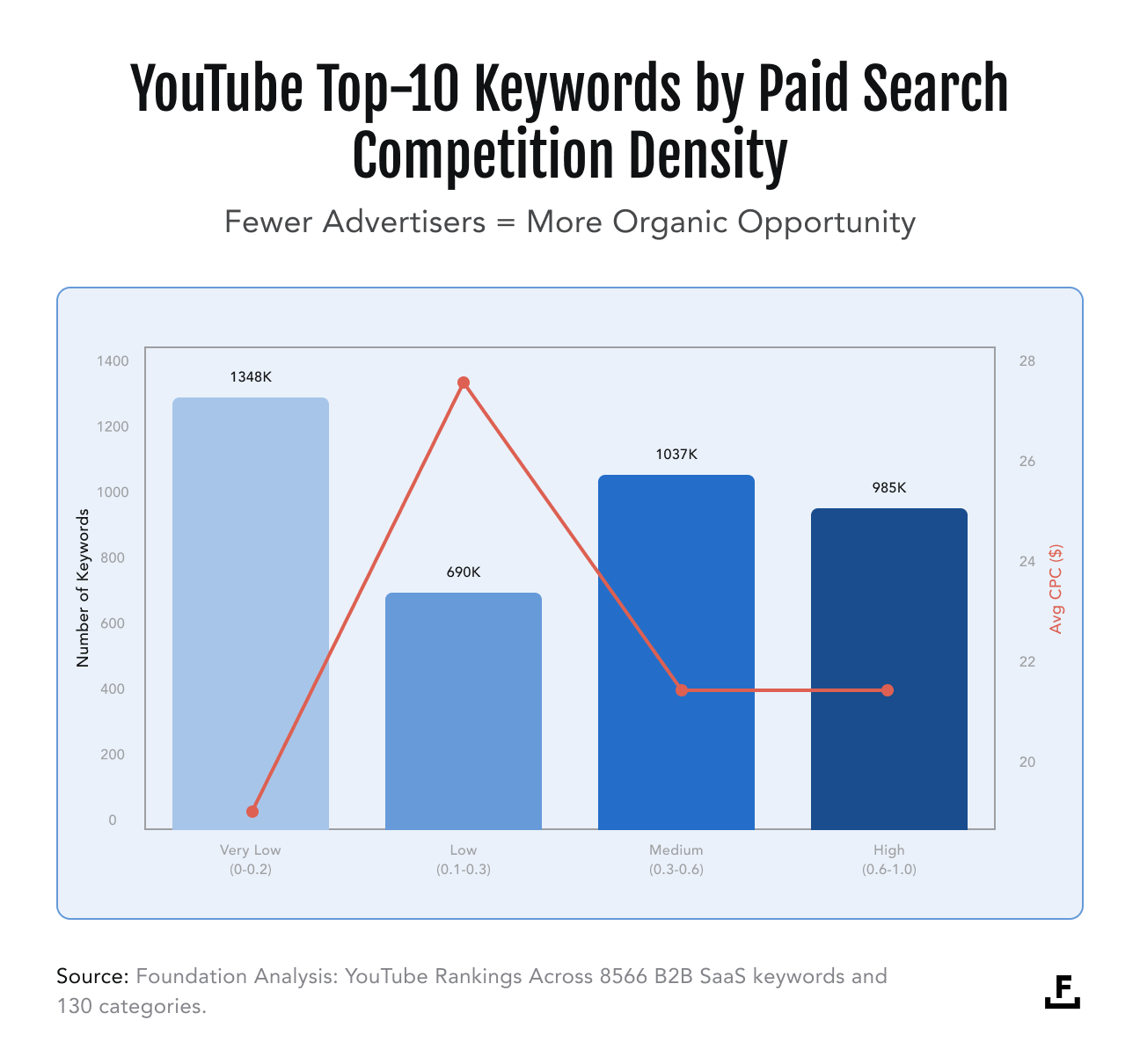
The “low” competition zone (690K monthly searches) has the highest average CPC at ~$28. Advertisers are paying premium prices, but the field is thin. YouTube is sitting in the top 10 organically, pulling clicks that would cost real money to buy.
When something generates disproportionate organic visibility relative to the investment it receives, investors call that mispriced. The B2B teams figuring this out in the next 18 months will own the channel. The ones reading this can figure it out today.
#2. YouTube is much more than a brand awareness story.
The most common pushback we see on YouTube investment is that it lives at the top of the funnel as a brand awareness play. The SERP data says the opposite. YouTube’s top-10 rankings over-index on transactional and navigational intent. Of the high-intent query modifiers in our keyword set, YouTube showed up for:
- 22.5% of “best” queries
- 20.4% of “review” queries
- 20% of “versus” queries
Calling that a brand awareness play is like calling Google Ads a discovery channel.
#3. The long-tail uptick is a leading indicator for AI search.
When we measured YouTube’s penetration rate by keyword length, the curve drops through 3- and 4-word queries (the mid-tail trough where traditional blog content competes hardest) and then climbs again. Five-word queries: 13.4%. Six-plus word queries: 16.1%.
That uptick matters because LLMs run query fan-outs. A single prompt expands into 150+ modified queries that are longer, more specific, and more conversational than what users type into Google. A blog post targeting “best employee productivity software” competes against 10,000 identical pages. A video titled “I Tested 8 Productivity Tracking Tools With My Remote Team — Here’s What Actually Worked” matches the natural language of a fan-out query far better.
The long-tail YouTube advantage is small today. As LLMs generate more of the discovery surface, we’re betting that it won’t stay small.
What to Do About It
- Start or revamp your YouTube channel: If you don’t have a channel yet, the data above is the business case to build one this quarter. If you have a channel that’s been sitting dormant or producing content nobody watches, it’s time to update your strategy.
- Run the audit on your most expensive keywords: Pull your Google Ads keyword report and sort by CPC. Manually search the top 50 and record whether YouTube shows up. Our data says it will for 20–25% of your high-intent modifiers. Count how many of those keywords you have zero video content for. That is the opportunity.
- Prioritize the modifiers where YouTube already dominates: If you can only make five videos this quarter, target the query types with the highest YouTube penetration: demo (80.2%), trial (25.7%), best (22.5%), review (20.4%), and vs (20%). These are the SERPs where the channel is already winning, which means the bar to entry is lower than building organic visibility from scratch.
- Optimize for both YouTube search and Google search: Titles, descriptions, chapters, tags, and transcripts should target the same keyword clusters your SEO team is already working on. YouTube and Google SERPs are the same battlefield.
Check out the full analysis of YouTube’s dominance over B2B SaaS terms on the Foundation blog.
🎙 Upcoming Event: What Still Works? Content, Search, and Distribution in the AI Era
If you’re sizing up where YouTube fits in a broader content strategy, this one is for you. Ross is sitting down with Samanyou Garg, Founder and CEO of Writesonic, for a live masterclass on what’s driving AI citations across thousands of brands.
Thursday, June 18, 1:30 PM ET. 60 minutes live on Zoom with audience Q&A.
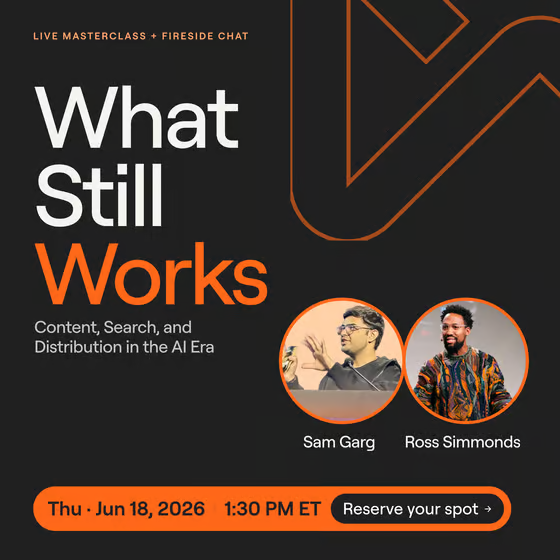
The session covers what to stop doing in content and SEO in 2026, and where YouTube, Reddit, and third-party mentions fit in the citation economy. Leave with something you can ship Monday morning.
👉 Save your seat for the free masterclass
Go Deeper on YouTube and AI Visibility
→ Ahrefs Q1 2026 AI Search Benchmark Report. A study of 75,000 brands found that YouTube mentions correlated more strongly with AI brand visibility than any other metric — stronger than link volume or total page count. The report also documents a 58% drop in clicks to top-ranking content from Google AI Overviews and confirms that AI Overview appearance scales with query length (9.5% on single-word queries, 46.4% on 7+ word queries). The cross-platform validation of everything we found in the SERP data. [Ahrefs]
→ How to Start a YouTube Channel for B2B. Our full playbook for kickstarting your YouTube presence. Covers the three archetypes in depth, the technical setup checklist, the pre/production/post framework, and the tooling stack. [Foundation Labs]
→ The Creator Driving Nearly 200M YouTube Views for vidIQ. If our research convinced you on the channel and you’re sizing up execution, this is the case study to read. vidIQ brought creator Rob Wilson in-house as their YouTuber-in-residence in 2017. The channel now has 2.1M subscribers, 2,011 videos, and 192M total views. Covers the thumbnail/CTR work, the “double down on what’s working” content philosophy, and the shift from subscriber-acquisition to watch-time-driven growth. [Foundation Labs]
That’s it for this week.
If something landed, tell us. If something felt off, tell us that too. Reply to this email or DM me on LinkedIn.
Have a great weekend,
Ethan Crump