
In 2006, Google paid $1.65 billion for YouTube. Sixteen very smart people sat in a room, argued about numbers, and wrote the check.
Twenty years later, YouTube does north of $30 billion a year in ad revenue and sits at number two on the list of most-visited sites on earth.
Here’s the question almost nobody in B2B is asking. If you owned the world’s biggest search engine and the world’s biggest video platform, who would you want to win?
We went looking for the answer. We analyzed 8,566 keywords across 130+ SaaS categories and stacked YouTube’s SERP presence against actual SaaS domains.
The headline number: YouTube shows up in Google’s top 10 for 80.2% of “demo” searches.
Eight out of ten times someone searches for a software demo, there’s a video on page one. The average CPC on those keywords is $49.
Which raises an uncomfortable question about where your demo video currently lives.
YouTube ranks where the money is
The common assumption in B2B is that YouTube is an awareness channel. Something you do for reach, at the top of the funnel, in the same budget line as podcast ads and event swag.
Then you compare the intent mix across all 8,566 keywords against the intent mix where YouTube actually cracks the top 10:
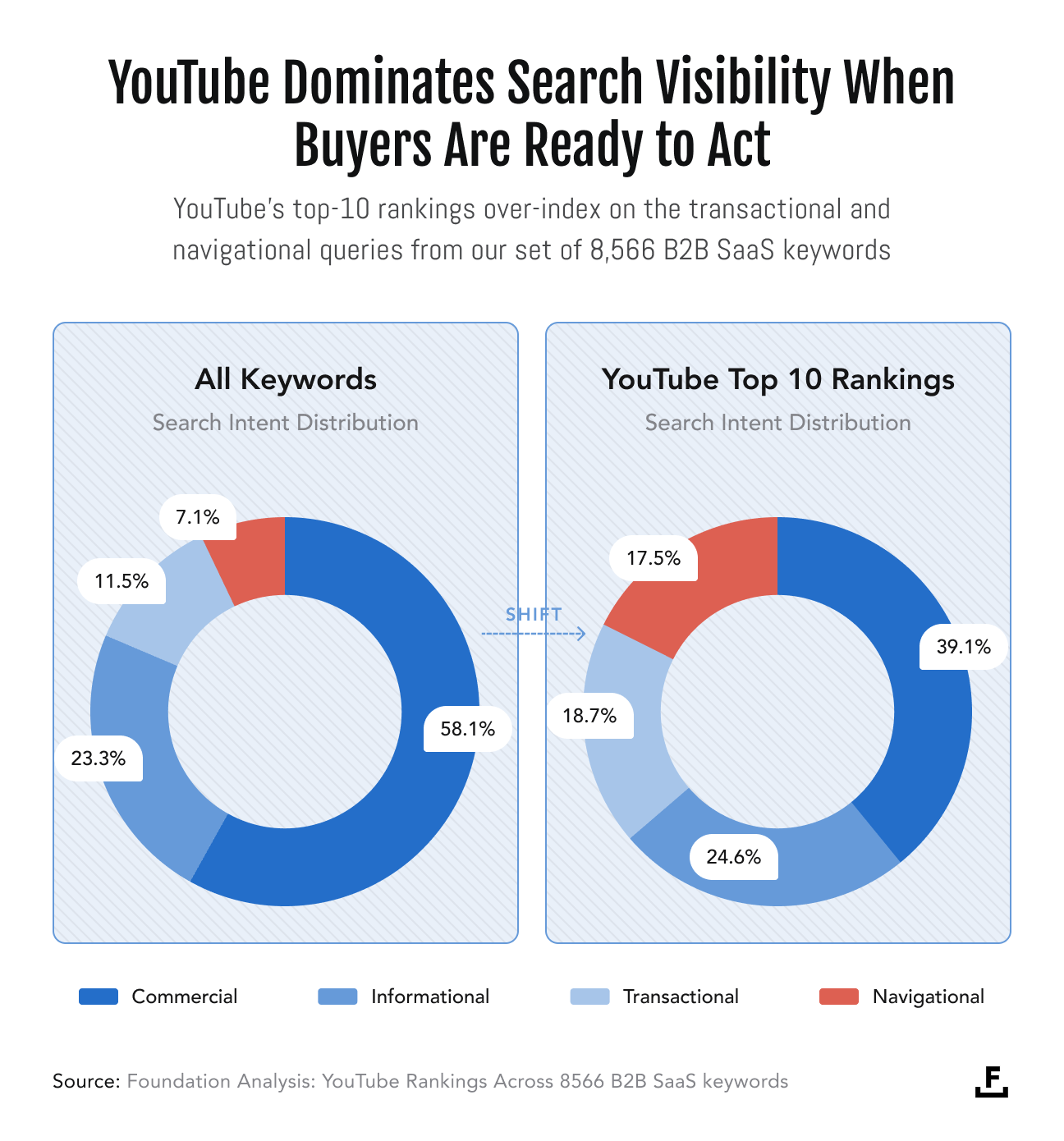
Commercial intent shrinks. Transactional and navigational both climb. YouTube’s rankings concentrate on the queries where a buyer already knows what they want and is getting ready to move.
That’s a shortlist channel wearing an awareness channel’s reputation.
Which makes the pricing look strange
Look at the bottom-of-funnel modifiers, the ones your demand gen team fights over every quarter:
→ “Best” queries: YouTube in the top 10 on 22.5%, avg CPC $20
→ “Review” queries: 20.4%, avg CPC $19
→ “vs” queries: 20%, avg CPC $27
→ “Alternatives” queries: 13%, avg CPC $33
One in five “best” searches. One in five “review” searches. One in five “versus” searches.
These are the moments a buyer is actively choosing between vendors. YouTube is sitting there collecting organic clicks while SaaS companies bid $20 to $33 for the same real estate.
It gets worse when you look at head-to-head.
On 1,723 keywords, YouTube outranks three or more SaaS companies in the same SERP. That’s 513,000 monthly searches. On 166 keywords, it outranks five or more simultaneously.
Five companies. With SEO teams. And content programs. And link building budgets. And domain authority built over a decade.
All losing the same page to a video.
Now the AI layer, which is where this gets loud
In a separate analysis, we found a 0.737 correlation between YouTube mentions and AI visibility.
Strongest relationship in the entire study. Ahead of Domain Rating. Ahead of backlinks.
That doesn’t mean uploading more videos makes ChatGPT recommend you. Correlation, causation, you know the drill. But brands with a stronger YouTube presence consistently show up more prominently in AI-generated answers.
There’s a structural reason, and it isn’t subtle. Google owns YouTube. Google controls the SERP. Google built AI Overviews. Google built AI Mode. Every one of those products draws on YouTube data.
Vimeo doesn’t get that treatment. Wistia doesn’t. Vidyard doesn’t.
The parent is feeding the child.
And the child just got a new toy: Ask YouTube, a conversational search experience for longer, messier, more human queries.
Which matters because of what our keyword-length data shows. YouTube’s top-10 penetration is 43.8% on single-word queries, dips to 11.6% at four words… then climbs back to 13.4% at five words and 16.1% at six-plus.
That uptick on the right side of the chart is the signal. When an LLM runs query fanout and fires 150+ long, specific queries on a user’s behalf, the channels that win long-tail win the discovery surface.
A blog post targeting “best employee productivity software” is one page competing against ten thousand identical pages. A video titled “I Tested 8 Productivity Tools With My Remote Team, Here’s What Broke” matches a fanout query in a way an optimized H1 never will.
Five things to do about it
- Audit your expensive keywords against YouTube. Pull the Google Ads report, sort by CPC, search the top 50 manually. Count how many have a video on page one and no video from you. That gap is the brief.
- Start with demos, comparisons, and reviews. The priority order is in the data. Demo at 80.2%. Trial at 25.7%. Best at 22.5%. If you only ship five videos this quarter, ship those.
- Put the search subject in the title. “The Forecasting Mistake Destroying Your Quarter” is a thumbnail. “How to Build an Accurate B2B Sales Forecast” is an answer. Save the intrigue for the artwork.
- Write chapters that stand alone. “Introduction, Features, Demo, Conclusion” tells a machine nothing. Someone landing at 6:42 should know what they’re getting without watching the first six minutes. Google can surface key moments straight from your timestamps.
- Fix your captions. Auto-captions will turn your product name into something unrecognizable and then feed that to a retrieval system. Ten minutes of proofreading, permanently.
The full playbook, including how to turn the webinar graveyard on your channel into an answer library, is here: How to Optimize Your YouTube Channel for AI Visibility →
Create once. Distribute forever.
See you Monday.
— Ross
 The Data Point
 The Data Point
Google’s AI Overview for “the best crm” cites a YouTube video from a channel called Tool Finder. Talking head. Looking at the camera. 3,500 views.
For scale, MrBeast does 3,500 views in the time it takes to reheat lunch.
That video ranks for 31 organic keywords total. And it is the number one influence on a SERP for one of the most commercially valuable queries in software.
So the bar for competing in AI answers sits lower than it looks. Answer the question, clearly, on the platform Google owns.
Quick Hits
 Quick Hits
- Shorts are quietly ranking too. We found YouTube Shorts in the top 10 for more than 1,100 “best + software” searches worldwide. In the US, Shorts held a top-10 spot on 475 of them and ranked first in three out of four. The short-form data
- The cheap seats are still empty. The biggest pool of search volume where YouTube ranks top 10, roughly 1.35 million monthly searches, sits in the “very low” paid competition zone. Almost nobody is bidding there. YouTube is winning it organically anyway.
- YouTube’s own advice is better than most agency advice. Their guidance on titles and thumbnails and their notes on descriptions both say the quiet part out loud: pick one or two real terms and put them where they can be found. Free, and roughly nobody reads it.
- Metadata does measurable work. Research in video-text retrieval found that titles, subtitles, and associated text improve how well videos match natural-language queries. Your description field is not decoration.
- Google keeps building doors into video. The AI-powered search carousel can identify relevant clips and generate descriptions around them. More surfaces, same footage.
From the Lab
 From the Lab
- 80% of Your B2B Demo Pipeline Is Already on YouTube
- How to Optimize Your YouTube Channel for AI Visibility
- The Content Supply Chain: Building the System Behind Repurposing
- How to Measure the ROI of GEO
Wondering whether your category is one of the ones where YouTube is quietly eating your SERP? Just reply, and we’ll take a look.