Article's Content
Article's Content
Our team asked ChatGPT and Claude the same question 11 times: “Which revenue intelligence platform should replace our stack before we onboard five new SDRs next month?”
Gong showed up in all 11 threads. It won three.
Showing up in an AI answer and being the AI’s recommendation are two different outcomes. Most brands are only tracking the first one.
Gong won when the model decided we were coaching, not prospecting
The prompt didn’t say, “we’re consolidating our stack.” Neither did it say, “we’re prospecting.” It never mentioned CRM migration.
The model filled in that blank on its own and picked accordingly:
- Read as coaching new reps → Gong won
- Read as prospecting → Apollo won
- Read as stack consolidation → Salesloft and Clari won
- Read as CRM migration → HubSpot and Outreach won
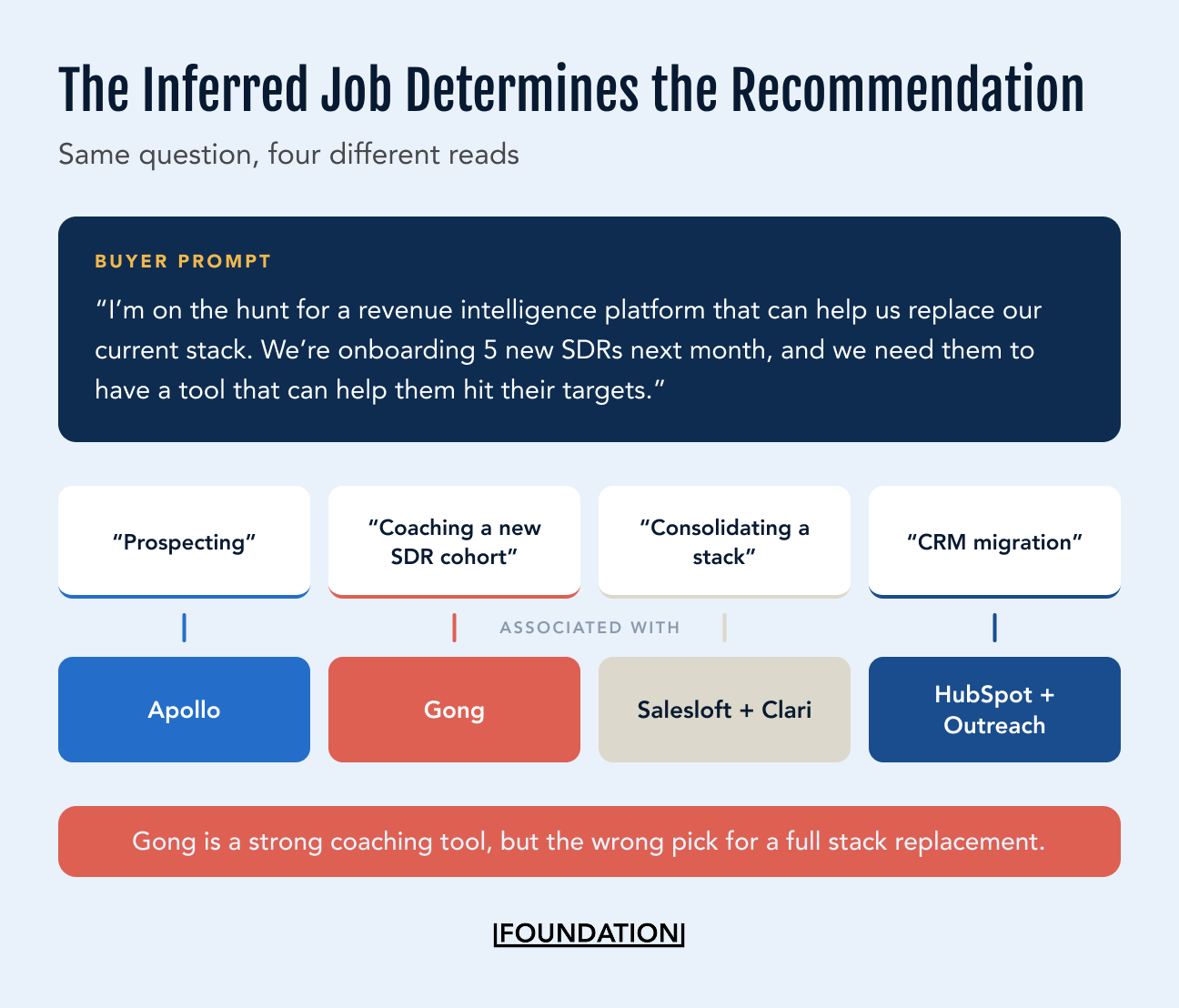
Gong’s three wins came entirely from the threads where the model decided the buyer’s objective was ramping up new reps. In the other eight, Gong stayed visible but lost the recommendation, probably because the model had cast the buyer as someone solving a different problem entirely.
That’s the gap. Being in the answer and being the answer depend on which version of the buyer the model thinks it’s talking to.
The same happens across the category
This isn’t a Gong-only pattern. Clari, Salesloft, and Outreach showed up in nearly every thread, too. The mention list stayed stable, but the pick did not.
- Gong and Apollo each landed three clear recommendations
- Two threads leaned Salesloft, paired with Clari
- One leaned HubSpot, paired with Outreach
- Two threads never settled on a single vendor

With the same set of considerations, we got four different winners. If you’re only tracking share of voice, the number can look healthy for months while your recommendation rate quietly erodes underneath it.
Why do the same vendors keep surfacing anyway?
The search paths varied thread to thread, but the sources feeding the answers didn’t. Zapier turned up in 70% of source records because its blog publishes comparison and roundup content that the models pull from. A handful of comparison pages, roundups, and review sites kept recurring no matter which route the model took to get there.
That’s the actual lever. You can’t control which job a model infers from an open-ended prompt, but you can check whether the sources it returns to actually connect your brand to a job you win.
What can you do to increase AI recommendations?
- Find the job, not the keyword, by pulling it from sales calls and win-loss interviews.
- Use unbranded, discovery-stage prompts such as “Looking for a project management tool that can scale with a fast-growing marketing team.” Comparison prompts narrow the field. You want the messy, pre-shortlist version of the question.
- Run each prompt repeatedly across different models and accounts, over time. One run tells you what the model said once, not what it usually says.
- Record who won and why. Note the inferred job, the preferred vendor and the sources behind the answer, every time.
- Audit the comparison pages, roundups, and review sites the model keeps citing for your target job, then work to get your brand named there in that job’s context.
- Track the gap, not just the mentions. Mention rate shows you got in the room. The recommendation rate shows whether anyone wanted you there.
For a full breakdown, plus a walkthrough on how to compare your winning sources against your losing ones: Read the full study →
Get mentioned. Get chosen. Two different jobs.
📊 The Data Point
A June 2026 academic study on LLM recommendation systems showed that when competing products have identical specs, the well-known brand gets recommended 100% of the time. Researchers call it a Conditional Monopoly.
That monopoly breaks the moment a lesser-known competitor gets just a 0.1-star rating edge.
Your brand’s default advantage in an AI answer isn’t earned. It’s a placeholder waiting for something slightly better to show up.
⚡ Quick Hits
- Being cited by one AI engine tells you nothing about the others. New GEO research finds only 11% of domains get cited by both ChatGPT and Perplexity, meaning cross-platform AI visibility is its own discipline, not a byproduct of ranking well in one engine. If your tracking only covers one model, you have a structural blind spot.
- AI is now a parallel search engine for B2B buyers. 80% of global B2B tech buyers use generative AI as much as traditional search when researching vendors, according to The State of AI in B2B Marketing in 2026. It means AI search visibility is now tied directly to whether you’re found during discovery, not just at the final comparison stage.
- Foundation Lab breaks down what makes vendors win AI recommendations, using Atlan’s case study. Atlan didn’t win 35% of its category’s AI citations, 1.6x its nearest competitor, by publishing more content. It won by building 52 pages that each answer a buyer’s question clearly and back it up with real proof.
- Even market leaders eventually lose the default advantage. A Harvard and UVA study in MIT Sloan Management Review tells the story of a company that led its market and outspent every competitor, only to have ChatGPT recommend a smaller rival instead. Being the safe default only works until there’s a reason to pick someone else. They improved by building real credibility, answering the question directly, and structuring content the way each platform expects.
🔗 From the Lab
- How Buyers Are Actually Using AI to Shortlist Vendors
- Why Nearly 90% of AI Citations Point Off-Site
- What Generative Engine Optimization Actually Is
- Understanding AI Visibility: How to Win Brand Influence in LLMs
- How to Measure the ROI of GEO
Does your brand have a presence or preference gap? Reply, and we’ll take a look.