
Article's Content
Article's Content
Ask leaders whether AI is helping their business, and 64% will say yes. But only 39% will point to an actual earnings impact, according to McKinsey’s The State of AI in 2026 Report.
So I asked Enzo Carletti, our AI Service Delivery Lead, aka Foundation’s “robot guy” and “Claude whisperer”, how he sees AI impacting marketers’ productivity and efficiency.
His take: most teams aren’t behind on AI at all. They’re just stuck paying what he calls “the learning tax”, the time it takes to actually learn a tool, poke at it, and wedge it into how your team really works. Pay that tax without a plan, and you’re just burning hours with no returns.
Adoption ≠ Impact
McKinsey’s own tracking shows AI use climbing from 20% of organizations in 2017 to 88% in 2025. GenAI specifically hit 79% adoption in the same window.
But impact hasn’t kept pace. The National Bureau of Economic Research surveyed 6,000 executives and found that 9/10 reported no measurable effect of AI on employment or productivity over the last three years.
It gets more specific at the individual level. ActiveCampaign surveyed 1,000 marketers and found that daily AI users win back roughly 13 hours a week. But despite 82% of marketers using AI for work, only 23% of them use it effectively.
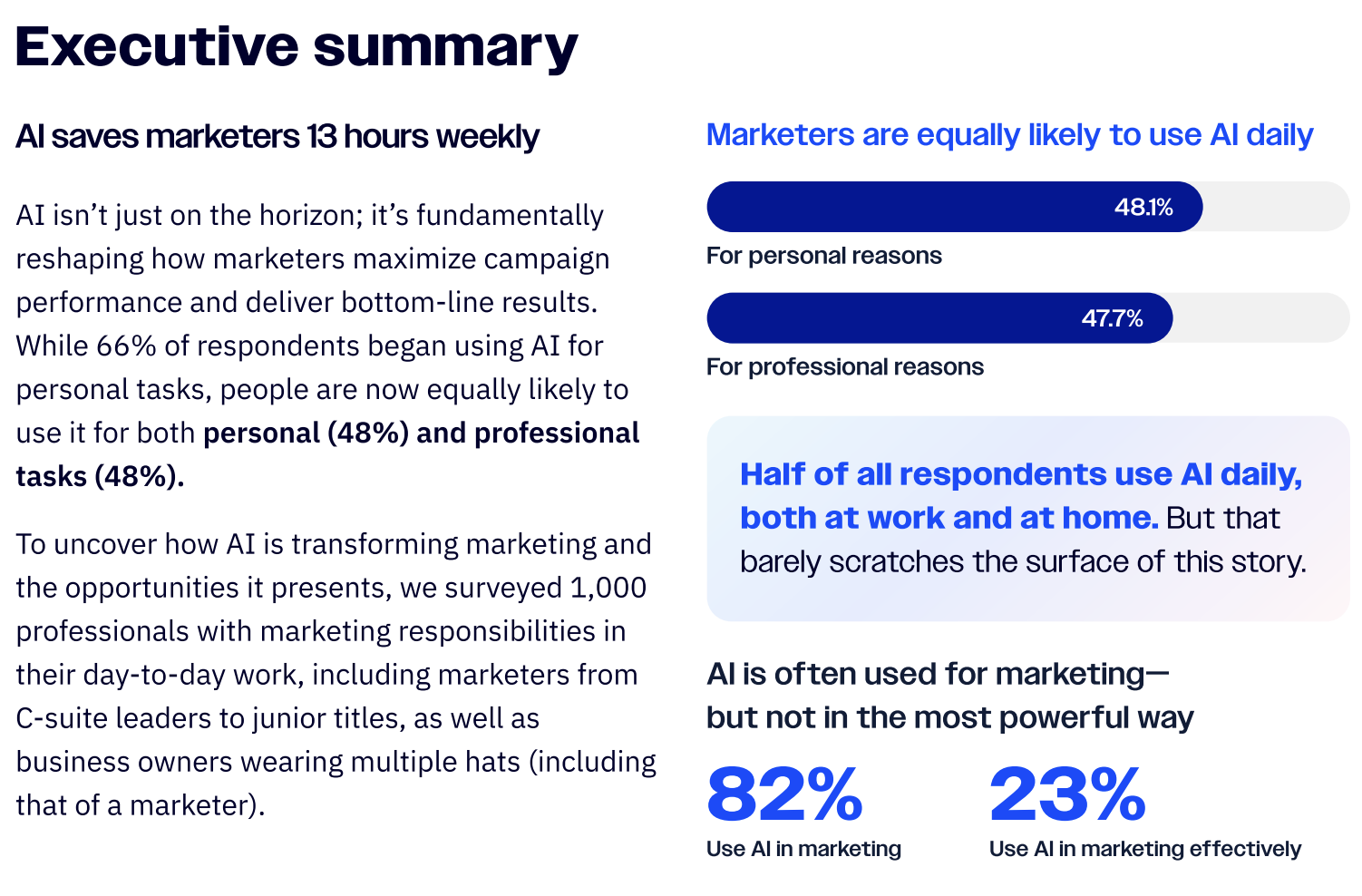
Most people lean on AI as a brainstorming partner, then hit a steep drop-off the moment it’s time to actually execute, measure, or act on what it generates. Uber knows something about that: Fortune reported the company burned through its entire 2026 AI budget in four months. The problem was spending without a plan, but with full enthusiasm.
Paying the AI Learning Tax
Every AI rollout follows the same J-curve: productivity dips first, as teams hit friction and rebuild workflows, before competence kicks in and the gains start compounding.
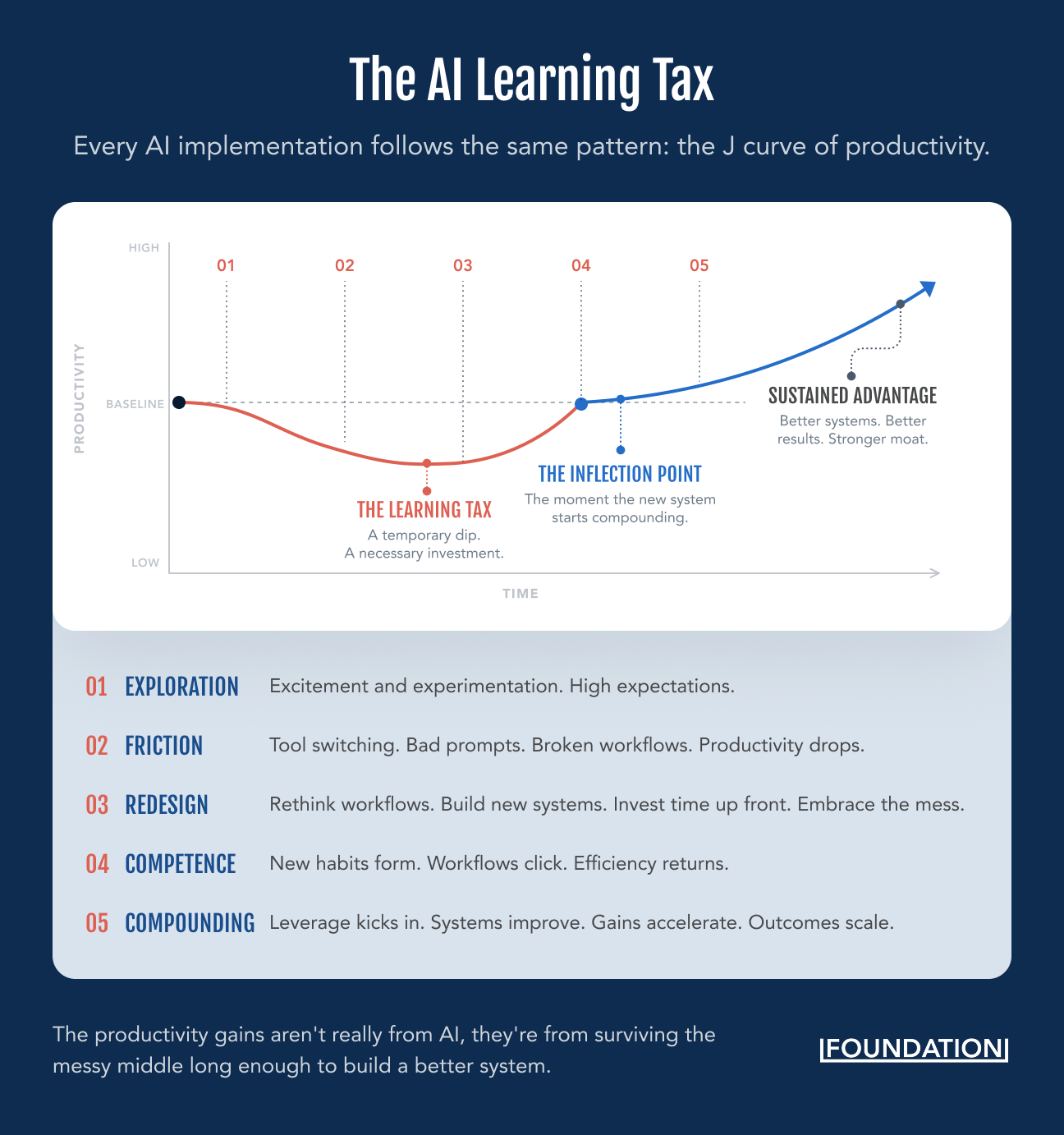
So you need to approach AI implementation with intent. If you pay the learning tax on purpose, with a plan for when and where you’ll start seeing the payoff, you’ll be able to see whether your investment is really paying off.
Enzo’s framework for doing that falls into three steps:
- Start with a business problem, not a tool: Name one thing you sell well, and one thing you’d sell if you had the time. Chasing every new tool that launches, without that anchor, is how teams spend three months training on one platform only to abandon it for the next shiny thing six months later.
- Benchmark the work before you automate it: Time what you currently do, step by step, before you let AI touch it. Without that baseline, you can’t tell whether a new workflow saved time or just shifted the busywork.
- Understand what you build well enough to change it: Define which steps genuinely need AI reasoning and which could be hard-coded. If you can’t explain how your own workflow works, replacing any single piece of it becomes expensive and stressful the moment a model or price changes.
One more real cost of skipping step three: a growing share of employees are now paying out of pocket for their personal AI tools because their company isn’t providing them, or they don’t have enough credits. That creates inconsistent outputs, security exposure, and a workforce building shadow workflows you can’t control.
Read the blog post → for Enzo’s full breakdown, and pick a copy-paste prompt for benchmarking your own AI workflow.
📊 The Data Point
Accenture’s most recent Pulse of Change survey found that 78% of leaders expect employee roles to change within the next 12 months due to AI. But 57% of employees say their roles have already changed significantly.
The discrepancy suggests employees are adapting to AI faster than leadership realizes and that leadership isn’t fully aware of how AI is being used on the ground.
⚡ Quick Hits
- Analysts expect an AI pullback. Forrester found that only 15% of AI decision-makers reported a positive impact on profitability over the past 12 months, and now predicts that enterprises will defer 25% of planned 2026 AI spend into 2027. Adoption without a plan eventually gets pulled back.
- PwC’s 2026 CEO Survey of 4,454 executives found just 12% report both a revenue gain and a cost reduction from AI, the strictest real test of whether it actually worked. Hitting one metric isn’t the bar anymore.
- Klarna is what paying the tax on purpose looks like. Its AI customer service agent now handles the workload of 853 full-time agents, saving roughly $60 million a year, with response times up 82% and repeat contacts down by 25%, as reported by Trixly AI. A contrasting outcome to Uber’s story above.
🔗 From Our Lab
- Brex Ranks #1 on Google and Appears in Half of AI Answers. The Recommendation Still Goes to a Competitor.
- The Reddit Cloud 100: Ranking B2B SaaS Subreddits by AI Visibility
- Recommended, Not Just Mentioned: What We Learned Running One Buying Prompt 11 Times
As always, if something landed, tell us. If something felt off, tell us that too! Reply to this email or DM us on LinkedIn.
Here’s to a great week ahead,
Katarina
Paying your own learning tax right now? Tell us where you’re stuck, and we’ll take a look.