
Article's Content
Article's Content
You’ve written new blog posts, updated old pages, and added FAQ blocks to the pricing page. You covered every place you assumed AI assistants would look for evidence about your product.
Docker’s data says the answer isn’t better blog posts. It’s documentation, which stays their largest first-party source even when buyers are comparing products.
We ran two Profound tests in August: 40 prompts, 480 answers, and 3,300+ citations. Across both runs, Docker’s technical documentation produced more first-party citations than every other Docker-owned surface combined: 54% on day one, 53% on day two.
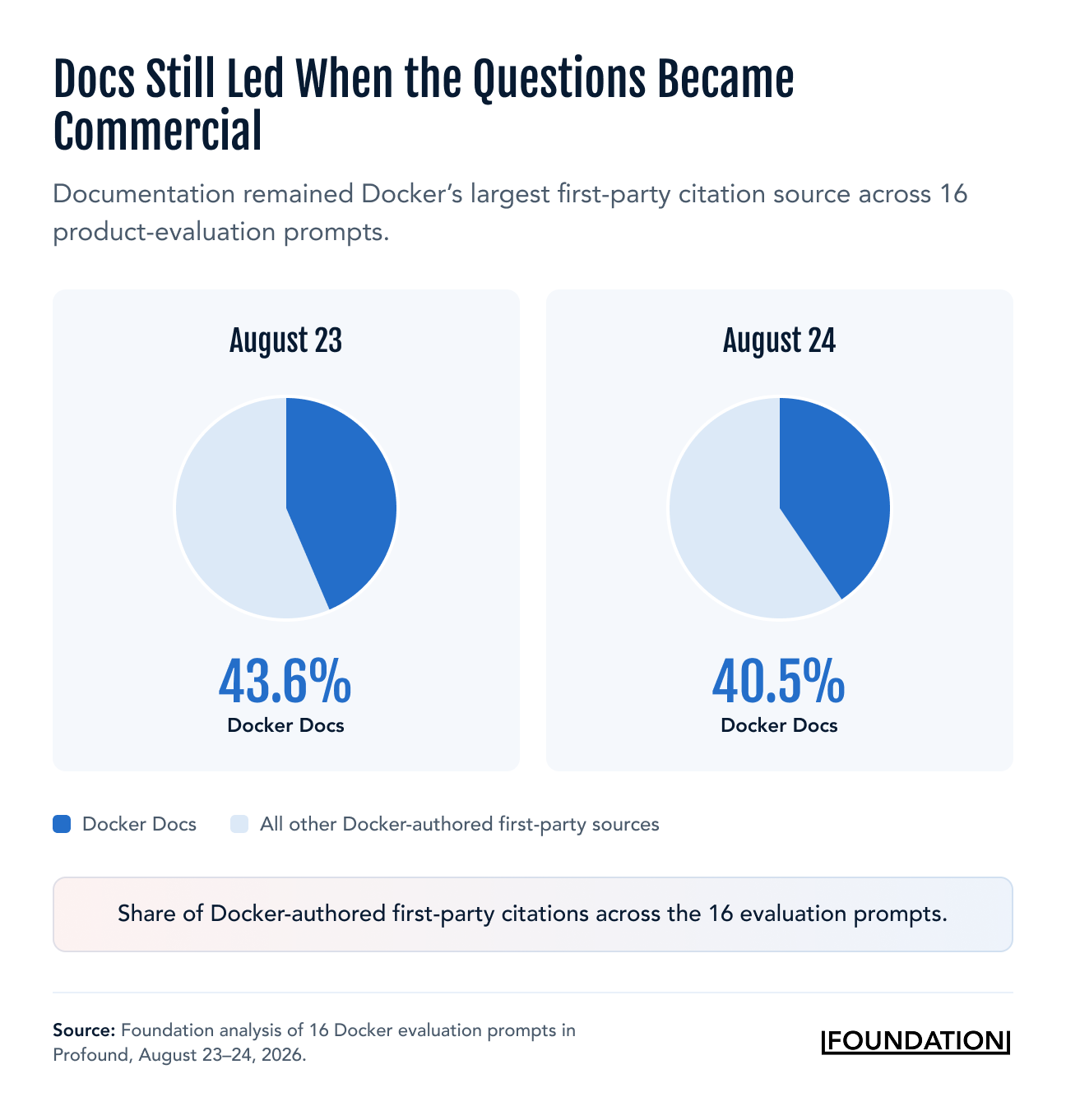
On a 16-prompt subset of commercial-evaluation queries, the ones closest to a buying decision, docs stayed the largest first-party source across the same two runs: 43.6% and 40.5%.
Docker’s Docs Win on Volume, Not Per-Page Performance
Counting only docs and blog, Docker’s docs earned 447 citations across both runs to the blog’s 196, a 69.5% share.
However, that lead shrinks once you count the pages. Docker’s docs library has roughly twice as many indexed URLs as the blog: 2,303 vs. 1,110. Take this into account, and docs are earning what their size predicts.
A 67.5% share of the combined inventory is nearly matched by a 69.5% share of citations, while the normalized rate remains almost the same: 19.4 citations per 100 URLs for docs against 17.7 for the blog.
Authority tells a different story. Docker’s docs have roughly 5.8x as many referring domains as the blog. Per page, docs also lead by about 2.8x with 23.2 referring domains per URL against 8.3. Unlike the citation rate, the authority gap survives the size adjustment. So Docker’s docs aren’t stronger page for page. There are more of them, and they carry more links.
No single number explains the docs’ lead. They’re Docker’s largest first-party library, they stay the most-cited first-party source when buyers compare products, and they’ve earned more links along the way. We call this the Docs Dividend: the return from building and maintaining a technical knowledge base that becomes your brand’s largest source of first-party evidence for AI answers.
Run This Audit for Your Brand
Here’s the framework we used. Run it, and you’ll know which content and topics to invest in and whether your weaker pages need a full rewrite or an update.
- Map your first-party citations by content type: Pull your citations from Profound or Ahrefs Brand Radar and tag each cited URL by type: docs, blog, product pages, comparison pages. Then check which types get more citations than their size on the site would suggest, and which get fewer. For example, if docs are 20% of your pages but earn 40% of your citations, docs are punching above their weight. If your blog is 50% of your pages but only earns 20% of citations, the blog is your weak spot. Prioritize blog content rework. And if the ratio’s even, the section isn’t underperforming: look at scale and links before you rewrite anything.
- Rank your pages by citation frequency and recurrence: The URLs that keep showing up across prompts, runs, and platforms are the pages already doing the work. Find out what buyer questions they’re answering, then build more pages that answer the same kinds of questions, and update the ones you already have.
- Compare authority and freshness by section: Check referring domains per URL and last-updated dates for each content type. If one section earns citations in line with its size but carries far more links, links are doing the work, not the format.
→ Read “The Docs Dividend” for the full audit breakdown
Invest in your content and backlinks, and citations will follow.
📊 The Data Point
An arXiv study of 252,000 AI citation trials found formatting-only changes barely matter. What predicts citation: relevance, list position, pricing, and how recently a page was updated, not how the page is structured. That tracks with Docker’s own numbers: the docs’ citation edge comes from how much documentation they’ve built, not from how each page is formatted. Before you restructure a page, check that it’s current and well-linked.
⚡ Quick Hits
- Most searchers now read the AI summary before your page: Pew Research found 49% of US adults now use AI chatbots, up from 33% in 2024, and 60% read the AI summary at the top of search results. If you target only people who scroll past that summary, you’re visible to an audience that keeps getting smaller every day.
- Hidden buyers skip your reps but still read your content: Edelman found 71% of hidden buyers, the unseen finance, legal, compliance, procurement, and operations stakeholders who influence a deal without signing it, have little or no interaction with sales teams, and 64% trust thought leadership more than product sheets or brochures. The pages doing that trust-building work are worth auditing first.
🔗 From our Lab