Article's Content
Article's Content
Ask Google’s AI Overview to compare Greenhouse with Ashby, and it’ll tell you Greenhouse’s reporting may need a separate BI tool. The source is Ashby’s own comparison page. When AI compares your product with a competitor, it builds the answer from whatever evidence exists, and it might not be yours.
We tested this in a category where buyers make a lot of comparisons: applicant tracking systems (ATS). Our team ran 20 ATS buying prompts twice across ChatGPT, Perplexity, Gemini, Claude, Google AI Mode, and Google AI Overview. We collected 240 AI answers and reviewed 2,695 recorded source presences to find out who owned the pages behind each answer.
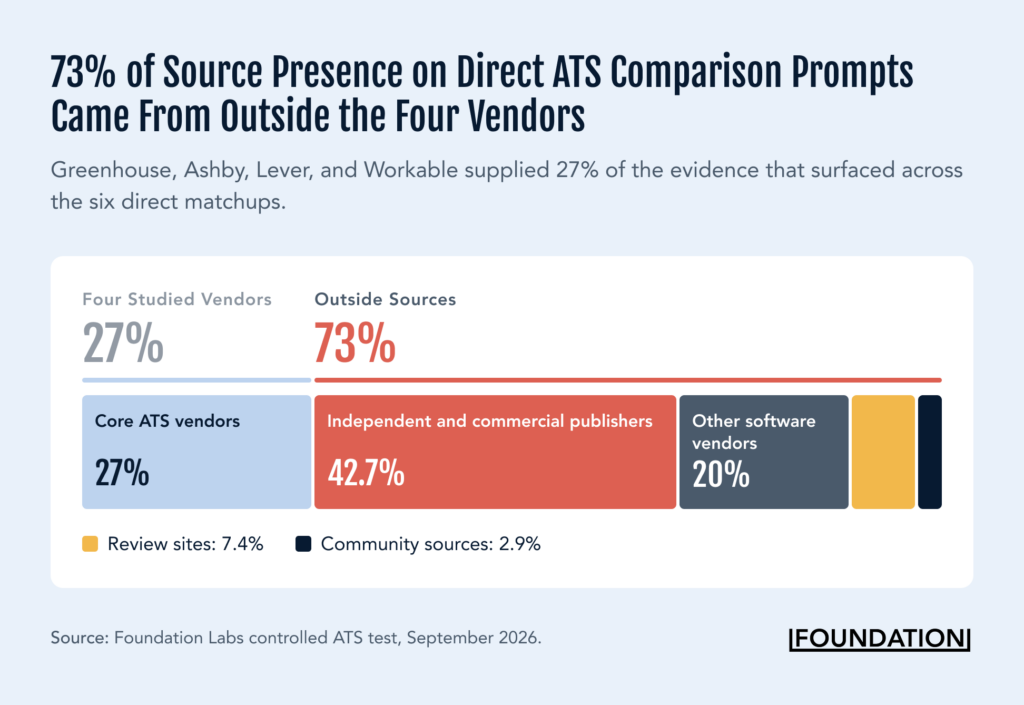
Across the six direct matchups, Greenhouse, Ashby, Lever, and Workable accounted for just 27% of visible source presence. The other 73% came from outside the four vendors, and none of the six matchups was led by a first-party comparison page from either product being compared.
Who Supplies the Other 73%
We call this source set the Versus Layer: the comparison, review, and category pages AI draws on to explain product differences and pick a winner. In ATS, independent and commercial publishers supplied 42.7%, other software vendors 20%, review sites 7.4%, and community sources 2.9%. Four patterns explain which of those pages AI picks.
1. AI doesn’t need your page to be popular or well-linked.
Lever already had comparison pages for each of its three rivals, and then it published another comparing two other companies, Greenhouse and Ashby. AI used Lever’s page in 27 answers and Ashby’s own page on the same comparison in 18. Lever’s page has a URL Rating of zero, two referring domains, and about 8 monthly visits, according to Ahrefs. Ashby’s has a URL Rating of 19, six referring domains, and about 20 visits.
2. The closer a buyer gets to a decision, the more comparison pages matter.
On the 10 neutral category prompts, listicles accounted for 51.1% of surface-weighted source presence, compared with 12.6% for dedicated comparison pages. Once a vendor appeared in the question, comparison pages rose to 33.8% and listicles fell to 21.4%, and on the six direct head-to-head questions, comparison pages reached 42.1%.
3. The pages AI used most placed the decision up front.
Pages that appeared in more answers surfaced buyer fit, decision criteria, trade-offs, and recommendations early.
Venture Harbour’s Workable-versus-Greenhouse page quickly explains who each product suits, which criteria separate them, where each is stronger, and which trade-offs affect the recommendation, and it appeared in 13 answers. Workable’s own page on the same matchup spent more of its opening on product benefits and demo messaging, and it appeared in 2.
Venture Harbour’s Workable-versus-Greenhouse page quickly explains who each product suits, which criteria separate them, where each is stronger, and which trade-offs affect the recommendation, and it appeared in 13 answers. Workable’s own page on the same matchup spent more of its opening on product benefits and demo messaging, and it appeared in 2.
4. Sometimes, AI uses a competitor’s page to describe the product.
That’s the Greenhouse example from the top. Greenhouse has no owned comparison page for its Ashby matchup, so when AI needed evidence about Greenhouse’s reporting, Ashby’s page supplied it.
ChatGPT Works Differently
ChatGPT, the US’s most used AI platform, is a different story. While the other platforms lean on comparison pages and listicles, ChatGPT pulls mostly from the vendors’ own product and support content.
When we asked it to compare Lever and Workable for a mid-market recruiting team, its citations pointed mainly to Lever’s product and pricing pages, and to Workable’s help pages. Content of this kind accounted for 77.3% of visible source presence (63.8% from product pages alone), while dedicated comparisons and listicles accounted for just 3.3% combined. That makes vendors’ own pages carry most of the evidence, so keeping them current matters as much as building comparison pages.
Foundation’s Template to Audit Your Comparison Pages
The Foundation team prepared a template to help you spot which comparison pages to create or fix first so your own evidence can start replacing the outside pages. You score each matchup on buyer demand, ownership gap, and AI source leakage, then audit your page against the strongest outside page AI is already using.
→Download the Comparison-Page Audit template
- Find the comparisons where other companies’ pages answer for you. For each “your product vs. competitor” query, check three things: its monthly search volume in Ahrefs, whether you have your own page for it, and whose pages AI uses when you ask it. Start with the one that has real demand and doesn’t have a page of yours.
- Move buyer fit and trade-offs to the top of the page. Open with who each product suits, the decision criteria and trade-offs that affect the recommendation. Then add the details buyers check: pricing, implementation, integrations, workflow, administration, scalability, and limitations.
- Answer the claims that others make about you. Run your matchup prompts and write down every claim a competitor’s page supplies about your limitations, like the Greenhouse reporting claim above. Publish current first-party evidence on those same decision points, then rerun the same prompts to see whether your page starts entering the source mix.
→Read the full Versus Layer teardown
If you don’t supply the evidence, somebody else will.
Do your competitors build up evidence about your product? Hit reply or DM me on LinkedIn.
Have a great week,
Ethan Crump
The State of B2B AI Discovery 2026 Report
Foundation and AirOps tracked how AI platforms choose the sources they cite, and what B2B marketers can do to earn those citations. Two moves to take:
- Treat your G2 profile like a product page. G2 shows up in a quarter to a third of citing answers on five of the six AI surfaces, so keep your category, features, and reviews current.
- Fix product and comparison pages before the next blog post. Brand and product pages are the largest source of citations on every platform tracked.
📊 The Data Point
According to Comscore’s Q2 2026 AI Intelligence Report, AI users are spreading across platforms: Gemini’s share of AI prompt volume rose from 17% to 30% this year and Claude’s from 2% to 11%, while ChatGPT’s fell from 70% to 50%. Those platforms don’t cite the same pages, so track your source share on each one separately.
⚡ Quick Hits
- 94% of business buyers use AI while buying, and many check its answers elsewhere. Forrester’s Buyers’ Journey Survey of nearly 18,000 global business buyers found that buyers seek validation from peers, product experts, and industry analysts to cover incomplete or unreliable AI answers. A tip for you: find out where the experts and analysts in your category publish comparisons, and get your evidence in front of them too.
- 69% of B2B buyers want a sales rep to validate what AI told them. In a Gartner survey of 645 B2B buyers, 45% said they used GenAI, mainly to gather information on vendors and products, and 67% said they prefer a rep-free experience, yet most still want a rep to confirm what AI produced. Check what AI tells buyers about you before they bring it to a call: run your top comparison prompts every month, and wherever an answer repeats an outdated or wrong claim, publish a first-party page that addresses it.
🔗 From Our Lab